Corporate bond ETFs offer higher yields than U.S. Treasuries, making them attractive for income-focused investors. Three popular options - VCIT, LQD, and IGIB - stand out in terms of cost, yield, and risk. Here's a quick summary:
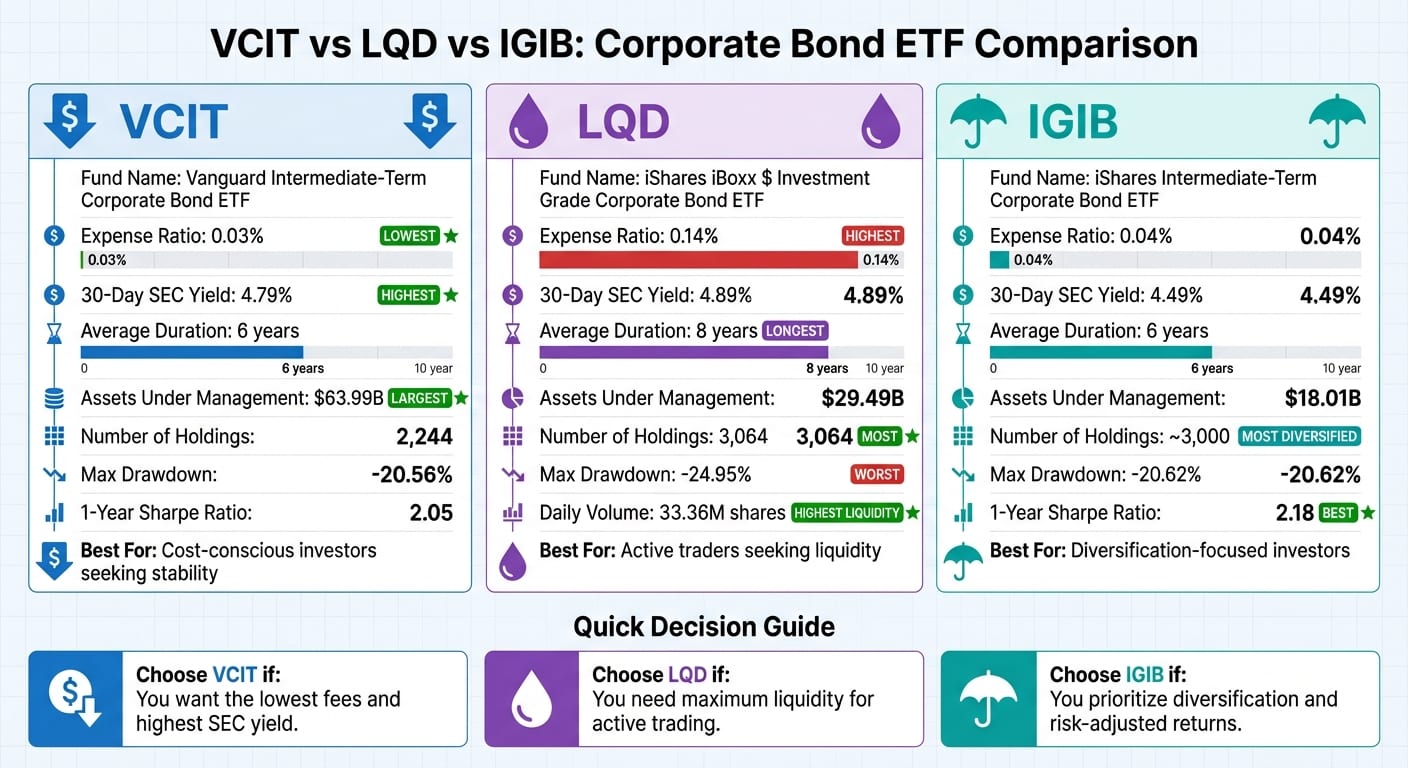
- VCIT: Lowest expense ratio (0.03%), intermediate duration (6 years), and strong yield (4.79% SEC yield). Best for cost-conscious, stability-focused investors.
- LQD: Broad exposure with the highest liquidity but higher expenses (0.14%) and longer duration (8 years). Suitable for those seeking higher income and trading flexibility.
- IGIB: Balanced approach with low fees (0.04%), broad diversification, and intermediate duration. May be considered for minimizing risk while maintaining competitive yields.
Quick Comparison
Key Takeaway: If you prioritize low costs, VCIT may be considered. For liquidity and higher yields, LQD may be an option. IGIB offers diversification and balanced risk. Selection should be based on your income goals and risk tolerance.
What Are Corporate Bond ETFs and How to Evaluate Them
Corporate bond ETFs are exchange-traded funds that hold a collection of debt securities issued by companies. Instead of buying individual corporate bonds - which often requires significant capital and expertise - these ETFs provide an easier way to access the corporate bond market through a single investment. These funds pool the interest payments from their underlying bonds and distribute them to shareholders monthly.
Corporate bonds generally offer higher yields than U.S. Treasuries because they come with credit risk. Kent Thune, Senior Content Editor at etf.com, highlights their appeal:
"Income investors seeking competitive yields without taking excessive risk may find corporate bond ETFs attractive as the Fed started lowering interest rates and an economic soft landing appears achievable".
By late 2024, SEC yields for leading investment-grade corporate bond ETFs ranged from about 4.29% to 4.90%.
When assessing corporate bond ETFs, five key metrics stand out:
- Yield: This reflects your income potential. Focus on the SEC Yield, which is a standardized 30-day measure that allows for fair comparisons across funds.
- Expense Ratios: These fees reduce your returns, so look for funds with costs below the category average.
- Credit Quality: This measures the financial strength of bond issuers. Investment-grade bonds (rated AAA to BBB) have lower default risks compared to high-yield or "junk" bonds.
- Duration: This gauges the fund's sensitivity to interest rate changes. For example, a duration of 6.0 years means the ETF’s price could drop about 6% if interest rates rise by 1%. Intermediate-term funds, with maturities between 5 and 10 years, balance higher yields with moderate volatility.
- Liquidity: High trading volumes and significant assets under management help ensure smooth buying and selling without major price fluctuations.
John Williamson of Optimized Portfolio adds:
"Corporate bonds are again more popular for using interest payments as regular income, as their yields are typically higher than that of treasuries".
For investors focused on yield, understanding these metrics is crucial. They form the foundation for comparing corporate bond ETFs like VCIT, LQD, and IGIB, which will be examined in detail in the next sections.
VCIT: Vanguard Intermediate-Term Corporate Bond ETF
Key Metrics and Characteristics
VCIT is known for being one of the most cost-efficient options in its category. Its expense ratio is just 0.03%, which is lower than IGIB's 0.04% and significantly below LQD's range of 0.14% to 0.15%. The fund focuses solely on investment-grade corporate bonds with maturities between 5 and 10 years, holding a portfolio of approximately 2,244 bonds. As of February 13, 2026, VCIT offers a 30-day SEC yield of 4.79%, an average duration of 6.0 years, and an effective maturity of 7.4 years.
The portfolio composition leans toward bonds rated at the lower end of the investment-grade spectrum, with 49.43% rated BBB and 44.81% rated A. Sector-wise, the fund is heavily weighted toward Financial Services (28%) and Technology (9%). An ETF Database analyst describes the fund as follows:
VCIT offers exposure to investment grade corporate bonds that fall in the middle of the maturity spectrum, thereby delivering a moderate amount of both interest rate and credit risk.
With $63.99 billion in assets under management as of February 2026, VCIT also provides excellent liquidity. These features make it a potential option for investors looking to balance risk and return in the bond market.
Performance and Suitability
VCIT's performance history highlights its ability to adapt to changing rate environments. The fund delivered returns of 9.33% in 2025 and 8.98% in 2023, although it experienced a –13.98% decline in 2022, reflecting its sensitivity to interest rate movements. Its maximum drawdown since inception stands at –20.56%, which is better than LQD's –24.95%. Additionally, VCIT boasts a 1-year Sharpe ratio of 2.05, outperforming LQD's 1.30, and its 1-year volatility is 0.86%, lower than LQD's 1.26%.
Rated 2 out of 5 on Vanguard's risk scale and awarded a Gold Medalist Rating by Morningstar as of January 2026, VCIT may be suitable for investors with a 4- to 10-year investment horizon. Its combination of low fees, intermediate duration, and focus on investment-grade bonds may appeal to those seeking consistent income rather than aggressive growth.
LQD: iShares iBoxx $ Investment Grade Corporate Bond ETF
Key Metrics and Characteristics
LQD provides broad access to investment-grade corporate bonds, managing $30.58 billion in assets as of February 2026. It follows the Markit iBoxx USD Liquid Investment Grade Index, holding a diverse portfolio of 3,064 bonds. The fund's expense ratio stands at 0.14%, which is notably higher than VCIT’s 0.03% and IGIB’s 0.04%.
In terms of credit quality, LQD's portfolio includes 47.99% A-rated bonds and 41.73% BBB-rated bonds, with smaller portions allocated to AA (8.31%) and AAA (1.05%) securities. Its 30-day SEC yield of 4.89% as of February 17, 2026, slightly surpasses VCIT’s 4.79%. One standout feature of LQD is its effective duration of 8.03 years, significantly longer than VCIT’s 6.0 years. This extended duration enhances yield potential but also increases sensitivity to interest rate changes.
Liquidity is another strength of LQD. The fund averages 33.36 million shares in daily trading volume, making it three times more liquid than VCIT and far surpassing IGIB. As one ETF Database analyst highlights:
LQD is a widely used option for investors looking to gain exposure to investment grade corporate bonds, making it a tool for those looking to access this segment of the bond market.
These features position LQD as a key player in the investment-grade corporate bond space.
Performance and Risk Considerations
The fund’s longer duration plays a major role in its performance and risk profile. While the extended duration can boost yield, it also increases price fluctuations when interest rates change. LQD has a standard deviation of 2.92%, higher than VCIT’s 2.32%, and a beta of 0.46, compared to VCIT’s 0.33. This indicates greater volatility and sensitivity to market movements.
Over the past year, LQD posted returns ranging from 7.7% to 8.21%, falling short of VCIT’s 8.9%–9.39% and IGIB’s 9.1%. This underperformance reflects the trade-offs of its longer duration. In a rising interest rate environment, LQD’s extended maturity profile can weigh on returns. However, in periods of declining rates, this same feature may lead to stronger price gains for investors willing to accept the higher volatility.
IGIB: iShares Intermediate-Term Corporate Bond ETF
Key Metrics and Characteristics
The IGIB ETF tracks the Bloomberg Barclays U.S. Intermediate Credit Index, focusing on investment-grade corporate bonds with maturities ranging between five and ten years. It manages $17.1 billion in assets and provides broad diversification by holding around 3,000 individual bonds. This extensive portfolio exceeds VCIT's 2,244 holdings, which helps reduce concentration risk.
IGIB's expense ratio of 0.04% places it between VCIT's very low 0.03% and LQD's higher 0.14%. Its dividend yield of 4.49% is slightly lower than VCIT's 4.79% SEC yield but remains competitive. With an effective duration of approximately 6.0 years, IGIB aligns with VCIT's intermediate-term profile while showing less sensitivity to interest rate changes compared to LQD, which typically has a much longer duration.
The fund maintains solid credit quality, with about 51% of its portfolio in BBB-rated bonds, and its beta of 1.08 indicates slightly lower volatility than VCIT's 1.10. Additionally, its current volatility of 0.85% is significantly lower than LQD's 1.22%. As Eric Trie, a contributing stock analyst for The Motley Fool, explains:
"IGIB's breadth mutes issuer-specific drama and tends to keep returns closer to the market's average experience." – Eric Trie
These metrics highlight IGIB's balanced approach and set the foundation for comparing it with VCIT and LQD.
Comparison with VCIT and LQD
When compared directly, IGIB offers a balanced mix of features relative to VCIT and LQD. It occupies a middle ground, combining intermediate duration, lower interest rate risk, and broader diversification. Similar to VCIT, IGIB has an intermediate-term duration, but its larger portfolio spreads exposure across thousands of issuers, reducing concentration risk compared to VCIT's more focused holdings.
Compared to LQD, IGIB presents roughly 50% less interest rate risk while delivering a comparable yield. This lower duration-driven risk is reflected in its Sharpe ratio of 2.18 and 5-year drawdown of –20.62%, both of which outperform LQD's 1.36 Sharpe ratio and –24.95% drawdown. These figures highlight IGIB's stronger risk-adjusted returns.
This makes IGIB a potential option when the yield spread between intermediate and long-term bonds narrows. In such scenarios, investors can achieve similar income levels with much less volatility. Its combination of lower drawdowns and a higher Sharpe ratio may make it an option for yield-focused investors prioritizing capital preservation.
Side-by-Side Comparison of VCIT, LQD, and IGIB
Comparison Table: Expense Ratios, Duration, and Yields
When comparing VCIT, LQD, and IGIB, the differences in cost, yield, and portfolio structure become clear. VCIT stands out as the largest among the three, managing $65.6 billion in assets. LQD follows with $30.4 billion, while IGIB manages $17.1 billion. This size difference underscores VCIT's popularity for investors seeking low-cost, intermediate-term exposure.
VCIT not only offers the highest 30-day SEC yield at 4.79% but also boasts the lowest expense ratio of 0.03%. LQD, while charging a higher expense ratio of 0.14%, provides exceptional liquidity with approximately 30 million daily traded shares. On the other hand, IGIB balances a competitive 0.04% expense ratio with extensive diversification, holding around 3,000 securities. These differences in metrics also reflect distinct risk profiles, which are explored further below.
Balancing Yield and Risk
Yield and risk are two sides of the same coin, and each ETF approaches this balance differently. VCIT's higher yield stems from its concentrated exposure, with about 28% allocated to Financial Services. While this focus can enhance returns during favorable credit conditions, it also increases sensitivity to market stress.
Eric Trie from The Motley Fool highlights this dynamic:
VCIT reflects a narrower set of credit decisions that can become more visible when spreads widen and dispersion returns.
LQD, with its broader maturity spectrum that includes longer-dated bonds, exhibits higher interest rate sensitivity. This is evident in its standard deviation of 2.92%, which is higher than VCIT's 2.32%. For investors prioritizing income while managing risk, IGIB offers an appealing alternative. Its Sharpe ratio of 2.18 outshines LQD's 1.36, suggesting better risk-adjusted returns, even with a slightly lower yield.
Which ETF Fits Your Investment Profile
Choosing the right corporate bond ETF depends on your investment goals - whether you prioritize stability, income potential, or minimizing costs. Each fund caters to different needs, so understanding your priorities is key. Here's a breakdown based on different investor profiles.
Conservative Income Seekers
If you're looking for steady income with limited volatility, VCIT and IGIB are strong contenders. Both focus on intermediate-term bonds (maturities of 5–10 years), which are less sensitive to interest rate fluctuations than longer-duration options. Their lower beta further reflects reduced volatility compared to LQD. For example, during rapid rate hikes, both VCIT and IGIB experienced maximum drawdowns near -20.5%, underscoring their relative stability.
IGIB stands out with broader diversification, holding 2,977 bonds versus VCIT’s 2,245. As Eric Trie of The Motley Fool explains:
"IGIB's breadth mutes issuer-specific drama and tends to keep returns closer to the market's average experience".
VCIT, on the other hand, boasts a lower expense ratio of 0.03%, ensuring more of your yield stays in your pocket. If you’re comfortable with a bit more risk for potentially higher returns, the next option might be a better fit.
Yield Maximizers with Moderate Risk Tolerance
For those willing to take on more volatility to pursue higher income, LQD is worth considering. Its portfolio includes longer-term bonds, resulting in higher duration and sensitivity to interest rate changes. While this adds risk, it can also lead to stronger returns during favorable market periods.
LQD's higher volatility is evident in its standard deviation of 2.92%, compared to VCIT's 2.32%. It also faced a steeper maximum drawdown of -24.95% during rate hikes, compared to VCIT's -20.56%. However, LQD offers unmatched liquidity, with over 30 million shares traded daily, far surpassing VCIT's 11 million.
Cost-Conscious Investors
For those focused on keeping expenses low, VCIT is a low-cost option. With an expense ratio of just 0.03%, it’s significantly cheaper than LQD and slightly more affordable than IGIB. Lower fees mean more of your returns stay in your pocket, which is especially critical for bond investors. As Morningstar points out:
"The best ETFs are low-cost, which is even more important when investing in bonds than in stocks: Every extra point paid in expenses is one less point in return, and returns are typically tougher to come by with bonds than with stocks".
VCIT's 30-day SEC yield of 4.79% (as of February 13, 2026) makes its low fees even more impactful. For instance, on a $100,000 investment, VCIT's lower expenses save you roughly $110 annually compared to LQD - savings that add up over time. IGIB, with a 0.04% expense ratio, is another cost-effective option for buy-and-hold investors seeking to maximize net returns.
Conclusion: Selecting the Right Corporate Bond ETF
When deciding between VCIT, LQD, and IGIB, consider factors like fees, diversification, and liquidity. Each ETF caters to different priorities, offering distinct advantages for yield-focused investors.
VCIT stands out for its low expense ratio and steady income. Its focus on intermediate-term bonds (5–10 years) strikes a balance between yield and stability, making it a potential option for those cautious about the volatility associated with longer-duration bonds.
IGIB provides extensive diversification with nearly 3,000 individual bonds in its portfolio. This wide coverage helps mitigate risks tied to any single issuer. While its 0.04% expense ratio is slightly higher than VCIT’s, its competitive trailing yield of 4.49% may appeal to investors looking to spread credit risk effectively.
LQD may be suitable for those prioritizing liquidity and broad market exposure. Its higher expense ratio may deter some, but it remains a strong option for active traders who are comfortable with greater volatility and deeper drawdowns.
Ultimately, your choice should align with your investment horizon, risk tolerance, and income goals. For buy-and-hold investors seeking low costs and reliable yield, VCIT is one option. If diversification is your main priority, IGIB offers broad exposure within the intermediate-term space. Meanwhile, LQD is an option for those who value liquidity. Evaluating these ETFs based on your specific needs can help align your bond portfolio with your financial objectives.
FAQs
How do SEC yield and dividend yield differ?
The SEC yield provides an estimate of the annual income a bond fund might produce if its holdings are kept until maturity and reinvested, factoring in expenses. On the other hand, the dividend yield represents the actual income distributed during a given period. Unlike the SEC yield, it doesn’t assume reinvestment or that the holdings will be held until maturity, and it can fluctuate.
What does duration mean for my ETF’s price?
Duration measures how much a bond ETF's price responds to shifts in interest rates. Essentially, it predicts how the price might move if rates change by 1%. For instance, if an ETF has a duration of 5 years, it could see a 5% price drop if rates increase by 1%, or a 5% gain if rates decrease by 1%.
When might LQD justify the extra fee?
LQD may justify its higher fees for those seeking broader exposure to investment-grade corporate bonds. Although its yields are often lower than options like VCIT, it grants access to a wide variety of bonds. This diversity may appeal to investors aiming to add more balance to their fixed-income portfolios.
Disclosures:
- This content is for informational purposes only and does not constitute investment advice or a recommendation to buy or sell any security.
- Past performance is not indicative of future results. No guarantee of future performance or outcomes is implied.
- Savings and performance examples are hypothetical and for illustrative purposes only. Actual results will vary based on individual circumstances, portfolio composition, market conditions, and fees.
- Registration does not imply a certain level of skill or that the SEC has approved the company or its services.
Related Blog Posts
- BND vs AGG: duration, credit quality, and historical behavior in rate cycles.
- SGOV vs BIL vs SHV vs TFLO - Best T-bill ETF for cash parking in a taxable account
- IEF vs VGIT vs SCHR - Best intermediate Treasury ETF for a core bond sleeve
- BNDX vs IAGG vs IGOV - Best international bond ETF (USD-hedged) for stability
The SEC yield provides an estimate of the annual income a bond fund might produce if its holdings are kept until maturity and reinvested, factoring in expenses. On the other hand, the dividend yield represents the actual income distributed during a given period. Unlike the SEC yield, it doesn’t assume reinvestment or that the holdings will be held until maturity, and it can fluctuate.
Duration measures how much a bond ETF's price responds to shifts in interest rates. Essentially, it predicts how the price might move if rates change by 1%. For instance, if an ETF has a duration of 5 years, it could see a 5% price drop if rates increase by 1%, or a 5% gain if rates decrease by 1%.
LQD may justify its higher fees for those seeking broader exposure to investment-grade corporate bonds. Although its yields are often lower than options like VCIT, it grants access to a wide variety of bonds. This diversity may appeal to investors aiming to add more balance to their fixed-income portfolios.