
Comparing VTI and VOO ETFs? VTI or VOO? Here are some key considerations:
- VTI covers the entire U.S. stock market (3,500+ stocks), including large-, mid-, small-, and micro-caps. Offers broad diversification.
- VOO focuses only on the S&P 500 (500 large-cap stocks). Provides large-cap focus and relative stability.
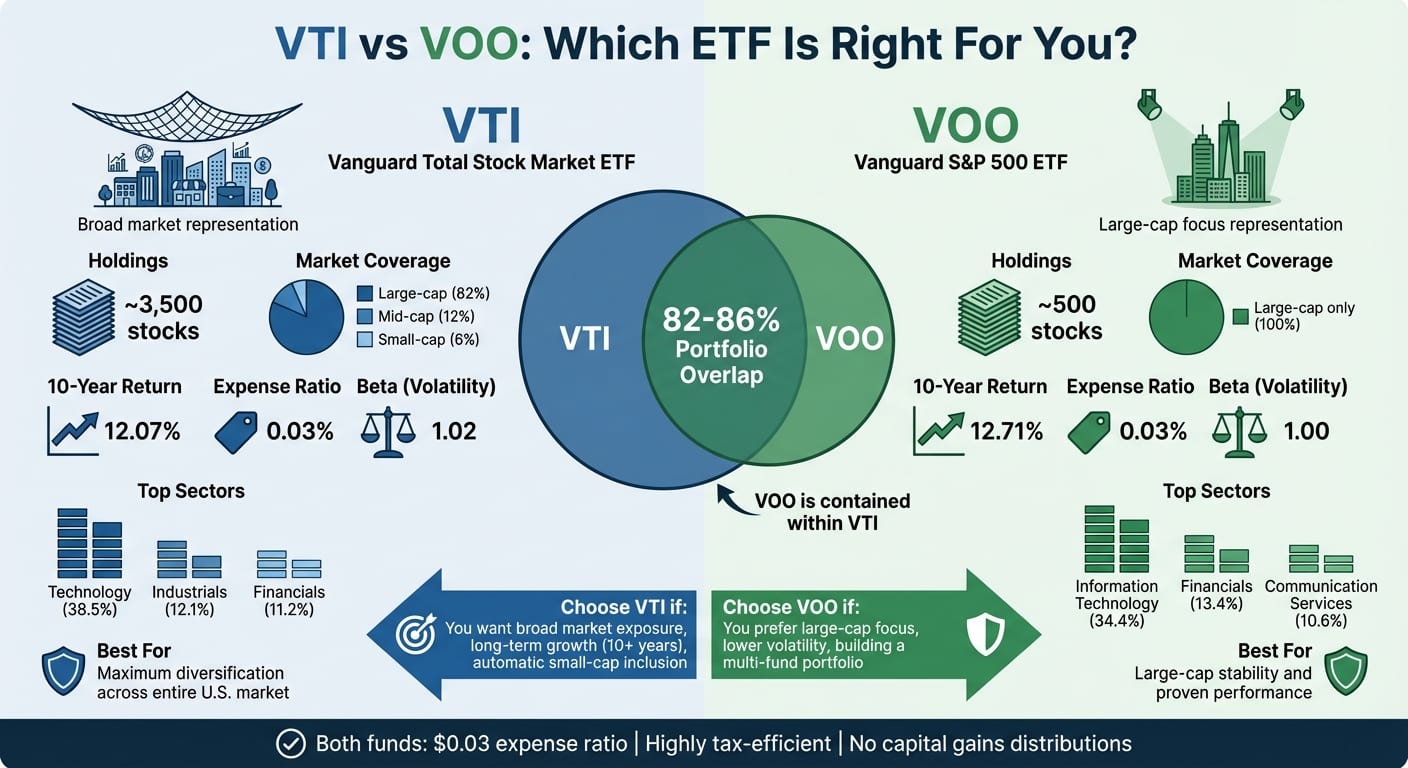
Both have a 0.03% expense ratio and similar performance due to overlap (82%-86% of VTI is VOO stocks). The choice depends on your goals:
- Want broad exposure? VTI may be appropriate.
- Prefer large-cap focus? VOO may be suitable.
Quick Comparison
Key takeaway: VTI offers broader diversification, while VOO provides large-cap stability. Consider your risk tolerance and investment strategy when choosing.
VTI: Vanguard Total Stock Market ETF
What VTI Offers
VTI is designed to track the CRSP US Total Market Index, covering nearly the entire investable U.S. equity market. As of December 31, 2025, the fund holds 3,512 stocks across companies of all sizes - large-, mid-, small-, and even micro-cap. Using an index-sampling strategy, VTI mirrors the industry weightings and financial characteristics of the CRSP US Total Market Index.
One of its standout features is its low expense ratio of 0.03%, which translates to just $3 in annual fees for every $10,000 invested. With total net assets reaching $2.1 trillion as of December 31, 2025, VTI ranks among the largest ETFs available. Its market price stood at $341.47 on February 11, 2026, while its 30-day SEC yield was 1.08% as of January 31, 2026. Additionally, its turnover rate of just 2.1% for fiscal year 2025 helps reduce taxable events, making it a tax-efficient choice for investors linking tax planning with investment tools in taxable accounts.
Benefits of Total Market Coverage
VTI's broad coverage offers impressive diversification. Its portfolio is made up of 82% large-cap, 12% mid-cap, and 6% small-cap stocks. This mix provides the stability of large-cap companies while also including approximately 3,000 smaller firms that are not part of the S&P 500. These smaller companies bring the potential to benefit from the "size factor premium", where smaller-cap stocks have historically shown the ability to outperform large-caps over extended periods.
The fund's top 10 holdings make up 25% of its portfolio, which is slightly less concentrated compared to VOO, where the top 10 represent about 30%. Technology dominates the sector allocation at 38.50%, followed by Industrials at 12.10% and Financials at 11.20%. Historically, the Total Stock Market Index has slightly outpaced the S&P 500, delivering an additional 8 basis points in compound annual growth rate from 1972 to recent years.
Best Fit for VTI Investors
VTI may be suitable for investors seeking broad diversification in a single fund. As Rob Berger, founding editor of Forbes Money Advisor, puts it:
If simplicity is your goal and you want all of your U.S. stocks in a single fund, go with VTI.
This ETF works well as a comprehensive solution for U.S. stock exposure, particularly in a three-fund portfolio strategy. It may be suitable for those with a long-term investment horizon of at least 10 years, who can tolerate short-term market volatility in pursuit of higher potential returns.
Starting with VTI is accessible, as you can invest with as little as $1.00, unlike its mutual fund counterpart, VTSAX, which requires a $3,000 minimum. It’s also a compelling choice for investors who want automatic exposure to small-cap stocks without the need to manage multiple funds.
VOO: Vanguard S&P 500 ETF
What VOO Offers
VOO is designed to track the S&P 500 Index, which represents 500 of the largest companies in the U.S., making it a key benchmark for large-cap stocks. As of December 31, 2025, the fund includes 504 stocks and manages total net assets of $1.5 trillion. Using a full replication approach, VOO mirrors the exact market-cap weight of each index constituent.
With an expense ratio of just 0.03%, VOO stands out as a low-cost option. On February 11, 2026, its market price was $636.35, and as of January 31, 2026, it offered a 30-day SEC yield of 1.08%. Its low portfolio turnover rate of 2.3% in fiscal year 2025 helps minimize taxable events. A median market cap of $382.8 billion and a 10-year average annual return of 15.55% highlight its focus on established, high-performing companies. These attributes make VOO a reliable option for investors prioritizing large-cap stability and growth.
Benefits of Large-Cap Focus
VOO emphasizes companies with well-established business models, which often provide greater stability. The fund's sector allocation is led by Information Technology at 34.40%, followed by Financials (13.40%) and Communication Services (10.60%). Its top 10 holdings, which include NVIDIA (7.75%), Apple (6.87%), and Microsoft (6.15%), make up about 26% of the portfolio.
This large-cap focus often translates to lower volatility, as mature companies typically experience smaller losses during market downturns. Over the 10 years ending in August 2025, VOO delivered a return of 14.57%, slightly outperforming VTI's 13.94%, thanks to the strength of mega-cap tech stocks. Additionally, VOO's trailing twelve-month yield is around 1.25%, compared to VTI's 1.20%.
Best Fit for VOO Investors
VOO may be suitable for investors seeking exposure to major U.S. corporations without the added complexity of smaller-cap stocks. Kent Thune, CFP and Senior Content Editor atetf.com, explains:
If you're comfortable with the concentration on larger-cap companies or are building a broader portfolio to include other funds, VOO can be a suitable choice.
This may make VOO a core holding for those balancing broad market exposure with focused growth strategies. It works well in core-and-satellite portfolio approaches, providing a stable base for diversification. It's also a practical choice when total market funds aren't available in workplace retirement plans.
For tax strategies, VOO pairs well with VTI for tax-loss harvesting, as the two have a 0.99 correlation but remain distinct enough to avoid wash sale rules. To maximize efficiency, consider trading VOO during the overlap between European and U.S. markets, typically from 8:00 to 12:00 Eastern Time (13:00 to 17:00 UTC).
VTI vs VOO: Main Differences
Holdings and Market Coverage
The key distinction between VTI and VOO lies in their scope. VTI includes a whopping 3,467 stocks, spanning the entire U.S. equity market - from massive corporations to tiny micro-cap companies. On the other hand, VOO is more focused, holding just 507 stocks, all of which are large-cap companies from the S&P 500 Index.
To put it simply, VOO is entirely contained within VTI. As John Williamson, APMA, explains:
VOO is already inside of VTI. There is no stock in VOO that is not also in VTI.
The S&P 500 stocks that VOO tracks make up about 82% to 87% of VTI’s total weight. That means VTI’s additional ~3,000 small- and mid-cap stocks account for only 13% to 18% of its total composition. Both funds are market-cap weighted, so major players like Apple, Microsoft, and NVIDIA dominate the performance of both ETFs. These differences in structure lead to subtle variations in performance and risk.
Performance and Price Movement
Over the last decade, VOO has delivered slightly better returns. As of September 2024, VOO’s 10-year annualized return was 12.71%, compared to VTI’s 12.07%. In the short term, VOO also edged out VTI, with a 1-year return of 15.84% versus VTI’s 15.36%, and a 3-year return of 21.03% compared to VTI’s 20.29%.
VTI’s beta of 1.02 indicates slightly higher sensitivity to market movements compared to VOO’s beta of 1.00. Historical data from 1972 to 2021 also shows VTI’s standard deviation at 15.59%, just above VOO’s 15.41%. Kent Thune, CFP, notes:
VTI provides broader diversification but has produced slightly lower returns in the past decade due to its inclusion of smaller-cap stocks.
Risk and Tax Efficiency
When it comes to risk, VTI carries a touch more volatility than VOO. This is because small-cap stocks, which are part of VTI’s portfolio, typically experience larger price swings than the more stable large-cap companies in VOO. As John Williamson points out:
VTI has been – and should be expected to be – slightly more volatile than VOO.
However, the difference in risk is minimal for most investors. Both funds share the same rock-bottom expense ratio of 0.03% and are exceptionally tax-efficient. Neither VTI nor VOO has ever made a capital gains distribution. Matt Shibata, Managing Partner at Thoughtful Finance, explains:
Neither VTI nor VOO has ever made a capital gains distribution (nor do I expect them to). Thus, these funds are about as tax-efficient as any fund can be.
In terms of taxes, there’s no practical difference between the two. The choice ultimately depends on whether you want the broadest market exposure or prefer to focus on the proven stability of large-cap companies.
How to Choose Between VTI and VOO
Match Your Investment Goals
Deciding between VTI and VOO comes down to what you want from your portfolio. If you're after simplicity and want a fund that covers the entire U.S. stock market, VTI is a solid choice. It spans large-, mid-, and small-cap companies, giving you broad market exposure. On the other hand, if you prefer to focus specifically on large-cap stocks, VOO could be a better fit. Rob Berger, an author and investor, shares his perspective:
If you want to slice and dice your portfolio into several U.S. asset classes... I prefer the S&P 500.
This approach allows you to fine-tune your portfolio by adding mid- and small-cap exposure separately. Since VOO is a subset of VTI, holding both may result in overlapping investments. Also, check your 401(k) options - some plans might only offer one of these funds. Ultimately, your goals and risk tolerance will guide your choice, which ties into your timeline and comfort with market fluctuations.
Consider Your Risk Level and Timeline
Your investment horizon and how much risk you can handle are key factors in choosing between these funds. VTI includes small- and mid-cap stocks, which tend to be more volatile than the large-cap stocks in VOO. Kate Underwood, a contributor at Moneywise, points out:
The long-term investor is better prepared to absorb losses from temporary swings, so small-cap and mid-cap companies are still solid investments.
If you’re investing with a long-term view - 10 years or more - VTI’s broader exposure could help you benefit from the size factor premium. Historically, smaller companies have delivered higher returns over time. But if you prefer stability and less volatility, VOO’s focus on the 500 largest U.S. companies might align better with your goals.
To give you an idea of their composition, VTI is about 82% large-cap, 12% mid-cap, and 6% small-cap. From 1972 to 2021, VTI had a compound annual growth rate of 10.66%, slightly edging out VOO’s 10.58% - a difference of just 8 basis points. With clear objectives and an understanding of your risk appetite, you can make an informed decision.
Optimize Your Choice with Mezzi
Mezzi’s X-Ray feature can help you analyze your portfolio and identify any overlaps, which may be useful when comparing VTI and VOO. Since VOO is contained within VTI, the tool can show if you are doubling up on large-cap stocks, helping you avoid unnecessary concentration.
Mezzi also offers tax optimization tools like AI-powered tax-loss harvesting, to help evaluate and avoid wash sales across your accounts. If you’re rebalancing or switching between VTI and VOO, Mezzi can calculate the tax implications ahead of time. This is particularly useful since both funds have the same low expense ratio of 0.03% and are highly tax-efficient. Your decision should ultimately hinge on how each fund supports your overall investment strategy.
Additionally, Mezzi’s AI-driven insights can show how much of your portfolio is already allocated to S&P 500 companies. Given that the S&P 500 accounts for nearly 90% of the total U.S. market capitalization, owning VTI still gives you significant large-cap exposure. The tool helps you assess whether the extra 18% exposure to mid- and small-cap stocks in VTI aligns with your investment goals.
VTI vs VOO (How To Choose Which ETF Is Best For You?)
Conclusion
VTI and VOO are both commonly used by long-term investors, differing mainly in their scope of market coverage. VOO focuses on the S&P 500, offering exposure to about 500 large-cap stocks, while VTI casts a wider net, covering the entire U.S. stock market with over 3,500 holdings. Despite their broader differences, the two funds share an 82% overlap in key holdings, leading to similar performance overall. The primary difference lies in VTI's additional 18% exposure to mid- and small-cap companies, which introduces more growth potential but also slightly higher volatility.
If you're looking for a single fund that captures the entire U.S. market, VTI offers broad diversification. On the other hand, if your strategy leans toward large-cap companies or you prefer to manage mid- and small-cap exposure separately, VOO provides a more focused approach. Both funds share an ultra-low expense ratio of just 0.03%.
To fine-tune your decision, Mezzi offers tools that simplify portfolio analysis. With its X-Ray feature, you can dive deep into your fund composition, ensuring you're not unintentionally overweighting large-cap stocks.
Mezzi also helps streamline your tax strategy. Its tax optimization tools calculate the impact of switching between VTI and VOO, helping you minimize wash sales and reduce tax liabilities. With Mezzi’s AI-driven insights, you can better understand your exposure to the S&P 500 and evaluate whether VTI’s additional mid- and small-cap holdings align with your financial objectives. By transforming complex decisions into clear, actionable strategies, Mezzi can help you keep your investments aligned with your goals.
FAQs
Is it worth holding both VTI and VOO?
Holding both VTI and VOO may offer a balanced approach to diversification. VTI provides exposure to the entire U.S. stock market, including small- and mid-cap stocks, while VOO focuses on large-cap stocks within the S&P 500. There is an approximate 82% overlap between the two, and they may be used together by some long-term investors seeking a mix of broad market coverage and large-cap stability.
How much do small- and mid-cap stocks in VTI really change my results?
Small- and mid-cap stocks in VTI can play a key role in shaping your investment outcomes. They bring the possibility of higher growth but also come with increased volatility. Unlike VOO, which sticks to large-cap stocks from the S&P 500, VTI offers a mix of small-, mid-, and large-cap stocks. This broader range gives you exposure to a wider market and adds an extra layer of diversification to your portfolio.
Which is better in a taxable account: VTI or VOO?
In a taxable account, VOO may be more tax efficient than VTI. VOO focuses on large-cap stocks within the S&P 500, which tend to generate fewer capital gains distributions. VTI covers a broader range, including small- and mid-cap stocks, which can sometimes result in higher turnover and more taxable events.
Related Blog Posts
- SPY vs VOO: fees, liquidity, dividend treatment, and tracking differences.
- VOO vs IVV: why might an investor choose one over the other?
- SPY vs VOO vs IVV - Best S&P 500 ETF for liquidity and tracking
- QQQ vs QQQM vs VOO: Nasdaq 100 or S&P 500 for Your Portfolio
Holding both VTI and VOO may offer a balanced approach to diversification. VTI provides exposure to the entire U.S. stock market, including small- and mid-cap stocks, while VOO focuses on large-cap stocks within the S&P 500. There is an approximate 82% overlap between the two, and they may be used together by some long-term investors seeking a mix of broad market coverage and large-cap stability.
Small- and mid-cap stocks in VTI can play a key role in shaping your investment outcomes. They bring the possibility of higher growth but also come with increased volatility. Unlike VOO, which sticks to large-cap stocks from the S&P 500, VTI offers a mix of small-, mid-, and large-cap stocks. This broader range gives you exposure to a wider market and adds an extra layer of diversification to your portfolio.
In a taxable account, VOO may be more tax efficient than VTI. VOO focuses on large-cap stocks within the S&P 500, which tend to generate fewer capital gains distributions. VTI covers a broader range, including small- and mid-cap stocks, which can sometimes result in higher turnover and more taxable events.