
Fixed income investments are financial tools that may provide retirees with steady, predictable income. They include bonds, CDs, and other products that pay regular interest and return the original investment at maturity. These options may help reduce exposure to market fluctuations and preserve savings as retirement approaches.
Key Points:
- What It Is: Fixed income involves lending money to governments or companies in exchange for interest payments.
- Why It Matters: It offers stability, predictable cash flow, and lower risk compared to stocks.
- Common Types: U.S. Treasuries, municipal bonds, corporate bonds, and CDs.
- Tax Considerations: Interest is often taxed as income, but options like municipal bonds may offer tax advantages. This is a key component of tax-efficient withdrawals in retirement.
- Portfolio Strategy: Many retirees allocate a portion of their savings to fixed income to balance risk and income needs.
Fixed income may not deliver high returns, but it plays a critical role in ensuring retirees have funds available when needed. Tools like Mezzi can help manage these investments by offering insights on fixed income diversification, tax efficiency, and portfolio adjustments.
Fixed Income for Retirement Income, Wealth Accumulation and Wealth Preservation
What is Fixed Income?
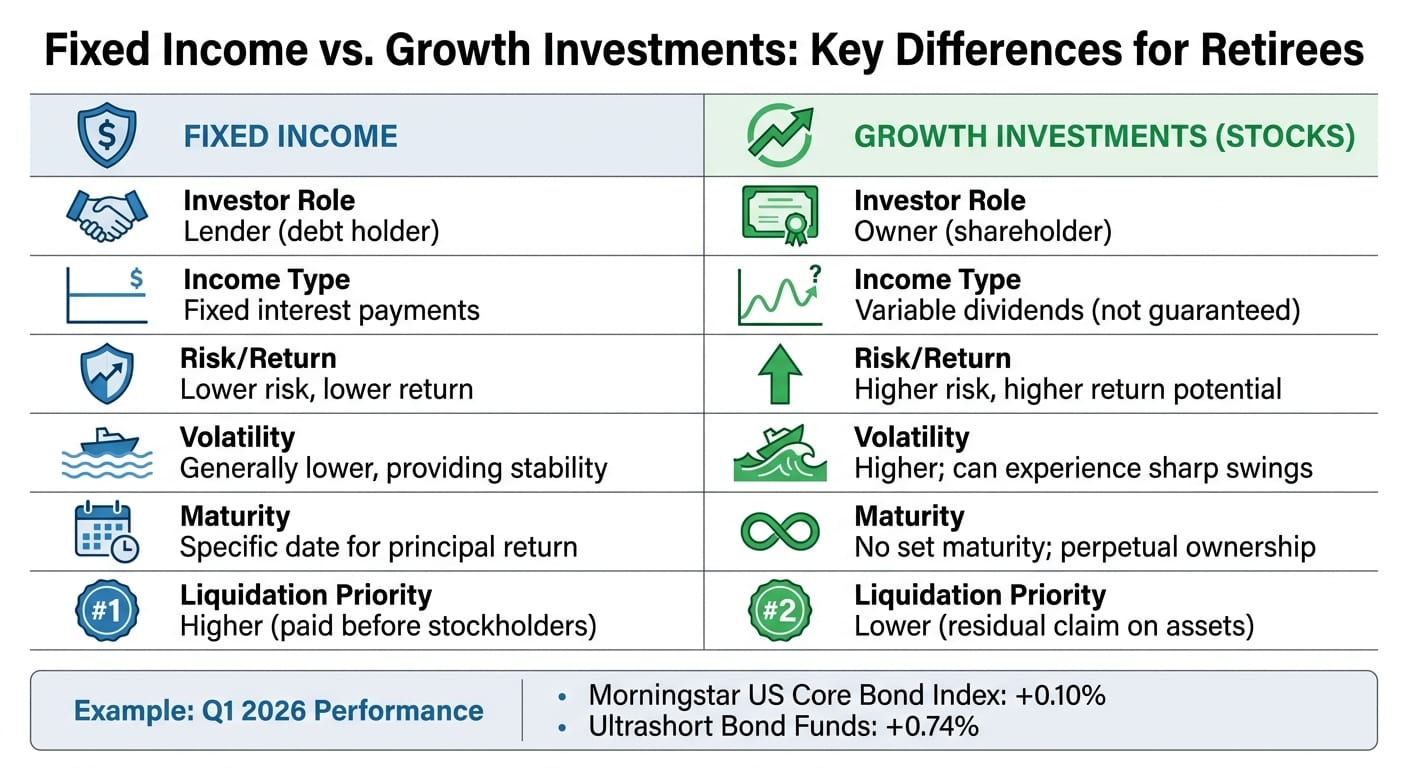
Fixed income investments provide set, regular interest payments and return the original principal amount when they mature. Unlike stocks, where returns depend on how well a company performs, fixed income positions you as a lender. You receive payments that are determined upfront - a key distinction that influences how these investments function in your portfolio.
How Fixed Income Works
When you purchase a bond or a certificate of deposit (CD), the payment schedule and maturity date are established at the outset. For instance, a Treasury bond pays a fixed interest rate annually until it matures, offering a predictable income stream even during market uncertainty.
In cases of bankruptcy, fixed-income investors hold a higher priority over common stockholders when it comes to asset claims.
Why Fixed Income Matters for Retirement
For retirees, fixed income provides a reliable source of funds, reducing the stress of market fluctuations. Christine Benz, Director of Personal Finance and Retirement Planning at Morningstar, highlights this benefit:
For people who are in retirement... fixed-income securities are also securing a portion of the retiree's cash flows. They're helping to stabilize it so the retiree doesn't have to worry so much about what's going on in the equity market. They know that they have a stable source of funds that they could pull from in a pinch.
This stability becomes especially important during market downturns, as it allows retirees to cover living expenses without needing to sell stocks at potentially unfavorable prices.
Fixed Income vs. Growth Investments
The primary difference between fixed income and growth investments, such as stocks, lies in their risk levels, return potential, and the investor's role. With fixed income, you act as a lender receiving predetermined payments, while stocks represent ownership with the possibility of price increases and dividends - though these come with greater uncertainty.
For example, during a particularly volatile first quarter of 2026, the Morningstar US Core Bond Index posted a return of 0.10%, while ultrashort bond funds gained 0.74%. While fixed income may not deliver dramatic returns, it plays a key role in preserving retirement savings, ensuring funds are available when needed.
Next, dive into the various types of fixed income investments that can help secure your retirement portfolio.
Types of Fixed Income Investments for Retirement
Retirees have a variety of fixed income options to consider, each catering to different income needs, risk levels, and tax situations.
Government Bonds and U.S. Treasuries
U.S. Treasury securities are often viewed as the safest fixed income choice, backed by the full faith and credit of the U.S. government. Jim Shagawat, CFP at AdvicePeriod, points out:
Treasurys typically form the backbone for safety and liquidity because they are backed by the U.S. government.
Treasury securities come in three main types:
- Treasury bills (T-bills): Mature in less than one year.
- Treasury notes (T-notes): Mature in 2 to 10 years.
- Treasury bonds (T-bonds): Mature in 20 to 30 years.
For example, in May 2025, a 10-year Treasury note matured at its $1,000 par value, maintaining the investor's principal while providing steady annual interest.
Treasury Inflation-Protected Securities (TIPS) add another layer of security by adjusting their principal value based on the Consumer Price Index (CPI). This feature makes them particularly useful during inflationary periods when purchasing power may decline. In March 2026, the 10-year Treasury yield rose to 4.88% due to inflation concerns and geopolitical events.
Corporate Bonds and Municipal Bonds
Corporate bonds are issued by companies to raise capital and generally offer higher yields than Treasuries, reflecting their increased credit risk. These bonds fall into two categories:
- Investment-grade bonds: Issued by financially stable companies, these bonds balance moderate risk with reasonable returns, appealing to retirees looking for more income than Treasuries provide.
- High-yield bonds: Offer higher returns but come with greater default risk. While they can generate income, their performance often mirrors the stock market, making them riskier during market downturns. Financial advisors typically suggest capping high-yield bonds at 20% of a portfolio to manage this risk.
Municipal bonds, issued by state and local governments, offer an advantage for high-income retirees: their interest is often exempt from federal taxes and, in some cases, state and local taxes. Melissa Cox, CFP at Future-Focused Wealth, highlights their appeal:
For high earners, tax-equivalent yield makes municipal bonds a strong contender, especially in high-tax states.
Municipal bonds are divided into:
- General obligation bonds: Backed by the issuer's taxing power, making them safer.
- Revenue bonds: Depend on income from specific projects, such as toll roads, and carry higher risk.
Certificates of Deposit (CDs) and Bond Funds
Certificates of Deposit (CDs) are bank-issued savings tools with fixed terms and guaranteed interest rates. They are ideal for retirees with near-term expenses, offering FDIC insurance coverage up to $250,000 per depositor, per institution. Many retirees use CD ladders to stagger maturity dates, ensuring regular access to funds while benefiting from higher rates on longer-term CDs.
Bond mutual funds and ETFs pool numerous bonds into a single investment, offering instant diversification. Over a 30-year period ending in 2018, bonds provided average annual returns of 6.1%, with much smaller fluctuations compared to stocks, which saw swings between +40% and –40%.
In early 2026, the Morningstar US Core Bond Index returned just 0.10%, while ultrashort bond funds (with durations under one year) gained 0.74%, showing their ability to preserve capital in a rising interest rate environment.
However, bond funds differ from individual bonds in one key way: they lack a fixed maturity date and do not guarantee the return of principal. Their share prices can fluctuate daily based on market conditions.
Next, we’ll look at how tax considerations can influence the placement of these fixed income investments.
How Fixed Income Reduces Risk and Generates Income
Fixed income investments play an important role in retirement planning by helping to lower portfolio risk while providing a steady income stream. This combination can help retirees maintain financial stability, even when markets are unpredictable.
Reducing Risk and Stabilizing Your Portfolio
Fixed income investments act as a stabilizer in your retirement portfolio, helping to soften the blow of stock market downturns. Collin Martin, Director of Fixed Income Strategy at Charles Schwab, describes their role:
Think of core bonds as the 'ballast' to your portfolio. We suggest they make up the bulk of your fixed income holdings.
One of their key benefits is their low correlation with stocks. For example, over the 10 years ending in June 2025, U.S. Treasuries demonstrated a very low correlation with the S&P 500 index. This means they often held their value - or even increased - when stocks declined.
Additionally, bond interest payments are legally required - a missed payment results in default - making them a dependable source of income, even during market downturns. This reliability is a cornerstone of their value in retirement portfolios.
Creating Predictable Retirement Income
Beyond stabilizing your portfolio, fixed income investments are designed to provide a consistent income stream. Bonds generate regular interest payments, offering cash flow that doesn’t rely on market performance. Unlike stock dividends, which can be reduced or eliminated, bond interest payments are contractual obligations.
One strategy retirees often use is bond laddering, which involves staggering bond maturities to ensure a steady flow of income while reducing the risk of reinvesting at unfavorable rates. Melissa Cox, CFP at Future-Focused Wealth, explains the appeal of this approach:
Staggering maturities through a bond ladder can help you take advantage of different interest rate environments over time... especially comforting for retirees needing predictable cash flow.
Tax Implications of Fixed Income in Retirement
Taxes can play a big role in shaping your retirement income. The type of bonds you hold and where you hold them can influence how much of your income you keep after taxes.
Where to Hold Fixed Income: Taxable vs. Tax-Advantaged Accounts
Interest from most bonds - like corporate bonds, CDs, and taxable bond funds - is taxed as ordinary income, which could be as high as 37% for top earners. This makes these investments less tax-friendly compared to stocks, which often benefit from lower long-term capital gains rates.
To minimize taxes, consider holding fixed income investments in tax-advantaged accounts like Traditional IRAs or 401(k)s. These accounts allow interest to grow tax-deferred until withdrawal. Cody Garrett, CFP at Measure Twice Financial, highlights this benefit:
Ordinary income from bonds in a taxable account can 'crowd out' your standard deduction and lower tax brackets, leaving less room for strategies like Roth conversions.
For example, in a $2 million portfolio divided between taxable and IRA accounts, placing all bonds in the IRA reduced taxable income by $10,410 compared to a mixed approach.
U.S. Treasuries offer a partial tax advantage. While their interest is subject to federal tax, it’s exempt from state and local taxes. Jacob Dayan, CEO of Community Tax LLC, explains:
Treasury bond interest... is completely exempt from state and local taxes. This makes them especially attractive for investors in high-tax states.
This exemption can make Treasuries slightly more tax-efficient in taxable accounts than corporate bonds, though they still generate federally taxable income.
Next, we’ll look at strategies like tax-loss harvesting and the benefits of municipal bonds.
Tax-Loss Harvesting and Municipal Bond Tax Benefits
Tax-loss harvesting involves selling bonds or bond funds that have lost value to offset capital gains elsewhere in your portfolio. This strategy works especially well with individual bonds held in taxable accounts.
Municipal bonds provide a different kind of tax benefit. Their interest is generally exempt from federal taxes, and if you own bonds issued in your state, the interest is often exempt from state and local taxes too - making them "triple tax-free". Christine Benz, Director of Personal Finance at Morningstar, explains their appeal:
Municipal bonds - discussed below - will be close to a no-brainer for investors in higher-income tax brackets (say, 24% and above).
However, selling a municipal bond before it matures could trigger capital gains taxes. Gains from bonds held less than a year are taxed as ordinary income, while gains from those held longer are taxed at lower rates of 0%, 15%, or 20%.
*Exempt if issued in your state of residence.
By understanding these tax considerations, you can better position your fixed income investments to maximize your retirement income. Using the right account types and tax-advantaged bonds can help you keep more of your earnings while maintaining the stability and cash flow that fixed income investments are known for.
Important: This article is for informational purposes only and does not constitute tax, legal, or financial advice. Consult a qualified tax professional or financial advisor before making investment decisions.
Building and Managing a Fixed Income Strategy with Mezzi
Creating a fixed income portfolio for retirement involves balancing safety, income, flexibility, and tax considerations to help ensure steady income while managing risk. A solid approach spreads investments across various maturities and credit ratings, adjusting as interest rates and market conditions evolve. Mezzi offers tools to help manage these strategies - without the typical 1% advisor fee.
Diversifying by Maturity and Credit Quality
Diversifying fixed income investments means spreading them across different bond types and maturity dates. Mezzi simplifies this process by recommending maturity splits that maintain liquidity and take advantage of rising interest rate environments.
Credit quality is another key factor. U.S. Treasuries and FDIC-insured CDs - protected up to $250,000 per individual - offer stability but lower yields. On the other hand, corporate bonds may offer higher returns but carry default risks, especially those rated below BBB- or Baa3, which are considered "junk bonds". Striking a balance between these options can help manage risk while seeking higher returns where appropriate.
Using Mezzi to Optimize Your Portfolio
Mezzi connects to all your accounts - 401(k), brokerage, Roth IRA, and taxable accounts - via read-only access, offering a complete view without requiring asset transfers. Unlike traditional advisors, who typically focus only on assets they manage, Mezzi provides a comprehensive perspective.
One of Mezzi's standout features is its ability to detect overlapping holdings, which can lead to concentration risk. For instance, if you hold the same corporate bond issuer across multiple funds, Mezzi's Exposure X-Ray highlights these overlaps for action. The platform also optimizes asset location, ensuring tax-efficient placement of investments. High-tax instruments like corporate bonds are placed in tax-advantaged accounts, while tax-exempt municipal bonds are better suited for taxable accounts.
Mezzi also identifies tax-saving opportunities throughout the year. If a bond or bond fund has lost value, Mezzi flags it for potential tax-loss harvesting. It tracks the 30-day wash sale rule and notifies you when it's safe to repurchase, helping avoid compliance issues across your accounts.
Since market conditions change, regular portfolio monitoring is crucial to maintain these optimizations.
Monitoring for Interest Rate and Market Changes
Once your portfolio is optimized, staying responsive to interest rate changes and market conditions is critical. When interest rates rise, bond prices tend to fall, with longer-term bonds experiencing sharper declines than shorter-term ones.
Mezzi provides tools for ongoing monitoring to help you adapt. The platform's AI Chat with Web Search allows you to ask specific questions, like how geopolitical events might impact your bond holdings, and delivers personalized insights using up-to-date web data. You can also set Custom AI Notifications to alert you when idle cash builds up, giving you the chance to move funds into higher-yield bonds or CDs before rates drop.
For example, as of April 30, 2026, 10-year Treasury yields have generally ranged between 4.00% and 4.50%. If rates change significantly, Mezzi's Research Assistant can help you review the duration of your bond funds and adjust your strategy as needed. With daily updates, you always have access to current information.
"Mezzi proactively surfaces the largest opportunities to grow wealth and optimize your portfolio, with fresh daily updates." - Mezzi Wealth App
By combining diversification, tax efficiency, and continuous monitoring, Mezzi supports a flexible fixed income strategy tailored to your retirement goals - all without the traditional advisor fee. On average, Mezzi members save $10,000 in advisory fees, keeping more of their retirement income working for them.
Important: This article is for informational purposes only and does not constitute tax, legal, or financial advice. Consult a qualified tax professional or financial advisor before making investment decisions.
Conclusion
Fixed income investments play a key role in retirement planning by offering steady cash flow to cover essential expenses and helping to reduce exposure to market volatility. These instruments - ranging from U.S. Treasuries to municipal bonds and CDs - focus on preserving your capital while delivering consistent interest payments, which may help you avoid dipping into stocks during market downturns.
Creating a well-rounded strategy involves finding the right balance between safety, yield, and tax efficiency. This often means diversifying across maturities and credit qualities. As Jim Shagawat, CFP at AdvicePeriod, explains: "Treasurys typically form the backbone for safety and liquidity because they are backed by the U.S. government". This underscores the value of building a strong, stable foundation for retirement finances.
While these products are designed to provide stability, managing them effectively is just as important. Mezzi simplifies this process by consolidating all your accounts - such as 401(k)s, brokerage accounts, Roth IRAs, and taxable accounts - into one comprehensive view. The platform identifies overlaps, suggests tax-efficient asset placement, and highlights tax-loss opportunities year-round, all while keeping costs low.
With daily updates and AI-powered insights, Mezzi helps you stay on top of interest rate changes and market trends. This allows you to fine-tune your bond ladder, adjust maturities, and manage duration risk with ease. By combining these tools with a thoughtful strategy, you can build a solid financial foundation for your retirement.
Important: This article is for informational purposes only and does not constitute tax, legal, or financial advice. Always consult a qualified tax professional or financial advisor before making investment decisions.
FAQs
How much fixed income should I hold in retirement?
The amount of fixed income you may need in retirement often depends on factors like your comfort with risk, how much income you require, and your broader financial approach. Some financial professionals suggest keeping enough in lower-risk options - such as short-term bonds or CDs - to cover 2–4 years of living expenses. Including a mix of government bonds, corporate bonds, and possibly annuities in your portfolio could help create reliable cash flow while potentially lowering exposure to market fluctuations during what might be a lengthy retirement.
What’s the difference between buying individual bonds and bond funds?
The key distinctions lie in control, diversification, and management effort. With individual bonds, you gain greater control. You can pick specific bonds, hold them to maturity, and have a clear understanding of your payment schedule. That said, managing individual bonds demands more time and effort.
On the other hand, bond funds - such as mutual funds or ETFs - provide broader diversification and professional management. However, they offer less control over the exact holdings and may be more susceptible to price swings caused by market changes.
How do rising interest rates affect my bond prices and income?
When interest rates rise, bond prices usually fall, which may lower the value of bonds you already hold. On the flip side, new bonds issued during these periods often come with higher interest rates, offering the chance for greater income. This combination underscores the need to approach bond investments thoughtfully during rate changes, aiming to offset potential losses while taking advantage of higher-income opportunities.
Disclosures:
- This content is for informational purposes only and does not constitute investment, tax, or legal advice. Consult a qualified tax professional or financial advisor before making investment decisions.
- Past performance is not indicative of future results. No guarantee of future performance or outcomes is implied.
- Savings and performance examples are hypothetical and for illustrative purposes only. Actual results will vary based on individual circumstances, portfolio composition, market conditions, and fees.
- Registration does not imply a certain level of skill or that the SEC has approved the company or its services.
Related Blog Posts
- How can I diversify my portfolio with ETFs before retiring in a few years?
- Which investments can help me retire comfortably within the next few years?
- What portfolio value and withdrawal strategy would generate a specific monthly after-tax income?
- Retirement Planning at 50: How to Assess If You Have Enough
The amount of fixed income you may need in retirement often depends on factors like your comfort with risk, how much income you require, and your broader financial approach. Some financial professionals suggest keeping enough in lower-risk options - such as short-term bonds or CDs - to cover 2–4 years of living expenses. Including a mix of government bonds, corporate bonds, and possibly annuities in your portfolio could help create reliable cash flow while potentially lowering exposure to market fluctuations during what might be a lengthy retirement.
The key distinctions lie in control, diversification, and management effort. With individual bonds, you gain greater control. You can pick specific bonds, hold them to maturity, and have a clear understanding of your payment schedule. That said, managing individual bonds demands more time and effort.
On the other hand, bond funds - such as mutual funds or ETFs - provide broader diversification and professional management. However, they offer less control over the exact holdings and may be more susceptible to price swings caused by market changes.
When interest rates rise, bond prices usually fall, which may lower the value of bonds you already hold. On the flip side, new bonds issued during these periods often come with higher interest rates, offering the chance for greater income. This combination underscores the need to approach bond investments thoughtfully during rate changes, aiming to offset potential losses while taking advantage of higher-income opportunities.