
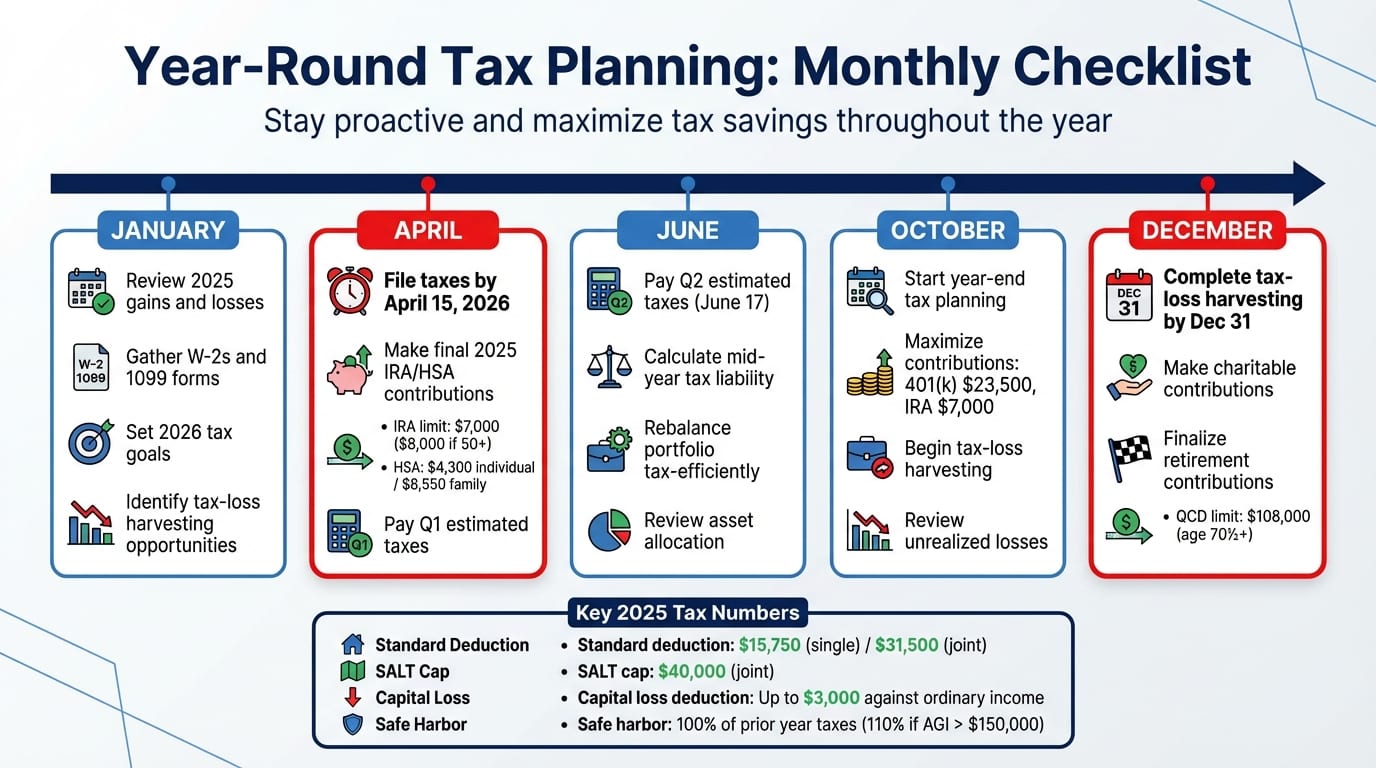
Tax planning isn’t just for April - it’s a year-round process that can enhance tax efficiency and help you stay organized. By staying on top of your portfolio every month, you can take advantage of opportunities like maximizing retirement contributions, offsetting gains with losses, and avoiding penalties. Here’s a quick summary of what you need to know:
- Key 2025 Tax Updates (filed in 2026):
Standard deduction: $15,750 (single) / $31,500 (joint).
- SALT deduction cap: $40,000 (joint, temporary through 2029).
- Contribution limits: $7,000 (IRA), $23,500 (401(k)), with extra $11,250 catch-up for ages 60–63.
- Monthly Highlights:
January: Review prior-year gains/losses, set 2026 tax goals.
- April: File taxes by April 15, make final 2025 IRA/HSA contributions.
- June: Pay Q2 estimated taxes, rebalance your portfolio using tax-efficient rebalancing best practices.
- October: Plan year-end strategies, maximize contributions, and start tax-loss harvesting.
- December: Finalize tax-loss harvesting, make charitable contributions, and complete 2026 strategies.
Using tools like Mezzi can simplify this process by monitoring your accounts, identifying tax-saving opportunities, and helping you avoid mistakes like wash sale violations. Staying proactive ensures you don’t miss out on potential savings and keeps your financial plan on track.
January: Review Last Year and Set Goals
Review 2025 Gains and Losses
January is the perfect time to dig into your tax documents and take stock of 2025. Start by gathering your W-2 forms (employers are required to send these by January 31, 2026), 1099 forms (usually ready by mid-February), and brokerage statements that detail your investment activity. If you're eager to get started, most brokerage platforms let you access preliminary data online, giving you an early look at your tax situation.
Pay close attention to your realized gains and losses from 2025 - these are tied to investments you sold during the year. Use your 1099-B to review capital gains and losses, your 1099-DIV for dividend income, and your 1099-INT for interest income. Here's why this matters: capital losses can directly offset your gains on a dollar-for-dollar basis. If your losses exceed your gains, you can deduct up to $3,000 from your ordinary income. Also, keep an eye on any unrealized losses in your portfolio, as these might be useful for tax-loss harvesting opportunities in 2026.
It’s also smart to compare your final 2025 paystub with previous years. This can help you spot changes in withholding that could affect whether you’ll owe taxes or receive a refund. Tools like Mezzi simplify this process by connecting directly to your brokerage accounts and compiling all your tax data in one place. This way, you can see your full tax picture without tracking down multiple documents. Use this information to identify areas for tax efficiency and set actionable goals for 2026.
Set Tax Planning Goals for 2026
Your 2025 results can guide your tax planning for 2026. Key goals might include minimizing taxable capital gains through loss harvesting, optimizing asset location by moving tax-inefficient investments (like certain bonds or REITs) into tax-advantaged accounts, and maximizing retirement contributions. For example, aim to contribute up to the $7,000 IRA limit and strategically harvest losses to offset gains - harvesting $10,000 in losses in a 24% tax bracket could result in potential tax savings of approximately $2,400.
Tailor your goals to your specific situation. If you realized $20,000 in capital gains in 2025, a practical target for 2026 might be harvesting $15,000 to $20,000 in losses to offset future gains. Define what success looks like for you, whether that’s maxing out contributions to tax-advantaged accounts, rebalancing your portfolio in a tax-efficient way, or staying ahead of estimated tax payments to avoid the $1,000 threshold that triggers quarterly payments. Having clear, measurable targets can help you stay proactive and make tax optimization a year-round effort.
April: File Taxes and Adjust Your Portfolio
Meet Tax Filing Deadlines
Mark your calendar: April 15, 2026, is Tax Day. This is your deadline to file your 2025 federal income tax return, make prior-year contributions to retirement accounts, and pay your first quarterly estimated taxes if you're self-employed or have investment income. If you need more time to file, you can request an extension using IRS Form 4868, which moves your filing deadline to October 15, 2026. But keep in mind, an extension only delays the paperwork - not the payment. Any owed taxes must still be paid by April 15 to avoid penalties.
To stay on track, gather essential documents like your W-2s, 1099-Bs, 1099-DIVs, and 1099-INTs before the deadline. This is also your last chance to make 2025 contributions to IRAs and HSAs. For 2025, you can contribute up to $7,000 to an IRA (or $8,000 if you're 50 or older) and up to $4,300 for individual HSA coverage or $8,550 for family coverage. Be sure to designate these contributions as 2025 when funding the accounts so you can claim the deductions on your 2025 tax return, even though the contributions are made in early 2026. Filing electronically can speed up processing and ensure accuracy.
Once your taxes are filed, use the insights from your return to fine-tune your tax strategy for the year ahead.
Find Post-Filing Tax Opportunities
Your completed tax return isn’t just a formality - it’s a roadmap for smarter financial planning. Start by reviewing your adjusted gross income (AGI) and tax bracket. This information can help you decide if there’s room to make Roth conversions or if you should focus on harvesting losses to offset gains.
Take a closer look at your 2025 capital gains and losses. For example, if you realized $10,000 in gains last year, you might have unrealized losses in your portfolio that could offset future gains. Tools like Mezzi's AI-powered platform can scan your portfolio for tax-loss harvesting opportunities, ranking them by tax lot basis and showing how they could impact your after-tax returns. Plus, Mezzi can help you avoid wash sale violations by suggesting alternatives - like selling VTI and buying SCHB - so you can claim the loss without losing market exposure.
"Your CPA prepares your return and ensures compliance. Tax Optimization finds opportunities throughout the year so there's less tax to report in April. They work together." - Mezzi
Tax-loss harvesting opportunities can disappear quickly, especially in a market recovery, so it's wise to monitor your portfolio daily. Use the information from your return to create a "tax projection" for 2026. Compare your actual tax liability to your estimates and adjust your quarterly payments or rebalancing strategy as needed. By treating April as more than just a deadline, you can turn it into a pivotal moment for shaping your financial strategy for the rest of the year.
June: Mid-Year Review and Rebalancing
Calculate Estimated Taxes
By June, your gains, dividends, and interest might have increased your tax liability. If you owe $1,000 or more after withholdings, missing the June 17, 2026 deadline for your second-quarter estimated tax payment could result in penalties - particularly for independent investors whose portfolios generate taxable events like capital gains or dividend income.
To get ahead, tally your wages, dividends, interest, business income, and realized gains from January through June. Compare these figures with last year’s totals to estimate your full-year income. For instance, if your gains so far amount to $50,000 and you’re in the 24% tax bracket with insufficient withholding, you may need to make a $5,000+ payment for Q2 to avoid penalties. Use IRS Form 1040-ES or tax software to crunch the numbers, and remember the safe harbor rule: paying 100% of last year’s taxes (or 110% if your AGI exceeds $150,000) can help you sidestep penalties.
If you’re using Mezzi, their platform simplifies this process. It tracks your portfolio in real time, categorizing realized and unrealized gains to assess tax implications. It even generates estimated tax projections based on your income and filing status. By flagging Q2 payment needs before June 17 and alerting you to underpayment risks, Mezzi helps you stay proactive without the headache of manual calculations. If your gains have bumped you into a higher tax bracket, consider strategies like increasing your 401(k) contributions or making charitable donations to lower your AGI before the deadline.
Rebalance Your Portfolio Tax-Efficiently
Once you’ve sorted out your tax obligations, it’s time to revisit your portfolio. Mid-year is ideal for checking whether your asset allocation still matches your goals. For example, if you started the year with a 60/40 stocks-to-bonds mix but tech stocks have surged, your portfolio might now be at 70/30, exposing you to more risk than planned. Rebalancing can help, but conventional methods - like selling overweight positions - might trigger capital gains taxes. A tax-efficient strategy takes a more calculated approach: sell positions with losses first, focus on high-basis shares to minimize taxable gains, and direct new contributions toward underweight assets in tax-advantaged accounts like a Roth IRA.
Mezzi’s platform takes this a step further by providing tax-cost analysis previews. It ranks rebalancing moves based on their tax impact and suggests the most efficient order. For example, say you have a $500,000 portfolio that’s overweight in tech by 10%, with $20,000 in unrealized gains. Mezzi might recommend selling $15,000 in high-basis shares (triggering a $2,000 gain), harvesting $10,000 in losses from bonds, and reallocating to index funds. This approach could result in a tax savings estimate of $3,000, compared to a $5,000 estimated cost with standard rebalancing.
The platform also helps you avoid wash sale violations in rebalancing by suggesting alternative investments - like swapping similar ETFs - so you can claim losses without losing market exposure. Treat June as a checkpoint, not just another month. It’s your chance to realign your portfolio, control tax costs, and stay on track with your financial goals.
Tax-Loss Harvesting Isn’t Just for Downturns. Here’s Why
October: Start Year-End Tax Planning
October is the perfect time to focus on wrapping up your year-end tax planning. With just a few months left, it’s an opportunity to fine-tune your strategies and maximize your financial benefits.
Maximize Tax-Advantaged Contributions
You’ve got until December 31, 2026, to make the most of your retirement and HSA contributions for the year. Here’s a quick breakdown of the limits for 2026:
- 401(k) or 403(b): Up to $23,500 if you’re under 50.
- IRA: Up to $7,000 for those under 50.
- HSA: $4,300 for individuals under 55, with an extra $1,000 catch-up contribution for those 55 or older, totaling $5,300.
- 401(k) Catch-Up (Ages 60–63): Contribution limits increase to $34,750.
Let’s say you’re under 50 and have already contributed $10,000 to your 401(k). You still have $13,500 left to contribute. Adjusting your payroll deductions now can help you hit the maximum limit by year-end. Remember, every dollar you contribute reduces your taxable income. For example, at a 24% marginal tax rate, adding more to your retirement account translates to noticeable tax savings.
Tax loss harvesting software like Mezzi can simplify this process. Mezzi aggregates data from your 401(k), IRA, and HSA accounts, showing real-time contribution progress against 2026 limits. It even sends alerts when you have room to contribute more and simulates potential tax savings based on your income and filing status. No more juggling spreadsheets or multiple logins.
Once you’ve reviewed your contributions, it’s time to tackle another key strategy: tax-loss harvesting.
Find Final Harvesting Opportunities
October is also a great time to review your portfolio for unrealized losses. Tax-loss harvesting allows you to sell investments at a loss to offset gains. If your losses exceed your gains, you can deduct up to $3,000 against ordinary income. Acting in October ensures trades settle before year-end, helping you avoid wash sale violations.
Here’s an example: Let’s say you have $10,000 in unrealized losses and $10,000 in realized gains from earlier in the year. Harvesting those losses could result in potential tax savings of $1,500 to $2,000, depending on long-term capital gains rates of 15–20%.
Mezzi can make this process easier by scanning your portfolio in real time. It flags positions with losses over $1,000 and calculates their potential tax impact. It also reviews your transaction history to identify wash sale risks - like buying back a security within 30 days of selling it - and suggests alternatives to maintain your market exposure while staying compliant with IRS rules.
December: Complete Year-End Tax Strategies
By December, it's time to finalize your tax strategy for 2026. With the year-end deadline of December 31, 2026, this is your last chance to implement the tax moves identified earlier. Two key areas to focus on are wrapping up tax-loss harvesting and making charitable contributions. These strategies can maximize your portfolio's tax efficiency before the clock runs out.
Complete Tax-Loss Harvesting
If you began tax-loss harvesting in October, December is the time to complete it. Take a final look at your portfolio to identify any remaining positions with unrealized losses.
Timing is everything here. Trades must settle by December 31 to count for 2026, which usually means initiating them by December 29 or 30 due to the T+2 settlement rule.
One critical point: ensure your broker uses specific lot identification when selling shares. This allows you to select the shares with the highest cost basis, which can help you maximize your losses for tax purposes.
Mezzi can assist by scanning your portfolio in real-time to identify positions with losses and estimate their tax implications. It also monitors wash sale windows across your accounts, helping you avoid violations. If you sell a position, Mezzi will notify you when the 30-day wash sale window closes, so you can repurchase the asset without triggering any issues.
Make Charitable Contributions
Once tax-loss harvesting is complete, shift your attention to charitable giving to further reduce taxable income.
Charitable donations aren't just an act of kindness - they're also a smart tax strategy. To claim a deduction for 2026, donations must be completed by December 31, 2026. This means the check must be mailed, the credit card transaction processed, or the asset transfer finalized by midnight.
Consider donating appreciated assets held for over a year instead of cash. This approach may avoid capital gains taxes and may allow you to deduct the asset's full market value. For example, donating stock purchased for $5,000 that has grown to $15,000 may allow you to avoid capital gains tax on the $10,000 gain while providing a $15,000 deduction., depending on your specific situation.
If you're 70½ or older, a Qualified Charitable Distribution (QCD) is another option. You can donate up to $108,000 directly from your IRA to a charity. This counts toward your Required Minimum Distribution (RMD) and is excluded from taxable income. However, the funds must go directly from your IRA to the charity - handling the money yourself makes it taxable.
Donor-Advised Funds (DAFs) are another tool to consider. They allow you to donate now, secure the 2026 tax benefit, and decide later which organizations receive the funds. This can be especially useful in high-income years.
Starting in 2026, even if you don't itemize deductions, you can still deduct up to $1,000 (single) or $2,000 (married filing jointly) for charitable contributions, provided they exceed 0.5% of your Adjusted Gross Income (AGI). This change makes charitable giving more beneficial for taxpayers who previously couldn't take advantage of the deduction.
Charitable giving is about more than generosity - it's also about strategy. Whether you're using retirement accounts, appreciated assets, or donor-advised funds, the right approach can help you give more while paying less in taxes.
Ryan Morrissey, President & Principal Wealth Advisor, Morrissey Wealth Management
While Mezzi doesn't handle donations, it can help you identify which appreciated assets in your portfolio would be the most tax-efficient to donate. It provides details like cost basis and holding periods, so you know which assets qualify for the full fair market value deduction.
Disclaimer: This content is for informational purposes only and does not constitute tax, legal, or financial advice. Consult a qualified tax professional or financial advisor before making any tax-related decisions.
Using Mezzi for Year-Round Tax Optimization
Managing taxes across multiple accounts can feel like a juggling act. Mezzi makes it simpler by securely linking all your accounts - whether it’s your 401(k), brokerage, Roth IRA, or taxable accounts. Unlike traditional advisors who only see the assets they directly manage, Mezzi provides a consolidated view of your finances, supporting a thorough approach to tax planning throughout the year.
One of Mezzi’s standout features is its daily portfolio monitoring, which identifies tax-loss harvesting opportunities before market conditions shift and those windows close. For example, if you have $40,000 in harvestable losses and $50,000 in gains, Mezzi estimates potential tax savings based on the data you provide, such as $10,000 at a 20% tax rate, depending on your circumstances. The best part? You remain in control. Mezzi provides the insights, but you decide whether to act and execute the trades yourself.
Another powerful tool is Mezzi’s cross-account wash sale detection. This feature tracks the IRS-mandated 30-day window across all your connected accounts simultaneously - a task that’s nearly impossible to handle manually. Say you sell a stock at a loss in your taxable account but accidentally repurchase it in your IRA within 30 days. Mezzi flags this before the IRS disallows the deduction. It also notifies you when the 30-day period ends, so you can repurchase the stock without worrying about triggering a wash sale violation. This constant monitoring ensures your tax strategy stays on track, seamlessly integrating with the proactive steps you’ve already implemented.
Beyond tax-loss harvesting, Mezzi supports your broader tax planning efforts, much like a tax planning checklist. It evaluates gains, helps finalize year-end strategies, and provides detailed guidance and insights without charging a typical 1% assets under management fee. Plus, you maintain full control over your accounts, ensuring transparency and flexibility.
Disclaimer: This content is for informational purposes only and does not constitute tax, legal, or financial advice. Always consult a qualified tax professional or financial advisor before making any tax-related decisions.
Conclusion
This checklist is designed to help independent investors leverage AI-driven tools to maintain tax efficiency throughout the year. Tax planning isn’t just a one-time effort - it’s an ongoing process that can help you identify potential tax savings. Whether it’s reviewing gains and losses in January or completing tax-loss harvesting in December, every month presents opportunities to lower your tax burden and boost your returns. The secret lies in staying proactive: maximizing contributions, offsetting capital gains with strategic losses, and donating appreciated stock can all lead to meaningful savings. By following this checklist, you can ensure that each month contributes to a well-rounded, tax-efficient strategy.
For instance, consider a $500,000 portfolio that harvests $20,000 in losses. At a 15% tax rate, this could result in potential tax savings of approximately $3,000. Combine that with maxed-out IRA and 401(k) contributions, and a $100,000 earner in the 22% tax bracket could potentially reduce their federal tax bill by approximately $4,700. Over five years, reinvesting those savings at a 7% annual growth rate could potentially increase your wealth by $10,000 or more compared to reactive, end-of-year planning.
With Mezzi’s technology, you gain a full picture of your finances through daily monitoring and actionable insights. The platform identifies tax-loss harvesting opportunities before they vanish, tracks the 30-day wash sale rule across accounts, and provides clarity on the tax implications of every decision - whether it’s rebalancing, withdrawing funds, or making a Roth conversion.
Switching to a monthly approach instead of scrambling at the last minute helps you avoid missed opportunities and build wealth over time. Mezzi helps you stay on top of deadlines, spot opportunities, and make informed, tax-efficient decisions without the typical 1% advisory fee.
Disclaimer: This content is for informational purposes only and does not constitute tax, legal, or financial advice. Always consult a qualified tax professional or financial advisor before making any tax-related decisions.
FAQs
How do I know if I need to pay estimated taxes?
If you anticipate owing at least $1,000 after accounting for withholding and credits, you might need to make estimated tax payments. This helps you avoid potential underpayment penalties. The IRS requires these payments if your total tax liability exceeds $1,000 or if your withholding and credits cover less than 90% of your current year's tax or 100% of last year's tax - a guideline often referred to as the "safe harbor" rule.
What counts as a wash sale across my accounts?
A wash sale occurs when you sell a security at a loss and then purchase the same or a substantially identical security within 30 days before or after the sale. This rule applies to all of your accounts and will prevent you from claiming the tax loss. It's important to keep this in mind when managing trades to ensure you don't accidentally void your tax-loss harvesting strategy.
Should I donate cash or appreciated stock?
Donating appreciated stock that you've held for more than a year can offer greater tax advantages compared to giving cash. Here's why: you won't have to pay capital gains taxes on the stock's increased value, and you can still claim a deduction for its full fair market value. This approach can stretch your charitable contributions further while also boosting your tax savings - particularly if you're in a higher tax bracket.
On the other hand, donating cash provides an immediate tax deduction, but it doesn't come with the added benefit of avoiding capital gains taxes like stock donations do.
Related Blog Posts
- Ultimate Guide to Tax-Efficient ETF Investing
- Tax-Loss Harvesting: Best Seasons for Maximum Savings
- Tax-Optimized Rebalancing: Strategies for 2025
- Tax-Loss Harvesting Across Multiple Accounts: A Complete Guide
If you anticipate owing at least $1,000 after accounting for withholding and credits, you might need to make estimated tax payments. This helps you avoid potential underpayment penalties. The IRS requires these payments if your total tax liability exceeds $1,000 or if your withholding and credits cover less than 90% of your current year's tax or 100% of last year's tax - a guideline often referred to as the "safe harbor" rule.
A wash sale occurs when you sell a security at a loss and then purchase the same or a substantially identical security within 30 days before or after the sale. This rule applies to all of your accounts and will prevent you from claiming the tax loss. It's important to keep this in mind when managing trades to ensure you don't accidentally void your tax-loss harvesting strategy.
Donating appreciated stock that you've held for more than a year can offer greater tax advantages compared to giving cash. Here's why: you won't have to pay capital gains taxes on the stock's increased value, and you can still claim a deduction for its full fair market value. This approach can stretch your charitable contributions further while also boosting your tax savings - particularly if you're in a higher tax bracket.
On the other hand, donating cash provides an immediate tax deduction, but it doesn't come with the added benefit of avoiding capital gains taxes like stock donations do.