Understanding your 401(k) tax forms is crucial for accurate tax filing and avoiding costly mistakes. Three key forms summarize your retirement account activity:
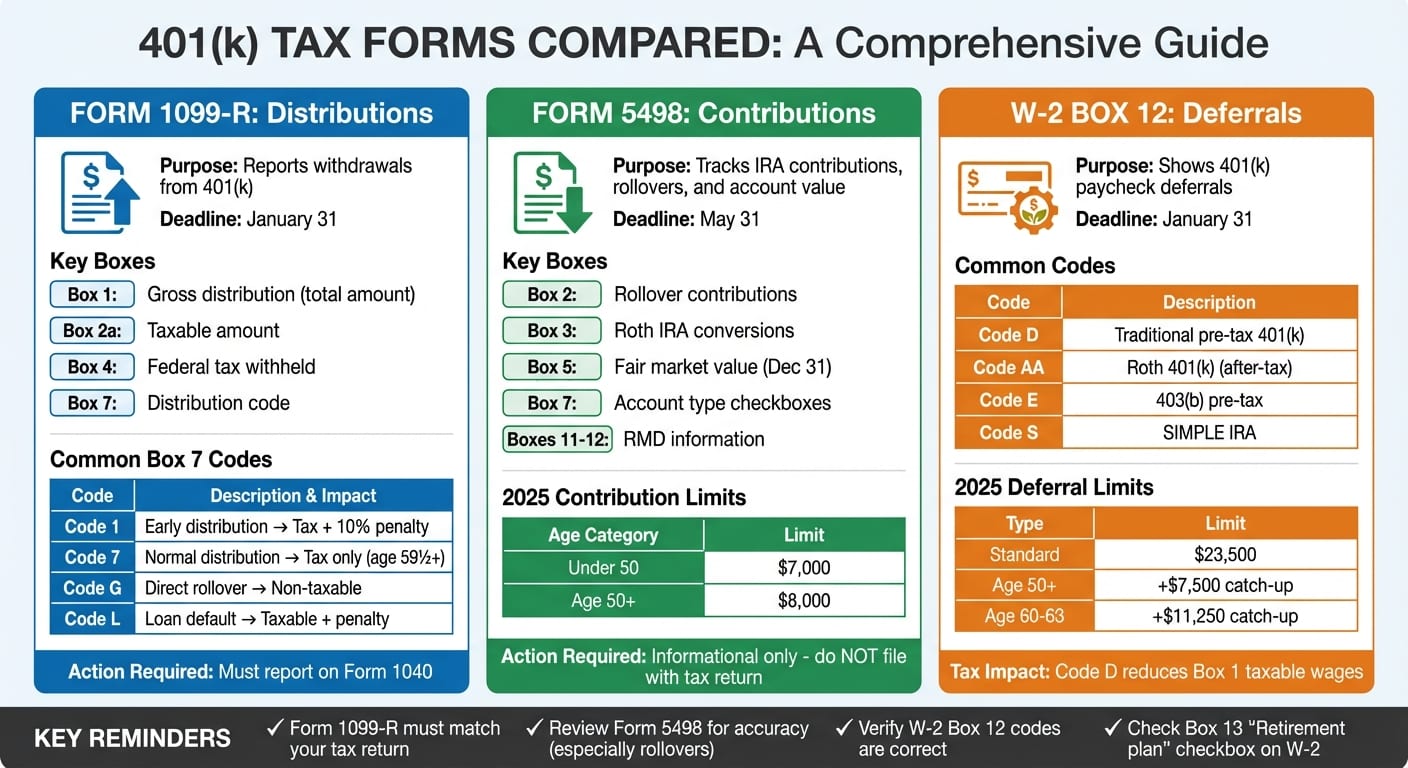
- Form 1099-R: Reports withdrawals from your 401(k). Key details include the total distribution amount (Box 1), taxable portion (Box 2a), and distribution type (Box 7 codes like "1" for early withdrawals or "G" for rollovers).
- Form 5498: Tracks IRA contributions, rollovers, and account value. It’s issued by May 31 and is for informational purposes only.
- W-2 Box 12: Shows your 401(k) paycheck deferrals. Common codes include "D" for pre-tax contributions and "AA" for Roth contributions.
Key reminders:
- Form 1099-R must match your tax return to avoid IRS issues.
- Review Form 5498 for accuracy, especially for rollovers and contributions.
- Ensure W-2 Box 12 codes are correct, as errors can impact deductions.
These forms help the IRS track your retirement account activity, ensuring taxes are properly applied to contributions and withdrawals. Double-check your forms for accuracy and consult your employer or plan administrator with any questions.
IRS Form 1099-R walkthrough (Distributions from Pensions, Retirement Accounts, Annuities, etc.)
Form 1099-R: Reporting 401k Distributions
Form 1099-R is sent out whenever you withdraw funds from your 401(k), whether it’s for a withdrawal, rollover, or loan default. Your plan administrator must provide this form by January 31 if the distribution is $10 or more. The IRS also gets a copy, so it’s important that the details on your tax return match the information on this form.
Key Boxes in Form 1099-R
- Box 1 (Gross distribution): This shows the total amount of your distribution. For instance, if you withdrew $25,000, the entire amount will be listed here, regardless of whether it’s taxable or rolled over.
- Box 2a (Taxable amount): This box reflects the portion of the distribution subject to federal income tax. If your 401(k) is funded entirely with pre-tax contributions, the taxable amount in Box 2a will typically match the gross distribution in Box 1. For direct rollovers to another qualified plan or IRA, Box 2a will show $0.
- Box 4 (Federal income tax withheld): Any tax withheld from your distribution is reported here. This amount is credited toward your overall tax liability when you file your Form 1040.
- Box 7 (Distribution code): This box uses specific codes to identify the type of distribution. For example, Code 1 indicates an early distribution with no known exception, subject to both income tax and a 10% early withdrawal penalty. Code 7 applies to normal distributions (usually for individuals over 59½), while Code G represents a direct rollover that is typically non-taxable. These codes play a big role in determining your tax liability.
How Form 1099-R Affects Your Taxes
The distribution code in Box 7 is key to understanding how your 401(k) withdrawal will impact your taxes. Here’s a breakdown of common codes and their tax implications:
Box 7 CodeMeaningTax Implication1Early distribution, no known exceptionSubject to income tax and a 10% penalty2Early distribution, exception appliesSubject to income tax only3DisabilityGenerally taxable; no 10% penalty4DeathTaxable to the beneficiary; no 10% penalty7Normal distributionTaxable; no penalty (if over age 59½)GDirect rolloverNon-taxable; no penaltyLLoans treated as distributionsTaxable as income; may include a penalty
When filing your taxes, you’ll need to report the gross distribution from Box 1 and the taxable amount from Box 2a in the "Pensions and annuities" section of Form 1040. If Box 4 shows any federal tax withheld, attach Copy B of Form 1099-R to your return. If Box 2b is checked, indicating "Taxable amount not determined", you may need to calculate the taxable portion yourself - especially if you’ve made after-tax contributions to your 401(k).
Review the form for accuracy and contact your plan administrator regarding any discrepancies. The IRS cross-references the details on their copy of Form 1099-R with the information you provide on your tax return, so accuracy is key.
Form 5498: Tracking 401k Contributions
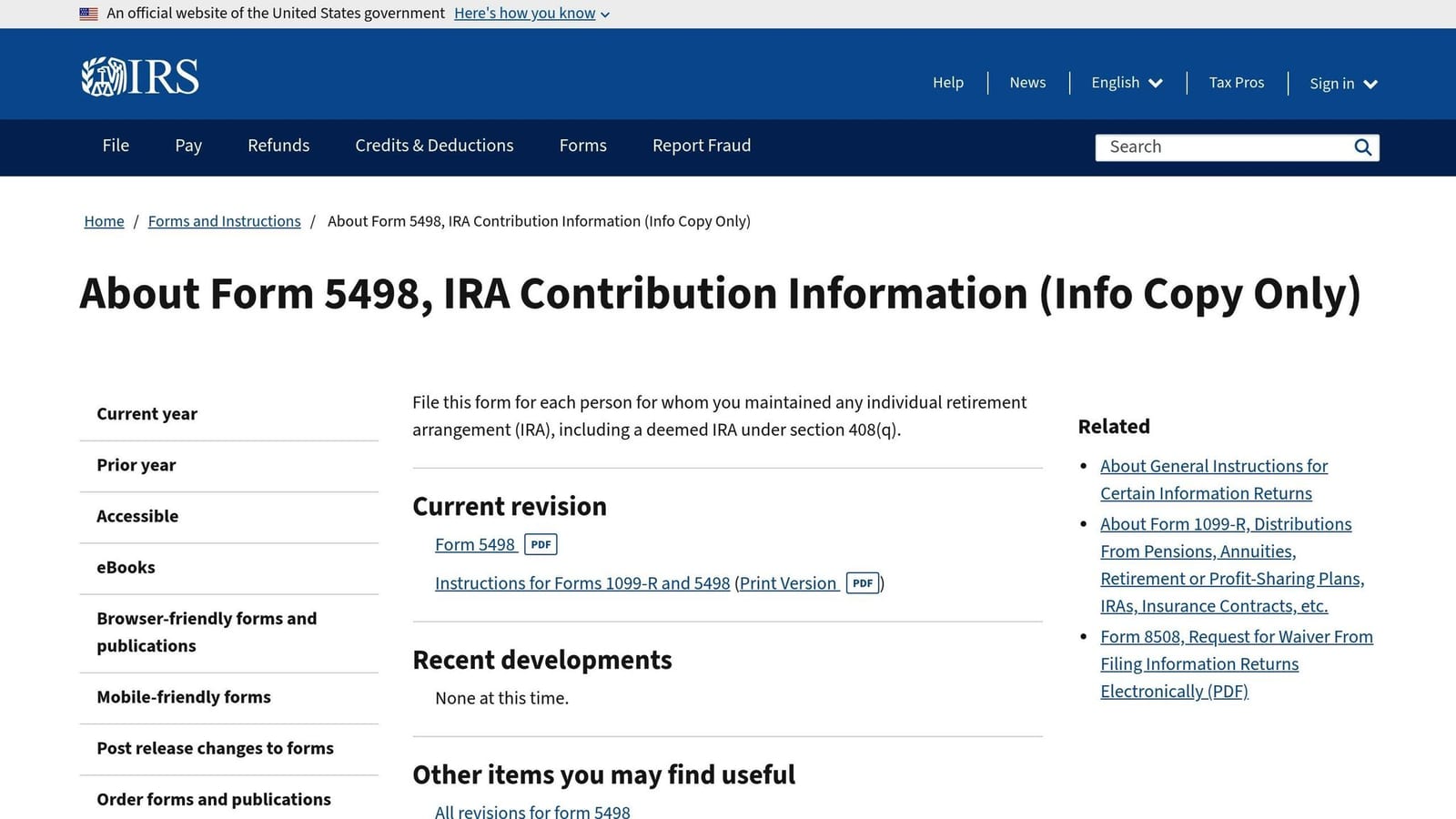
Once you’ve tackled how distributions affect your taxes, it’s equally important to understand how contributions are tracked. While Form 1099-R handles the reporting of distributions, Form 5498 focuses on contributions, rollovers, and the fair market value of your retirement accounts. This form is issued by your IRA custodian or trustee and plays a key role in tracking your retirement savings activity.
What Form 5498 Reports
Form 5498 captures several critical details about your retirement accounts:
- Box 2 (Rollover contributions): Records non-taxable transfers of funds from a 401(k) or another retirement plan into an IRA.
- Box 3 (Roth IRA conversion amount): Tracks taxable amounts converted from a traditional IRA or employer plan to a Roth IRA.
- Box 5 (Fair market value): Reflects the total value of your account as of December 31, which the IRS uses to calculate Required Minimum Distributions (RMDs).
- Box 7 checkboxes: Indicate the type of account (Traditional, Roth, SEP, or SIMPLE).
- Boxes 11, 12a, and 12b: Provide details about RMDs, including whether you’re required to take one and the associated deadline.
For the 2025 tax year, the IRA contribution limit is set at $7,000 for individuals under 50 and $8,000 for those 50 or older.
When You Receive Form 5498 and How to Use It
Form 5498 is sent to both you and the IRS by May 31 each year. This later deadline aligns with the extended timeline for IRA contributions - taxpayers can make contributions for the previous year up until the April 15 tax deadline.
Here’s a key point: Form 5498 is for informational purposes only. You don’t need to file it with your tax return. As Fidelity explains:
"Form 5498 is informational - again, you don't need to file it with your tax return - but it may help guide your future distribution decisions".
That said, it’s important to review the form closely. Compare the contributions listed on Form 5498 with the deductions you claimed on your tax return. If there’s a mismatch - like claiming more deductions than the form reports - you could face IRS inquiries.
If you’ve rolled over a 401(k) into an IRA, double-check that Box 2 aligns with your records. Keep Form 5498 on hand for tracking your cost basis and for future tax planning, especially if you’re making Roth conversions or non-deductible contributions. This can help you track your basis and avoid potential reporting issues on withdrawals.
Should you notice any errors on the form, contact your financial institution immediately to request an amended version. Note that corrections may not be permitted for prior years once the filing window closes.
W-2 Box 12: Understanding 401k Deferrals
Your W-2 Box 12 is where your employer reports details about your 401(k) deferrals. This section uses specific letter codes to inform the IRS about different types of compensation and elective deferrals. Box 12 can accommodate up to four codes (12a through 12d), and if more reporting is required, your employer will issue an additional W-2.
Common 401k Codes in Box 12
The most frequently seen codes for 401(k) contributions are Code D and Code AA. Here's what they represent:
- Code D: Used for elective deferrals to a traditional pre-tax 401(k) plan, including SIMPLE 401(k) arrangements.
- Code AA: Indicates Roth 401(k) contributions, which are made with after-tax dollars.
For 2025, the limit for elective deferrals is $23,500, with additional catch-up contributions allowed: $7,500 for those aged 50 and older, and up to $11,250 for individuals aged 60–63 (if applicable).
To help clarify, here’s a table of common retirement-related codes:
Box 12 CodePlan TypeContribution TypeD401(k)Traditional Pre-tax Elective DeferralAA401(k)Designated Roth (Post-tax)E403(b)Traditional Pre-tax Elective DeferralBB403(b)Designated Roth (Post-tax)G457(b)Elective and Employer (Nonelective) DeferralsSSIMPLE IRAEmployee Salary Reduction Contributions
A common mistake employers make is using Code S for SIMPLE 401(k) plans instead of the correct Code D. If you notice this error on your W-2, reach out to your employer's payroll department to request a corrected form.
How 401k Deferrals Reduce Taxable Wages
One of the biggest advantages of contributing to a traditional 401(k) is the reduction in your taxable income for the year. When you make contributions under Code D, the amount is subtracted from your taxable wages, which are reported in Box 1 (Wages, tips, other compensation).
For instance, if you earn $10,000 per month and defer $1,000 into your 401(k), Box 1 will show $9,000 as taxable income. However, the full $10,000 will still be reported in Box 3 (Social Security wages) and Box 5 (Medicare wages). This is because 401(k) deferrals don’t reduce your FICA tax liability. Social Security tax is withheld at 6.2% up to a wage base limit of $176,100 for 2025, while Medicare tax is 1.45% on all wages, with no cap.
On the other hand, Roth 401(k) contributions under Code AA are made with after-tax dollars. These contributions don’t reduce your taxable wages in Box 1, but they allow for tax-free withdrawals during retirement. Also, ensure that the "Retirement plan" checkbox in Box 13 is marked if you contributed to a 401(k). This checkbox informs the IRS that your eligibility to deduct traditional IRA contributions may be limited based on your income.
Lastly, remember not to deduct your 401(k) contributions again on Form 1040 - they’re already excluded from your taxable wages.
Using These Forms for Tax Filing and Planning
How to Report These Forms on Your Tax Return
Each tax form serves a specific purpose when filing your federal tax return. For example, W-2 Box 1 reflects reduced taxable wages, so you shouldn’t re-deduct these contributions on Form 1040. The IRS already tracks these contributions through Code D in Box 12.
If you’ve taken a distribution from your 401(k), you’ll need to report the amounts from Form 1099-R on Form 1040 to determine your taxable income. Pay attention to Box 7 on Form 1099-R - it specifies whether the distribution is a regular one, an early withdrawal subject to penalties, or a tax-free rollover.
Form 5498, which reports IRA contributions, often arrives later - by May 31st - because you can contribute to an IRA up until the April tax deadline. If you file before receiving Form 5498, use it later to verify the contributions you reported. For 2025, you can deduct up to $7,000 in traditional IRA contributions (or $8,000 if you’re 50 or older). Be sure to check your W-2 Box 13 status to confirm eligibility for traditional IRA deductions.
Common Mistakes to Avoid
One frequent mistake involves incorrect Box 12 codes. A study by the Employee Plan Compliance Unit (EPCU) revealed that only 6% of employers using Code H in Box 12 applied it to the correct plan type, underscoring how often coding errors occur.
Double-check that your employer used Code D for your 401(k) contributions and not Code S, which applies to SIMPLE IRAs. If you notice an error, contact your payroll department immediately to get a corrected W-2. Also, compare your IRA contributions on Form 5498 with what you reported on your tax return. Any discrepancies might require filing an amended return.
Using technology can help you sidestep these issues and simplify your tax planning process.
How Mezzi Helps with Retirement Tax Planning

Mezzi makes retirement tax planning easier by automating account aggregation and flagging inconsistencies. The platform consolidates your retirement account data, making it simpler to track contributions and adjust your tax strategy for multiple 401(k)s and IRAs.
With its AI-driven insights, Mezzi can identify potential problems - like nearing contribution limits or overlooking deduction opportunities - before you file your tax return. Advanced tax tools help you avoid expensive errors, while real-time alerts and unlimited AI chat support (available through the Mezzi Membership starting at $39/month or $399/year) provide tailored advice based on your specific tax forms and financial needs. This provides tools for information and decision support during tax season.
Conclusion
Summary of Key Points
Understanding Form 1099-R, Form 5498, and W-2 Box 12 is important for tax compliance and retirement planning. These forms work together to show your retirement account activity - like distributions, contributions, and paycheck deferrals. Pay special attention to the "Retirement plan" checkbox in Box 13 of your W-2. If it's checked, it means you're an active participant in a retirement plan, which could limit your ability to deduct contributions to a traditional IRA based on your modified adjusted gross income. Accurate reporting of these forms is necessary for proper tax filing and retirement account monitoring.
Next Steps for Tax Optimization
Now that you understand the basics, take time to review your tax forms before filing. Double-check that your employer used the correct Box 12 codes and that Form 1099-R’s Box 7 codes align with your transaction type. If anything looks off, request a corrected form to avoid the hassle of amending your return later on.
Mezzi’s platform simplifies managing your retirement accounts by consolidating everything into one view. This helps consolidate account information for tracking contributions and monitoring annual limits. Concierge, with real-time AI prompts and unlimited AI chat support included in the Advisory ($39/month or $399/year), you can receive information regarding how these forms may affect your taxes. The platform provides tools to identify potential tax issues, such as wash sales, across accounts.
FAQs
How do I know if my 1099-R rollover is taxable?
To figure out whether your 1099-R rollover is taxable, start by checking if it was a qualified rollover. A qualified rollover typically involves a direct transfer of funds from one qualified plan or IRA to another, without you taking control of the money. These rollovers are usually not subject to taxes.
On the other hand, if the rollover wasn’t handled correctly or if the distribution was treated as income, it could be taxable. Carefully review the information on your 1099-R to make sure everything aligns with the rules for rollovers.
What should I do if my 1099-R Box 2a says $0?
If Box 2a on your 1099-R shows $0, it indicates that no taxable distribution was reported for that year. In most cases, this means you likely don’t owe taxes on the distribution. However, your overall tax situation might affect this, so it’s a good idea to review your tax documents carefully or consult a tax professional to be certain.
Why doesn’t my 401(k) contribution lower my Social Security wages on my W-2?
Your 401(k) contributions won’t reduce your Social Security wages because they’re still subject to FICA taxes. These taxes are what fund Social Security and Medicare. While your 401(k) contributions lower your taxable wages for federal income tax purposes (reported in Box 1), your Social Security (Box 3) and Medicare (Box 5) wages are calculated based on your total earnings before any 401(k) deductions. In short, FICA taxes apply to your full gross earnings, not the reduced amount after contributions.
Mezzi is free to get started. Choose Advisory for unlimited advice and advanced features at $39/month or $399/year. Concierge includes the same, plus hands-on support, at $99/month or $999/year.