
Asset-based mortgages focus on your financial assets instead of your income, making them an option for retirees, entrepreneurs, and high-net-worth individuals who may not qualify for income-based loans. Here's the key idea:
- Lenders calculate eligibility by dividing liquid assets (like cash, stocks, or retirement accounts) by a set number of months (e.g., 360).
- Assets are valued differently: cash at 100%, stocks at 70%-80%, and retirement accounts at 70%.
- These loans often require a 20%-30% down payment and may have interest rates 0.5%-1.5% higher than conventional loans.
While this approach avoids income verification and preserves investments, it comes with risks like higher costs and potential asset depletion. Platforms like Mezzi simplify the process by aggregating your financial data, helping you evaluate if this option aligns with your goals.
Asset Backed Mortgage | Buy a House Without A Job
How Asset-Based Mortgages Work
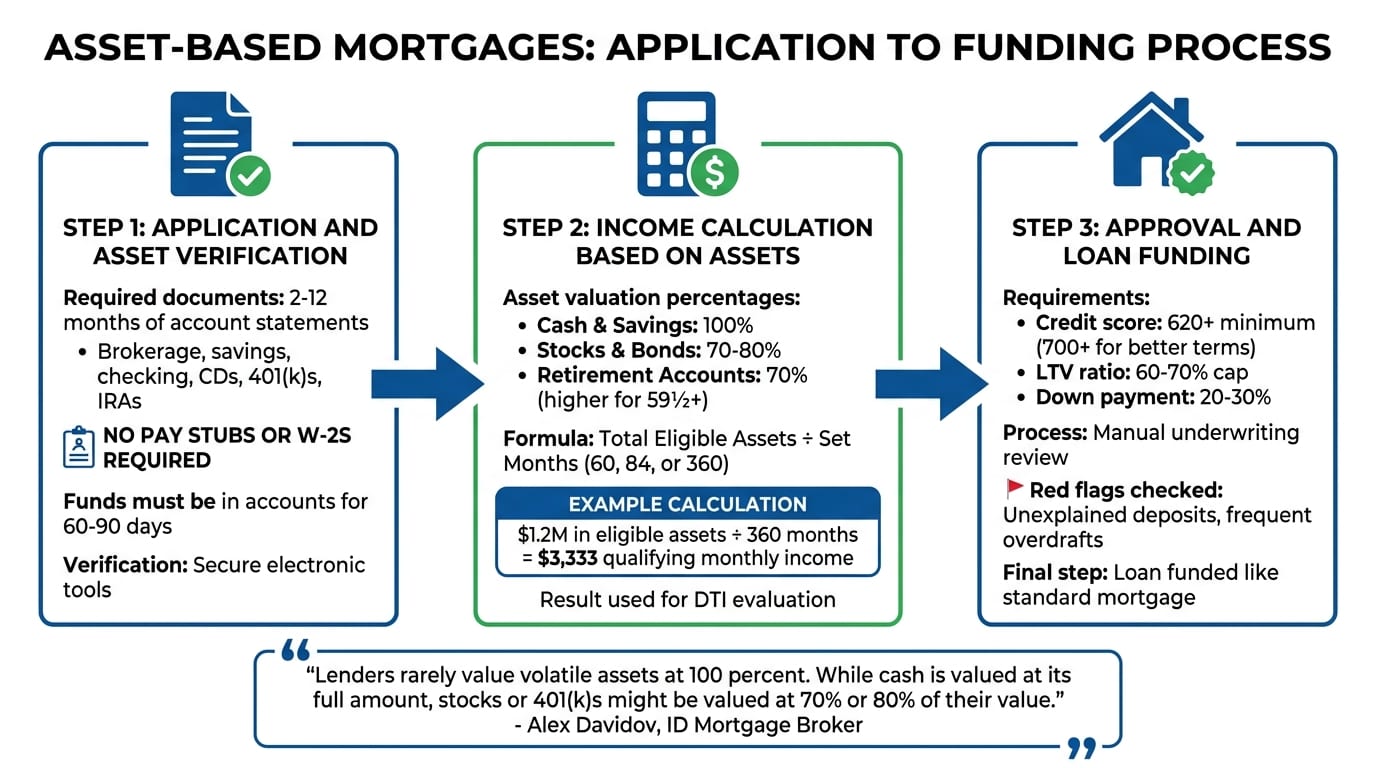
Asset-based mortgages take a different approach to home financing by focusing on your financial assets rather than your income. Instead of relying on pay stubs or W-2s, lenders evaluate your overall financial picture. Here's a breakdown of how the process works, from application to funding.
Step 1: Application and Asset Verification
When applying for an asset-based mortgage, you'll need to provide statements from your liquid and semi-liquid accounts covering two to twelve months. These accounts might include brokerage accounts, savings, checking, certificates of deposit, and retirement funds like 401(k)s or IRAs. Unlike traditional loans, pay stubs or W-2s aren't required. Instead, lenders use secure electronic tools to verify your accounts, reducing paperwork and the risk of fraud.
Lenders typically want to see that your funds have been in your accounts for at least 60 to 90 days before applying. Large, recent transfers could raise questions and delay the process, so it's a good idea to download official PDF statements directly from your bank rather than relying on screenshots or exported files.
Once your assets are verified, lenders convert them into a monthly income figure that determines your eligibility.
Step 2: Income Calculation Based on Assets
Rather than using traditional income, lenders calculate a "qualifying monthly income" by applying percentage adjustments to your assets based on their stability. For example:
- Cash and savings are usually valued at 100%.
- Stocks, bonds, and similar assets might be valued at 70% to 80%.
- Retirement accounts, especially for borrowers under 59½, are discounted further.
After these adjustments, the total eligible assets are divided by a set number of months - commonly 60, 84, or 360. This calculation determines the monthly income figure used in debt-to-income (DTI) evaluations. For instance, $1.2 million in eligible assets divided by 360 months would result in approximately $3,333 in qualifying monthly income.
"Lenders rarely value volatile assets at 100 percent. While cash is valued at its full amount, stocks or 401(k)s might be valued at 70% or 80% of their value. This protects the lender against a sudden market drop."
– Alex Davidov, Loan Officer, ID Mortgage Broker
This calculated income is then used to assess whether your debt-to-income ratio meets the lender's requirements.
Step 3: Approval and Loan Funding
Once your qualifying monthly income is determined, lenders evaluate your debt-to-income ratio and credit score. Most lenders look for a credit score of at least 620, though higher scores (700 and above) often lead to better terms. Additionally, loan-to-value (LTV) ratios are typically capped at 60% to 70%, meaning you'll need a down payment of 20% to 30% of the property's value.
Asset-based loans involve manual underwriting, where underwriters thoroughly review your financial documents. They check for potential red flags, such as unexplained deposits or frequent overdrafts. If everything is in order, the loan is funded in much the same way as a standard mortgage.
Which Assets Qualify for Asset-Based Mortgages
When applying for an asset-based mortgage, knowing which assets qualify and how they are valued can make a big difference. Lenders group assets into specific categories and assign valuation percentages to each, which affects how much of your portfolio can be used to qualify for a loan. This knowledge can help you decide which accounts to leverage and give you a clearer idea of the loan amount you may qualify for.
Liquid Assets
Cash and cash-equivalent accounts are the gold standard for asset-based mortgage qualification. These include checking accounts, savings accounts, money market accounts, and certificates of deposit (CDs). Lenders value these at 100% of their balance because they are low-risk and can be accessed immediately. Keeping consistent activity in these accounts can help avoid extra scrutiny from lenders.
Investment Accounts
Investment accounts such as stocks, bonds, mutual funds, ETFs, and REITs are valued at 70% to 80% of their current market value. This discount reflects the potential for market fluctuations. For instance, a $1 million diversified stock portfolio might be counted as $700,000 to $800,000 for qualification purposes. The exact percentage depends on the lender's evaluation of your portfolio's risk and composition.
Retirement Accounts and Other Qualified Assets
Retirement accounts like 401(k)s and IRAs are also considered, but with specific rules. Typically, these are valued at 70% of their balance. However, for borrowers aged 59½ or older, some lenders may increase this valuation to 80% or more since these funds can be withdrawn without penalties. Other assets, such as trust funds, annuities, and the cash value of life insurance, are usually valued around 70%. On the other hand, non-vested stock options, private business holdings, and real estate equity are generally excluded from consideration.
Pros and Cons of Asset-Based Mortgages
Benefits
Asset-based mortgages provide a level of income flexibility that traditional loans typically don't. Instead of relying on W‑2s, pay stubs, or tax returns, these loans allow borrowers to qualify based on their net worth. This makes them particularly appealing for retirees, freelancers, and entrepreneurs who may not have a steady paycheck but hold substantial assets.
Another key advantage is the ability to maintain control over your investments. Borrowers aren't required to liquidate their portfolios, which helps avoid triggering capital gains taxes. For high-net-worth individuals, this approach often opens the door to larger loan amounts than conventional debt-to-income ratios would permit. Business owners who strategically draw lower salaries for tax purposes may also find this option beneficial.
On the practical side, the documentation process is simpler. Many lenders skip employment verification, relying instead on recent bank and brokerage statements. This streamlined process can save time and reduce paperwork headaches.
Drawbacks
However, these benefits come at a price. Interest rates for asset-based mortgages are typically 0.5%–1.5% higher than those for conventional loans. Lenders justify this premium by considering these loans riskier. As Alex Davidov, a loan officer at ID Mortgage Broker, explains:
"Think of the extra interest as the cost of bypassing the headache of two years of tax returns and a mountain of business paperwork." – Alex Davidov, Loan Officer, ID Mortgage Broker
Another downside is the higher down payment requirement. While traditional loans may only require 3%–5% down, asset-based mortgages often demand 25%–30%. Additionally, lenders apply "haircuts" to certain assets, such as stocks and retirement accounts, valuing them at only 70%–80% of their market worth.
The biggest risk lies in asset depletion. Texas Capital Bank warns of the dangers of pledging revenue-generating assets as collateral:
"If you put up an important revenue‐producing asset as collateral, failing to pay back the loan could result in the loss of that critical asset. This is the greatest risk in this type of financing." – Texas Capital Bank
This means that failing to repay the loan could jeopardize key income-producing assets. Additionally, strict credit requirements and the unpredictable nature of financial markets add another layer of risk to this type of financing.
When Asset-Based Mortgages Make Sense
Asset-based mortgages offer a way to tap into the value of your assets, making them an appealing option for retirees and entrepreneurs who may not have a steady, traditional income stream. These loans are most effective when your financial stability is better represented by your assets rather than your reported income.
Retirees with Large Asset Portfolios
Retirees with significant assets can use asset-based mortgages to transform their wealth into qualifying income. Traditional lenders often focus on monthly income, which can disadvantage retirees with limited retirement income despite substantial wealth.
Asset-based mortgages solve this issue by treating liquid assets as income. For example, in February 2025, Truss Financial Group demonstrated how a borrower with $1 million in liquid assets could qualify for a mortgage. By dividing this amount over 360 months, the borrower’s qualifying monthly income was calculated as $2,777. Lenders usually assign different values to assets: cash is valued at 100%, stocks and bonds at approximately 80%, and retirement accounts at 70–80% for individuals over 59½. This approach enables retirees to secure financing without selling investments or triggering capital gains taxes.
Entrepreneurs can also benefit from this method when traditional income qualifications fall short.
Entrepreneurs and Investors with Variable Income
For those with irregular income but substantial assets, asset-based mortgages offer a practical alternative to conventional home loans. You might operate a successful consulting business or own rental properties, yet your tax returns may show limited income due to tax-saving strategies. While these strategies are excellent for high-net-worth investing, they can make you appear less qualified to traditional mortgage lenders.
"This is a no-doc loan alternative where your liquidity, your stocks, bonds, and savings, act as the primary qualifier for your loan." – Alex Davidov, Loan Officer, ID Mortgage Broker
With asset-based mortgages, your savings, brokerage accounts, and other liquid assets take center stage, rather than your lower adjusted gross income. This is especially helpful for consultants, freelancers, and real estate professionals whose income might fluctuate seasonally. By relying on your cash reserves instead of artificially inflating your salary, you can still secure the financing you need.
How Mezzi Helps You Evaluate Asset-Based Mortgages
Deciding whether an asset-based mortgage is the right choice involves carefully assessing your financial situation. Mezzi equips you with tools and insights to evaluate this option as part of your wealth management strategy - all without the traditional 1% AUM fee charged by many financial advisors.
Complete Asset Visibility Through Account Aggregation
Asset-based mortgages hinge on one key factor: verified liquid assets. Lenders need a full view of your financial assets - checking accounts, savings, CDs, brokerage accounts, and retirement funds - to calculate your qualifying income. Mezzi simplifies this process by connecting your accounts through secure read-only access via Plaid and Finicity, giving you a consolidated view of your net worth.
This aggregation is critical for asset-based mortgage applications. With Mezzi's continuous monitoring, you can track your account balances over time, ensuring funds remain stable and avoiding potential issues from large interbank transfers. The platform also generates detailed reports of your asset holdings, meeting lender documentation requirements without the hassle of manually collecting statements.
Mezzi helps you understand how lenders assess your assets. For example, cash and CDs are valued at 100% of their face value, while stocks and bonds are typically discounted to 70%-80%. By seeing all your accounts in one place, you can estimate your realistic qualifying income before applying.
This comprehensive asset overview ties directly into portfolio optimization, where Mezzi's X-Ray tool becomes invaluable.
Portfolio X-Ray and Overlap Analysis
After your assets are aggregated, understanding their performance and composition is essential. Mezzi's X-Ray tool identifies overlapping positions in your portfolio - redundancies that may lead to unnecessary fees without improving diversification. Since lenders apply discounts to volatile assets (e.g., securities valued at 70%, compared to cash at 100%), analyzing your portfolio composition can help you maximize your borrowing capacity. For instance, holding identical stocks across multiple ETFs and individual accounts could mean you're paying duplicate fees for the same exposure - money that could be directed toward more stable assets like cash or CDs.
Mezzi also clarifies which assets qualify for mortgage consideration. Business holdings, non-vested stock options, and illiquid investments are often given a 0% valuation by lenders, while eligible assets typically count toward the $1 million minimum many asset-based mortgage programs require. This transparency helps you avoid surprises during the application process and ensures you're prepared with the right documentation.
Tax Optimization and Retirement Planning
Beyond asset analysis, Mezzi supports your broader financial strategy by addressing tax considerations and retirement planning. The platform offers guidance on tax-efficient withdrawal sequencing to help minimize tax liabilities, allowing you to maintain your portfolio's growth potential while securing mortgage financing.
Mezzi also helps you weigh the benefits of an asset-based mortgage against selling investments outright. Keeping your capital invested avoids triggering capital gains taxes and preserves your portfolio's growth. Additionally, Mezzi's retirement planning tools project how mortgage payments fit into your long-term financial picture, factoring in current portfolio values, contributions, withdrawals, and fees.
For retirees, an asset-based mortgage can be particularly useful in avoiding the need to sell investments during market downturns, which could exacerbate sequence of returns risk. Mezzi's AI models compare mortgage costs with potential tax savings and portfolio preservation benefits, helping you make informed decisions. You can ask specific questions and receive answers tailored to your actual financial data, rather than relying on generic calculators.
"The process of securing an asset utilization loan is more about math than it is about employment history." – Alex Davidov, Loan Officer, ID Mortgage Broker
Asset-based mortgages require a strong asset profile, and Mezzi simplifies the process by providing tools that highlight and enhance your financial strengths. With its calculations and strategic insights, Mezzi helps you determine whether this type of financing aligns with your wealth management goals.
Conclusion
Asset-based mortgages provide a financing option tailored to those whose financial strength lies in their assets rather than a steady paycheck. This can include retirees relying on investment income, entrepreneurs reinvesting in their businesses, or high-net-worth individuals with inconsistent cash flow. Instead of focusing on traditional income verification, these loans assess your assets, calculating qualifying income using established formulas. This approach opens doors for borrowers who might not meet the requirements of conventional mortgages.
That said, asset-based mortgages come with certain conditions: a down payment of 25%-30%, a credit score near 700, and typically higher interest rates due to their non-QM status. In return, borrowers can retain their investment portfolios, avoid triggering capital gains taxes from forced liquidations, and keep their assets growing. For those with over $1 million in liquid assets, the flexibility these loans offer may outweigh the added costs.
A crucial part of navigating these mortgages is understanding how lenders evaluate your assets. This requires a clear view of your financial picture - not just what you own, but how it will be assessed. Earlier sections of this guide delve into this process in greater detail.
Platforms like Mezzi simplify this evaluation by aggregating accounts, analyzing portfolios, and offering tax-related insights. Mezzi helps you decide whether an asset-based mortgage is a better fit than liquidating investments, offering tailored answers without the delays or fees of traditional advisory services. For borrowers with the right financial profile, tools like Mezzi can make the process more straightforward and align with broader financial strategies.
While asset-based mortgages aren't suitable for everyone, they can be a versatile option for those with substantial assets and non-traditional income streams. With careful planning and the right resources, this financing method could align with your overall financial objectives.
FAQs
How do I estimate my qualifying income from my assets?
To figure out your qualifying income for an asset-based mortgage, start by dividing your total liquid assets by 360 months, which reflects the standard 30-year mortgage term. Keep in mind that lenders typically account for 70-80% of your asset values, depending on the asset type.
Collect your financial statements, calculate the total of your eligible assets, and use this formula to estimate your monthly qualifying income. This approach allows lenders to assess your repayment capacity based on your assets rather than relying on conventional income sources.
Will I need to sell investments or withdraw retirement funds to qualify?
Whether selling investments or withdrawing retirement funds is necessary often hinges on your financial circumstances and the specific requirements set by your lender. Asset-based mortgages commonly assess eligibility based on liquid assets, such as investment portfolios or retirement accounts, without requiring you to liquidate them upfront. However, if your assets fall short of the lender's thresholds, you might need to explore selling investments or making withdrawals. It's a good idea to work with your lender or financial advisor to ensure any decisions align with your broader financial goals.
What happens if my portfolio drops after I apply?
If the value of your portfolio decreases after applying for an asset-based mortgage, it may affect your qualifying assets. These loans are assessed based on asset value rather than traditional income, so a decline in your portfolio could influence your ability to qualify for or retain the mortgage.
Disclosures:
- This content is for informational purposes only and does not constitute investment advice or a recommendation to buy or sell any security.
- Past performance is not indicative of future results. No guarantee of future performance or outcomes is implied.
- Savings and performance examples are hypothetical and for illustrative purposes only. Actual results will vary based on individual circumstances, portfolio composition, market conditions, and fees.
- Registration does not imply a certain level of skill or that the SEC has approved the company or its services.
Related Blog Posts
- Does high net worth include 401k?
- Who qualifies for physician mortgage loans?
- RBAC in Wealth Management: Cost vs. Benefits
- Private Money vs. Hard Money Loans for Real Estate
To figure out your qualifying income for an asset-based mortgage, start by dividing your total liquid assets by 360 months, which reflects the standard 30-year mortgage term. Keep in mind that lenders typically account for 70-80% of your asset values, depending on the asset type.
Collect your financial statements, calculate the total of your eligible assets, and use this formula to estimate your monthly qualifying income. This approach allows lenders to assess your repayment capacity based on your assets rather than relying on conventional income sources.
Whether selling investments or withdrawing retirement funds is necessary often hinges on your financial circumstances and the specific requirements set by your lender. Asset-based mortgages commonly assess eligibility based on liquid assets, such as investment portfolios or retirement accounts, without requiring you to liquidate them upfront. However, if your assets fall short of the lender's thresholds, you might need to explore selling investments or making withdrawals. It's a good idea to work with your lender or financial advisor to ensure any decisions align with your broader financial goals.
If the value of your portfolio decreases after applying for an asset-based mortgage, it may affect your qualifying assets. These loans are assessed based on asset value rather than traditional income, so a decline in your portfolio could influence your ability to qualify for or retain the mortgage.