
If you rent out a personal residence for 14 days or fewer in a calendar year, that rental income may be excluded from federal income tax. That’s the core idea behind the Augusta Rule under IRC Section 280A(g).
Here’s the short version:
- 14 days or fewer: rental income may stay off your federal return
- 15 days or more: normal rental tax rules may apply
- Fair-market rent matters: made-up pricing may draw scrutiny
- Your home must qualify as a personal residence
- A separate business entity may be needed for rent paid by your own business
- Records may make or break the setup, especially for related-party rentals
- State taxes may differ, so federal treatment may not match your state return
This rule often gets attention from homeowners near high-demand events and from business owners who may rent their home to an S corp, C corp, or partnership for meetings. But the setup may fall apart fast if the rent is too high, the day count hits 15, or the paperwork is weak.
One court case shows the risk. In Sinopoli v. Commissioner (2023), taxpayers claimed about $291,000 of home-rental payments over three years, and the court allowed only $500 per documented meeting while disallowing undocumented amounts.
How to Make $50K Tax-Free Renting Your Home (Augusta Rule Explained)
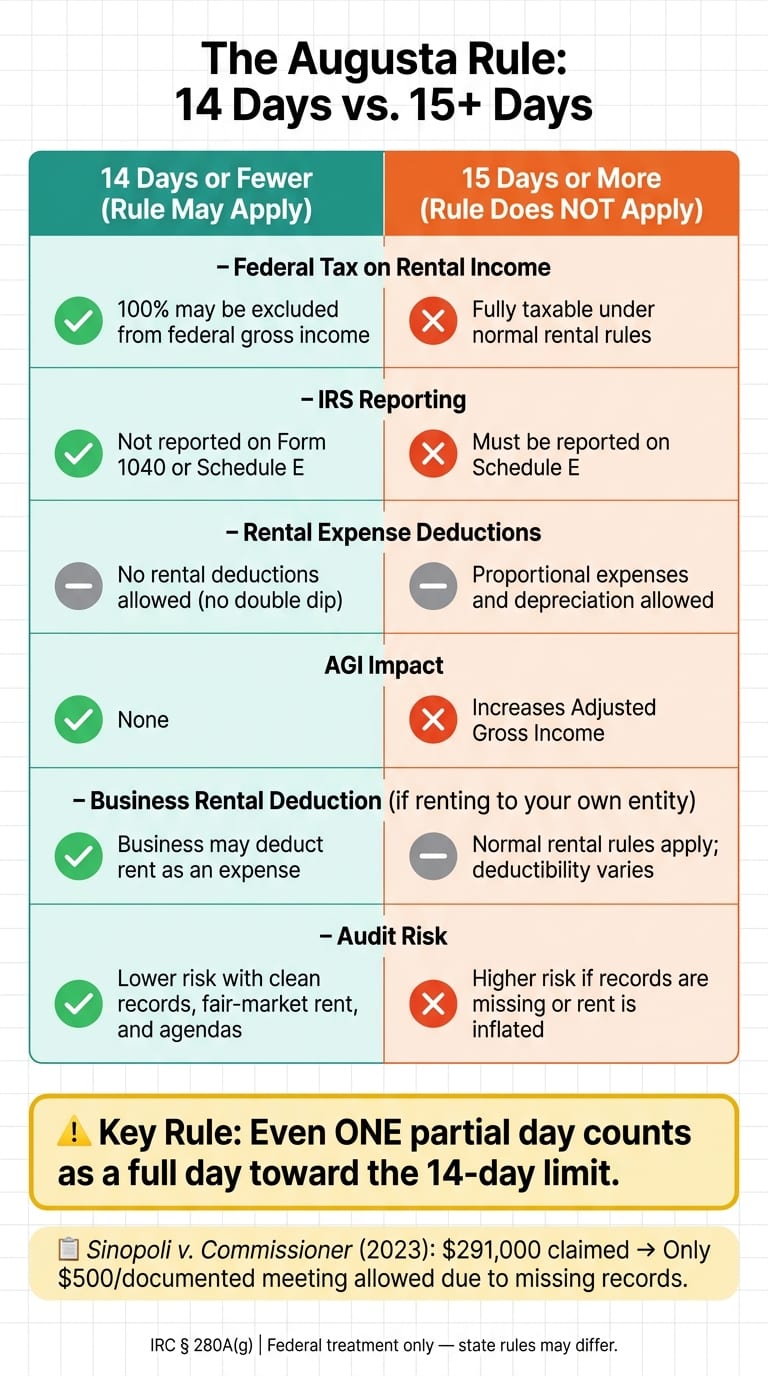
Quick Comparison
In other words: the Augusta Rule may be simple on paper, but using it well may depend on day limits, entity structure, market pricing, and clean documentation.
How the Augusta Rule Works Under IRS Section 280A(g)
The rule takes its name from Augusta, Georgia, where it became well known during Masters week.
IRC Section 280A(g) says that if a dwelling unit is used as a personal residence and rented for 14 days or fewer during a calendar year, the owner may exclude all rental income from gross income. In plain English: if you rent a personal residence for 14 days or fewer in a year, that income may be left out of federal gross income, and it may not need to be reported on Schedule E. From there, the key issue becomes whether the property counts as a qualifying residence.
The 14-Day Rule and the Tax-Free Income Benefit
The 14-day limit is a hard statutory cutoff. Once a home is rented for 15 days or more in a calendar year, the Section 280A(g) exclusion may no longer apply, and the rental income may become reportable on Schedule E.
There’s a tradeoff here. If the rental income is excluded under the 14-day limit, rental-related expenses for those days also may not be deducted. No double dip.
One small detail that may matter a lot: any day the home is rented, even part of a day, counts as a full day toward the 14-day limit.
Personal Residence vs. Rental or Investment Property
The day count is only part of the story. The property also has to qualify as a personal residence. The rule applies only to a dwelling unit used as a personal residence.
A property may meet the personal-use test if the owner stays in it for more than 14 days a year, or more than 10% of the total days it is rented out, whichever is greater.
That means a property held only as a rental may not qualify, even if it is rented for fewer than 14 days. And a home held in an LLC or another entity generally may not qualify either.
Next, the practical eligibility rules and common use cases show when the rule may apply in day-to-day situations.
Eligibility Rules, Examples, and Common Use Cases
Basic Eligibility Requirements
Once the rule is on the table, the next step is figuring out whether your home and rental setup may qualify. Three tests matter: the home must be a personal residence under the IRS test, total rental use must stay at 14 days or fewer, and the rent must be at fair-market value.
If those tests are met, the rent may be excluded from federal income. You generally may not deduct rental-related expenses tied to those days, such as cleaning, utilities, or maintenance, although standard itemized deductions like mortgage interest and property taxes may still apply.
Renting During Local Events or Peak-Demand Dates
One simple use case involves renting your home during a local event that creates a short burst of demand. Homes near Augusta National Golf Club during the Masters Tournament may command $5,000 to $15,000 per night, and that income may remain tax-free if you stay within the 14-day limit. The same setup may apply to other peak-demand dates, such as bowl games, the Super Bowl, graduations, and festivals.
The main point is pretty plain: you need support for the rate. That may include comparable local quotes or listings, with pricing that lines up with what the market may support.
That same fair-market rule may apply when you rent to your own business, but the paperwork may face more scrutiny.
Renting Your Home to Your Own Business for Meetings
This use case tends to get the most attention. When a homeowner rents a home to a business they also own, the arrangement may be treated as a related-party transaction.
For the strategy to work, the business must be a separate legal entity: an S corp, C corp, partnership, or multi-member LLC. Sole proprietors and single-member LLCs taxed as disregarded entities generally may not qualify because the owner and the business are treated as the same taxpayer.
Even with the right structure, execution still matters. In Sinopoli v. Commissioner (T.C. Memo. 2023-105, August 2023), the Tax Court disallowed nearly the entire deduction claimed by three S corp shareholders who paid themselves roughly $291,000 over three years to rent their homes for monthly meetings - reducing it to $500 per substantiated meeting and $0 for meetings with no documentation - because they had no agendas, no meeting minutes, no attendee lists, and no comparable venue data to support the rate.
A cleaner example shows what tighter records may look like. A business owner hosted a two-day strategic planning retreat at his home, pulled written quotes from local hotels and event spaces, set his rate below the median of those comps at $2,000/day, and documented each step. The result was $4,000 in tax-free income and a matching $4,000 business deduction, with a paper trail behind every dollar.
Documentation, Tax Reporting, and Key Risk Areas
Records to Keep to Support the Tax Treatment
Once the home and entity qualify, the next step may be proving the setup with clean records. This rule may depend heavily on contemporaneous records, not paperwork pulled together months later.
Have a signed rental agreement between you and the business entity in place before the first rental day. Keep a running calendar that logs rental days, personal use days, and maintenance days. Track maintenance days on their own.
For business rentals, keep a file for each rental day with:
- the meeting agenda
- formal minutes or notes
- an attendee list
- proof of payment by business check or ACH transfer
A memo that references "Section 280A(g) rental" may help support the record at the time of payment. Avoid cash. Save contemporaneous screenshots or printouts of at least three local market comps.
How Reporting Works on the Personal and Business Side
With the paper trail in place, the next piece may be getting the federal reporting right. If the home is rented for 14 days or fewer, the rental income may be excluded from gross income under IRC § 280A(g). You also may not deduct rental-related expenses for those days. If a 1099 is issued, keep it with your records and report the exclusion in a consistent way.
On the business side, the rent may be treated as a deductible business expense. This setup may work best when a separate business entity pays the rent. State tax treatment may differ from the federal rule. States such as California, New Jersey, and Pennsylvania may not conform to the federal exclusion, so the income may still be taxable at the state level.
The Mistakes Most Likely to Cause Problems
These records matter because the IRS may focus on day counts, rental rates, and related-party deals. The biggest mistake may be crossing the 14-day line. Inflated rates and missing records may be the most common problems.
Another trap involves home office overlap. If the same space is already claimed as a home office, renting that exact area may create issues. Some people who use this setup specify common areas, such as the living room or dining room, in the rental agreement.
The final question may be whether this rule fits into a broader tax strategy.
When the Augusta Rule Fits Into a Broader Tax Strategy
Who Is Most Likely to Benefit
Once the eligibility rules are clear, the next step is figuring out whether the tax savings may be worth the paperwork. In plain English: does the upside look large enough to justify the recordkeeping? That tradeoff often makes more sense when you look at it in the context of your full tax picture.
Business owners with a qualifying separate entity - an S-corp, C-corp, or partnership - may be the most likely candidates. That may be especially true for those in higher marginal brackets, where the business deduction may carry more weight. For many households, though, the rule may be less appealing if the tax savings look modest next to the compliance work, or if the rental setup may be tough to support with records.
How Mezzi Can Help You Evaluate the Opportunity
Mezzi may help you test whether this strategy fits your income, entity structure, and current deductions. Mezzi aggregates your accounts in read-only mode and flags tax-planning opportunities. If you're running an S-corp and making regular payments between your business and personal accounts, Mezzi may help you spot patterns that may be worth discussing with your CPA - so your CPA may start with a clearer picture.
Mezzi is an SEC-registered fiduciary. It doesn't prepare tax returns or execute transactions, but it may help you ask the right questions before you sit down with your tax advisor.
Conclusion: Key Points Before You Use the Rule
IRC § 280A(g) is a real, legitimate provision - but it's narrow. Weak records and inflated rent may cause the strategy to fail entirely, as the Sinopoli v. Commissioner case (T.C. Memo. 2023-105) makes clear. The rule applies only when there is a qualifying residence, a separate entity, fair-market rent, and clean records. Some taxpayers may choose to validate the strategy with a tax advisor before using it.
FAQs
What is fair-market rent?
Fair-market rent refers to the amount a third party may pay for a similar space in your area, based on factors like size, condition, furnishings, location, and intended use.
To back that up, it may make sense to keep quotes or rate screenshots for comparable local hotel conference rooms, coworking spaces, or event-ready rentals. Using a rate at or below the documented average may reduce the chance of IRS scrutiny.
Does a partial rental day count as a full day?
Yes. Under §280A(g), a partial rental day still counts as one full rental day.
If you have more than one business use on the same day, that day would typically count as just one rental day. It may make sense to track dates with care so you do not go over the 14-day limit, since exceeding it may cause you to lose the exclusion for the entire year.
Can I use the Augusta Rule with my S corp?
Yes. Because your S corp may be treated as a separate taxpayer, it may rent your home for legitimate business meetings. In that setup, the rent may be deductible to the business while excluded from your personal federal tax return.
To keep that tax treatment, use a fair market rate, document the business purpose, and stay within the 14-day annual limit.Disclosures:
- This content is for informational purposes only and does not constitute investment advice or a recommendation to buy or sell any security.
- State tax treatment may differ from federal rules. Consult a qualified tax professional for advice specific to your situation.
Related Blog Posts
- Tax Implications of Short-Term vs. Long-Term Rentals
- Short-Term Rental ROI: Tax Benefits and Risks
- Short-Term Rental Taxes: What Hosts Must Know
- Short-Term Rental Tax Strategy: Airbnb, VRBO, and Schedule C vs. E
Fair-market rent refers to the amount a third party may pay for a similar space in your area, based on factors like size, condition, furnishings, location, and intended use.
To back that up, it may make sense to keep quotes or rate screenshots for comparable local hotel conference rooms, coworking spaces, or event-ready rentals. Using a rate at or below the documented average may reduce the chance of IRS scrutiny.
Yes. Under §280A(g), a partial rental day still counts as one full rental day.
If you have more than one business use on the same day, that day would typically count as just one rental day. It may make sense to track dates with care so you do not go over the 14-day limit, since exceeding it may cause you to lose the exclusion for the entire year.
Yes. Because your S corp may be treated as a separate taxpayer, it may rent your home for legitimate business meetings. In that setup, the rent may be deductible to the business while excluded from your personal federal tax return.
To keep that tax treatment, use a fair market rate, document the business purpose, and stay within the 14-day annual limit.Disclosures:
- This content is for informational purposes only and does not constitute investment advice or a recommendation to buy or sell any security.
- State tax treatment may differ from federal rules. Consult a qualified tax professional for advice specific to your situation.