
When you invest in private equity, you don’t pay everything upfront. Instead, funds request money as needed through capital calls, typically with 10–15 days' notice. This process allows funds to avoid holding idle cash, which could reduce returns. Managers often use capital call lines (short-term loans) to secure investments quickly while waiting for investors to transfer funds. These loans are backed by investors' uncalled commitments (the money they’ve pledged but haven’t yet paid).
Key Takeaways:
- Capital Calls: Investors commit to funding private equity over time; funds request payments as needed.
- Capital Call Lines: Short-term loans help funds act on opportunities without delays.
- Investor Impact: Late payments may result in penalties, loss of voting rights, or forced sale of fund interests.
- Tax & Liquidity: Investors should plan for liquidity and consider tax implications when raising cash.
Understanding how capital calls and credit lines work can help investors manage private equity commitments effectively.
How Capital Calls Work in Private Equity
Why Capital Isn't Deployed Upfront
Private equity funds operate using a pay-as-you-go approach rather than collecting all committed capital upfront. This method helps avoid "cash drag", where uninvested funds sitting idle reduce overall performance. For context, cash drag can lower a fund's Internal Rate of Return (IRR) by approximately 50–100 basis points annually. Instead of holding all investor capital at once, fund managers issue capital calls as needed. These calls typically fund new investments, provide follow-on support for existing portfolio companies, or cover management fees and operational costs.
By only calling capital when necessary, fund managers limit early risk exposure while allowing investors to keep their unused commitments in interest-bearing or short-term investments. This setup benefits both parties. Data shows that over 80% of venture capital funds call capital quarterly during their first three years, with many adopting a 70:30 investment-to-reserve ratio, a shift from the older 1:1 model.
Let’s break down the process and timelines behind these capital calls.
Capital Call Process and Timelines
When a fund identifies a need for capital - such as closing an acquisition or supporting a portfolio company - it typically follows these steps:
- Determine the funding requirement: The General Partner identifies the specific amount needed.
- Calculate each investor's share: Fund administrators determine the pro-rata share for each investor based on their commitment.
- Issue a Capital Call Notice: This formal notice, sent via email or a secure portal, outlines the amount due, its purpose, payment instructions, deadlines, and the remaining uncalled capital.
- Investors wire funds: Investors transfer the required amount to the fund's account within the given timeframe.
- Deploy the funds: The manager uses the capital for its intended purpose.
Most Limited Partnership Agreements require investors to fulfill capital calls within 10–15 business days, though institutional investors may negotiate up to 20 days for internal approvals. In urgent situations, notice periods can be as short as 5–10 days. To help investors prepare, managers often provide informal "heads-up" notices during deal discussions. For larger calls - those exceeding 5% of total commitments - it’s considered best practice to issue advance warnings at least 30 days ahead. Despite these measures, about 3–5% of capital calls experience late payments, usually due to administrative delays rather than liquidity issues.
This structured process is essential, as the timing of capital calls has a direct impact on fund performance.
How Capital Calls Affect Investment Returns
The timing and size of capital calls play a key role in how fund performance metrics are calculated. By drawing capital only when deals close, fund managers reduce the time investor money remains idle, which helps improve metrics like IRR and Total Value to Paid-in Capital (TVPI). Many funds also use subscription lines - short-term credit facilities that allow managers to fund deals immediately while deferring investor capital calls, often batching them quarterly. These credit lines can boost reported IRR by 200–400 basis points, though they do not add actual value to the underlying investments.
Investors face a balancing act between maintaining liquidity and benefiting from the performance gains linked to well-timed capital calls. On average, venture capital funds call about 85–95% of total commitments over their lifecycle, with deployment rates typically falling between 15–25% per year during the investment period (Years 1–5). Notably, around 40% of all capital calls occur in the fourth quarter, as funds rush to close deals and address tax considerations before year-end.
"78% of LPs rank capital call transparency as a top-three factor in GP re-up decisions."
– Institutional Limited Partners Association (ILPA)
Top-performing venture capital funds tend to deploy capital 15–20% faster than their median counterparts during favorable market conditions. This means investors in these funds need to maintain higher liquidity to meet capital calls promptly. To streamline operations, many managers consolidate smaller requests - typically under 2–3% of the total fund size - into quarterly batches instead of issuing frequent, smaller calls.
Private Equity Capital Calls Explained | Commitments, Drawdowns & Fund Flow | Module 6
Capital Call Lines: How They Work and Why They Matter
Building on how capital calls may optimize fund performance, capital call lines add another layer to liquidity management.
What Are Capital Call Lines?
A capital call line, often referred to as a subscription credit facility, is a short-term revolving loan that allows private equity funds to access cash immediately without waiting for investors to transfer funds. These loans are secured by the fund's legal right to call uncalled capital from its limited partners. Essentially, they serve as bridge financing: when an investment opportunity arises, fund managers can use the credit line to act quickly, then call investor capital to repay the loan.
The security for these loans typically includes three elements: the contractual right to call capital, the entitlement to receive those funds, and a pledge over the accounts where investor payments are deposited. Lenders determine the size of these facilities based on a borrowing base, which is calculated from the uncalled commitments of eligible investors. Advance rates generally range from 50% to 90% of eligible commitments, with higher rates offered to investors with strong credit profiles, such as sovereign wealth funds, and lower rates for entities like family offices that lack formal credit ratings. Most facilities are structured to represent 10% to 30% of total fund commitments.
Benefits for Investors
Capital call lines may ease the burden on limited partners by reducing the need to hold large cash reserves. Instead of keeping liquidity readily available for unpredictable capital calls, investors can keep their money in interest-bearing accounts or other short-term investments until the fund requires it. When a capital call is issued, it is often consolidated into a single, scheduled request rather than multiple smaller calls over a quarter.
This structure also helps investors plan cash flow more effectively. Many funds align capital call dates with the interest payment schedule on the credit line, making it easier for investors to manage fund transfers. This added predictability can simplify liquidity management, particularly for those juggling commitments across multiple funds and asset classes. By streamlining this process, capital call lines not only improve convenience for investors but also provide strategic advantages for fund managers.
Benefits for Fund Managers
Capital call lines address timing issues that fund managers often face. Investment opportunities rarely align with the typical 10–15 day capital call settlement period, but with a credit line in place, managers can close deals immediately.
These facilities also bring operational efficiencies. Instead of issuing frequent, smaller capital calls, managers can consolidate them into one quarterly call, reducing administrative work for both general partners and limited partners. Additionally, by minimizing the time investor capital remains in the fund, capital call lines may boost reported Internal Rate of Return (IRR) as a timing benefit. However, it’s worth noting that the associated interest and fees generally have little effect on the Multiple of Invested Capital (MOIC).
For established sponsors, pricing for these facilities typically ranges from 135 to 325 basis points over SOFR, with undrawn commitment fees between 30 and 75 basis points annually, and upfront fees falling between 25 and 100 basis points.
Tax and Multi-Account Considerations for Capital Calls
Sourcing Capital Across Multiple Accounts
Managing liquidity for capital calls often involves pulling funds from various accounts like taxable brokerage accounts, IRAs, and other investment vehicles. Investors typically allocate their committed capital across these accounts until the fund initiates a call for the funds. When a capital call is issued, you may need to gather funds from multiple accounts within a tight 10- to 15-business-day window.
To avoid scrambling for cash or selling assets under pressure, maintaining a liquidity buffer in short-term investments can help. Some investors even use distributions from one fund to meet another's capital call. For those managing multiple funds, setting up a regular call schedule - such as quarterly or semi-annually - can make cash flow more predictable.
"Smaller investors like high-net-worth individuals and family offices, simply may not have the infrastructure to provide capital on short notice. We recommend at least 10 and up to 30 days notice for all LPs."
– Jim Marshall, Head of Emerging Manager Practice, Silicon Valley Bank
Keeping track of uncalled capital - essentially the difference between your committed capital and what you've already paid in - is crucial. This is especially true for funds with "recallable distributions", where proceeds from early exits can be re-called for new investments. Proper tracking across all account types can help ensure you’re ready when notices arrive and prevent compliance issues.
Tax Implications and Planning
While a capital call itself doesn’t create a taxable event, raising the necessary cash might. For instance, selling appreciated assets in a taxable account to meet a $100,000 call could trigger capital gains taxes, as well as Net Investment Income taxes, which may reduce your overall returns.
Be cautious of wash sale rules when liquidating positions. If you sell a stock at a loss and repurchase it - or a substantially identical security - within 30 days, the loss will be disallowed. Tools like Mezzi’s platform can help flag potential wash sale risks across your accounts and provide guidance to navigate these rules.
For high-net-worth investors, state-level Pass-Through Entity (PTE) tax elections may offer a way to work around the $10,000 federal cap on state and local tax deductions by taxing partnerships at the entity level. Additionally, investments that qualify as Section 1202 Qualified Small Business Stock (QSBS) may offer tax benefits, such as partial or full exclusion of gains if the stock is held for more than five years.
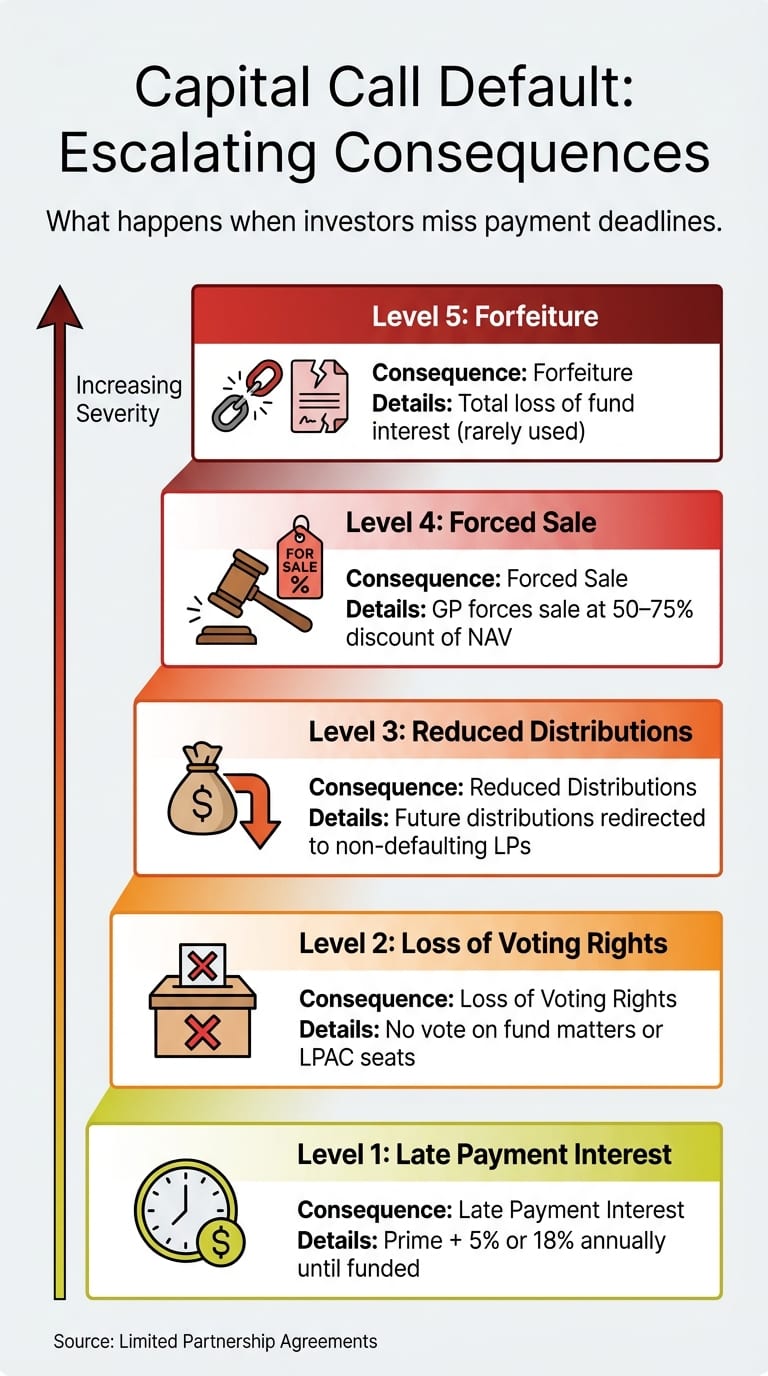
Missing a capital call can have serious consequences, including penalties like default interest, dilution of your partnership stake, or even loss of interest. This makes it essential to plan ahead, both for liquidity and any tax considerations, well before a call notice arrives.
Risks and Challenges of Capital Calls
Liquidity and Timing Risks
Capital calls can be unpredictable, influenced by factors like deal flow, market conditions, and the strategies of General Partners (GPs). Once a notice is issued, investors usually have just 10 to 14 days to transfer the required funds.
The challenge grows when you're invested in multiple funds. If several GPs issue calls at the same time - particularly during periods of market instability - you might struggle to maintain liquidity. In stable markets, capital calls and distributions often balance each other out, but this equilibrium can fall apart during downturns. When market liquidity tightens, large capital calls can coincide with the worst possible timing. While subscription lines may delay the need for immediate funding, they can lead to larger, aggregated capital calls later. Additionally, during volatile markets, lenders may pressure funds to reduce leverage, prompting GPs to issue more aggressive capital calls to Limited Partners (LPs).
"Unexpected capital call spikes during market downturns force asset liquidations at terrible prices. For these organizations, accurate forecasting isn't convenience - it's survival."
– Phil Wheaton, Copia Wealth Studios
To manage these risks, consider structuring your liquidity into tiers. Maintain cash or money-market instruments for short-term needs (1–2 quarters) and allocate investment-grade fixed income for medium-term obligations. Stress testing your portfolio - assuming scenarios like a 20% to 30% exclusion of LP commitments or a temporary suspension of the investment period - can also help you prepare. Automated alerts tracking uncalled versus committed capital across your investments can provide additional oversight. These strategies form a foundation for proactive liquidity management, helping you navigate the challenges posed by capital calls.
Performance and Compliance Risks
Meeting capital call deadlines is more than a matter of convenience - it’s critical for avoiding financial and operational penalties. Missing a deadline can result in escalating consequences, including penalty interest (often calculated as the prime rate plus 5% or a flat 18% per year), loss of voting rights, redirection of future distributions to other LPs, or even the forced sale of your stake at a steep discount of 50–75% of Net Asset Value (NAV).
In addition to these risks, delays in capital deployment can negatively impact fund performance. While subscription lines may improve Internal Rate of Return (IRR) by shortening the holding period for called capital, the associated interest and fees are treated as fund expenses, ultimately reducing net returns. Some LPs negotiate "excuse rights" for specific investments, which can reduce the fund's available capital for certain deals.
It's also important to carefully review your Limited Partnership Agreement for "overcall" provisions. These clauses limit how much you might be required to contribute if another investor defaults. Many funds now use electronic platforms and Virtual Data Rooms to automate notifications and track compliance, making it easier to avoid missed deadlines.
Conclusion
Capital calls are legally binding requests for a portion of your committed capital, typically requiring payment within 7 to 15 business days. It's important to understand how capital calls work and how subscription credit lines can help manage private equity commitments. These credit lines, often sized at 10–30% of total commitments, allow managers to secure deals quickly while giving you extra time to keep your capital in liquid, interest-earning assets.
To stay prepared, consider maintaining uncalled capital in short-term, accessible investments and holding enough cash reserves to meet calls promptly. Stress testing your portfolio - by simulating scenarios like a 20–30% commitment exclusion or multiple simultaneous capital calls - can help you anticipate and manage potential challenges. This readiness can help you avoid penalties tied to missed deadlines.
When evaluating fund performance, look beyond IRR. Subscription credit lines can inflate IRR by shortening holding periods without affecting MOIC. To address this, organizations like the Institutional Limited Partners Association (ILPA) suggest that managers report performance metrics both with and without the influence of credit facilities, promoting better transparency. These practices encourage a more strategic perspective across your portfolio.
Private equity should be viewed as just one part of your overall financial strategy. Regularly track your uncalled versus committed capital and review your Limited Partnership Agreement to ensure it allows borrowing and avoids legal complications. By combining careful liquidity planning with clear performance reporting, you can strengthen fund management and support your broader financial goals.
FAQs
How much cash should I keep on hand for capital calls?
The amount of cash to set aside for capital calls may vary depending on your investment approach and the usual size of these calls. Typically, they range between 10% and 30% of your total commitments, with factors such as the quality of limited partners (LPs) and the pace of deals playing a role. Reviewing your fund's historical trends can provide a clearer picture and help you prepare for anticipated timelines.
Do capital call lines help me, or mostly the fund?
Capital call lines serve as a useful liquidity tool for funds, offering several operational benefits. For fund managers, they provide the flexibility to close deals quickly, manage cash flow more effectively, and present stronger performance metrics. While investors may also benefit - such as experiencing reduced cash flow pressures and delaying immediate capital commitments - the primary advantages tend to favor fund managers. These lines simplify deal execution and contribute to smoother fund operations overall.
How can I compare fund returns when a subscription line is used?
When comparing fund returns involving a subscription line, it's important to recognize how these lines may distort metrics such as the internal rate of return (IRR). Subscription lines work by delaying capital calls, which shortens the investment period. This adjustment can create an inflated appearance of higher IRRs.
To make fair comparisons, adjust for timing differences and factor in the interest costs associated with the subscription line. Pay close attention to net IRRs that incorporate these adjustments, as they can provide a clearer picture of performance across funds with different levels of leverage.
Disclosures:
- This content is for informational purposes only and does not constitute investment advice or a recommendation to buy or sell any security.
- Past performance is not indicative of future results. No guarantee of future performance or outcomes is implied.
- Savings and performance examples are hypothetical and for illustrative purposes only. Actual results will vary based on individual circumstances, portfolio composition, market conditions, and fees.
Related Blog Posts
- Covered-call ETFs during rate cuts: what happens to yield and upside capture?
- What are the risks associated with using JEPI for income (yield mechanics, options overlay, tax character)?
- Capital Call: How Private Equity and Capital Call Lines Work
- Pledged Asset Lines: A Guide for High Net Worth Individuals
The amount of cash to set aside for capital calls may vary depending on your investment approach and the usual size of these calls. Typically, they range between 10% and 30% of your total commitments, with factors such as the quality of limited partners (LPs) and the pace of deals playing a role. Reviewing your fund's historical trends can provide a clearer picture and help you prepare for anticipated timelines.
Capital call lines serve as a useful liquidity tool for funds, offering several operational benefits. For fund managers, they provide the flexibility to close deals quickly, manage cash flow more effectively, and present stronger performance metrics. While investors may also benefit - such as experiencing reduced cash flow pressures and delaying immediate capital commitments - the primary advantages tend to favor fund managers. These lines simplify deal execution and contribute to smoother fund operations overall.
When comparing fund returns involving a subscription line, it's important to recognize how these lines may distort metrics such as the internal rate of return (IRR). Subscription lines work by delaying capital calls, which shortens the investment period. This adjustment can create an inflated appearance of higher IRRs.
To make fair comparisons, adjust for timing differences and factor in the interest costs associated with the subscription line. Pay close attention to net IRRs that incorporate these adjustments, as they can provide a clearer picture of performance across funds with different levels of leverage.