
Own a few funds across your retirement accounts, and you may be paying three managers to hold you the same Apple and Microsoft shares. That’s overlap: funds quietly stacking the same names, so your fees climb and your risk concentrates while you think you’re diversified. Pair SPY and QQQ and you’ve doubled down on the same handful of tech giants without meaning to.
Here’s what you need to know:
- Overlap Risks: Duplicate fees, concentrated exposure, and reduced diversification.
- How to Spot It: Use tools like Mezzi’s X-Ray or manually compare fund holdings.
- Action Steps:Consolidate funds with high overlap to reduce costs.
- Diversify into different asset classes or sectors.
- Use tax-advantaged accounts to rebalance efficiently.
Mezzi’s X-Ray tool simplifies this process by analyzing your portfolio across accounts, identifying overlaps, and offering suggestions to help optimize your retirement strategy. Over time, reducing overlap may help reduce fees and improve your portfolio’s balance.
How portfolio overlap can increase your portfolio's risk and what you can do about it
What Overlap Is Really Costing Your Retirement
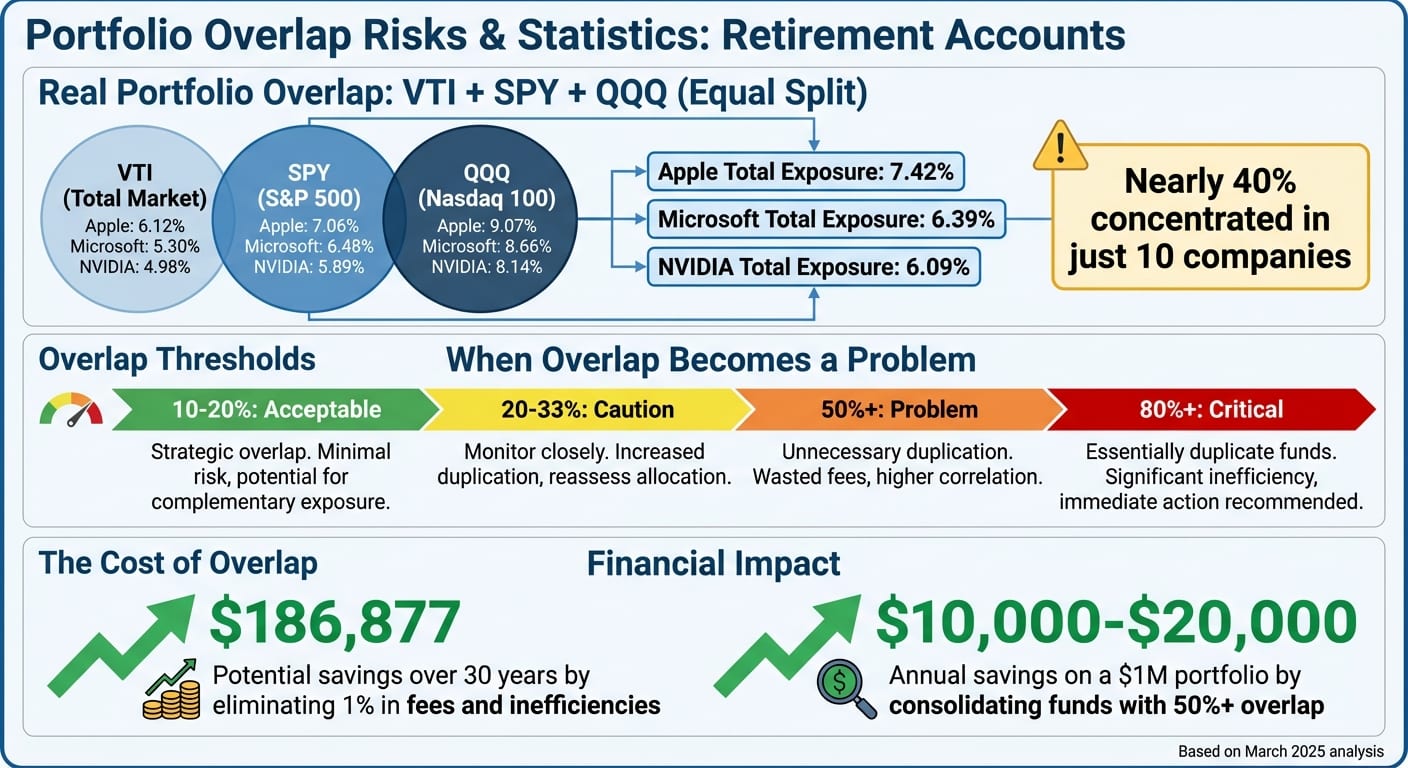
Portfolio overlap occurs when multiple ETFs or mutual funds include the same underlying stocks, leading to concentrated exposure rather than the broad diversification you might expect. Let’s break down how this happens and why it matters for your retirement accounts.
How Portfolio Overlap Happens
Overlap is particularly common when you combine broad-market funds with sector-specific ones. For example, if you equally split your investments across Vanguard Total Stock Market ETF (VTI), SPDR S&P 500 ETF Trust (SPY), and Invesco QQQ Trust (QQQ), you end up with 7.42% exposure to Apple, 6.39% to Microsoft, and 6.09% to NVIDIA. Together, nearly 40% of your portfolio could be concentrated in just 10 companies.
This issue can worsen if you separate funds by account type. For instance, your 401(k) might hold one set of funds while your IRA holds another, yet both could be heavily weighted in the same tech companies, unintentionally doubling down on certain stocks.
Why Overlap Creates Risk in Retirement Accounts
If a major stock in your portfolio declines, every fund holding that stock will take a hit. For example, if Microsoft’s value drops, it won’t just impact one fund - it could ripple across all funds that include it. Bajaj Finserv explains:
A high degree of overlap can limit the effectiveness of diversification, exposing the portfolio to heightened risks associated with specific sectors, industries, or individual securities.
There’s also a financial downside. You’re paying management fees for each fund, but if those funds hold the same stocks, you’re essentially paying extra for redundant exposure. Over time, this inefficiency adds up. For instance, eliminating just 1% in fees and inefficiencies over 30 years may result in significant cost savings.
Recognizing these risks is key to determining whether overlap is part of a purposeful strategy or a costly inefficiency.
When Overlap Is Acceptable vs. When It's a Problem
Experts generally recommend keeping overlap between 10% and 20%, though up to 33% might work depending on your investment goals.
- Acceptable overlap happens when it’s intentional. For example, combining a total market fund with a small-cap value fund may create some overlap, but it also adds exposure to smaller companies, aligning with a specific strategy.
- Problematic overlap arises when multiple funds essentially duplicate the same holdings. For instance, many dividend ETFs share 60% to 70% of their holdings, despite being marketed differently. Holding several of these funds means you’re paying extra fees for little added benefit, undermining diversification and inflating costs.
Spotting overlap risks is just the beginning. Tools like Mezzi’s X-Ray can help you dig deeper, identify redundancies, and fine-tune your portfolio for greater efficiency.
How to See the Duplication You’re Already Paying For
Understanding the risks of overlap is one thing, but identifying them in your portfolio is another challenge. You’ve got two main approaches: doing it manually or using a tool like Mezzi’s X-Ray for automation. Let’s break down both methods.
Checking for Overlap Manually
If you’re going the manual route, start by gathering the latest prospectus or fact sheet for each ETF or mutual fund you own. These documents detail the fund’s holdings and their weights, although many only list the top 10 to 25 positions instead of the full portfolio.
Once you have the documents, compare the top holdings side by side. Tools such as ETF Database’s Head-to-Head Comparison can help you check sector allocations - if two funds have, say, 30% exposure to technology, that’s a potential overlap. Add up the weights of any shared holdings to measure overlap. If overlap exceeds 50%, it’s a sign of redundancy. Over 80%? You’re essentially holding duplicate funds.
While this method offers insights, it can be tedious and may overlook smaller holdings. Free tools like Vanguard’s comparison feature (for up to five funds) or ETF Research Center’s Fund Overlap tool can assist, but they only provide partial visibility and still require effort.
Using Mezzi’s X-Ray Tool to Identify Overlap

For a more efficient option, Mezzi’s X-Ray Tool automates the process. By connecting securely to your accounts - 401(k), IRA, or taxable brokerage accounts - via Plaid and Finicity, it consolidates all your ETF and mutual fund holdings in one place. The tool calculates overlap percentages by analyzing the weights of shared positions across your portfolio.
What makes Mezzi’s X-Ray stand out is its ability to uncover hidden exposures. For instance, it might reveal that 40% of your portfolio is tied up in tech stocks because multiple funds hold the same companies. This is particularly useful for tech employees who already own company stock. As Andre Nader, author of FAANG FIRE, explained: "The hidden concentration is such a good feature. Particularly for those in tech who already hold significant amount of company stock. They often forget those same holdings make up a large % of the indexes they hold."
Another advantage? The X-Ray updates automatically as markets fluctuate and funds rebalance, ensuring you always see your portfolio’s current exposure.
Which Metrics to Review
When analyzing overlap, focus on three key metrics:
- Common stock weights: The total percentage of a single stock across all your funds.
- Sector concentration: Whether multiple funds are heavily invested in the same industry.
- Fund correlation: Values above 0.8 indicate funds move in sync, offering little diversification.
For example, if Apple accounts for 7.1% of VOO, 18.4% of VGT, and 11.2% of QQQ, owning all three funds could result in a total Apple exposure of 12.3% across your portfolio.
A reasonable overlap is typically between 10–20%, while anything above 50% could mean you’re paying for unnecessary duplication. By reviewing both the number of shared stocks and their weights, you can pinpoint areas of concentration and avoid paying extra management fees for the same exposure.
Trimming the Redundancy, on Purpose
Once you've identified overlap in your retirement portfolio, the next step is reducing redundancy. This doesn’t mean eliminating every shared holding, but rather being deliberate about what you own and why. The aim? Streamline your portfolio to lower costs, improve diversification, and avoid tax headaches.
Consolidating Duplicate Holdings
Think of all your retirement accounts - 401(k), Roth IRA, traditional IRA, and taxable brokerage accounts - as parts of a single portfolio. When you evaluate them collectively, it’s easier to spot funds that are essentially duplicating efforts.
If two funds have more than 50% of the same holdings by weight, you’re likely paying unnecessary management fees for the same market exposure. Consolidating into the lower-cost option may result in annual savings on a $1 million portfolio.
To decide which fund to keep, compare factors like expense ratios, tax efficiency, and the type of account each fund is held in. For example, a lower-cost fund in a tax-advantaged account like a Roth IRA often makes more sense to retain. Tools like Mezzi’s X-Ray feature can simplify this analysis by showing the underlying exposure across all your accounts.
"Mezzi's X-Ray feature allowed me to uncover exposure to stocks I didn't realize I had." - Shuping, Founder of Summer AI
Reallocating to Different Asset Classes
If consolidating doesn’t fully address the overlap, consider reallocating to different asset classes. For instance, if your portfolio leans heavily on U.S. large-cap stocks, adding bonds, REITs, or international funds can reduce overlap and enhance diversification.
Here’s an example: In March 2025, an analysis of three ETFs - VTI, SPY, and QQQ - showed that an investor equally invested in all three would have a 7.42% total concentration in Apple stock alone. Apple made up 6.12% of VTI, 7.06% of SPY, and 9.07% of QQQ. Microsoft and NVIDIA had similar overlap patterns. By shifting part of your portfolio to a bond ETF or REIT, you can spread your exposure across different market segments.
Another strategy is swapping multiple niche funds for a single broad-market ETF. For instance, if you hold several sector-specific ETFs, you might unknowingly concentrate on the same companies. A total market fund can offer similar diversification with fewer overlaps and lower fees.
When Some Overlap Is Acceptable
Overlap isn’t always a bad thing. Sometimes, it’s a deliberate part of your strategy. For example, if you’re intentionally overweighting a specific sector, like technology or dividend-paying stocks, some overlap may align with your goals.
A reasonable overlap threshold is typically between 10% and 20%. Anything above 50% likely signals unnecessary duplication. Evaluate whether the overlap is strategic or redundant.
For instance, holding three low-cost index funds that all track the S&P 500 is redundant. But if you pair a total market fund for broad exposure with a dividend growth fund for income, the overlap could be intentional and beneficial - as long as each fund serves a distinct purpose. A well-structured retirement portfolio should ideally consist of 3 to 5 focused positions, each playing a specific role.
Before making changes, consider the tax implications. Selling in taxable accounts can trigger capital gains taxes, while rebalancing in tax-advantaged accounts like IRAs and 401(k)s avoids immediate tax consequences. By streamlining overlap, you not only reduce costs but also strengthen diversification within your portfolio.
Fixing Overlap Without Handing the IRS a Bill
Once you've identified and reduced overlap in your portfolio, the next step is managing it with an eye on tax efficiency. Selling funds to consolidate holdings can trigger capital gains taxes in taxable accounts. Additionally, overlapping positions across various account types could lead to wash sale violations, complicating rebalancing efforts.
Avoiding Wash Sale Violations
A wash sale happens when you sell a security at a loss in a taxable account and then buy the same or a substantially identical security within 30 days before or after the sale. This disallows the loss deduction, making it harder to manage overlapping holdings across accounts. For example, if you sell an ETF like SPY in your taxable account to reduce redundancy but still hold the same ETF in a Traditional IRA, you could unintentionally trigger a wash sale. The IRS enforces the 30-day rule across all accounts, including retirement accounts, even though IRAs themselves don’t allow for wash sale adjustments.
Mezzi's X-Ray Tool helps identify these risks before they happen. It scans all linked accounts - taxable, Roth, and Traditional IRAs - and alerts you if selling a holding could lead to a wash sale due to overlapping positions elsewhere. For instance, if you’re planning to sell VTI in your taxable account, the tool might notify you with something like, "Selling VTI risks wash sale due to 25% overlap with VXUS in IRA." This gives you the chance to either wait 31 days or choose a non-identical alternative. Once these risks are addressed, you can turn your attention to optimizing asset placement to minimize tax inefficiencies.
Optimizing Asset Location Across Account Types
Each type of account - taxable accounts, Traditional IRAs, and Roth IRAs - comes with its own tax rules. Placing assets in the right accounts can significantly reduce tax burdens. For example:
- Tax-inefficient assets like high-dividend funds, bond ETFs, or actively managed mutual funds are better suited for tax-advantaged accounts (Traditional or Roth IRAs) since their income isn’t taxed annually.
- Tax-efficient assets like low-turnover index ETFs (e.g., VTI) work well in taxable accounts, as qualified dividends and long-term capital gains enjoy lower tax rates.
If you hold overlapping high-yield bond ETFs in both a taxable account and a Traditional IRA, consolidating them into the IRA could reduce annual tax leakage on dividends by 1–2%. These small adjustments can make a big difference - effective tax strategies like this may improve your after-tax returns.
Rebalancing Without Creating Tax Problems
When rebalancing your portfolio, focus on minimizing tax costs. Start by making changes within tax-advantaged accounts, where transactions don’t trigger immediate taxes. In taxable accounts, use new contributions or dividend reinvestments to buy underweighted, low-overlap assets instead of selling overweighted ones.
Tax-loss harvesting can also help offset gains when selling overlapping funds - just make sure to maintain a 31-day gap to avoid wash sale violations.
Mezzi simplifies this process by simulating rebalancing scenarios across all account types. It calculates potential tax liabilities and offers suggestions for improving tax efficiency. For example, the platform might indicate, "Rebalancing 15% overlap reduces risk but incurs $1,200 in tax; alternatively, consider using Roth contributions for a tax-free adjustment.". On a $1 million portfolio, smart tax strategies like this may improve annual returns, depending on your unique situation.
The Payoff of Knowing What You Actually Own
Managing portfolio overlap is key to reducing hidden risks and improving diversification in your retirement accounts. When overlap exceeds 50%, you may be paying unnecessary duplicate fees. If it climbs above 80%, you're likely holding nearly identical funds, which can concentrate risk and undermine your investment strategy. Over a 30-year retirement period, these inefficiencies can significantly erode your wealth.
Mezzi's X-Ray tool offers a clear solution by pinpointing redundancies across all your accounts - whether they’re 401(k)s, IRAs, HSAs, or taxable accounts. Unlike traditional brokerage platforms that only show holdings at a single institution, Mezzi aggregates data from thousands of sources to provide a comprehensive view. It dives deep into the underlying holdings of your investments, showing exactly where overlaps exist and helping you make informed decisions.
Beyond identifying overlap, Mezzi’s AI-powered insights go a step further. The platform simulates rebalancing scenarios, calculates potential tax impacts, and offers actionable recommendations. For instance, it might suggest consolidating duplicate holdings in your IRA to minimize capital gains taxes or reallocating to different asset classes to diversify effectively. These strategies may improve annual returns, depending on your unique situation.
Mezzi doesn’t stop there. Its continuous monitoring ensures you stay ahead of emerging risks. As markets shift, funds rebalance, or your portfolio evolves, the platform alerts you to potential issues before they escalate. This level of analysis - typically reserved for high-net-worth investors - puts institutional-grade tools in your hands, helping you make informed decisions about your financial future.
FAQs
What overlap percentage is too high?
When the overlap percentage in your portfolio exceeds 70%, it’s usually a red flag. Such a high level of overlap can lead to reduced diversification, which may increase the overall risk of your investments. This could, in turn, affect your ability to meet long-term financial goals. To help manage risk in your retirement account, it’s important to identify and address any significant overlap in your holdings.
How can I check overlap across all my retirement accounts?
Mezzi offers AI-powered tools to help you spot overlap in your retirement accounts. With the Portfolio Overlap Checker and X-Ray analysis, you can scan your 401(k)s, IRAs, and brokerage accounts to pinpoint duplicate stocks or sectors. By securely linking your accounts, these tools can reveal hidden risks, identify redundancies, and support diversification. Regularly reviewing your portfolio ensures it stays optimized and aligned with your long-term retirement goals.
How do I reduce overlap without triggering taxes or wash sales?
To minimize overlap in your portfolio without running into tax issues or wash sale rules, tools like Mezzi's AI-powered X-Ray can help pinpoint duplicate holdings. Once identified, you may consider rebalancing by swapping overlapping funds for assets that are similar but not exactly the same, to support your portfolio's diversification.
Steer clear of IRS wash sale violations by avoiding the sale of securities at a loss followed by repurchasing identical ones within 30 days. By monitoring your investments and rebalancing thoughtfully, you may be able to manage your portfolio while seeking to avoid unnecessary tax complications.
Mezzi is free to get started. Choose Advisory for unlimited advice and advanced features at $39/month or $399/year. Concierge includes the same, plus hands-on support, at $99/month or $999/year.
Disclosures:
• This content is for informational purposes only and does not constitute investment advice or a recommendation to buy or sell any security.
• Past performance is not indicative of future results. No guarantee of future performance or outcomes is implied.
• Registration does not imply a certain level of skill or that the SEC has approved the company or its services.
• Savings and performance examples are hypothetical and for illustrative purposes only. Actual results will vary based on individual circumstances, portfolio composition, market conditions, and fees.