If you already own VOO, adding a tech-focused ETF like FTEC, VGT, or XLK can increase your portfolio’s exposure to the technology sector. Here’s a quick breakdown of what each ETF offers:
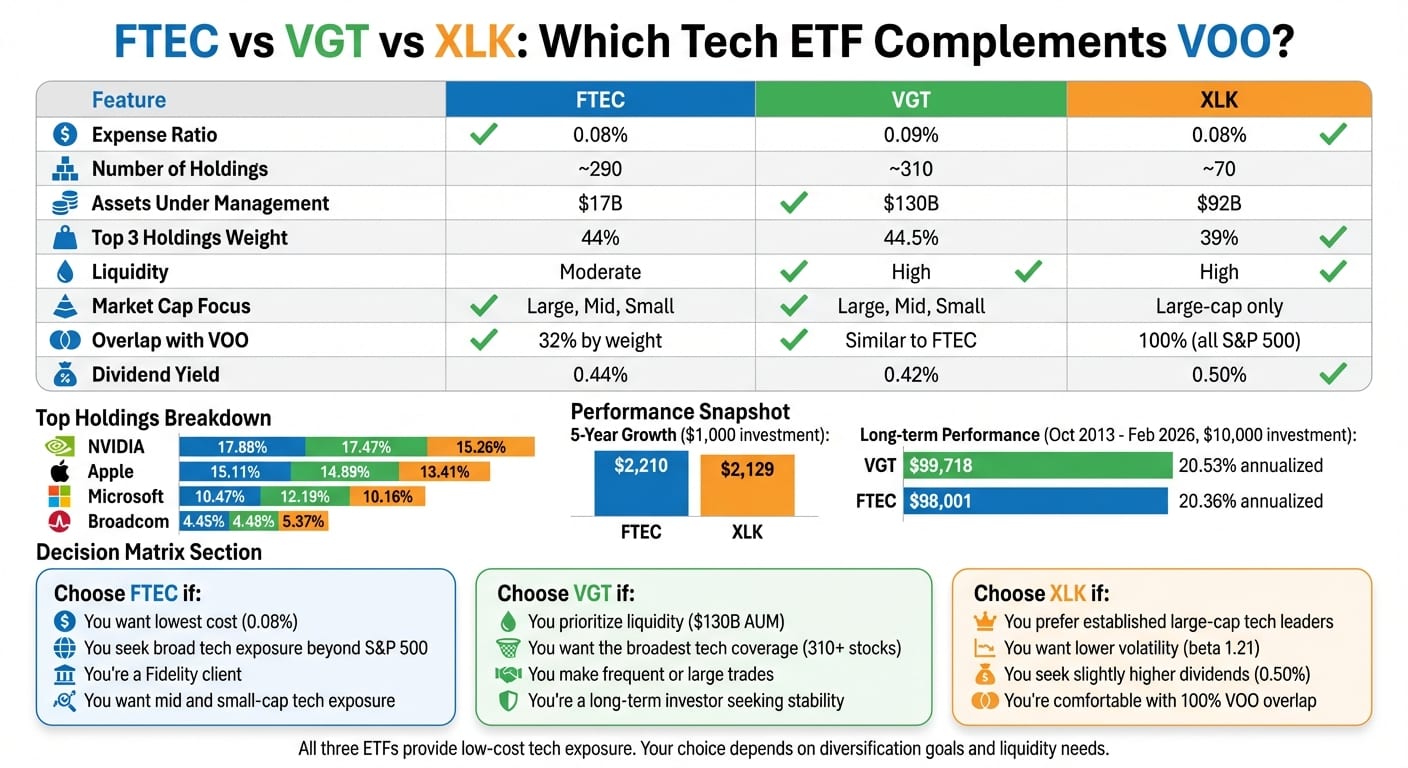
- FTEC: Broad exposure to 290+ tech stocks, including mid- and small-cap companies. It’s cost-effective with a 0.08% expense ratio but has lower liquidity compared to others.
- VGT: Slightly higher fees (0.09%) but includes 310+ stocks, offering strong liquidity and broad tech industry coverage. Best for investors prioritizing trade efficiency.
- XLK: Focuses on 70 large-cap S&P 500 tech leaders. Lower diversification but provides stability and complements VOO’s existing holdings.
Quick Comparison
Key Takeaways:
- Choose FTEC or VGT for broader tech exposure, including mid- and small-cap companies.
- Opt for XLK if you want to focus on large-cap tech leaders with lower volatility.
- VGT offers the best liquidity, making it a top choice for long-term investors.
Your choice depends on whether you want diversification beyond VOO or a stronger focus on established tech giants. All three ETFs are low-cost and can be used in a tech-focused growth strategy.
4 ETFs to PAIR with VOO for S&P 500 Investing
FTEC, VGT, and XLK: What Each ETF Offers
If you're looking to pair VOO's broad market exposure with a sharper focus on tech growth, these ETFs provide distinct strategies. While all three target the tech sector, their approaches vary. FTEC and VGT cover a wider range of companies across large, mid, and small caps, while XLK zeroes in on the tech heavyweights of the S&P 500.
Here’s a closer look at what sets each ETF apart.
FTEC: Fidelity MSCI Information Technology Index ETF
FTEC follows the MSCI USA IMI Information Technology 25/50 Index, offering exposure to smaller tech firms that might not appear in the S&P 500 - and by extension, VOO. With an expense ratio of 0.08% and about $17 billion in assets under management, it’s a cost-efficient way to diversify. The fund holds between 286 and 294 tech stocks across different market caps, but its top three holdings - Nvidia, Microsoft, and Apple - account for over 44% of its total assets. This highlights its concentrated tilt toward major players despite its broader scope.
The Fidelity MSCI Information Technology ETF is one of the cheaper broad-based tech ETFs on the market but it hasn't enjoyed the same popularity as pricier rivals offered by State Street and Vanguard.
ETF Database Analyst
VGT: Vanguard Information Technology ETF
VGT tracks the MSCI US Investable Market Information Technology 25/50 Index and holds between 310 and 320 stocks, ensuring a broad reach across the tech industry. Managing approximately $130 billion in assets, it offers high liquidity for large-scale transactions. Its expense ratio is slightly higher than FTEC’s at 0.09%. Like FTEC, VGT spans various tech sectors, including software, hardware, consulting, and semiconductors.
XLK: Technology Select Sector SPDR Fund
With a 27-year history, XLK focuses exclusively on technology companies within the S&P 500. It manages between $92 and $96 billion in assets and maintains an expense ratio of 0.08%. Unlike FTEC and VGT, XLK narrows its holdings to just 68–73 stocks, emphasizing established tech leaders. Nvidia, Microsoft, and Apple dominate its portfolio, making up roughly 39–40% of the fund.
XLK's narrower focus caters to investors favoring established tech leaders over diversified, smaller names.
Cory Renauer, Healthcare Analyst, The Motley Fool
Comparing Costs, Holdings, and Performance
Let’s dig into the costs, sector breakdowns, and performance of these ETFs to see how they stack up against each other.
Expense Ratios and Costs
When it comes to fees, there’s almost no daylight between these three ETFs. Both FTEC and XLK have an expense ratio of 0.08%, while VGT charges a slightly higher 0.09% fee. What does that difference mean in dollars? On a $10,000 investment, it’s just $1 per year - hardly enough to sway most investors.
All three ETFs are low-cost options because they track broad indices passively, avoiding the higher fees associated with active management. But liquidity is where things get interesting. VGT towers over the others with $130 billion in assets, followed by XLK at $92 billion, and FTEC at $17 billion. This size difference matters, especially during volatile markets when executing trades efficiently becomes crucial.
The cost difference is negligible, making yield and liquidity the primary differentiators for fee-conscious investors.
Jake Lerch, Technology Analyst, The Motley Fool
Now, let’s see how these costs align with the sector allocations and holdings of each ETF.
Sector Allocation and Top Holdings
Even with different indexing strategies, these ETFs focus heavily on the same tech giants. VGT is the most concentrated, with about 44.5% of its portfolio in top holdings, while XLK is slightly less concentrated at 39%.
The number of stocks in each ETF varies widely. VGT holds around 320 stocks, FTEC includes roughly 290, and XLK focuses on just 70 companies from the S&P 500. This means VGT and FTEC provide exposure to smaller and mid-cap tech firms, while XLK sticks to large-cap leaders that are already prominent in funds like VOO.
Interestingly, none of these ETFs include Alphabet, Meta, or Amazon. That’s because these companies fall under Communication Services or Consumer Discretionary sectors, not Information Technology. If you’re already holding VOO, you’re covered for those names.
These distinctions in structure and holdings lead directly to differences in performance and liquidity.
Historical Performance and Trading Volume
For investors looking to complement VOO with tech-focused exposure, performance and liquidity are key factors to consider.
Over the long term, the performance gap is minimal. From October 2013 to February 2026, a $10,000 investment in VGT grew to about $99,718, compared to FTEC at $98,001. That’s an annualized return of 20.53% for VGT versus 20.36% for FTEC.
In the last five years, FTEC has edged out XLK, with a $1,000 investment growing to $2,210 in FTEC, compared to $2,129 in XLK.
Liquidity is another area where VGT and XLK shine. Their larger asset bases and higher trading volumes result in tighter spreads, making them easier to trade during volatile periods. FTEC, with its smaller size, can experience more price swings during heavy trading. For investors making large trades or navigating choppy markets, this liquidity advantage might outweigh the slight fee differences.
Which ETF Fits Your Investment Goals
Avoiding Overlap with VOO
If you're already holding VOO, it's important to think about how additional ETFs might complement - not duplicate - your existing portfolio. VOO already provides exposure to major tech players, so adding another ETF should ideally broaden your reach into areas VOO doesn't cover.
Take XLK, for example. Since every stock in XLK is part of the S&P 500, it overlaps entirely with VOO. On the other hand, FTEC and VGT go beyond the S&P 500 by including mid- and small-cap tech firms. These ETFs offer access to around 230–250 additional tech companies, compared to XLK's focus on just 70 holdings.
The overlap between VOO and FTEC is about 32% by weight, but only 14% of VOO's holdings are found in FTEC. This means FTEC provides additional diversification, giving you exposure to smaller tech companies without losing your core S&P 500 exposure. Plus, VOO already includes large tech-adjacent companies like Amazon, Alphabet, and Meta - names often excluded from specialized tech ETFs due to sector classifications.
Growth Potential vs. Risk
With ETFs, there's always a trade-off between potential returns and the risks you take on. FTEC and VGT, with their 300+ holdings, include smaller companies that may offer higher growth potential. But that growth comes with higher volatility. In contrast, XLK focuses on just 70 large-cap tech stocks, offering more stability and liquidity but less exposure to newer tech firms. Over the past five years, all three ETFs have seen maximum drawdowns ranging from about 33.5% to 35%.
If you're okay with more volatility in exchange for broader tech exposure, FTEC or VGT might be a better fit. However, if you prefer the steadiness of large-cap stocks, XLK’s concentrated approach may offer greater stability. Keep in mind, though, that XLK’s focus means it will amplify the tech exposure you already have with VOO.
What Long-Term Investors Should Consider
When taking the long view, it's not just about growth and risk - it’s also about practical factors like liquidity. Larger funds tend to offer better trade execution during volatile times, which can outweigh small differences in expense ratios.
Vanguard Information Technology ETF's larger scale and stronger liquidity profile offers greater liquidity and stability for long-term holdings.
Eric Trie, Contributing Stock Analyst, The Motley Fool
If you're planning to hold your investment for years, FTEC or VGT could be appealing for their broader tech market coverage, including companies at various growth stages. While XLK has a slightly higher dividend yield (0.50%) compared to FTEC (0.44%) and VGT (0.42%), the difference is minimal when looking at long-term total returns. The choice ultimately depends on whether you want to double down on the tech exposure already in VOO with XLK or diversify into newer tech innovators through FTEC or VGT.
Conclusion: Choosing Your Tech ETF
What Matters Most
When it comes to costs, the differences are minimal - FTEC and XLK have an expense ratio of 0.08%, while VGT sits slightly higher at 0.09%. This makes other factors like diversification and liquidity more important in your decision-making process. If you're looking for broader exposure, FTEC and VGT each hold around 300 stocks, offering a more diverse portfolio compared to XLK's focus on roughly 70 holdings. That said, all three ETFs have a heavy concentration in major tech companies, with FTEC and VGT leaning slightly more toward these giants than XLK.
Liquidity is another key factor. VGT leads the pack with about $110 billion in assets, followed by XLK with $92 billion, and FTEC trailing with approximately $17 billion. This can influence how easily you can buy or sell shares and the overall stability of the fund.
Ultimately, your choice hinges on how you want to complement your existing VOO holdings.
Which ETF to Choose
Here’s how each ETF aligns with different investment goals:
- FTEC: Ideal if you're seeking a low-cost option with broad tech exposure. It includes mid- and small-cap companies not typically found in VOO, making it a good choice for investors looking to expand beyond the S&P 500. It's particularly appealing for Fidelity clients.
- VGT: Best suited for those prioritizing liquidity. With over $110 billion in assets, VGT offers ease of trading and stability alongside its diversified tech exposure, making it a solid addition to your VOO holdings.
- XLK: A great pick if you prefer a more focused approach. XLK concentrates on the 70 largest S&P 500 tech companies, offering slightly lower volatility (a beta of 1.21 compared to 1.28–1.29 for FTEC and VGT). However, it provides limited diversification beyond what VOO already covers.
Each ETF has its strengths, so the right choice depends on your specific investment strategy and how you want to balance your portfolio.
FAQs
How much FTEC, VGT, or XLK should I add if I already own VOO?
When deciding how much to allocate, consider your overall portfolio and how much exposure to tech you want. Since VOO already provides broad market coverage, adding a small to moderate portion of FTEC, VGT, or XLK can expand your tech holdings but consider overlap. Make sure your allocation matches your investment objectives and risk tolerance to maintain a well-balanced and diversified portfolio.
Which one has the least overlap with VOO?
The ETF with the lowest overlap with VOO is VGT, sharing only about 14% of its holdings. In contrast, FTEC has over 91% overlap with VGT. Although both VGT and FTEC focus heavily on tech stocks, VGT provides slightly broader exposure, making it an option if you're looking to reduce overlap with VOO.
Why don’t these tech ETFs hold Amazon, Alphabet, or Meta?
These tech ETFs leave out Amazon, Alphabet, and Meta, instead prioritizing top holdings in other major tech players like NVIDIA, Apple, and Microsoft. The goal is to offer broader exposure across the tech industry, rather than focusing heavily on just a few of the largest companies.
Disclosures:
- This content is for informational purposes only and does not constitute investment advice or a recommendation to buy or sell any security.
- Past performance is not indicative of future results. No guarantee of future performance or outcomes is implied.
- Savings and performance examples are hypothetical and for illustrative purposes only. Actual results will vary based on individual circumstances, portfolio composition, market conditions, and fees.
Related Blog Posts
- What’s a good total-market index mutual fund that isn’t heavily tilted toward technology?
- QQQM vs VGT: 5-year total return, sector concentration, top-10 weight drift, valuation metrics snapshot.
- XLK vs VGT vs FTEC - Best tech sector ETF for broad mega-cap exposure
- QQQ vs QQQM vs VOO: Nasdaq 100 or S&P 500 for Your Portfolio
When deciding how much to allocate, consider your overall portfolio and how much exposure to tech you want. Since VOO already provides broad market coverage, adding a small to moderate portion of FTEC, VGT, or XLK can expand your tech holdings but consider overlap. Make sure your allocation matches your investment objectives and risk tolerance to maintain a well-balanced and diversified portfolio.
The ETF with the lowest overlap with VOO is VGT, sharing only about 14% of its holdings. In contrast, FTEC has over 91% overlap with VGT. Although both VGT and FTEC focus heavily on tech stocks, VGT provides slightly broader exposure, making it an option if you're looking to reduce overlap with VOO.
These tech ETFs leave out Amazon, Alphabet, and Meta, instead prioritizing top holdings in other major tech players like NVIDIA, Apple, and Microsoft. The goal is to offer broader exposure across the tech industry, rather than focusing heavily on just a few of the largest companies.