
Investors often overlook international stocks, even though they make up about 40% of the global stock market. U.S. portfolios typically allocate 81% to domestic stocks, but experts suggest aiming for 20% to 40% international exposure for better diversification and reduced risk.
Key takeaways:
- 30%–40% international allocation balances diversification and risk.
- International stocks provide access to undervalued markets, sectors like energy and financials, and act as a hedge against dollar weakness.
- Risks include currency fluctuations, geopolitical instability, and market volatility.
For long-term investors, increasing international exposure can improve returns and reduce portfolio volatility. Adjust your allocation based on your risk tolerance, age, and market trends.
Allocation to International Equity ETFs – A tale of home bias?
What to Consider When Allocating to International Stocks
Your personal risk profile and current market trends play a big role in deciding how much to allocate to international stocks.
Risk Tolerance and Investment Goals
When deciding on your allocation, start with your risk tolerance and investment goals. If you're a conservative investor focused on preserving capital, you might allocate between 5% and 20% to international stocks. On the other hand, if you're aiming for higher growth and are comfortable with more risk, you could go as high as 30% to 40%. This aligns with the fact that non-U.S. stocks made up 37% of global market capitalization as of September 2025. Using a market-cap-weighted approach can also help offset "home-country bias", which often leads to over-reliance on U.S. markets.
"International diversification is not about betting against the U.S. It's about reducing dependence on a single region or group of companies." - J.P. Morgan Wealth Management
If you're investing for the long term - think 10 years or more - you'll be better equipped to handle the ups and downs of international markets, which can see steep drawdowns of over 50%. However, if your goal is short-term (less than five years), it’s better to stick with a smaller allocation to international stocks to limit risk.
Age and Portfolio Size
Your age and the size of your portfolio also play a big role in determining how much international exposure is right for you. Younger investors in their 20s and 30s typically have the flexibility to take on more risk. They can allocate more to high-growth areas like emerging markets, even if it means enduring quarterly losses of 20% or more, which international stocks have historically experienced.
For retirees or those nearing retirement, the focus usually shifts to stability. Developed international markets, known for higher dividend yields and lower volatility, often take center stage. Retirees might still maintain an international allocation of 20% to 30% for diversification but are likely to limit riskier investments, such as region-specific funds, to 15% or less of their portfolio.
Expanding your portfolio internationally also reduces the risk of being too concentrated in a handful of dominant companies. These personal factors, combined with global market trends, help shape your international investment strategy.
Global Market Conditions and Valuations
Market trends and valuations provide additional guidance. At the end of 2024, U.S. stocks were trading at a 54% premium compared to global stocks. By mid-April 2025, that premium had narrowed to 42%. Looking ahead, J.P. Morgan forecasts annual returns of 8.1% for developed international stocks (EAFE) over the next 10 to 15 years, compared to 6.7% for U.S. equities. These numbers suggest that a larger international allocation could be advantageous.
Regional developments also matter. For instance, Germany’s €500 billion infrastructure stimulus and Japan’s shareholder-focused reforms could drive growth in those markets.
Currency movements are another factor. International stocks tend to perform better when the U.S. dollar weakens, as gains in foreign currencies convert into more dollars. If the dollar is expected to decline, increasing your international allocation can provide a natural hedge.
Ultimately, set a target allocation that fits your circumstances and adjust it regularly. These considerations can help guide your strategy, whether you're making decisions manually or using tools like Mezzi to automate the process.
How Much to Allocate to International Stocks
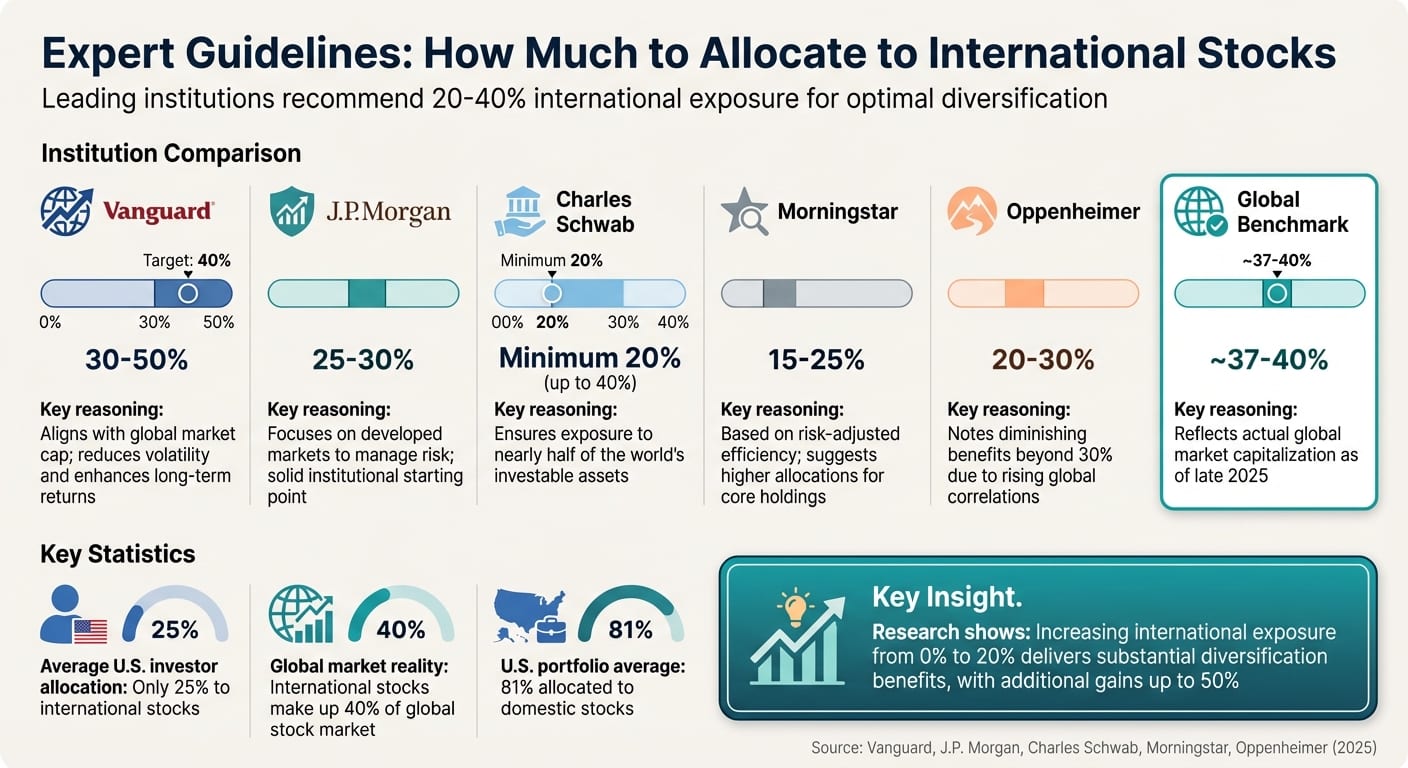
Expert Allocation Guidelines
Experts suggest allocating 20% to 40% of your equity portfolio to international stocks to strike a balance between diversification and managing global investing risks.
Here’s a breakdown of recommendations from leading institutions:
These recommendations align closely with global market cap proportions, providing a clear framework for investors. However, the average U.S. investor allocates only about 25% to international stocks, potentially missing out on significant benefits.
"For many investors, an allocation that falls between 30% and 50% should be considered reasonable, given the historical benefits of diversification." - Vanguard
Research backs this up: increasing international exposure from 0% to 20% delivers substantial diversification benefits, with additional gains up to 50%. Vanguard's simulations show that a 60/40 stock-bond portfolio with market-cap-weighted international assets can yield 0.6% higher annual returns and experience 0.4% less volatility compared to a domestic-only portfolio. For example, in 2022, portfolios with 30%–40% international exposure had drawdowns that were 3.2% smaller than those limited to U.S. stocks.
These insights form the foundation for Mezzi's advanced tools, helping you fine-tune your portfolio and optimize your international allocation.
Benefits and Risks of International Stocks
Benefits: Diversification and Growth Potential
Investing in international stocks can help smooth out portfolio performance while uncovering opportunities for growth. By spreading investments across markets that don't always move in sync with the U.S., you can reduce overall volatility. For example, the 10-year standard deviation of a global index (including U.S. and international stocks) was 15.0, compared to 15.5 for a U.S.-only portfolio.
International markets also provide access to sectors that are underrepresented in the U.S. While the U.S. market is heavily weighted toward technology (29% of indexes), international markets lean more toward sectors like energy, basic materials, and financials, which make up a larger share abroad. On top of that, non-U.S. stocks are trading at around 35% cheaper valuations compared to U.S. stocks, based on forward price-earnings ratios, and they offer dividend yields that are approximately 1.4 percentage points higher.
Currency fluctuations can also play to your advantage. A weakening U.S. dollar increases the value of foreign investments. For instance, Vanguard estimates that a weakening dollar could add about 1.1 percentage points to annual international stock returns over the next decade. In 2025, the dollar dropped nearly 9% through mid-December, further boosting returns. Moreover, international markets give you access to global leaders in industries that aren't well-represented in U.S. exchanges, such as Taiwan's AI supply chain, European infrastructure companies, and Japan's specialized manufacturers.
"Ignoring international is a bit like buying a US stock fund that only invests east of the Mississippi. It's a large opportunity set." - Jed Weiss, Manager, Fidelity International Growth Fund
By diversifying internationally, you not only balance your portfolio but also position yourself for potential higher returns - key principles in modern wealth management strategies like those employed by Mezzi.
Risks: Currency, Geopolitical, and Market Volatility
Of course, international investing isn't without risks. Currency fluctuations can go both ways. While a weaker dollar boosts returns, a stronger dollar can erode them. If the dollar gains against foreign currencies, the value of your international investments decreases when converted back to dollars. This kind of volatility can be especially concerning for retirees who rely on stable income streams.
Geopolitical risks are another factor. Foreign markets often face challenges like political upheaval, wars, or sudden regulatory changes - risks that U.S. investors encounter less frequently. Emerging markets are particularly vulnerable due to less stringent regulations and oversight. Additionally, market volatility abroad can be more pronounced, with price swings often exceeding those seen in U.S. markets.
There's also the issue of diminishing diversification benefits. Correlations between U.S. and international markets have risen over time, going from 0.45 in the 1990s to 0.85 in the 2020s. This means international stocks may not provide as much protection during global crises as they once did. However, in 2024, sector-level correlations began to drop again, reaching 0.42, which could signal a return of diversification benefits.
Despite these risks, the long-term case for international stocks remains compelling. From 2000 to 2009, international stocks outperformed U.S. stocks by 4.2 percentage points annually. More recently, in Q1 2025, non-U.S. stocks outpaced U.S. equities by 5.3 percentage points. The key is staying consistent with your allocation and rebalancing annually. This disciplined approach can add 0.3% to 0.6% to your annual returns by ensuring you buy low and sell high.
How Mezzi Helps You Determine Your International Allocation
Deciding on the right international allocation isn’t something you figure out once and forget. It evolves with your financial goals, market trends, and tax considerations. Mezzi, an SEC-registered AI fiduciary advisor, provides guidance across tax planning, retirement strategies, and asset allocation. What sets Mezzi apart from traditional advisors is its ability to connect to all your financial accounts - 401(k)s, IRAs, taxable brokerages - using read-only access through Plaid and Finicity. This gives you a full picture of your finances, ensuring your allocation strategy benefits from the diversification principles discussed earlier. Let’s dive into how Mezzi’s tools fine-tune your international allocation.
Personalized Allocation Advice
Mezzi tailors its recommendations to your unique risk tolerance, financial timeline, and current market conditions. Whether you’re chasing FIRE (Financial Independence, Retire Early) by 45, exploring "Barista FIRE", or planning for a more traditional retirement, Mezzi adapts its advice to suit your goals. The platform’s AI uses a deterministic, logic-based system to ensure reliable, accurate recommendations, avoiding the pitfalls of AI hallucinations.
"Providing personalized fiduciary financial advice with a deterministic, logic-based system to really take into account and avoid hallucinations." - Manish Jain, CEO, Mezzi
Mezzi’s AI doesn’t just offer static advice - it evolves with you. By continuously tracking your conversations and financial changes, it updates your plan in real-time. Whether markets shift or your goals change, you can rely on Mezzi for quick, informed answers - even in the middle of the night.
Portfolio X-Ray and Overlap Analysis
On top of personalized advice, Mezzi enhances your strategy with its Portfolio X-Ray tool. This feature digs deep into your accounts to uncover overlapping investments, helping you avoid unintentional duplication in your international exposure. For instance, you might unknowingly hold the same international stock across multiple ETFs. By identifying these overlaps, Mezzi ensures every investment in your portfolio adds value to your global diversification.
"Mezzi's X-Ray feature allowed me to uncover exposure to stocks I didn't realize I had." - Shuping, Founder of Summer AI
This level of analysis not only streamlines your portfolio but also keeps unnecessary fees in check, ensuring a more efficient approach to diversification.
Tax-Efficient Rebalancing Guidance
International investments often come with tax complexities. For example, emerging market ETFs may need to sell securities to raise cash for redemptions, potentially triggering taxable capital gains. Mezzi’s AI tracks these nuances, identifying tax-loss harvesting opportunities throughout the year while monitoring wash sale risks across all your accounts using AI tools. When the 30-day wash sale window passes, Mezzi notifies you, so you can rebuy confidently.
Mezzi’s tax optimization strategies can enhance your annual returns by 1%–2%, which translates to $10,000–$20,000 on a $1 million portfolio. It also advises you on the best account types - Roth, Traditional, or taxable - for holding international stocks, helping you minimize tax liabilities while maximizing growth.
"I loved chatting with the AI to make important changes to my portfolio. I haven't found another wealth app like Mezzi." - Tim, CEO, Somnee
While Mezzi doesn’t execute trades or move funds, it provides clear, actionable advice on what to rebalance and when. Think of it as having access to the expertise of a high-cost advisor, but available 24/7 at a fraction of the price.
Conclusion
Deciding how much to invest in international stocks is not a one-size-fits-all decision. Your allocation should take into account personal factors like your risk tolerance, investment timeline, and the current market environment. While experts often suggest a baseline of 25% to 30% in developed non-U.S. equities, the right percentage for you will depend on these unique considerations.
The benefits of international diversification go beyond just potential returns. It also reduces reliance on the U.S. market, where a staggering seven companies now make up nearly one-third of the S&P 500. This heavy concentration highlights the importance of balancing your portfolio with global exposure.
Mezzi simplifies this process by helping you navigate these variables. By linking all your accounts - 401(k)s, IRAs, and taxable brokerage accounts - Mezzi provides personalized, real-time allocation advice. Its Portfolio X-Ray tool uncovers hidden risks in your portfolio, while tax-efficient rebalancing strategies keep you aligned with your target allocations as markets fluctuate. Whether you're planning for a traditional retirement or aiming for FIRE, Mezzi equips you with the tools and insights to confidently manage both domestic and international investments - all while keeping costs lower than traditional advisors.
FAQs
Should I count my target-date fund’s international stocks toward my total allocation?
When deciding how to account for international stocks in your portfolio, it often comes down to your strategy and the makeup of your investments. Target-date funds, for example, usually hold a combination of domestic and international stocks to help spread out risk and add variety. Many investors simply count these international stocks as part of their overall allocation.
That said, if you're someone who actively manages your portfolio or has particular financial goals in mind, you might prefer to track international stocks separately. This approach can help ensure they align with your broader investment plan.
Do I need a separate emerging-markets fund, or is developed international enough?
Adding an emerging-markets fund to your portfolio comes down to your goals for diversification and how much risk you’re comfortable taking. Developed international stocks already provide diversification by being less tied to U.S. market movements and offering exposure to different economic cycles. Emerging markets take this a step further, with even lower correlation to U.S. markets and the potential for unique growth opportunities.
If you prefer to keep things straightforward, sticking with developed markets might meet your needs. However, if you’re aiming for broader diversification and a chance to tap into higher growth potential, emerging markets could be worth considering. Ultimately, your decision should match both your risk tolerance and overall investment strategy.
Should I use currency-hedged or unhedged international stock funds?
When deciding between currency-hedged and unhedged international stock funds, it comes down to your risk tolerance and outlook on currency trends.
Hedged funds aim to minimize the impact of currency fluctuations, giving you steadier returns by neutralizing foreign exchange risks. On the other hand, unhedged funds leave you exposed to currency movements. While this adds an extra layer of risk, it can also diversify your portfolio and boost returns if foreign currencies gain strength against the U.S. dollar.
The best choice depends on how much risk you're comfortable with and how these funds fit into your overall investment strategy.
Disclosures:
- This content is for informational purposes only and does not constitute investment advice or a recommendation to buy or sell any security.
- Past performance is not indicative of future results. No guarantee of future performance or outcomes is implied.
- Registration does not imply a certain level of skill or that the SEC has approved the company or its services.
- Savings and performance examples are hypothetical and for illustrative purposes only. Actual results will vary based on individual circumstances, portfolio composition, market conditions, and fees.
Related Blog Posts
- Ultimate Guide to Geographic Diversification
- Is it wise to add a single growth stock to a diversified portfolio, and what’s a sensible position size?
- VXUS vs IXUS: Which International ETF for a Three-Fund Portfolio
- Am I Too US-Concentrated in My Portfolio?
When deciding how to account for international stocks in your portfolio, it often comes down to your strategy and the makeup of your investments. Target-date funds, for example, usually hold a combination of domestic and international stocks to help spread out risk and add variety. Many investors simply count these international stocks as part of their overall allocation.
That said, if you're someone who actively manages your portfolio or has particular financial goals in mind, you might prefer to track international stocks separately. This approach can help ensure they align with your broader investment plan.
Adding an emerging-markets fund to your portfolio comes down to your goals for diversification and how much risk you’re comfortable taking. Developed international stocks already provide diversification by being less tied to U.S. market movements and offering exposure to different economic cycles. Emerging markets take this a step further, with even lower correlation to U.S. markets and the potential for unique growth opportunities.
If you prefer to keep things straightforward, sticking with developed markets might meet your needs. However, if you’re aiming for broader diversification and a chance to tap into higher growth potential, emerging markets could be worth considering. Ultimately, your decision should match both your risk tolerance and overall investment strategy.
When deciding between currency-hedged and unhedged international stock funds, it comes down to your risk tolerance and outlook on currency trends.
Hedged funds aim to minimize the impact of currency fluctuations, giving you steadier returns by neutralizing foreign exchange risks. On the other hand, unhedged funds leave you exposed to currency movements. While this adds an extra layer of risk, it can also diversify your portfolio and boost returns if foreign currencies gain strength against the U.S. dollar.
The best choice depends on how much risk you're comfortable with and how these funds fit into your overall investment strategy.