
If you're a high-income earner looking to save more for retirement while minimizing taxes, the Mega Backdoor Roth strategy might be a game-changer. This approach allows you to contribute up to $72,000 in 2026 to your 401(k) and convert after-tax contributions into a Roth account for tax-free growth. Here’s what you need to know upfront:
- No income limits: Unlike Roth IRAs, this strategy is available regardless of how much you earn.
- Key requirements: Your employer’s 401(k) plan must allow after-tax contributions and offer either in-plan Roth conversions or in-service rollovers.
- Contribution breakdown: You can contribute up to the $24,500 employee deferral limit, plus additional after-tax contributions to reach the $72,000 annual cap, including employer matches.
This strategy is ideal for those who’ve maxed out their standard 401(k) contributions and want to avoid tax drag on investments in taxable accounts. However, not all 401(k) plans support it, so you’ll need to confirm your plan’s features before proceeding.
Let’s dive into how it works, eligibility, and steps to execute it effectively.
Mega Backdoor Roth: What It Is and Who Should Use It (Complete Guide!)
What Is a Mega Backdoor Roth Contribution?
A Mega Backdoor Roth is a powerful strategy that allows you to funnel extra after-tax 401(k) contributions into Roth accounts, paving the way for tax-free growth. It works by converting funds beyond your standard pre-tax or Roth contributions, giving you an opportunity to maximize your retirement savings.
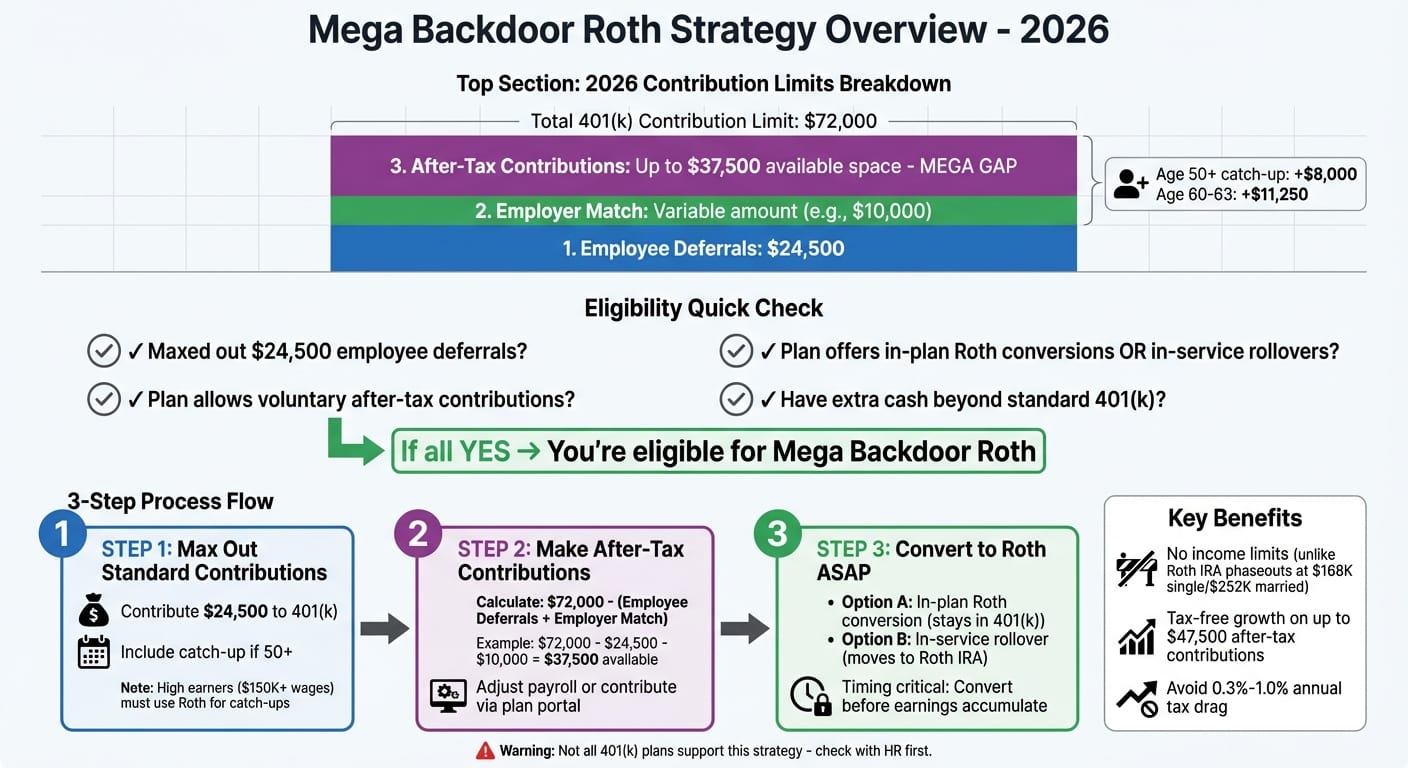
Here’s how it works: The strategy taps into the "Mega Gap" - the difference between your annual employee deferral limit ($24,500 in 2026) and the total IRS Section 415(c) limit for all 401(k) contributions ($72,000 in 2026). For instance, if you contribute the full $24,500 and your employer adds $10,000 as a match, you've used $34,500 of the $72,000 limit. That leaves $37,500 of available space for after-tax contributions, which can then be converted into a Roth account.
While after-tax contributions don’t offer an upfront tax deduction, converting them eliminates the annual tax drag (typically 0.3% to 1.0%), allowing your investments to grow tax-free. As Marcel Miu, Founder of Simplify Wealth Planning, explains:
"By failing to utilize the Backdoor and Mega Backdoor strategies, [high earners are] voluntarily opting into higher potential taxes in retirement".
To make the most of this strategy, it’s essential to understand its mechanics and the features required for implementation.
Key Features of a Mega Backdoor Roth
The Mega Backdoor Roth relies on three types of 401(k) contributions: employee deferrals, employer matches, and voluntary after-tax contributions. The third category is the cornerstone of this strategy, allowing you to contribute beyond the standard $24,500 employee limit.
For this to work, two key plan features must be in place:
- Voluntary After-Tax Contributions: Your employer’s 401(k) must allow these additional contributions. Note that these are not the same as Roth 401(k) contributions - they start in a non-Roth account, even though they’re made with after-tax dollars.
- Conversion Options: Your plan must permit either in-service distributions (rolling funds into a Roth IRA while still employed) or in-plan Roth conversions (moving funds directly into the Roth portion of your 401(k)).
Timing is critical. If after-tax contributions generate earnings before conversion, those earnings are taxable as ordinary income upon conversion. To avoid this, many plans now offer automatic daily conversions, which move after-tax contributions to the Roth bucket immediately, minimizing tax exposure.
Who Should Consider This Strategy?
This strategy is particularly appealing for high-income earners who have already maxed out their standard 401(k) contributions and still have extra cash to save. If your income disqualifies you from making direct Roth IRA contributions, the Mega Backdoor Roth provides a way to bypass those limits.
Ideal candidates include W-2 employees or business owners who:
- Have contributed the full $24,500 to their 401(k).
- Receive at least a modest employer match.
- Have enough discretionary income to make additional after-tax contributions.
The strategy works best if you have significant "Mega Gap" space available - unused room between your pre-tax contributions and the total 401(k) limit. As Commons Capital highlights:
"For high earners who are phased out of direct Roth IRA contributions due to their income, this is a game-changer".
2026 Contribution Limits and Eligibility Rules
The IRS has set new contribution limits for 2026 that determine how much you can allocate toward after-tax contributions and Roth conversions. Knowing these limits is essential for successfully using the Mega Backdoor Roth strategy.
401(k) Contribution Limits for 2026
In 2026, the employee elective deferral limit will rise to $24,500, which is $1,000 higher than the 2025 limit.
The Section 415(c) limit - which includes employee deferrals, employer matching or profit-sharing contributions, and voluntary after-tax contributions - will increase to $72,000. The difference between these two limits, often called the "Mega Gap", is the amount available for after-tax contributions.
For individuals aged 50 or older, an additional $8,000 catch-up contribution is allowed. Those aged 60–63 may qualify for an even higher "super" catch-up contribution of $11,250, if permitted. These catch-up contributions are not counted toward the $72,000 limit, potentially increasing your total contribution ceiling to $80,000 or $83,250. However, starting in 2026, if your FICA wages in 2025 exceeded $150,000, catch-up contributions must be made as Roth contributions.
Now let’s see how these limits stack up against the Roth IRA income thresholds for 2026.
Roth IRA Income Phaseouts
In 2026, Roth IRA contributions will phase out for single filers with a Modified Adjusted Gross Income (MAGI) between $153,000 and $168,000. Those earning $168,000 or more will not qualify for direct Roth IRA contributions. For married couples filing jointly, the phaseout range is between $242,000 and $252,000, with contributions entirely disallowed above $252,000.
As Commons Capital highlights:
The income limits that prevent direct Roth IRA contributions do not apply to this 401(k)-based approach.
This makes the Mega Backdoor Roth an attractive option for high earners who are otherwise restricted from contributing directly to a Roth IRA but still want the benefits of tax-free growth.
Plan Requirements for Eligibility
Your 401(k) plan's structure is key to implementing the Mega Backdoor Roth strategy. It’s not just about IRS contribution limits - your plan must support specific features.
Does Your Plan Allow After-Tax Contributions?
To make this strategy work, your plan needs to permit voluntary after-tax contributions. These are different from pre-tax and Roth contributions and are essential for filling the gap between the $24,500 employee deferral limit and the $72,000 total contribution cap for 2026. Unfortunately, many standard 401(k) plans don’t offer this option.
If you’re self-employed, you might need to switch to a custom Solo 401(k) provider. Companies like MySolo401k.net or OEBI can help, typically charging between $99 and $400 annually to enable after-tax contributions.
Start by reviewing your plan’s Summary Plan Description (SPD) for terms such as "voluntary after-tax contributions" or "non-Roth after-tax contributions." If the SPD isn’t clear, ask your HR department: "Does our plan allow voluntary after-tax contributions beyond the standard deferral limit?"
Once confirmed, you’ll also need to check how your plan handles these contributions to fully activate the strategy.
In-Plan Roth Conversions or Rollovers
Your plan must allow after-tax contributions to be converted into a Roth account. This can be done through one of two options:
- In-plan Roth conversions: This moves after-tax funds into a Roth 401(k) within the same plan. These conversions can often be automated - sometimes referred to as "Roth sweeps" or "rollover-as-you-go" - which reduces the tax impact on any earnings before conversion.
- In-service rollovers: This option lets you transfer after-tax contributions to an external Roth IRA while you’re still employed. While less automated, it offers more investment choices and eliminates required minimum distributions during your lifetime.
To confirm your plan’s capabilities, check your SPD for terms like "in-plan Roth conversion", "in-service distribution", or "automatic conversion." If you’re unsure, ask your plan administrator whether after-tax contributions can be converted automatically to Roth.
Once both features - after-tax contributions and conversion options - are verified, you’re ready to implement the Mega Backdoor Roth strategy, potentially leveraging tools like Mezzi for optimization.
How to Execute a Mega Backdoor Roth Contribution
Once you've confirmed your plan includes the necessary features, you can start implementing this strategy step by step. It's essential to follow each step carefully and stay within the IRS limits.
Step 1: Max Out Pre-Tax and Roth Contributions
Before diving into after-tax contributions, you need to hit the $24,500 employee deferral limit for 2026, which applies to your traditional or Roth 401(k) contributions through payroll deductions. If you're eligible for catch-up contributions, make sure to include them to reach your total deferral limit.
Important to note: If your Social Security wages in 2025 were above $150,000, the IRS requires that all catch-up contributions for 2026 go into a Roth account. This ensures that high earners pay taxes upfront on these additional contributions.
Step 2: Make After-Tax Contributions
Next, figure out how much room you have for after-tax contributions. Use this simple formula: $72,000 – (Employee Deferrals + Employer Contributions). For example, if you've already contributed $24,500 in employee deferrals and your employer added $10,000 in matching contributions, you'd have $37,500 left for after-tax contributions ($72,000 – $24,500 – $10,000).
To make these contributions, either adjust your payroll elections or manually contribute through your plan's portal. Be aware of ACP testing: If you're considered a Highly Compensated Employee (HCE), your after-tax contributions might be refunded if the plan fails nondiscrimination testing because lower-paid employees aren't contributing enough. Once the contributions are in, move quickly to convert them.
Step 3: Convert to a Roth Account
The final step is converting your after-tax funds to a Roth account as soon as possible to avoid taxable earnings.
You have two main options for conversion. In-plan Roth conversions move the funds into a Roth 401(k) subaccount within your current plan. Many plans offer "Roth sweeps", which automatically convert contributions right after each paycheck. Alternatively, in-service rollovers let you transfer the funds to an external Roth IRA while still employed. This option gives you more investment flexibility and exempts you from required minimum distributions during your lifetime.
Timing is everything. Converting the funds before they earn any taxable growth is crucial to avoid ordinary income taxes. Setting up automatic conversions can help ensure this happens seamlessly. Check with your plan administrator to see if they offer an "auto-convert" feature to make the process even easier.
Tax Implications and Common Mistakes
When working through a Mega Backdoor Roth strategy, it's critical to navigate potential tax issues and plan limitations carefully. Missteps could lead to unexpected costs or complications that derail your efforts.
Tax on Earnings During Conversion
While your after-tax contribution principal is not taxed during conversion, any investment earnings that accrue between the contribution and conversion dates are taxed as ordinary income. This tax liability grows the longer you delay the conversion.
"The longer your money sits in the 401(k) before conversion, the bigger those earnings become." - Robert, Retirement Planning Coach, Retirin
For example, if you contribute $10,000 on January 15 but wait until March 31 to convert, you might accumulate $500 in earnings. That $500 becomes taxable income. Your plan administrator will issue Form 1099-R, which lists the total conversion amount in Box 1 and the taxable earnings in Box 2a. To avoid double taxation, you'll need to file Form 8606 when rolling over to a Roth IRA.
Also, keep in mind the five-year rules. Each conversion starts its own five-year clock, and withdrawing converted principal before that period ends (if you're under age 59½) could result in a 10% early withdrawal penalty. Another five-year rule applies to when your entire Roth account becomes eligible for tax-free earnings withdrawals.
Plan Restrictions and Timing Issues
Plan-specific rules can further complicate your strategy. For example, failing your plan's ACP (Actual Contribution Percentage) testing could lead to refunds of after-tax contributions for highly compensated employees (HCEs). These refunds are taxed in the year they are issued.
Exceeding the $72,000 total contribution limit (Section 415(c)) can also trigger corrective actions. If your payroll system doesn't automatically stop after-tax contributions when the limit is reached, you may face corrective distributions and penalties. To avoid this, work with your payroll department to ensure contributions stop precisely at the cap. Additionally, some plans limit conversion frequency - such as allowing conversions only quarterly instead of monthly - giving taxable earnings more time to build up.
State tax laws can add even more complexity. For instance, states like California don’t align with federal Roth conversion rules, meaning you could owe state taxes even if the federal conversion is tax-free. Always check your state’s specific rules before proceeding.
Using Mezzi to Optimize Your Mega Backdoor Roth Strategy
Managing the details of a Mega Backdoor Roth can feel overwhelming, especially when it comes to navigating 401(k) rules. Mezzi simplifies the process by securely connecting all your accounts through read-only access and offering fiduciary-level guidance - without charging the typical 1% AUM fee.
Checking Eligibility and Plan Compatibility
One of the first steps in executing a Mega Backdoor Roth is confirming whether your 401(k) plan allows for voluntary, non-Roth after-tax contributions and supports either in-plan Roth conversions or in-service distributions. Mezzi handles this verification for you. By aggregating your accounts, it automatically calculates your remaining after-tax contribution capacity, helping you avoid exceeding annual limits.
The platform also simplifies navigating IRS rules, such as the Actual Contribution Percentage (ACP) test, ensuring your strategy aligns with compliance requirements.
Timing Conversions for Tax Efficiency
Timing is crucial when it comes to Roth conversions, and Mezzi’s tools make this easier. The Roth Conversion Optimizer and tax projection modeling work together to help you determine the best timing for conversions, reducing taxable earnings in the process.
Mezzi often recommends an immediate rollover strategy - converting after-tax deposits as soon as possible to limit the accumulation of taxable earnings. It also tracks your after-tax principal, ensuring accuracy when it’s time to review IRS Form 1099-R and file Form 8606. This streamlined approach ensures your conversions align with your broader retirement goals.
Complete Financial Picture
To truly optimize your Mega Backdoor Roth, it’s essential to consider your entire financial situation. Mezzi connects all your accounts - 401(k), Roth IRA, Traditional IRA, and taxable accounts - giving you a comprehensive view of your finances.
With this full picture, Mezzi evaluates how the Mega Backdoor Roth strategy fits into your overall plan. For example, it analyzes the Pro-Rata Rule, which treats all IRAs as a single bucket. If you have pre-tax funds in a Traditional, SEP, or SIMPLE IRA, a portion of your Roth conversion may be taxable. Mezzi helps you assess whether it’s better to address pre-tax balances before implementing your Mega Backdoor Roth strategy.
Need clarity? Ask Mezzi questions like, "Should I convert now or later?" to get personalized guidance tailored to your financial setup.
Conclusion: Is a Mega Backdoor Roth Right for You?
A Mega Backdoor Roth can be an excellent option for high earners who’ve already maxed out their traditional 401(k) contributions and still have extra funds to invest. This strategy allows you to contribute up to $47,500 in 2026 of after-tax income into a Roth account, offering the potential for tax-free growth and withdrawals during retirement. Plus, unlike regular Roth IRA contributions, there are no income limits - making it accessible even if your earnings exceed the $160,000 threshold that defines highly compensated employees.
This approach can help you sidestep the 0.3% to 1.0% annual tax drag caused by dividends, interest, and portfolio rebalancing in taxable accounts. It also provides added flexibility for early retirement and estate planning, as Roth IRAs don’t require minimum distributions for the original account holder. However, this strategy depends on whether your 401(k) plan allows after-tax contributions with conversion options. Additionally, if you have existing pre-tax IRA balances, you’ll need to be cautious about the pro-rata rule.
To take full advantage of these benefits, having a clear plan is key. Tools like Mezzi can simplify the process by linking your accounts, calculating how much you can still contribute, and ensuring compliance with IRS rules like ACP testing. Mezzi’s Roth Conversion Optimizer can even help you pinpoint the best time to convert, reducing taxable earnings in the process. You can ask questions like, "Is now the right time to convert?" and get tailored advice - all without paying a 1% AUM fee.
FAQs
How do I tell if my 401(k) supports a Mega Backdoor Roth?
To determine if your 401(k) plan supports a Mega Backdoor Roth, you’ll need to check for two key features:
- Voluntary, non-Roth after-tax contributions: Your plan must allow you to contribute additional after-tax dollars beyond the standard pre-tax or Roth contributions.
- In-service distributions or in-service non-hardship withdrawals: This allows you to move after-tax contributions out of your 401(k) while still employed, either to a Roth IRA or within the plan to a Roth 401(k).
You can find this information in your plan document or by reaching out to your plan administrator. If both features are included, your 401(k) is likely compatible with this strategy.
Will the pro-rata rule affect my Mega Backdoor Roth conversion?
The pro-rata rule can complicate a Mega Backdoor Roth conversion. This rule requires you to consider the ratio of pre-tax and after-tax funds across all your IRAs when performing the conversion. As a result, it could lead to additional tax liabilities, depending on the composition of your IRA balances.
To avoid surprises, it's crucial to carefully assess your IRA balances and understand how much of your funds are pre-tax versus after-tax. This will help you anticipate the potential tax impact before proceeding with the conversion.
What’s the easiest way to avoid taxes on earnings before conversion?
To minimize taxes on earnings before executing a Mega Backdoor Roth conversion, start by making after-tax contributions to your 401(k) plan - provided your employer allows it. Next, perform an in-service withdrawal or rollover to a Roth account. It’s crucial to confirm that your employer’s plan supports both after-tax contributions and in-service distributions to ensure the process stays tax-efficient.
Disclosures:
- This content is for informational purposes only and does not constitute investment advice or a recommendation to buy or sell any security.
- Past performance is not indicative of future results. No guarantee of future performance or outcomes is implied.
- Savings and performance examples are hypothetical and for illustrative purposes only. Actual results will vary based on individual circumstances, portfolio composition, market conditions, and fees.
Related Blog Posts
- Roth IRA Contribution Timing for High Earners
- What is a mega backdoor roth?
- Backdoor Roth IRA Step by Step: Rules, Limits, and Mistakes to Avoid
- I Make Too Much for a Roth IRA. What Are My Options?
To determine if your 401(k) plan supports a Mega Backdoor Roth, you’ll need to check for two key features:
- Voluntary, non-Roth after-tax contributions: Your plan must allow you to contribute additional after-tax dollars beyond the standard pre-tax or Roth contributions.
- In-service distributions or in-service non-hardship withdrawals: This allows you to move after-tax contributions out of your 401(k) while still employed, either to a Roth IRA or within the plan to a Roth 401(k).
You can find this information in your plan document or by reaching out to your plan administrator. If both features are included, your 401(k) is likely compatible with this strategy.
The pro-rata rule can complicate a Mega Backdoor Roth conversion. This rule requires you to consider the ratio of pre-tax and after-tax funds across all your IRAs when performing the conversion. As a result, it could lead to additional tax liabilities, depending on the composition of your IRA balances.
To avoid surprises, it's crucial to carefully assess your IRA balances and understand how much of your funds are pre-tax versus after-tax. This will help you anticipate the potential tax impact before proceeding with the conversion.
To minimize taxes on earnings before executing a Mega Backdoor Roth conversion, start by making after-tax contributions to your 401(k) plan - provided your employer allows it. Next, perform an in-service withdrawal or rollover to a Roth account. It’s crucial to confirm that your employer’s plan supports both after-tax contributions and in-service distributions to ensure the process stays tax-efficient.