
If your income exceeds the Roth IRA limits for 2026 - $168,000 for single filers and $252,000 for married couples filing jointly - you still have ways to save for retirement with tax advantages. Here’s a quick breakdown of your options:
- Backdoor Roth IRA: Contribute after-tax dollars to a traditional IRA, then convert to a Roth IRA. Watch out for the pro-rata rule, which may complicate taxes if you have pre-tax IRA balances.
- Mega Backdoor Roth: If your 401(k) allows after-tax contributions, you could contribute up to $72,000 (including employer match) and convert to a Roth account.
- Other Options: Maximize 401(k) deferrals ($24,500 for 2026, or $32,500 if you're 50+), use Health Savings Accounts (HSAs), or invest in taxable brokerage accounts for flexibility.
These strategies can help you achieve tax-free growth, but they require careful planning to avoid mistakes like penalties or unexpected taxes. Tools like Mezzi can simplify the process by analyzing your accounts and guiding you through these options effectively.
The Ultimate Backdoor Roth IRA Guide (Step-by-Step)
2026 Roth IRA Income Limits Explained
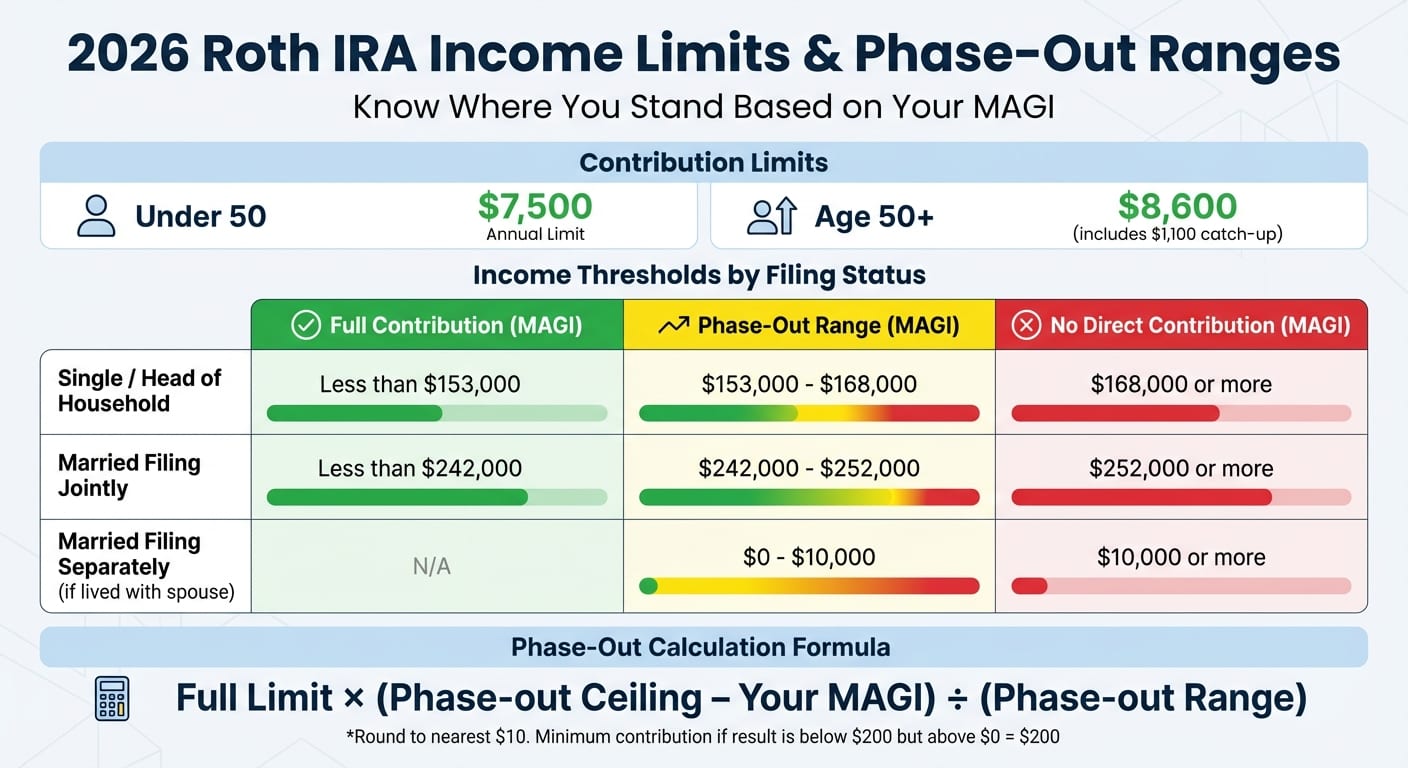
The IRS doesn’t enforce a hard cutoff for Roth IRA contributions; instead, there’s an income phase-out range. Within this range, your allowed contribution gradually decreases until it reaches zero. Knowing where your modified adjusted gross income (MAGI) falls in this range is key to determining your contribution eligibility.
Income Thresholds for 2026
In 2026, Roth IRA contribution limits are set at $7,500 for individuals under 50 and $8,600 for those 50 or older (which includes the $1,100 catch-up contribution). However, your MAGI and filing status determine whether you can contribute the full amount, a reduced amount, or nothing at all. Here’s a quick overview:
If your MAGI falls within the phase-out range, you’ll need to calculate your reduced contribution. Use this formula:
Full Limit × (Phase-out Ceiling – Your MAGI) ÷ (Phase-out Range).
Round the result to the nearest $10. If the amount is below $200 but greater than zero, the minimum contribution allowed is $200.
Here’s how it works in practice:
- Example 1: Sarah, a 45-year-old single filer with a MAGI of $160,000, falls into the $153,000–$168,000 phase-out range. Her reduced contribution is:
(168,000 – 160,000) ÷ 15,000 = 0.533
0.533 × $7,500 = approximately $4,000.
- Example 2: A married couple filing jointly with a MAGI of $250,000 falls into the $242,000–$252,000 range. Their calculation is:
(252,000 – 250,000) ÷ 10,000 = 0.2
0.2 × $7,500 = $1,500 per person.
Next, understanding how to calculate your MAGI is essential for determining eligibility.
How to Calculate Your MAGI
Your MAGI isn’t the same as your gross income or even your adjusted gross income (AGI). For Roth IRA purposes, start with your AGI (Line 11 of IRS Form 1040) and add back certain deductions that lower your taxable income. Specifically, add back these items:
- Student loan interest deductions
- Foreign earned income and housing exclusions
- Tuition and fees deductions
- Adoption benefits excluded from income
However, pre-tax contributions to accounts like a 401(k) or Health Savings Account (HSA) lower your MAGI and are not added back. As SDO CPA explains:
"Your pre-tax solo 401(k) contributions reduce MAGI... That could be the difference between Roth eligibility and phase-out".
One important note: MAGI for Roth IRA eligibility does not include income from a Roth IRA conversion. Getting your MAGI calculation right is crucial for making informed decisions about retirement strategies, such as using a backdoor Roth IRA. These strategies can help cut retirement taxes by securing tax-free growth for your savings.
The Backdoor Roth IRA Strategy
If your income is too high to qualify for direct Roth IRA contributions, the backdoor Roth IRA offers a way around this restriction. It's not a special account but rather a two-step process. First, you make a nondeductible contribution to a traditional IRA - there are no income limits for this. Then, you convert that contribution to a Roth IRA, which allows conversions regardless of income. This method remains a legal and effective strategy, as confirmed by the One Big Beautiful Bill Act of July 2025. It's a practical option for maximizing retirement savings when direct contributions aren't possible.
Once your funds are in a Roth IRA, they grow tax-free, and withdrawals are also tax-free. Plus, there are no required minimum distributions. For high earners who expect to retire in the same or a higher tax bracket, this can translate into major tax savings over time.
Jim Dahle, founder of White Coat Investor, highlights the IRS's stance on this process:
The IRS clarified in early 2018 that no waiting period is required between the contribution and conversion steps of the Backdoor Roth IRA. It has essentially given its blessing on the whole process.
Steps to Complete a Backdoor Roth IRA
- Make a nondeductible contribution to a traditional IRA.
In 2026, contribution limits are $7,500 if you're under 50 or $8,600 if you're 50 or older. These contributions are made with after-tax dollars, so they don't qualify for a tax deduction.
- Wait for the funds to settle.
Allow 24–48 hours for the funds to settle in cash or a money market fund. Some custodians, like Fidelity, may require specific steps, such as using a money market fund like SPAXX, to avoid longer settlement delays.
- Convert the traditional IRA to a Roth IRA.
Once the funds have settled, initiate the conversion. Acting quickly helps reduce the chance of taxable gains accumulating in the traditional IRA before the conversion.
- File IRS Form 8606.
This form records your after-tax contributions and confirms that taxes have already been paid, ensuring the conversion itself isn't taxed.
The Pro-Rata Rule and Tax Implications
One important factor is the IRS's pro-rata rule, which applies to all conversions. This rule requires you to account for all your IRA balances - traditional, SEP, and SIMPLE - when converting funds. You can't just convert the after-tax dollars; the taxable and non-taxable portions are calculated proportionally.
To figure out the non-taxable portion, divide your after-tax contributions by your total IRA balance on December 31. For instance, if you have $92,500 in pre-tax IRA funds and add a $7,500 nondeductible contribution, your total balance becomes $100,000. In this case, only 7.5% of your conversion would be tax-free, while the rest would be taxable.
Artha Taxes emphasizes this point:
The IRS does not allow you to 'cherry-pick' only the nondeductible (after-tax) dollars for conversion if you own other pre-tax IRAs.
To avoid the pro-rata rule's tax complications, you might consider a reverse rollover. This involves transferring pre-tax IRA balances into your employer's 401(k) plan if rollovers are allowed. Because workplace plans aren't included in the pro-rata calculation, this move can help ensure a tax-free conversion. It's also worth noting that the pro-rata rule applies individually, so one spouse's IRA balances won't affect the other's conversion.
Mezzi simplifies these calculations by reviewing your IRA balances before you proceed.
How Mezzi Helps with Backdoor Roth Conversions
Navigating the pro-rata rule can be tricky, but Mezzi offers tools to simplify the process. Mezzi reviews your IRA balances, models potential tax outcomes, and advises on strategies like reverse rollovers to make the conversion as efficient as possible. After the conversion, Mezzi keeps track of your after-tax basis, aggregating data from all your financial accounts. This allows it to provide a comprehensive view of how the conversion fits into your broader tax strategy, helping you decide the best timing for your conversion - whether that's this year or later.
Other Retirement Savings Options for High Earners
For high earners, building retirement wealth often requires exploring beyond the backdoor Roth strategy. There are several tax-advantaged tools available, each with its own perks and limitations. Finding the right fit depends on your financial goals and situation.
Nondeductible Traditional IRA Contributions
Even if your income is too high for a tax-deductible contribution, you can still contribute to a traditional IRA. For 2026, the contribution limits are $7,500 if you're under 50, or $8,600 if you're 50 or older. The downside? No tax deduction for high-income earners.
These contributions can play a role in a backdoor Roth IRA strategy. However, if you don't convert the funds, make sure to file IRS Form 8606 each year. This form tracks your basis, ensuring you don’t pay taxes twice on the money you’ve already contributed when you eventually withdraw it.
Mega Backdoor Roth Through Your 401(k)
Some 401(k) plans offer a mega backdoor Roth option, which can significantly boost your retirement savings. After maxing out your employee deferral limit of $24,500 for 2026, you may be able to make additional after-tax contributions. Keep in mind, the total contribution limit - combining your deferrals, employer match, and after-tax contributions - caps at $72,000 for 2026.
Once you make after-tax contributions, you can convert them through an in-plan conversion or an in-service rollover. Timing is crucial here; converting the after-tax dollars quickly minimizes taxable earnings. Unlike a traditional backdoor Roth IRA, this strategy usually avoids the pro-rata rule since 401(k) assets are treated separately from IRAs.
Before diving into this option, confirm with your HR department whether your 401(k) plan permits after-tax contributions. For instance, if your employer provides a $10,000 match and you defer $24,500, you could contribute an additional $37,500 in after-tax dollars for conversion.
Taxable Brokerage Accounts and Health Savings Accounts (HSAs)
If these strategies don’t fully align with your needs, taxable brokerage accounts and HSAs provide additional flexibility.
- Taxable brokerage accounts: These accounts have no contribution limits and allow easy access to funds. By holding investments for over a year, you may benefit from lower long-term capital gains tax rates (typically 15% or 20%) instead of higher ordinary income tax rates. This makes them a great option for both retirement and non-retirement goals.
- HSAs: If you're enrolled in a High Deductible Health Plan, HSAs offer a triple tax benefit. For 2026, you can contribute $4,400 for individual coverage or $8,750 for family coverage, with an extra $1,000 catch-up contribution if you’re 55 or older. Contributions are tax-deductible, earnings grow tax-deferred, and withdrawals for qualified medical expenses are tax-free. After age 65, you can use the funds for non-medical expenses, though they’ll be taxed as ordinary income. Medical withdrawals remain tax-free at any age.
Streamlining Your Strategy with Mezzi
Mezzi simplifies the process by integrating these account options into a cohesive retirement plan. It provides complete visibility across accounts, helping you identify opportunities like tax-loss harvesting or capital gains deferral or the best timing for Roth conversions. With Mezzi, you can align each account with your long-term financial objectives, ensuring your strategy works efficiently as a whole.
How Mezzi Optimizes Your Retirement Strategy
Mezzi takes retirement planning to the next level by simplifying account management and streamlining tax strategies. Managing multiple retirement accounts while dealing with complex tax rules can be daunting, especially when tackling strategies like backdoor Roth conversions or mega backdoor Roths. Mezzi makes this process easier by connecting all your accounts through secure, read-only access and offering fiduciary-level advice - without charging the typical 1% AUM fee.
Complete Account Visibility
Mezzi brings all your accounts - 401(k), traditional IRA, Roth IRA, HSA, and taxable accounts - into one unified platform using secure, read-only integrations via Plaid and Finicity. This is especially critical for high earners using backdoor Roth strategies, where the pro-rata rule requires a clear picture of your entire IRA balance. With Mezzi, you can instantly view the tax impact across all your accounts, eliminating the need for manual calculations and multiple platform logins.
Tax Optimization Guidance
Mezzi offers year-round tax optimization insights tailored to your situation. The platform helps you navigate the pro-rata rule and ensures Roth conversions are timed to minimize taxable earnings between contributions and conversions. Mezzi also evaluates your tax bracket and projected income to recommend the ideal timing for conversions. Additionally, it flags wash sale risks and identifies tax-loss harvesting opportunities across your linked accounts. Need answers at odd hours? Mezzi provides personalized responses within minutes, so you’re not left waiting days for a traditional advisor to get back to you.
Pricing Plans and Features
Mezzi offers three pricing tiers designed for high earners seeking expert guidance and control:
- Core Plan: $299/year. Includes unlimited AI chat, 24/7 monitoring, portfolio analysis, and tax optimization tools.
- Plus Plan: $499/year. Adds advanced AI features, deeper research capabilities, early access to new tools, and concierge support via video, phone, and email.
- White Glove Plan: $1,499/year. Includes everything in the Plus plan, along with personalized AI coaching via video and unlimited support calls.
All plans provide SEC-registered fiduciary services, ensuring Mezzi operates with your best interests in mind. This pricing structure allows you to access expert-level guidance while keeping your retirement strategy on track.
Conclusion
Earning above the Roth IRA income limits requires a bit more planning, but it opens up some effective strategies for building tax-free retirement savings. The Backdoor Roth IRA is a straightforward option for high earners, allowing contributions of $7,500 annually (or $8,600 if you're 50 or older) via a nondeductible Traditional IRA, followed by a conversion. Just be mindful of the pro-rata rule if you have pre-tax IRA balances.
For those with access to a 401(k) plan that supports after-tax contributions and in-service distributions, the Mega Backdoor Roth is a powerful way to maximize contributions - up to $72,000 in 2026. Always check with your plan administrator to confirm eligibility.
Don’t stop at Roth strategies. Take advantage of other tax-advantaged options like maximizing 401(k) deferrals ($24,500 for 2026, or $32,500 if you’re 50 or older), leveraging HSAs, and managing taxable accounts. The key is understanding how these strategies fit together and align with your unique tax situation.
Tools like Mezzi can make this process much easier. By consolidating your retirement accounts into one platform, Mezzi helps you stay on top of pro-rata rule considerations, track conversion timing, and uncover year-round tax optimization opportunities. Whether you’re tackling your first Backdoor Roth or juggling multiple retirement savings strategies, having clear, data-driven insights can make all the difference.
Earning above the Roth IRA limit is a good problem to have, and with the right approach - and the right tools - you can still achieve meaningful, tax-free savings for retirement.
FAQs
How do I know if the pro-rata rule will make my backdoor Roth taxable?
The pro-rata rule can complicate your backdoor Roth IRA conversion if you have pre-tax IRA balances. Essentially, this rule requires you to calculate the ratio of pre-tax to after-tax funds across all your IRAs when making the conversion. This calculation determines how much of the converted amount might be taxable.
To steer clear of unexpected tax bills, it’s a good idea to review your total IRA balances beforehand. Consulting a tax professional can also help you navigate the potential tax implications and ensure you’re making informed decisions.
Can I roll my pre-tax IRA into my 401(k) to avoid pro-rata taxes?
If your goal is to avoid pro-rata taxes, you can't simply roll a pre-tax IRA into your 401(k) for that reason alone. That said, if your 401(k) plan accepts rollovers, you could transfer pre-tax IRA funds into the 401(k). This might help isolate the after-tax funds in your IRA, which could lessen the impact of pro-rata tax calculations.
Does my 401(k) plan allow a mega backdoor Roth, and how do I check?
To determine if your 401(k) plan supports a mega backdoor Roth, you'll need to check two key features: whether it allows after-tax contributions and whether it permits in-service withdrawals or conversions of those contributions to a Roth account. You can find this information by reviewing your plan documents or reaching out to your plan administrator. Be sure to specifically ask about after-tax contribution options and whether in-service distributions or conversions to a Roth IRA or Roth 401(k) are available.
Disclosures:
- This content is for informational purposes only and does not constitute investment advice or a recommendation to buy or sell any security.
- Past performance is not indicative of future results. No guarantee of future performance or outcomes is implied.
- Savings and performance examples are hypothetical and for illustrative purposes only. Actual results will vary based on individual circumstances, portfolio composition, market conditions, and fees.
- Registration does not imply a certain level of skill or that the SEC has approved the company or its services.
Related Blog Posts
- Roth IRA Contribution Timing for High Earners
- What is a mega backdoor roth?
- Can I contribute to a Roth IRA if I’ve already contributed to a Traditional IRA (including backdoor options)?
- Backdoor Roth IRA Step by Step: Rules, Limits, and Mistakes to Avoid
The pro-rata rule can complicate your backdoor Roth IRA conversion if you have pre-tax IRA balances. Essentially, this rule requires you to calculate the ratio of pre-tax to after-tax funds across all your IRAs when making the conversion. This calculation determines how much of the converted amount might be taxable.
To steer clear of unexpected tax bills, it’s a good idea to review your total IRA balances beforehand. Consulting a tax professional can also help you navigate the potential tax implications and ensure you’re making informed decisions.
If your goal is to avoid pro-rata taxes, you can't simply roll a pre-tax IRA into your 401(k) for that reason alone. That said, if your 401(k) plan accepts rollovers, you could transfer pre-tax IRA funds into the 401(k). This might help isolate the after-tax funds in your IRA, which could lessen the impact of pro-rata tax calculations.
To determine if your 401(k) plan supports a mega backdoor Roth, you'll need to check two key features: whether it allows after-tax contributions and whether it permits in-service withdrawals or conversions of those contributions to a Roth account. You can find this information by reviewing your plan documents or reaching out to your plan administrator. Be sure to specifically ask about after-tax contribution options and whether in-service distributions or conversions to a Roth IRA or Roth 401(k) are available.