
If you’re in a low-income year - whether due to a job change, early retirement, or a sabbatical - it might be the perfect time to consider a Roth conversion. Even if you usually have a high income, you may still be eligible to convert. Here's why:
- Lower Tax Bracket: Converting during a low-income year lets you pay taxes at a lower rate on the converted amount.
- Tax-Free Growth: Once converted, your investments grow tax-free in a Roth IRA, and withdrawals in retirement won’t be taxed.
- Avoid Future RMDs: Roth IRAs don’t require mandatory withdrawals, unlike traditional IRAs, giving you more control over your retirement funds.
- Estate Planning: Heirs can inherit Roth IRAs tax-free, making it a smarter option for passing down wealth.
However, conversions come with immediate tax implications. The converted amount is added to your taxable income, potentially pushing you into a higher bracket or increasing Medicare premiums. Careful planning is essential to avoid these pitfalls.
Key Tip: Convert only as much as you can without exceeding your current tax bracket or triggering extra costs like Medicare IRMAA surcharges. Using tools or consulting a financial advisor can help you calculate the optimal amount.
If timed correctly, a Roth conversion in a low-income year can cut retirement taxes and provide long-term financial flexibility.
How Roth Conversions Work and Why Low-Income Years Matter
What Is a Roth Conversion?
A Roth conversion involves moving money from a tax-deferred account, like a traditional IRA or 401(k), into a Roth IRA. While this process triggers income taxes on the converted amount, it sets the stage for tax-free growth and withdrawals in the future. Importantly, there’s no limit to how much you can convert in a single year, even in 2026.
However, keep in mind that Roth conversions are permanent - once done, they cannot be reversed. Additionally, any converted funds must stay in the Roth IRA for at least five years to avoid a 10% early withdrawal penalty if you're under 59½.
This approach becomes especially advantageous during low-income years, as it allows for strategic tax planning.
Why Low-Income Years Create Better Opportunities
When you convert funds to a Roth IRA, the amount adds to your taxable income for that year. This means the tax you pay on the conversion depends on your marginal tax rate. If your income is lower, your tax rate will likely be lower too, making the conversion more cost-effective. For instance, staying within the 10% or 12% tax brackets is far less expensive than converting at higher rates like 22%.
Financial planners often recommend converting just enough to stay within your current tax bracket without spilling over into a higher one. This strategy optimizes tax efficiency. For example, in 2026, married couples filing jointly can earn up to $24,800 before leaving the 10% bracket and up to $100,800 before moving into the 22% bracket.
"A Roth conversion benefits those whose tax rates are lower now than they will likely be in the future." – Beth Pinsker, Financial Columnist, Morningstar
The best time for many people to consider a Roth conversion is during the retirement "sweet spot." This period typically occurs after you’ve stopped working but before you begin claiming Social Security or taking Required Minimum Distributions. Market downturns also create an added advantage - converting when asset values are lower reduces the taxable amount while allowing for greater future tax-free growth.
The Roth Conversion Most Retirees Miss
Benefits of Converting During a Low-Income Year
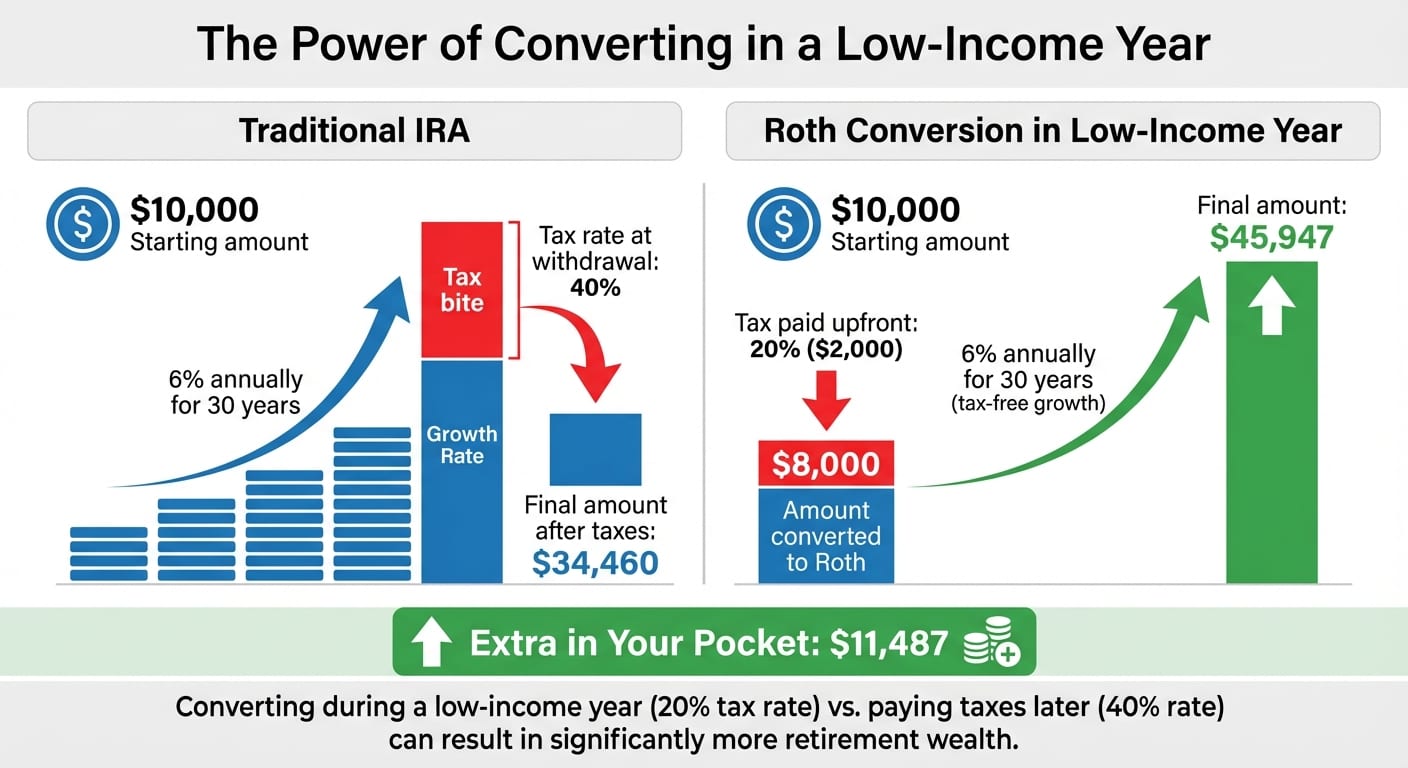
Taking advantage of a low-income year to convert to a Roth IRA can provide several long-term financial benefits.
Tax-Free Growth and Withdrawals
One of the biggest perks of a Roth IRA is tax-free growth. Once you convert, any earnings on your investments grow without being taxed. Here's an example: Imagine you have $10,000 in a traditional IRA growing at 6% annually for 30 years. After factoring in a 40% tax, you'd end up with about $34,460. But if you convert that same amount during a low-income year and pay taxes at a 20% rate, you'd start with $8,000 in a Roth IRA. That $8,000 could grow tax-free to around $45,947 - an extra $11,487 in your pocket.
This benefit becomes even more valuable in retirement. Qualified withdrawals from a Roth IRA are completely tax-free, which gives you more control over your taxable income. This can help you avoid crossing income thresholds that trigger additional taxes, like the 3.8% net investment income tax for married couples with a modified adjusted gross income (MAGI) above $250,000. Beyond the tax-free growth, Roth conversions come with other strategic advantages.
Eliminating Required Minimum Distributions
Roth IRAs also free you from the hassle of required minimum distributions (RMDs). Unlike traditional IRAs, which force you to start withdrawing funds at age 73, Roth IRAs let you keep your money invested for as long as you like. RMDs from traditional IRAs can push you into higher tax brackets, increase the taxable portion of your Social Security benefits, and even lead to higher Medicare premiums. On top of that, failing to take an RMD results in a steep 25% penalty. By converting during a low-income year, you can sidestep these forced withdrawals entirely, allowing your investments to grow tax-free for longer.
Estate Planning Benefits
"Many people in their 70s and 80s make Roth conversions less for their own benefit and more as a thoughtful gift to the next generation." – Drew Coleman, CFA and Sarah Bourdon, CFP, The Next Level Planning Group
Roth IRAs can also simplify estate planning. Heirs inherit Roth IRAs tax-free, though they are generally required to empty the account within 10 years under current rules. Importantly, those withdrawals don’t count as taxable income. For instance, a $1 million traditional IRA might leave heirs with only $680,000 after taxes. But if you convert that same IRA in a 22% tax bracket, your heirs could receive approximately $780,000 - a $100,000 difference.
Additionally, for married couples, converting while filing jointly can be particularly effective. The surviving spouse may benefit from wider tax brackets compared to filing as an individual, making this strategy even more appealing.
Drawbacks and Tax Considerations
While low-income years can provide opportunities for Roth conversions, there are some immediate financial challenges to keep in mind.
Immediate Tax Liability
A Roth conversion generates a tax bill in the same year you convert, as the entire converted amount is added to your adjusted gross income and taxed as ordinary income. This can push you into a higher tax bracket and increase the tax rate on your other income sources. For example, if your income is $80,000 and you convert $30,000, part of your income may shift from the 12% to the 22% tax bracket.
Conversions are permanent and cannot be undone, so careful planning is essential. Financial advisors often suggest using funds outside your IRA to cover the taxes. If you use IRA funds to pay the tax, it reduces the amount left to grow tax-free and could trigger a 10% early withdrawal penalty if you're under 59½.
"Roth conversion is not only a tax decision. It's a cash flow decision." – Danni Shen, CFA at Allset Wealth
Additionally, conversions might lead to higher taxation of Social Security benefits. To avoid these issues, consider spreading conversions across multiple years and leaving a buffer of $5,000 to $10,000 below the IRMAA thresholds to account for unexpected capital gains or dividends at the end of the year.
Beyond the tax bill, Roth conversions can have broader financial implications.
Impact on Medicare Premiums and Financial Aid
Roth conversions can also affect Medicare premiums and financial aid eligibility. Conversions increase your Modified Adjusted Gross Income (MAGI), which can trigger Income-Related Monthly Adjustment Amounts (IRMAA) for Medicare Part B and Part D premiums. Medicare uses a two-year lookback period, so a conversion in one year may increase premiums two years later. For example, while the standard Medicare Part B premium for 2026 is $202.90 per month, IRMAA surcharges can significantly raise those costs.
IRMAA thresholds are strict - exceeding the limit by even $1 can push you into a higher premium tier. For married couples filing jointly in 2025, crossing the $212,000 threshold by just $1 could increase monthly premiums from $185 to $259, adding about $1,776 annually.
If you're not yet on Medicare, a higher MAGI from a conversion may disqualify you from Premium Tax Credits on the federal health insurance marketplace. It could also make it harder to deduct unreimbursed medical expenses, which must exceed 7.5% of your AGI, and may reduce financial aid eligibility for college-age children if your MAGI rises significantly.
The 5-Year Withdrawal Rule
Each Roth conversion starts its own five-year clock. If you withdraw converted funds within five years and you're under 59½, you'll face a 10% penalty. This rule applies separately to each conversion, not to your Roth IRA as a whole.
If you're over 59½, you can withdraw the converted principal without penalty, even if the five-year period isn't complete. However, if your Roth IRA itself is less than five years old, any earnings withdrawn will still be subject to ordinary income tax. This makes Roth conversions less appealing if you need quick access to the funds, as the money benefits most from growing over time in a tax-advantaged account.
How to Execute a Roth Conversion
If you've determined that a Roth conversion fits into your low-income year strategy, the next step is figuring out how much you can convert without triggering unexpected tax consequences.
Calculate Your Tax Bracket and Conversion Limit
To stay within your current tax bracket, calculate your taxable income. This involves factoring in your Adjusted Gross Income (AGI), any tax-exempt interest, and deductions. For 2026, the standard deduction is $16,100 for individuals, with an additional $6,000 senior deduction available through 2028.
The gap between your current taxable income and the top of your target bracket shows how much you can convert. For instance, if you're married and filing jointly with $60,000 in taxable income, you could convert up to $40,800 without exceeding the 22% bracket threshold of $100,800. Keep in mind that conversions are taxed in layers - only the portion that crosses into a higher bracket is taxed at the higher rate.
A single dollar over the line moves you into the next tier for a full year. Knowing exactly where your income sits relative to the next cliff is the only way to make sure you are not making a costly mistake.
It's wise to leave a buffer of $5,000–$10,000 below any tax bracket or IRMAA (Income-Related Monthly Adjustment Amount) thresholds. This cushion helps protect against unexpected year-end gains or dividends. Once you've established your limits, decide whether a partial or full conversion makes the most sense for your situation.
Decide Between Partial and Full Conversions
Partial conversions are often the better choice, as they allow you to spread the conversion over several years. This helps keep you in lower tax brackets, manage your tax bill, and avoid IRMAA surcharges. This approach is particularly helpful if you have a gap between early retirement and the start of Social Security for early retirement or Required Minimum Distributions (RMDs).
Full conversions might work in rare low-income years. For example, if you retire at 62 but delay Social Security until 70, you may have a window of minimal income. However, converting too much in one year could lead to higher taxes and reduce your portfolio's overall value. For instance, a couple who stayed within the 12% tax bracket saved more over their lifetime compared to converting into the 22% bracket.
To meet the December 31 deadline, finalize your conversions by early December. Pay the taxes using cash from a separate taxable account rather than withholding from the IRA itself. This helps preserve the full value of your retirement account. Additionally, use available tools to refine your strategy.
Get Personalized Analysis with Mezzi
Mezzi offers tailored insights by analyzing your connected accounts to determine the ideal conversion amount based on your income and tax details. By securely aggregating your accounts, Mezzi calculates your taxable income, projects the tax impact of different conversion amounts, and weighs these against long-term benefits like tax-free growth and avoiding future RMDs.
The platform also helps you identify how much "headroom" remains before hitting the next tax bracket or IRMAA threshold. This ensures you avoid costly errors. For example, in October 2025, financial planners Cody Garrett and Sean Mullaney shared a 2026 scenario for a 65-year-old couple, Robert and Natasha. By executing a $41,500 Roth conversion, they incurred no federal tax liability. Thanks to the combined 2026 standard and senior deductions totaling $47,500, their taxable income was effectively reduced to $0. Mezzi's analysis finds opportunities like this using your actual account data - not theoretical models - so you can make well-informed decisions without moving your assets to a new platform.
Conclusion
A year with lower income can be an ideal time to consider a Roth conversion. By paying taxes at a reduced rate now, you open the door to decades of tax-free growth and withdrawals, while sidestepping required minimum distributions and potential future surcharges.
The key is precision: convert only as much as you can without pushing yourself into higher tax brackets or triggering additional Medicare premiums and Social Security taxes.
To simplify this process, Mezzi offers a unique advantage. It connects all your accounts to calculate your taxable income, identify your available conversion space, and project the long-term benefits of your conversion. Unlike many traditional advisors who only view the assets they manage, Mezzi provides a full financial picture, helping you make well-informed decisions without needing to move your accounts. This approach aligns perfectly with the strategies outlined earlier.
Whether you're retiring early, taking a break from work, or navigating a temporary income drop, this window of opportunity won’t last forever. Make the most of it, and you could potentially save tens of thousands in lifetime taxes while creating a more flexible and tax-efficient retirement plan.
FAQs
How do I know how much to convert without jumping tax brackets?
To keep from bumping into a higher tax bracket during a Roth conversion, start by estimating your total income for the year. Then, compare it to the threshold of your current tax bracket. The difference between your income and the threshold will show you the maximum amount you can safely convert without triggering a higher tax rate. Watching for income dips and using tools or calculators to fine-tune your numbers can help you stay within your target bracket.
Will a Roth conversion raise my Medicare premiums or ACA subsidies?
A Roth conversion can increase your taxable income, which might lead to higher Medicare premiums because of IRMAA (Income-Related Monthly Adjustment Amount) if the conversion amount is significant. However, it’s important to note that this does not affect ACA subsidies. Carefully consider how much you choose to convert to avoid unexpected premium hikes and ensure the approach fits within your broader financial plans.
Should I pay the conversion tax from cash or from the IRA?
Paying the conversion tax with cash, rather than withdrawing from your IRA, is often the smarter move. Why? Using cash ensures your IRA balance stays intact, giving those funds more opportunity to grow either tax-deferred or tax-free over time. On the other hand, tapping into your IRA to cover taxes can shrink the account's growth potential, potentially undercutting the long-term advantages of a Roth conversion. If possible, using cash from outside the IRA typically offers a better outcome.
Disclosures:
- This content is for informational purposes only and does not constitute investment advice or a recommendation to buy or sell any security.
- Past performance is not indicative of future results. No guarantee of future performance or outcomes is implied.
- Savings and performance examples are hypothetical and for illustrative purposes only. Actual results will vary based on individual circumstances, portfolio composition, market conditions, and fees.
Related Blog Posts
- 7 Steps to Minimize Taxes on Retirement Withdrawals
- Roth vs. Traditional IRA: Tax Implications for High Earners
- Why should I avoid pushing into a higher tax bracket when doing Roth conversions?
- How to Do a Roth Conversion Ladder in Early Retirement
To keep from bumping into a higher tax bracket during a Roth conversion, start by estimating your total income for the year. Then, compare it to the threshold of your current tax bracket. The difference between your income and the threshold will show you the maximum amount you can safely convert without triggering a higher tax rate. Watching for income dips and using tools or calculators to fine-tune your numbers can help you stay within your target bracket.
A Roth conversion can increase your taxable income, which might lead to higher Medicare premiums because of IRMAA (Income-Related Monthly Adjustment Amount) if the conversion amount is significant. However, it’s important to note that this does not affect ACA subsidies. Carefully consider how much you choose to convert to avoid unexpected premium hikes and ensure the approach fits within your broader financial plans.
Paying the conversion tax with cash, rather than withdrawing from your IRA, is often the smarter move. Why? Using cash ensures your IRA balance stays intact, giving those funds more opportunity to grow either tax-deferred or tax-free over time. On the other hand, tapping into your IRA to cover taxes can shrink the account's growth potential, potentially undercutting the long-term advantages of a Roth conversion. If possible, using cash from outside the IRA typically offers a better outcome.