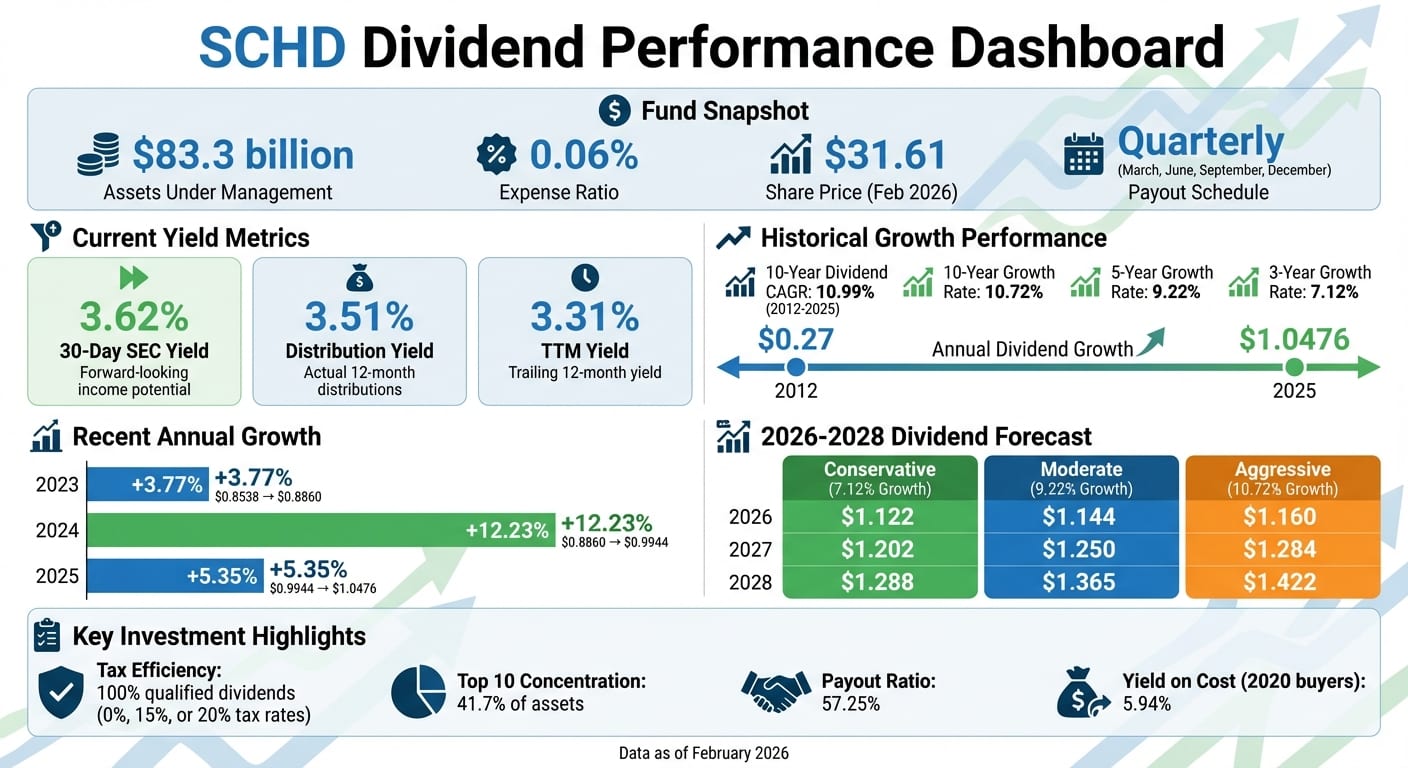
The Schwab U.S. Dividend Equity ETF™ (SCHD) is a popular choice for income-focused investors. As of February 13, 2026, SCHD manages $83.3 billion in assets and offers a low expense ratio of just 0.06%. Here's a quick summary of its key metrics:
- Current Yield: 3.62% (30-day SEC yield)
- 5-Year Dividend Growth Rate: 5.35%
- Annual Dividend (2025): $1.0476 per share
- Share Price (Feb 2026): $31.61
- Payout Schedule: Quarterly (March, June, September, December)
SCHD has consistently grown dividends since its launch in 2011, with a 10-year CAGR of 10.99%. Its dividends are mostly qualified, offering tax advantages for investors. Looking ahead, projections suggest annual dividends could reach $1.288–$1.422 by 2028, depending on growth rates. SCHD's portfolio is concentrated, with 41.7% of assets in its top 10 holdings, and its exposure to sectors like energy may introduce some variability.
With competitive yields, steady growth, and tax efficiency, SCHD remains an option for long-term dividend-focused portfolios.
SCHD ETF ALERT (Is Dividend Growth Slowing?)
SCHD's Current Dividend Yield
As of February 13, 2026, SCHD is trading at $31.61 per share, providing a foundation to assess its income performance. Let's break down its key yield metrics to understand its current income potential before diving into historical trends and future projections.
February 2026 Yield Metrics
SCHD uses three primary yield measurements to reflect its income performance:
- The 30-day SEC Yield stands at 3.62%, offering a forward-looking view of income potential after accounting for the fund's 0.06% expense ratio. This metric allows for standardized comparisons across funds.
- The Distribution Yield is 3.51%, representing the actual cash distributions investors received over the past 12 months relative to the current net asset value.
- The Trailing 12-Month (TTM) Yield comes in at 3.31%, calculated using SCHD's $1.05 annual dividend payout divided by the current share price.
Here’s a quick summary of these metrics for February 2026:
These figures show a slight dip compared to the 3.74%–3.91% range observed in 2025. The primary driver? Share price growth, which compresses yields proportionally.
For long-term investors, SCHD's performance becomes even more compelling. Those who purchased shares in 2020 at a split-adjusted price of $17.50 now enjoy a yield on cost of 5.94%. This illustrates the effect of dividend growth and reinvestment over time.
While these current figures are insightful, SCHD's historical dividend trends offer even more context for its overall performance.
SCHD's Historical Dividend Growth Rate
Since its launch in October 2011, SCHD has consistently increased its dividend every year.
The fund boasts a 10-year dividend growth rate of 10.72%, with a compound annual growth rate (CAGR) of 10.99% from 2012 to 2025. Over the past three years, SCHD's dividend growth rate stands at 7.12%. Recent annual growth includes a 3.77% increase in 2023 (from $0.8538 to $0.8860), a 12.23% jump in 2024 (from $0.8860 to $0.9944), and a 5.35% rise in 2025 (from $0.9944 to $1.0476).
3-Year and Long-Term Growth Analysis
In its earlier years, SCHD achieved impressive annual dividend increases, with growth rates of 19.79% in 2019 and 17.64% in 2020. Notably, the 2020 increase occurred during the pandemic's market turbulence, highlighting the ETF's ability to withstand economic challenges at a time when many companies were reducing or suspending dividends. In 2022, the fund posted another strong increase of 13.90%.
The recent moderation in growth percentages reflects the fund's natural progression. As SCHD's asset base and dividend payouts have grown significantly - from $0.27 in 2012 to $1.0476 in 2025 - achieving high percentage increases becomes more challenging. This is partly due to the fund's underlying companies, which are required to have at least 10 consecutive years of dividend payments and demonstrate strong financial metrics, such as robust cash flow-to-debt ratios and solid returns on equity.
SCHD's 5-year dividend growth rate is reported at either 9.22% or 11.44%, depending on the source. This performance highlights the ETF's ability to provide income growth that has historically kept ahead of inflation, making it notable among similar dividend-focused ETFs.
The fund's growth trajectory not only reflects its maturity but also sets the stage for a closer examination of its payout history, which will be explored in the next section.
SCHD's Dividend Payout History
SCHD pays dividends on a quarterly schedule, typically in March, June, September, and December. Since its first full operational year in 2012, the fund has consistently increased its annual dividend payouts. However, individual quarterly payments can vary due to the dividend schedules of the 100 underlying stocks in the Dow Jones U.S. Dividend 100 Index.
This fluctuation is particularly noticeable in seasonal patterns. For instance, March payouts are often lower than those in December. In 2024, this trend was stark: the March dividend dropped 17.69% from $0.2474 in December 2023 to $0.2037, only to rebound by 34.88% to $0.2747 in June 2024. Such swings reflect the timing of dividends from the fund’s top holdings.
Despite these quarterly variations, SCHD’s annual dividend payments have shown steady growth. From $0.2700 in 2012 to $1.0476 in 2025, the fund has nearly quadrupled its annual payout. Even during challenging market years, like 2022 when the fund's price return was -3.23%, the annual dividend grew by 13.90%.
A key factor influencing SCHD’s payouts is its high concentration in its top 10 holdings, which account for about 41.7% of its total assets. Changes in dividends from major companies like Lockheed Martin or Chevron can significantly impact the fund’s overall distributions. Analyst Craig Stephens of Retire Before Dad highlights this risk:
The implosion of one top holding in the SCHD ETF would have a significant impact on the fund's total returns.
Below is a table detailing historical quarterly dividend data, showcasing these payout trends.
Quarterly Dividend Data Table
Note: Quarterly growth percentages are calculated relative to the previous quarter [[13]](https://dividendhistory.org/payout/SCHD).
SCHD Dividend Forecast for 2026-2028
Looking ahead at SCHD's dividend trends, projections through 2028 suggest continued growth, though the rate of increase may depend on historical patterns and market conditions.
SCHD's dividend growth has been impressive over the years, but recent shifts in its portfolio composition may influence future payouts. The fund's 5-year dividend growth rate is 9.22%, while the 10-year rate is slightly higher at 10.72%. However, the more recent 3-year rate has slowed to 7.12%, likely reflecting changes after the 2025 index reconstitution, which increased exposure to cyclical sectors (now about 19.3%). Analysts note that this adjustment could result in more variable returns compared to the fund's historically steady growth.
Despite these changes, SCHD's screening process - focused on metrics like cash flow to debt ratios, return on equity, and consistent dividend histories - supports the potential for sustainable payouts. With a payout ratio of 57.25%, there’s room for dividends to grow without overburdening the companies in the portfolio.
Projected Yields and Growth Rates
Based on different growth scenarios, here’s how SCHD's dividends could evolve through 2028:
- Conservative Growth (7.12%): Annual dividends may reach $1.122 in 2026, $1.202 in 2027, and $1.288 in 2028.
- Moderate Growth (9.22%): Dividends could rise to $1.144 in 2026, $1.250 in 2027, and $1.365 in 2028.
- Aggressive Growth (10.72%): Projections suggest $1.160 in 2026, $1.284 in 2027, and $1.422 in 2028.
With SCHD's current share price around $31.61, these projections suggest yields on cost could range from 4.08% to 4.50% by 2028 - well above the current S&P 500 yield of approximately 1.2%. SCHD continues its quarterly payout schedule, with ex-dividend dates expected in late March, June, September, and December through 2026.
The largest annual increases are often seen in the March distribution, reflecting dividend raises across the fund's 100 holdings. However, investors should watch the March and September rebalancing periods, as index changes during these times can lead to short-term fluctuations in payouts.
These projections offer SCHD investors valuable insights for planning tax-efficient portfolio rebalancing strategies.
Using Mezzi to Optimize SCHD in Tax-Efficient Portfolios
Owning SCHD requires careful planning to allocate assets across different account types and reduce tax drag. Mezzi's platform simplifies this process by tracking SCHD holdings across multiple accounts and pinpointing ways to lower tax liabilities. Here’s how Mezzi's tools can fine-tune tax efficiency and portfolio balance for SCHD investors.
Tax Optimization for SCHD Investors
SCHD is known for its tax-friendly dividends - about 100% of them are qualified, which means they’re taxed at favorable rates of 0%, 15%, or 20%, instead of higher ordinary income rates. This makes SCHD an attractive option for income-focused investors. However, to fully benefit from these tax advantages, proper account placement and strict adherence to holding period rules are essential. Mezzi's tax optimization tools monitor these holding periods, ensuring dividends qualify for the lower tax rates.
The platform also helps determine the best account type for SCHD based on your tax situation. For example:
- Roth IRA: Ideal for investors in lower tax brackets today but anticipating higher rates in retirement. SCHD’s 11.44% five-year dividend growth can grow tax-free in this account type.
- Traditional IRA: A better choice for those in higher tax brackets now, as it provides immediate tax deductions.
Consider this: a $250,000 investment in SCHD over 25 years, placed in the right account type, could save over $71,000 in taxes during your lifetime. Mezzi's tools make these calculations straightforward, helping you maximize savings.
Portfolio Analysis with Mezzi's X-Ray Tool
SCHD has a concentrated portfolio, with its top 10 holdings making up about 41.57% of the fund - well above the category average of around 30.49%. This level of concentration increases the risk of overlap if you own the same stocks, such as Lockheed Martin or Texas Instruments, in other parts of your portfolio.
Mezzi's X-Ray tool dives deep into your portfolio to uncover hidden overlaps and sector imbalances. For instance, it highlights SCHD's heavy exposure to Energy (20.79%) and Consumer Defensive (18.24%) sectors while identifying underrepresented areas like Real Estate (0.00%) and Utilities (0.04%). By using this tool, you can adjust your holdings to complement SCHD, reducing duplication and creating a more balanced portfolio overall.
Conclusion
The analysis above highlights SCHD's strong position as a dependable income-focused investment.
As of early 2026, SCHD offers a competitive 3.86% SEC yield paired with an impressively low 0.06% expense ratio[6,31]. The fund's quarterly dividends - distributed in March, June, September, and December - have grown at an average annual rate of 10.58% over the past decade, easily outpacing inflation.
This consistency stems from SCHD's strict quality standards, which focus on companies with long-term dividend growth records. With a 62.08% payout ratio, the fund's underlying companies also have room to increase their dividends in the future.
Looking ahead, SCHD's projected March 2026 dividend is approximately $0.2782 per share, signaling continued growth momentum. A recent increase in Energy sector exposure - now around 21% of the portfolio - might bring some volatility but also opens the door to potential gains from commodity-driven income growth.
Additionally, SCHD's distributions primarily consist of qualified dividends, which are taxed at preferential rates of 0%, 15%, or 20%, depending on your income level. Tools like Mezzi can help investors decide whether a Roth IRA, traditional IRA, or taxable account is the most tax-efficient option for their situation. Mezzi's X-Ray feature also helps identify overlaps in SCHD's top 10 holdings, which make up about 42% of the fund's total assets[6,31].
For those focused on building wealth through income, SCHD combines an attractive yield, steady dividend growth, and tax advantages. With proper planning and the right tools, it’s a strong candidate for long-term, income-focused portfolios.
FAQs
Which SCHD yield number should I use?
The most recent yield for SCHD is approximately 3.39%, as of February 2026. This figure represents the latest data and offers an accurate view of its current performance.
Can SCHD’s dividend drop in a recession?
SCHD’s dividend track record highlights its resilience, even during recessions and market downturns. It has consistently maintained payouts, often bouncing back quicker than broader market indices. This demonstrates its steadiness and ability to generate income, even when economic conditions are tough.
Is SCHD better in a Roth IRA or taxable account?
SCHD may be appropriate for a Roth IRA because its qualified dividend income has the potential to grow tax-free. This makes it especially appealing for building wealth over the long haul, particularly for retirement savings.
On the other hand, if you hold SCHD in a taxable account, those dividends could be subject to taxes, which might chip away at your overall returns.
Ultimately, it’s important to weigh your personal tax situation and long-term investment goals when deciding where SCHD fits best in your portfolio.
Related Blog Posts
- SCHD vs VYM: dividend growth vs current yield for retirees.
- SCHD/VYM/DGRO head-to-head: dividend yields, 5/10-year dividend growth, fees, and top-10 overlap.
- SCHD vs VYM vs DGRO vs DIVO - Best dividend ETF for income + dividend growth
- SCHD vs DGRO: Dividend Growth ETF for Long-Term Compounders
The most recent yield for SCHD is approximately 3.39%, as of February 2026. This figure represents the latest data and offers an accurate view of its current performance.
SCHD’s dividend track record highlights its resilience, even during recessions and market downturns. It has consistently maintained payouts, often bouncing back quicker than broader market indices. This demonstrates its steadiness and ability to generate income, even when economic conditions are tough.
SCHD may be appropriate for a Roth IRA because its qualified dividend income has the potential to grow tax-free. This makes it especially appealing for building wealth over the long haul, particularly for retirement savings.
On the other hand, if you hold SCHD in a taxable account, those dividends could be subject to taxes, which might chip away at your overall returns.
Ultimately, it’s important to weigh your personal tax situation and long-term investment goals when deciding where SCHD fits best in your portfolio.