
Managing your finances evolves as your wealth grows. If you're using Copilot Money to track expenses but now need tools for optimizing investments, platforms like Mezzi may offer more advanced features. While Copilot focuses on budgeting and expense tracking, Mezzi is designed for portfolio management, tax strategies, and risk analysis. Here's what you need to know:
- Copilot Money: Tracks spending, syncs accounts, and provides a net worth overview. Best for budgeting but lacks advanced investment tools.
- Mezzi: Focuses on investment analysis, tax optimization, and portfolio risk management. Offers insights like tax-loss harvesting and asset location strategies.
To switch, export your data from Copilot, compile a full inventory of your accounts, and connect them securely to Mezzi. With Mezzi, you may gain a clearer view of your investments, identify risks, and explore tax-saving opportunities - all while keeping your portfolio aligned with your goals.
Quick Comparison:
FeatureCopilot MoneyMezziPurposeBudgeting & expense trackingInvestment & tax optimizationInvestment ToolsBasic account balancesPortfolio X-Ray, risk analysisTax StrategiesNot availableTax-loss harvesting, wash sale alertsPlatformiOS, Mac, WebWeb-based, cross-platformPricing~$95/yearFrom $39/month or $399/year
For those transitioning from budgeting to wealth management, Mezzi may provide the tools needed to manage complex portfolios and long-term growth.
Copilot Money vs. Mezzi: What Each Platform Actually Does

Copilot Money: What It Does and Where It Falls Short
Copilot Money functions as a budgeting app, offering features like automated bank syncing, machine learning-based transaction categorization, and adaptive budgets. It connects to over 10,000 U.S. financial institutions through Plaid, categorizing transactions automatically and highlighting recurring charges - like forgotten subscriptions - all while providing a net worth overview.
"Copilot Money is, at its core, a budgeting app... It earns that recognition with automatic bank syncing, AI-powered categorization, and adaptive budgets." - David Brougham, Founder, FlashFi
This setup is effective for monitoring cash flow. However, for investors juggling taxable brokerage accounts, retirement accounts like a 401(k) or Roth IRA, and even company stock, Copilot’s limitations become apparent. Investment balances are updated only once per day, and the platform lacks tools for tax strategies, portfolio overlap analysis, or insights into performance and risk. These gaps highlight why a more investment-focused tool may be necessary for managing portfolios effectively.
What Mezzi Adds for Investors
Mezzi picks up where Copilot leaves off. Instead of focusing on budgeting, it zeroes in on investment analysis and portfolio efficiency.
By using read-only access through Plaid and Finicity, Mezzi consolidates your portfolio across all account types. It identifies overlapping ETF holdings - helping you avoid duplicate fees - flags concentration risks in individual stocks or sectors, and uncovers tax-loss harvesting opportunities throughout the year. Additionally, it warns you about potential wash sale risks before they occur, which is particularly helpful for those managing multiple brokerage accounts. These tools are especially useful for investors aiming to reduce risk and improve portfolio outcomes.
As an SEC-registered fiduciary, Mezzi is legally obligated to prioritize your best interests. Its AI delivers insights that typically require a financial advisor - services that could cost over $10,000 annually - directly from your connected account data.
Copilot Money vs. Mezzi: Feature Comparison
The table below outlines the key differences between the two platforms:
FeatureCopilot MoneyMezziPrimary GoalBudgeting & expense trackingInvestment & tax optimizationInvestment TrackingAccount balances, net worth viewPortfolio X-Ray, overlap detection, allocation analysisTax StrategyNoneTax-loss harvesting guidance, wash sale alerts, account type optimizationAdvice TypeSpending insightsFiduciary investment advice (SEC-registered)Data SyncingPlaidPlaid, FinicityAccount AggregationBanks, credit cards, investment balancesTaxable accounts, IRAs, 401(k)s, joint accountsPlatformiOS, Mac, WebWeb-based, cross-platformPricing~$95/yearFree to get started; Advisory offers unlimited advice and advanced features for $39/month or $399/year; Concierge adds hands-on support for $99/month or $999/year
The pricing difference reflects the platforms’ focus areas. Copilot is geared toward managing everyday spending, while Mezzi is tailored for investors seeking deeper insights and active portfolio management.
How to Organize Your Financial Data Before Switching
How to Export or Pull Data From Copilot Money
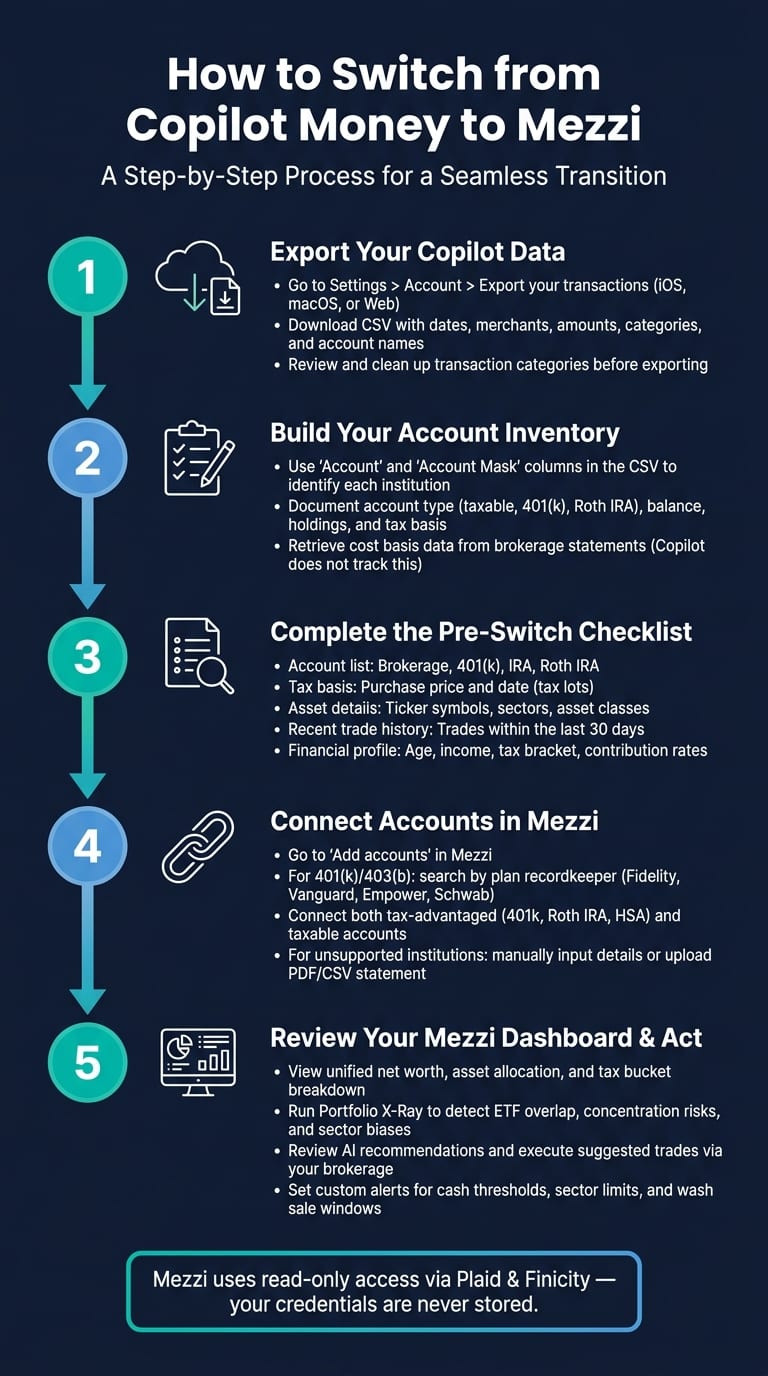
Start by exporting your transaction history from Copilot. On iOS, navigate to Settings > Account > Export your transactions to download a CSV file. This option is also available on macOS and the Web. The CSV file will contain details like transaction dates, merchant names, amounts, categories, account names, transaction types, and any notes you've added. To ensure accuracy, review and clean up transaction categories before exporting.
Keep in mind that Copilot only records data from the time you connect each account. It does not backfill historical investment data. For accounts that aren’t linked, use the "Track Holdings" feature to log ticker symbols and quantities for setting up Mezzi.
Building a Full Account Inventory
Once you've exported your data, create a detailed inventory of all your financial accounts. Use the "Account" and "Account Mask" columns in the CSV to identify each financial institution. For each account, document the type (e.g., taxable, 401(k), Roth IRA), the current balance, primary holdings, and the tax basis. Since Copilot doesn’t track tax basis information (like purchase price and date), you’ll need to retrieve this data from your brokerage statements or cost basis tools. This step is essential for Mezzi to effectively analyze tax-loss harvesting opportunities and flag potential wash sale risks.
Pre-Switch Checklist for U.S. Investors
After compiling your account information, use the checklist below to confirm your data is complete and accurate. This ensures Mezzi can fully utilize its investment and tax optimization features.
Checklist ItemData Point NeededWhy It Matters in MezziAccount ListBrokerage, 401(k), IRA, Roth IRABuilds your consolidated dashboardTax BasisPurchase price and date (tax lots)Supports tax-loss harvesting and capital gains analysisAsset DetailsTicker symbols, sectors, asset classesEnables Portfolio X-Ray and risk assessmentRecent Trade HistoryTrades within the last 30 daysEnsures compliance with wash sale rulesFinancial ProfileAge, income, tax bracket, contribution ratesHelps personalize investment strategy recommendations
If you have hybrid accounts - those combining brokerage and depository features - be aware that Copilot's data aggregators may not automatically capture all transactions. Flag these accounts and double-check their data for completeness before transitioning to Mezzi. This extra step helps avoid any gaps in your financial records.
Setting Up Your Financial Picture in Mezzi
How to Connect Your Accounts in Mezzi
Mezzi relies on Plaid and Finicity to securely connect your financial accounts. These are widely trusted tools in the U.S. fintech space, ensuring your login credentials remain private. Instead of storing your information, Mezzi uses a secure, read-only token provided by these services to access your balances and holdings.
To link your accounts, go to the "Add accounts" section in Mezzi. Use your institution's name for most accounts, but for 401(k) or 403(b) plans, search by the plan recordkeeper (such as Fidelity, Vanguard, Empower, or Schwab) instead of your employer's name. Once you enter your credentials and complete two-factor authentication, you can choose which accounts to sync, like "401(k) – Traditional", "Roth IRA", or "Taxable Brokerage."
Make sure to connect both tax-advantaged accounts (e.g., 401(k), Roth IRA, HSA) and taxable accounts (e.g., brokerage, joint accounts). For institutions that don’t support automated syncing, Mezzi offers manual options: you can input account details directly or upload a PDF or CSV statement, with AI helping to extract the data.
Reading Mezzi's Aggregated View
Once your accounts are linked, Mezzi organizes all your financial data into a single, easy-to-read dashboard. At the top, you’ll see your total net worth, calculated by subtracting liabilities from your combined assets, all displayed as a single dollar figure. Below this, your accounts are grouped by tax status - taxable, tax-deferred, or tax-free - with clear labels like "Fidelity 401(k)" or "Vanguard Roth IRA."
Mezzi also provides an asset allocation breakdown, showing your holdings across categories like U.S. stocks, international stocks, bonds, cash, and alternatives. These are displayed as both percentages and dollar amounts, offering a comprehensive view of your portfolio. This feature is especially useful, as many U.S. households hold accounts across multiple institutions - a Vanguard study found this is true for 58% of households with investment assets. Additionally, Morningstar research highlights that investors often have 50–70% overlap between broad-market ETFs when accounts are viewed separately. Mezzi’s Portfolio X-Ray identifies these redundancies, along with other risks like overconcentration in single stocks (e.g., employer stock exceeding 10–20% of your portfolio) or unintended sector biases.
Another critical feature is Mezzi’s ability to segment your holdings by tax bucket. For example, if you notice a large portion of your bonds in a taxable brokerage account, you might reconsider their placement. Bond interest is taxed as ordinary income annually, so housing them in tax-deferred accounts could be more efficient. This consolidated view sets the stage for deeper investment and tax strategies, which Mezzi explores further in its advanced tools.
Before and After Mezzi: What Changes in Your Financial View
Managing accounts separately can make it harder to see the full picture of your investments and risks. Here’s how Mezzi’s unified dashboard compares to a fragmented setup:
AspectFragmented Setup (Copilot Money + individual portals)Mezzi's Aggregated ViewPrimary focusBudgeting, spending, and transaction trackingInvestments, risk, and tax optimization across all accountsInvestment detailHigh-level balances onlyHoldings-level data: tickers, asset classes, sector exposureRisk detectionNot availableETF overlap, single-stock concentration, sector tilts flagged automaticallyTax visibilityBasic transaction historyTax buckets (taxable, tax-deferred, tax-free) with asset location guidancePortfolio monitoringManual, account by accountUnified dashboard with AI-driven alerts and rebalancing suggestionsWash sale trackingNot availableCross-account wash sale risk flagged before you trigger a violation
Using Mezzi to Set Investment Goals and Cut Your Tax Bill
With Mezzi bringing all your financial data together, you can refine your investment approach to aim for better portfolio outcomes.
Setting Clear Investment Goals in Mezzi
Once your accounts are connected, Mezzi helps you define investment goals using insights derived from your data. Whether you're planning for a traditional retirement, aiming for FIRE (Financial Independence, Retire Early) by 45, or considering semi-retirement strategies like Barista FIRE, Mezzi creates personalized plans tailored to your objectives. These recommendations are based on your actual account details - balances, contributions, and asset allocation. For example, Mezzi might suggest prioritizing a Roth IRA contribution over a Traditional IRA or explore whether a mega backdoor Roth strategy fits your income and employer-sponsored plan. As your financial situation evolves, so does the guidance you receive.
From there, Mezzi's tools help you close the gap between your current portfolio and your ideal investment strategy.
Improving Your Portfolio With Mezzi's Tools
With your goals in place, Mezzi's X-Ray and alert system help fine-tune your portfolio for better efficiency. The X-Ray feature analyzes your holdings to identify overlapping ETFs, flag duplicate fees, and highlight sector imbalances. As Shuping, Founder of Summer AI, shared:
Mezzi's X-Ray feature allowed me to uncover exposure to stocks I didn't realize I had.
Mezzi's AI also suggests lower-cost options like ETFs or index funds that offer similar market exposure. Even saving 1% on fund fees could potentially grow your retirement savings by $186,877. Plus, you can set up custom alerts to stay informed - whether it's a tech sector allocation exceeding your comfort level or idle cash sitting above a certain threshold.
Tax Efficiency Strategies for U.S. Investors
Mezzi also focuses on improving tax efficiency by continuously scanning your portfolio for strategic opportunities. It flags chances to harvest losses and keeps track of wash sale windows across all accounts. This means you'll know exactly when you've met holding periods to qualify for favorable tax rates.
Tax optimization may boost annual returns by 1% to 2%, which could mean an extra $10,000 to $20,000 annually on a $1M portfolio. For example, reinvesting $10,221 saved on capital gains taxes could grow to $76,123 over 30 years. As Tim, CEO of Somnee, remarked:
I loved chatting with the AI to make important changes to my portfolio. I haven't found another wealth app like Mezzi.
Disclaimer: Mezzi is an SEC-registered investment advisor and provides information for informational purposes only. Advisory services may not be suitable for all investors. Consult a qualified tax professional before making tax-related decisions.
Making the Switch and Managing Wealth With Mezzi Over Time
How to Act on Mezzi's Recommendations
Mezzi operates in read-only mode through platforms like Plaid and Finicity, meaning it doesn’t handle your money or execute trades. Instead, it provides personalized recommendations that you can act on directly through your brokerage.
For instance, your Mezzi dashboard might suggest selling a poorly performing asset to take advantage of a tax-loss harvesting opportunity or transferring a bond fund from a taxable account to your Traditional IRA to improve its tax efficiency. Once you review the advice, you log into your brokerage account and manually carry out the suggested trade. If you’re unsure about the recommendation, Mezzi’s built-in AI chat is available to provide further clarification.
When it comes to retirement accounts, Mezzi offers guidance on contribution strategies. It might suggest prioritizing contributions to a Roth 401(k) over a Traditional 401(k) or help you assess whether a mega backdoor Roth strategy makes sense for your situation. You would then update your payroll contribution settings through your HR portal or plan administrator.
After you act on the advice, Mezzi continues to monitor your portfolio, ensuring it remains in line with your financial goals.
Ensuring Your Portfolio Remains Optimized With Mezzi
Mezzi continuously tracks your accounts, identifying tax-saving opportunities, potential concentration risks, and key retirement milestones as they arise. This constant monitoring eliminates the need to check your accounts only during tax season or after major market events. Instead, Mezzi provides an up-to-date, comprehensive view of your finances at all times.
You can also customize alerts to suit your needs. For example, you might set up notifications for when idle cash surpasses a specific amount or when your sector allocations stray from your target. As Mike, a Product Manager, shared:
Mezzi gives me answers and ideas when I need them, no matter what time of day or how big or small the question.
By acting on Mezzi’s recommendations and relying on its ongoing monitoring, you can ensure your investments stay aligned with your goals. This approach shifts your financial management from reactive to proactive, focusing on long-term wealth building.
Workflow Comparison: Managing Money Before and After Mezzi
The table below illustrates how Mezzi simplifies and enhances financial management by turning a traditionally reactive process into a proactive one.
TaskBefore MezziAfter MezziPortfolio ViewRelied on manual spreadsheets and budget-focused trackingAutomatically aggregates data from 401(k), IRA, brokerage, and crypto accountsMonitoringDepended on manual checks or calendar remindersOffers 24/7 monitoring with customizable AI notificationsTax StrategyAddressed only during tax seasonIdentifies tax-loss harvesting opportunities and tracks wash-sale risks proactivelyRebalancingBased on guesswork or broad allocation targetsProvides data-driven advice using detailed sector exposure analysisFee ManagementRequired manual review of fund expense ratiosSuggests lower-cost fund alternatives through AI analysisAdviceLimited to generic tips or expensive human advisorsDelivers 24/7 personalized fiduciary guidance through Mezzi Advisor
This side-by-side comparison highlights how Mezzi streamlines financial management, making it easier to stay on top of your investments and focus on achieving your financial goals.
Conclusion: Taking Control of Your Investments With Mezzi
Copilot Money may help with tracking spending, but understanding and managing long-term financial growth calls for a different kind of platform. This is where Mezzi steps in, offering tools that go beyond budgeting to focus on building and managing wealth.
Mezzi’s portfolio analysis and tax optimization features aim to shift your approach from reactive financial habits to proactive wealth management. With real-time tracking of portfolio alignment, asset allocation, and tax-loss opportunities, it provides insights designed to help you make informed decisions. Research from Vanguard suggests that strategies like behavioral coaching, cost-efficient portfolios, and tax-aware planning - the type Mezzi highlights - may contribute approximately 3% in net annualized value over time for U.S. investors.
As an SEC-registered fiduciary, Mezzi operates with a legal commitment to serve your best interests. Its recommendations are based on your actual account data, personal risk tolerance, and tax considerations, ensuring that advice is tailored to your situation rather than influenced by commissions or partnerships. When Mezzi suggests changes to your portfolio or contributions, the reasoning is clear and directly tied to your financial goals.
Mezzi also prioritizes simplicity and accessibility. For those new to investment management, it eliminates the need for complicated spreadsheets, offering a straightforward way to get started. By connecting your accounts, setting a primary goal, and reviewing initial insights, you can ease into the platform and expand your strategy at your own pace.
Mezzi helps you move beyond day-to-day budgeting to focus on strategic wealth planning. It encourages you to think bigger, asking questions like, "Am I on track to retire at 65, and what steps can I take this quarter to get closer to that goal?"
FAQs
Will switching affect my accounts or investments?
Switching to Mezzi has no impact on your existing accounts or investments. Mezzi operates with secure, read-only access to your financial institutions, meaning your assets remain exactly where they are. You maintain complete control over your portfolio, while Mezzi offers AI-powered insights, such as guidance on tax-loss harvesting and risk analysis. Your accounts stay untouched, but Mezzi brings all your financial data together in a single, streamlined dashboard to help you manage your finances more effectively.
What data should I gather before connecting Mezzi?
Before linking your accounts to Mezzi, start by compiling a list of all financial institutions where you have assets. Organize these by category, such as traditional IRAs, Roth 401(k)s, or taxable brokerage accounts. Next, gather the necessary details, including your login credentials and recent account statements (preferably from the last 90 days). These documents will help you confirm balances, holdings, and cost basis during the setup process.
As you connect your accounts, be prepared to complete any required multi-factor authentication steps. Once the accounts are synced, carefully review the imported balances and holdings to ensure they align with your records. This extra step helps maintain accuracy and avoids potential discrepancies.
How does Mezzi find tax savings without trading for me?
Mezzi helps uncover potential tax savings by reviewing all your connected accounts and providing tailored suggestions while leaving execution entirely in your hands. Its AI tools scan for opportunities like tax-loss harvesting, work to minimize wash sale risks, and aim to improve asset placement across Roth, traditional, and taxable accounts. Additionally, Mezzi keeps an eye on capital gains thresholds and identifies investments with higher fees, offering lower-cost options that may improve your overall returns.
Disclosures:
- This content is for informational purposes only and does not constitute investment advice or a recommendation to buy or sell any security.
- Past performance is not indicative of future results. No guarantee of future performance or outcomes is implied.
- Registration does not imply a certain level of skill or that the SEC has approved the company or its services.
- Savings and performance examples are hypothetical and for illustrative purposes only. Actual results will vary based on individual circumstances, portfolio composition, market conditions, and fees.
- Users should not rely solely on AI-driven tools for financial decision-making.
Mezzi is free to get started. Choose Advisory for unlimited advice and advanced features at $39/month or $399/year. Concierge includes the same, plus hands-on support, at $99/month or $999/year.