
Updated September 26, 2026.
An asset and liability tracker should show what you own, what you owe, and how those two sides connect. For financial guidance across that picture, consider Mezzi. For a detailed multi-asset balance sheet, consider Kubera. For shared household budgeting, consider Monarch. Empower, YNAB, Quicken Simplifi, and Ziggma serve different combinations of free financial oversight, spending management, and investment analysis.
AI is a feature, not the definition of this category. A tool that reliably records your mortgage can be more useful than an assistant that gives a fluent answer from incomplete information. The right choice depends on which accounts and decisions you need to include.
Method and disclosure: Mezzi publishes this guide. We reviewed current official documentation on September 26, 2026, and use our Mezzi application review for product context. We have not conducted a controlled reliability test across all seven services. Recommendations reflect documented workflows and our interpretation of fit, not a ranking of customer outcomes.
Compare the seven by the job they do
| Tool | Primary job | Best reason to shortlist it | Main boundary |
|---|---|---|---|
| Mezzi | Connected financial guidance | Discuss investments, cash, liabilities, and goals together | Advice and monitoring do not execute transfers or trades |
| Kubera | Multi-asset balance sheet | Organize diverse holdings and ownership structures | A valuation total does not establish spending capacity |
| Monarch | Household money management | Budgets, transactions, shared planning, and net worth | Check which analysis and forecasting features require Plus |
| Empower Personal Dashboard | Financial overview | Free aggregation and planning tools | The dashboard and paid advisory service are separate offers |
| YNAB | Spending and saving plan | Decide how available money will cover priorities | Detailed investment analysis is a different job |
| Quicken Simplifi | Cash-flow and spending oversight | Connect everyday accounts to a spending plan | Verify unusual assets and specialist reports separately |
| Ziggma | Investment portfolio analysis | Follow securities and investigate portfolio composition | Do not assume complete household liability management |
Mint has moved to Credit Karma and is no longer an active option. Personal Capital's tools are now branded Empower, so we treat them as one service rather than two competitors. Use current product names when comparing features and support.
1. Mezzi: ask what your balance sheet means for your next decision
Mezzi organizes information across Investments, Banking, Other Assets, and Liabilities. You can connect investment and bank accounts, include credit cards, and enter assets such as real estate. The product update explains the account groups and connection-dependent information.
The practical advantage is the relationship between the categories. A household may appear wealthy because of retirement savings and property while having little accessible cash for a planned expense. Looking at the brokerage account alone would miss that constraint. Mezzi provides a place to ask about the decision with the relevant household context available.
AI Personalization can retain goals, preferences, and constraints you supply. For example, you might explain that a large expense is approaching or that you want to maintain a particular reserve. These are contextual instructions for advice. They are not automatic payment rules or a guarantee that the reserve will be maintained. Active Delegations are a separate monitoring feature on paid plans.
Cost and fit: Free offers a starting point, including connected assets and liabilities and limited AI insights. Advisory is $399 annually; Concierge is $999 annually. Mezzi pricing explains support and Delegation allowances. Choose Mezzi if you want help interpreting your financial picture and working through decisions. Choose a dedicated budgeting workflow if your main requirement is assigning every available dollar to a spending category.
Important limit: manually entered property values need maintenance, and connection data can be incomplete or delayed. Mezzi does not move money, place trades, or file tax returns. A useful answer depends on supplying and checking the relevant information.
2. Kubera: a balance sheet for a varied set of assets
Kubera focuses on organizing wealth across multiple assets, accounts, and structures. It is particularly relevant when a simple investment dashboard leaves out a meaningful share of what you own. Its Essentials and Black explanation distinguishes plan scope rather than treating every feature as universally available.
The reason to evaluate Kubera is balance-sheet organization. If you own public securities, private investments, property, and other assets, you need a consistent place to record values and ownership. The total becomes more useful when it is clear which figures come from connected sources and which are estimates you entered.
A useful workflow: record the value, valuation date, ownership share, and associated debt for each major asset. For a rental property, do not compare the property's gross value with an investment account's net value without accounting for the mortgage. For a private holding, avoid treating an old funding-round valuation as a current sale price.
Cost and fit: Kubera Essentials is $250 annually and Black is $2,500 annually. Black adds ownership tags, nested portfolios, guided onboarding, and higher-touch support. Kubera plan comparison. Its strength is relevant to people who care about the structure of their wealth as much as daily market movement. The tradeoff is that a detailed balance sheet still requires interpretation: it does not tell you that an illiquid asset can fund next month's expenses or that a valuation will be realized in a sale.
For a deeper comparison of its approach with Mezzi, see Mezzi vs. Kubera.
3. Monarch: connect net worth to household routines
Monarch combines account tracking with budgeting and planning. It is a strong candidate when two people need a shared understanding of spending, upcoming obligations, and progress toward goals. A balance sheet is useful here because it sits alongside the routine that changes it.
Imagine a household whose net worth rises while credit-card balances also grow. The headline total does not explain whether the debt reflects timing, a deliberate financing decision, or spending above income. A transaction and budget workflow can help make that distinction visible. This is where an everyday money-management product deserves consideration even when the household also has substantial investments.
Monarch now offers AI and a Plus tier with forecasting and deeper investment features. Its Plus guide should be checked before assuming the service is only a basic budgeting app or that all features are included in Core. Some newer capabilities have platform-specific availability.
Cost and fit: Monarch's pricing page lists Core at $99.99 annually and Plus at $199.99 annually. Evaluate the ongoing renewal price rather than only an introductory promotion. Monarch fits households seeking a repeatable shared money routine. If your central need is personalized investment guidance grounded in saved context, compare that deliverable explicitly rather than assuming that all AI assistants do the same work.
4. Empower Personal Dashboard: a free starting point
Empower's financial tools include a dashboard, net-worth tracking, budgeting, retirement planning, and investment-oriented tools. That makes the free service a reasonable first shortlist entry for someone who wants a broad overview before committing to a subscription.
The practical question is whether it covers the accounts that matter to you and whether the resulting picture is easy to maintain. Connect a representative banking account, an investment account, and a liability. Check them against the underlying institutions before judging the product by the total it displays.
The dashboard and Empower's paid wealth-management service are different offerings. The existence of an advisory business does not make the free tools a paid service, and a free dashboard should not be presented as equivalent to a comprehensive advisory relationship. Evaluate any separate contact or advisory proposal on its own terms.
Cost and fit: the dashboard is free; advisory pricing and eligibility are separate. Empower can suit someone who wants broad financial visibility without a software subscription. If you need detailed personalization, a specific export, or a specialist asset type, confirm that requirement directly. For a more focused comparison, see Mezzi vs. Empower Personal Capital.
5. YNAB: make current money decisions explicit
YNAB is built around planning how available money will be used. It deserves consideration when your main challenge is covering obligations, making room for goals, and managing the relationship between cash and credit-card spending.
An accurate net-worth number will not, by itself, prevent overspending. A household could have substantial retirement savings while repeatedly borrowing for predictable annual expenses. A spending plan addresses that operating problem by making priorities visible before money leaves the account.
A useful workflow: start with cash you already have, account for upcoming bills and less frequent expenses, and decide how much remains for other priorities. Then consider how the plan changes after a debt payment or income disruption. This workflow is different from evaluating whether a stock portfolio has excessive sector exposure.
Cost and fit: YNAB's pricing page lists $109 annually or $14.99 monthly, plus applicable tax, with a trial. Compare billing cadence consistently with other tools. YNAB fits someone willing to engage with an ongoing spending method. If you primarily want analysis across a large investment portfolio, a dedicated investment tool may be a better first purchase. It can also be reasonable to use a spending product and an investment advisor for distinct jobs, provided the combination is worth maintaining.
6. Quicken Simplifi: a practical cash-flow view
Quicken Simplifi emphasizes connected financial information, a Spending Plan, spending reports, and goals. It is relevant when you want to understand what everyday accounts are doing without constructing a detailed investment model.
The useful question is whether the routine helps you anticipate commitments. A current balance can look comfortable immediately before recurring payments arrive. A spending-oriented tool can provide a more useful view of what is available after planned obligations, subject to the accuracy of the information entered or connected.
A useful workflow: verify recurring bills, review categories for large transactions, and inspect how a planned expense affects the month. Keep transfers distinct from spending so that moving money between your own accounts does not distort the picture. These checks matter in any connected cash-flow tool.
Cost and fit: the current Simplifi page displays a first-year offer of $3.99 per month billed annually, against a $6.99 monthly equivalent. Quicken notes that the final annual charge can differ from the displayed monthly amount multiplied by 12; confirm the checkout total and renewal terms. Its current offer also includes a Retirement Planner on the web, so it should not be described as only a spending tracker or assumed to offer the planner in every mobile workflow. Simplifi should also be distinguished from Quicken Classic, a different product with a different workflow. Evaluate Simplifi for everyday financial oversight. If you need detailed private-asset ownership, specialist tax-lot analysis, or a complex long-term plan, verify those requirements separately rather than treating the Quicken brand as one uniform feature set.
7. Ziggma: useful when the missing piece is investment analysis
Ziggma offers portfolio tracking and investment research. It is included here as a specialist alternative for people whose main concern is understanding the investment side of the balance sheet.
That focus can be useful. If your home, cash, and debt records are already organized, the remaining question might be whether your securities are concentrated or how individual holdings compare. A portfolio-analysis product may contribute more than a second general household dashboard.
A useful workflow: reconcile the securities and cash in a connected brokerage account, review portfolio composition, and then investigate individual holdings that deserve attention. Keep the total investment portfolio distinct from household net worth, particularly if debt and private assets are recorded elsewhere.
Cost and fit: Ziggma's plans include Free, then annual-billing monthly equivalents of $6.99 for Starter, $10.49 for Investor, and $13.99 for Expert. Those imply $83.88, $125.88, and $167.88 across 12 months. Starter links one investment account; Investor links five; Expert supports more than five. Ziggma's investment focus should not be stretched into a claim that it is a comprehensive property, credit-card, or liability-management system. If you need one place for all those categories, start with a broader financial tracker. If you need research into the securities themselves, its specialization is a reason to consider it.
A balance-sheet example that exposes common mistakes
Consider a hypothetical household with a $900,000 home, a $350,000 mortgage, $600,000 of investments, $50,000 in cash, and $15,000 in credit-card debt. Assets total $1,550,000; liabilities total $365,000; net worth is $1,185,000.
That does not mean the household has $1,185,000 available to spend. Much of it is tied up in the home or investments, and some investment accounts may have tax or withdrawal constraints. The useful dashboard should let you distinguish the categories rather than encouraging you to treat the total as a checking-account balance.
Avoid double counting. If you enter home equity of $550,000 and also subtract the $350,000 mortgage, you understate net worth. Record the gross home value and the debt separately, or use an equity value consistently without subtracting the debt twice.
Test a liability, not just an asset balance
A complete-looking net-worth total can still miss the information needed to manage debt. For one actual liability, record the balance, interest rate, minimum payment, due date, ownership, and source date. A tracker may import the balance without receiving every other field; keep missing terms visible rather than assuming them.
For a hypothetical $10,000 credit-card balance, a $300 payment does not necessarily reduce principal by $300 if interest or new purchases also post. Reconcile the ending balance with the card statement. For a mortgage, distinguish the outstanding loan from the monthly payment, which may include interest and escrow as well as principal.
The best trial result is a usable record: “This debt balance is connected; its rate and payment terms are manually maintained; this person will update them.” That tells you whether the product solves your recurring task more clearly than a general claim that it supports liabilities.
What to check during a trial
Begin with the hardest account, not the easiest. If a private investment, retirement plan, or loan is the reason you need a new tool, establish how it will be represented. Record refresh dates and mark manual estimates clearly.
Next, test a transfer, a credit-card payment, and an asset-value update. These reveal whether the system presents the picture in a way you understand. Review account permissions, household access, exports, and deletion options using the provider's current documentation. Do not infer a security certification from marketing phrases such as bank-level security.
Finally, bring one real question to the product. “What changed?” “What is available after obligations?” and “What should I consider doing next?” are different questions. Choose the workflow that answers the one you will actually revisit.
Frequently asked questions
What is an asset and liability tracker?
It records assets such as cash, investments, and property alongside debts such as mortgages and credit cards. Subtracting liabilities from assets gives net worth, but a useful tracker also shows liquidity, valuation dates, and account details.
Is an AI feature necessary for tracking net worth?
No. Accurate inputs and clear categorization come first. AI can help interpret information or discuss decisions, but it cannot make an outdated property estimate or missing debt balance accurate without better data.
Can I still choose Mint?
Mint is no longer an active option. Compare current services on the accounts and workflows you need rather than selecting it from an older recommendation list.
Can a tracker automatically pay down my debt?
Do not assume that tracking or advice includes payment execution. Check the service's specific permissions. Mezzi provides guidance and monitoring; you arrange transfers, payments, and trades separately.
See how Mezzi groups accounts
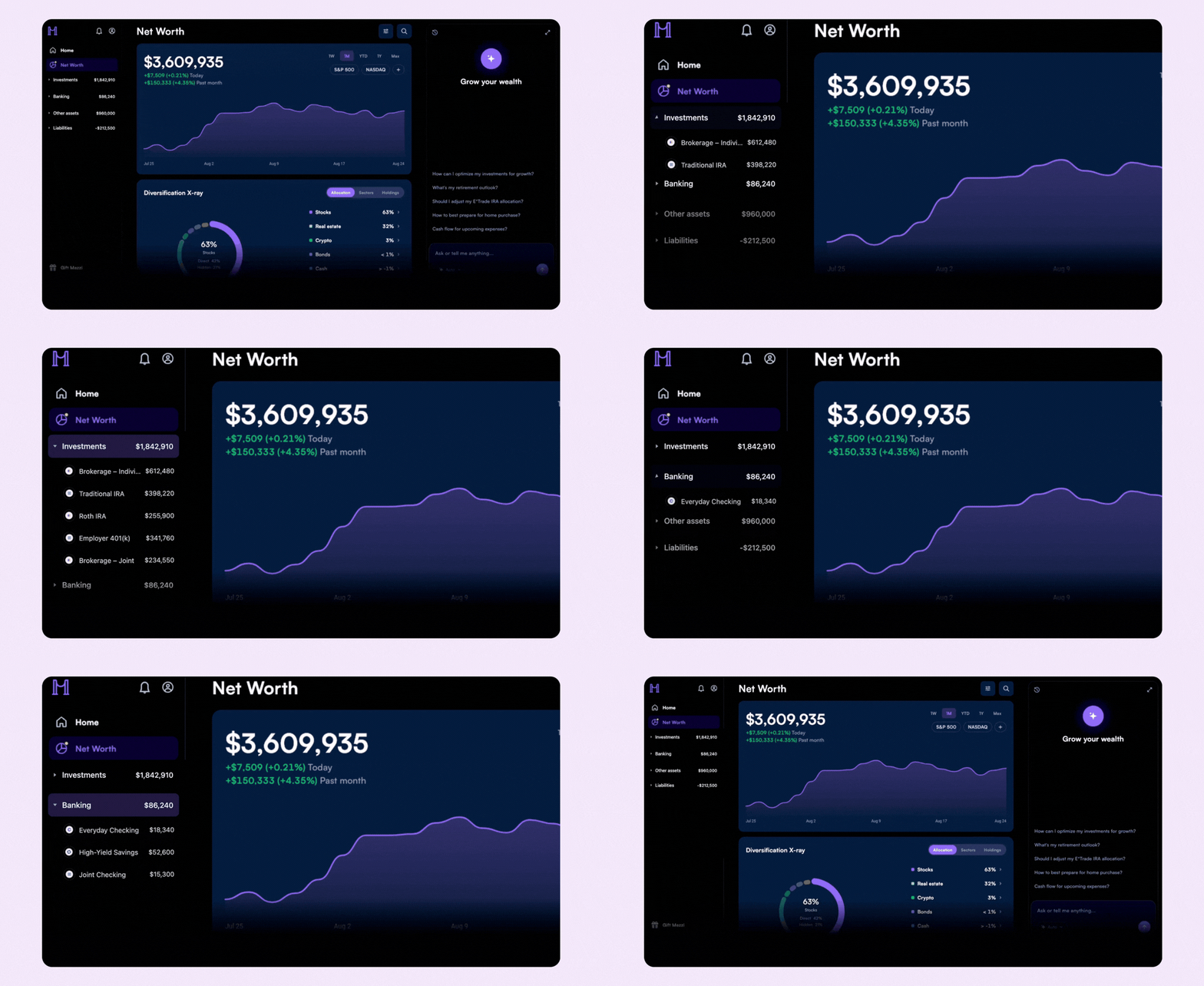
Bring the whole picture into the conversation. Connect your investments, banking, assets, and liabilities, then add the goals that matter to you.
Start with Mezzi FreeThis comparison is published by Mezzi for educational purposes and is not personalized investment, tax, or legal advice. Features, prices, and data availability can change. Investing involves risk, including loss of principal. Examples are illustrative and are not customer results or guarantees.