
A global stock portfolio comes down to a choice: own the world in one fund with VT (Vanguard Total World Stock ETF), or split it into VTI for the U.S. and VXUS for everything else. One trades effort for simplicity. The other trades simplicity for control and a tax edge. Here's where they diverge:
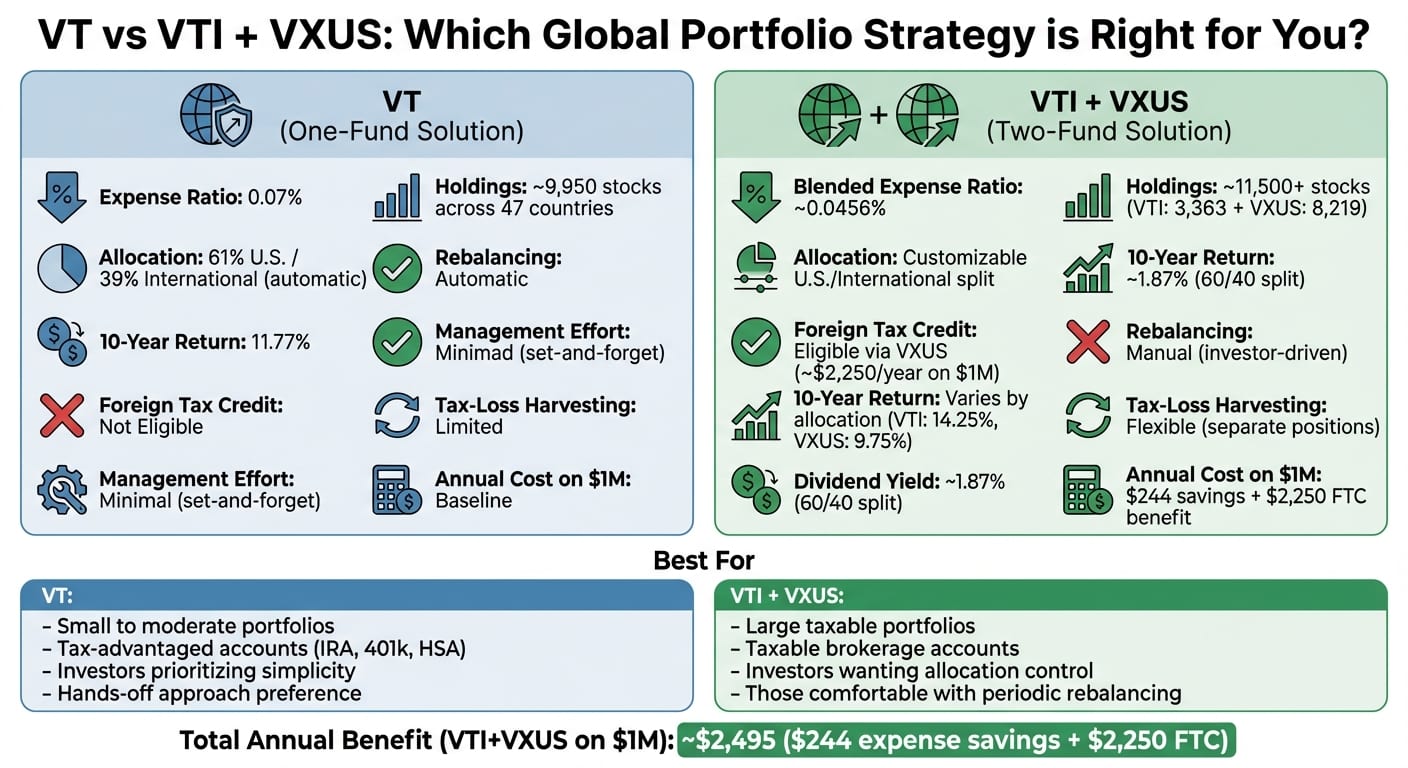
- VT: Simple, all-in-one global exposure with automatic rebalancing (61% U.S., 39% international). Expense ratio: 0.07%.
- VTI + VXUS: Offers more control, lower costs (blended expense ratio
0.0456%), and tax benefits like the Foreign Tax Credit ($2,250/year per $1M invested).
Quick Comparison
Bottom Line: VT offers simplicity, while VTI + VXUS may provide greater tax efficiency and control in taxable accounts.
What Each Fund Holds, and What It Charges
VT: Single-Fund Global Portfolio
The Vanguard Total World Stock ETF (VT) is built to simplify global investing. It tracks the FTSE Global All Cap Index and, as of December 31, 2025, holds around 9,950 stocks across 47 countries. This fund is structured to automatically maintain a balance of approximately 61% U.S. stocks and 39% international stocks, offering exposure to a wide range of markets, including North America, Europe, Emerging Markets, the Pacific, and the Middle East.
"VT provides a simple, globally diversified portfolio. With one fund, you own essentially every publicly traded company in the world." – SPTWS
If you’re looking for more control over your portfolio’s allocation, splitting your exposure between VTI and VXUS is another option worth considering.
VTI + VXUS: Two-Fund Global Portfolio
The two-fund strategy divides global exposure into separate components. VTI focuses on the U.S. market, tracking the CRSP US Total Market Index with approximately 3,363 U.S. stocks. VXUS, on the other hand, covers international markets by tracking the FTSE Global All Cap ex US Index, holding around 8,219 international stocks. Together, these funds allow investors to customize their allocation between U.S. and international stocks, stepping away from the fixed market-cap weighting of VT.
With the fund structures laid out, let’s dive into the expense ratios to understand the cost differences between these approaches.
Expense Ratio Comparison
When it comes to costs, the difference between these strategies is relatively small but worth noting. VT charges an annual expense ratio of 0.07%. Meanwhile, VTI costs 0.03%, and VXUS comes in at 0.05%. If you replicate VT’s 61/39 allocation using VTI and VXUS, the blended expense ratio drops to roughly 0.0456%. This results in approximately $244 less in annual fees on a $1 million portfolio, compared to holding VT alone.
But expense ratios are just one piece of the puzzle. Tax treatment also plays a key role in differentiating these strategies. For instance, VXUS’s full international exposure qualifies for the Foreign Tax Credit, unlike VT’s partial 39% allocation. This tax benefit is estimated to be worth about $2,250.80 per $1 million invested, which can outweigh the modest expense ratio savings.
The Track Record, and the Bumps Along the Way
Historical Performance
Over the past decade, the strength of the U.S. market has been a key driver of global returns. By the end of 2025 (December 31), VTI delivered a 10-year annualized return of 14.25%, while VXUS - focused on international markets - returned 9.75%. The globally diversified VT, blending about 61% U.S. stocks with 39% international stocks, achieved a 10-year return of 11.77%.
For the 5-year period, VTI posted a return of 13.06%, VXUS returned 9.19%, and VT delivered 11.02%. However, 2025 was marked by an international market rally - VXUS surged with a 32.35% total return, outpacing VTI's 17.10% and VT's 22.44%.
To get a fuller picture of these funds, let’s dive into dividend yields and volatility metrics to better understand their risk profiles.
Dividend Yields and Volatility
Dividend yields show notable differences across these funds. VXUS offers a yield of 3.01%, significantly higher than VTI's 1.11%. VT, with its global mix, provides a yield of 1.77%. For those considering a 60/40 allocation between VTI and VXUS, the yield averages out to approximately 1.87%, slightly above VT's yield.
When it comes to volatility, the differences are minimal. Over the past 10 years, VT's standard deviation was 14.53%, while VTI and VXUS recorded 14.29% and 14.38%, respectively. However, maximum drawdowns reveal a sharper contrast. VXUS saw the steepest decline at -27.76%, compared to -24.81% for VTI and -25.52% for VT. This highlights the potential for deeper corrections in international markets over shorter periods.
Risk Metrics Comparison
The table below provides a clear side-by-side comparison of the key risk metrics:
The correlation of 0.83 between VTI and VXUS reflects that while they don’t move in perfect sync, they still offer meaningful diversification. This is a key advantage of VT, which automatically balances these global exposures.
Where the Two-Fund Split Earns Its Keep at Tax Time
Foreign Tax Credits
When deciding between these investment strategies, tax treatment plays a key role, alongside expense ratios and performance. One major difference lies in the foreign tax credit (FTC). According to IRS Section 853(a), funds must allocate more than 50% of their assets to foreign securities to pass the FTC benefits to their shareholders. VXUS qualifies for the full FTC since it exclusively holds foreign stocks. On the other hand, VT falls short of the threshold, as only 39% of its holdings are international stocks. This distinction can significantly affect after-tax returns for investors in taxable accounts.
The estimated FTC for VXUS is about 0.225% of the fund's value annually. For a $1,000,000 portfolio, this equates to approximately $2,250.80 in annual tax savings. VT investors, however, are taxed on net dividends (post-foreign taxes), and the absence of the FTC makes VXUS a more tax-efficient option for taxable accounts.
Another factor to weigh is the treatment of qualified dividend income (QDI). Nearly 100% of VTI dividends qualify for lower long-term capital gains tax rates, while only around 70% of VXUS dividends meet this standard. The remaining 30% of VXUS dividends are taxed at ordinary income rates. For residents of high-tax states like California, which doesn’t recognize the FTC at the state level, this can lead to additional tax liabilities.
"Only funds comprised of more than 50% foreign investments are eligible for foreign tax credit. Since VT only holds 39% foreign investments, you would pay foreign tax but receive no foreign tax credit." – Jacob Massanopoli, Financial Analyst, Marotta On Money
Beyond FTC considerations, separating funds opens up more opportunities for tax-loss harvesting.
Tax-Loss Harvesting Opportunities
The combination of VTI and VXUS provides far greater flexibility for tax-loss harvesting compared to a single VT fund. With two separate funds, you can harvest losses in one segment without selling your entire global exposure. For instance, if international stocks experience a downturn while U.S. stocks remain stable, you can sell VXUS to realize the loss while holding onto VTI. With VT, you’d need a global market decline to harvest losses.
To avoid wash sale violations during harvesting, you can use secondary funds like ITOT (as a substitute for VTI) or IXUS (as a substitute for VXUS) to stay invested during the mandatory 30-day period. Tools like Mezzi’s automated wash-sale prevention features can help automate this process and assist with compliance.
However, keep in mind that if your FTC exceeds $300 ($600 for married couples filing jointly), you’ll need to file Form 1116, which adds a layer of complexity that some investors may prefer to avoid. Additionally, foreign taxes are reported as income on Form 1099-DIV, potentially increasing your MAGI and affecting ACA subsidies.
Tax Efficiency Comparison Table
How Much Tending Each One Asks of You
Ease of Management
VT follows a "set-it-and-forget-it" approach, making it incredibly simple to manage. The fund automatically rebalances its holdings to match the FTSE Global All Cap Index, so you don’t have to intervene at all. For example, if U.S. stocks outperform international markets, VT adjusts its allocation internally, all without requiring any action on your part. This effortless style is often referred to as "VT and chill". VT is designed for those who value simplicity and prefer not to monitor their investments daily.
"With VT, you don't need to manually rebalance to stay aligned with the index, as it is all handled within the ETF." – Jacob Massanopoli, Financial Analyst, Marotta Wealth Management
On the other hand, managing the VTI + VXUS combination requires more involvement. You’ll need to keep an eye on both holdings to ensure your portfolio stays aligned with your target allocation. For instance, if U.S. stocks outperform international ones, your portfolio could become overly skewed toward U.S. equities. To correct this imbalance, you’d either need to direct new contributions toward VXUS or sell some VTI shares to restore the desired balance.
Rebalancing Needs
VT handles rebalancing internally. In contrast, the two-fund strategy demands active participation. With VTI + VXUS, market shifts can throw your allocations off target, requiring you to step in and make adjustments. Some investors choose to rebalance on a fixed schedule, such as annually, while others use rebalancing without selling strategies by using new contributions to buy more of the underperforming fund. This approach can help you avoid triggering capital gains taxes, but it does require ongoing attention and a checklist for ETF tax-loss harvesting.
One benefit of the two-fund approach is its flexibility. Unlike VT, which sticks to global market-cap weights, VTI + VXUS allows you to tweak your allocation. For example, you can adjust allocations to U.S. stocks if you prefer a home-country bias.
Pros and Cons Comparison
VT vs VTI + VXUS Compared
Which One Fits the Way You Invest
This section builds on the earlier analysis of costs, performance, and taxes to help you decide which investment approach aligns best with your style and goals.
When to Choose VT
VT is designed for investors who prioritize simplicity. If your portfolio is modest - especially if it's in tax-advantaged accounts like IRAs, 401(k)s, or HSAs where the foreign tax credit doesn't apply - VT's automatic rebalancing can save you time and effort. It eliminates the need to juggle multiple tickers or adjust allocations as markets fluctuate. It is designed for those who value simplicity and prefer not to monitor their investments daily.
"VT appeals primarily to those who highly value simplicity in their portfolio. They can eliminate an asset class from their portfolio. VT provides a one-stop global exposure." – Jim Dahle, Founder, The White Coat Investor
As mentioned earlier, VT's simplicity reduces the need for active management. If you prefer a "set it and forget it" approach, VT offers a convenient, all-in-one solution that avoids the pitfalls of emotional or delayed rebalancing.
When to Choose VTI + VXUS
The VTI + VXUS combination is structured for larger taxable portfolios and may provide greater tax efficiency and greater control. VXUS, being entirely international, qualifies for the foreign tax credit. Additionally, the combined expense ratio of about 0.0456% is lower than VT's 0.07%, which could save you roughly $244 annually on a $1 million portfolio.
This strategy also allows for manual rebalancing and tax-loss harvesting, giving you more precision. For example, if U.S. stocks hold steady while international stocks decline, you can harvest the losses from VXUS to offset gains elsewhere, reducing your tax burden. If you're comfortable with occasional rebalancing and want control over your U.S. versus international exposure, the VTI + VXUS method provides greater flexibility for those comfortable with rebalancing and allocation control.
Final Comparison Summary
Here's a quick breakdown of how each option fits different investment profiles:
This comparison highlights how VT and VTI + VXUS serve different needs, depending on your portfolio size, account type, and preference for management style.
FAQs
What U.S./international split should I use with VTI + VXUS?
A frequently suggested strategy is an 80% U.S. (VTI) and 20% international (VXUS) allocation, which aligns with the general guidance from the Bogleheads community. Some investors tweak this ratio, opting for anywhere between 20% and 40% international exposure, depending on their risk tolerance and desire for diversification. Ultimately, the best allocation comes down to your individual goals and how comfortable you are with including international investments in your portfolio.
How often should I rebalance a VTI + VXUS portfolio?
Rebalancing a VTI + VXUS portfolio is generally suggested at least once per year or when the portfolio's allocations shift by roughly 5%. Many investors lean toward annual rebalancing because it strikes a good balance between managing risk and maintaining tax efficiency.
Does the foreign tax credit still matter if I hold these funds in an IRA or 401(k)?
When you hold these funds in an IRA or 401(k), the foreign tax credit usually doesn’t come into play. That's because these tax-advantaged accounts are either tax-deferred or tax-exempt, meaning taxes paid to foreign governments typically can’t be credited within them.
Related Blog Posts
- How does VXUS’ risk/return profile compare to holding VEA + VWO separately?
- VXUS vs VEA+VWO: 5-year total return and overlap analysis (country/sector/holding overlap).
- VXUS vs VEU vs IXUS - Best total international ETF for one-ticket ex-US exposure
- VXUS vs IXUS: Which International ETF for a Three-Fund Portfolio
A frequently suggested strategy is an 80% U.S. (VTI) and 20% international (VXUS) allocation, which aligns with the general guidance from the Bogleheads community. Some investors tweak this ratio, opting for anywhere between 20% and 40% international exposure, depending on their risk tolerance and desire for diversification. Ultimately, the best allocation comes down to your individual goals and how comfortable you are with including international investments in your portfolio.
Rebalancing a VTI + VXUS portfolio is generally suggested at least once per year or when the portfolio's allocations shift by roughly 5%. Many investors lean toward annual rebalancing because it strikes a good balance between managing risk and maintaining tax efficiency.
When you hold these funds in an IRA or 401(k), the foreign tax credit usually doesn’t come into play. That's because these tax-advantaged accounts are either tax-deferred or tax-exempt, meaning taxes paid to foreign governments typically can’t be credited within them.