
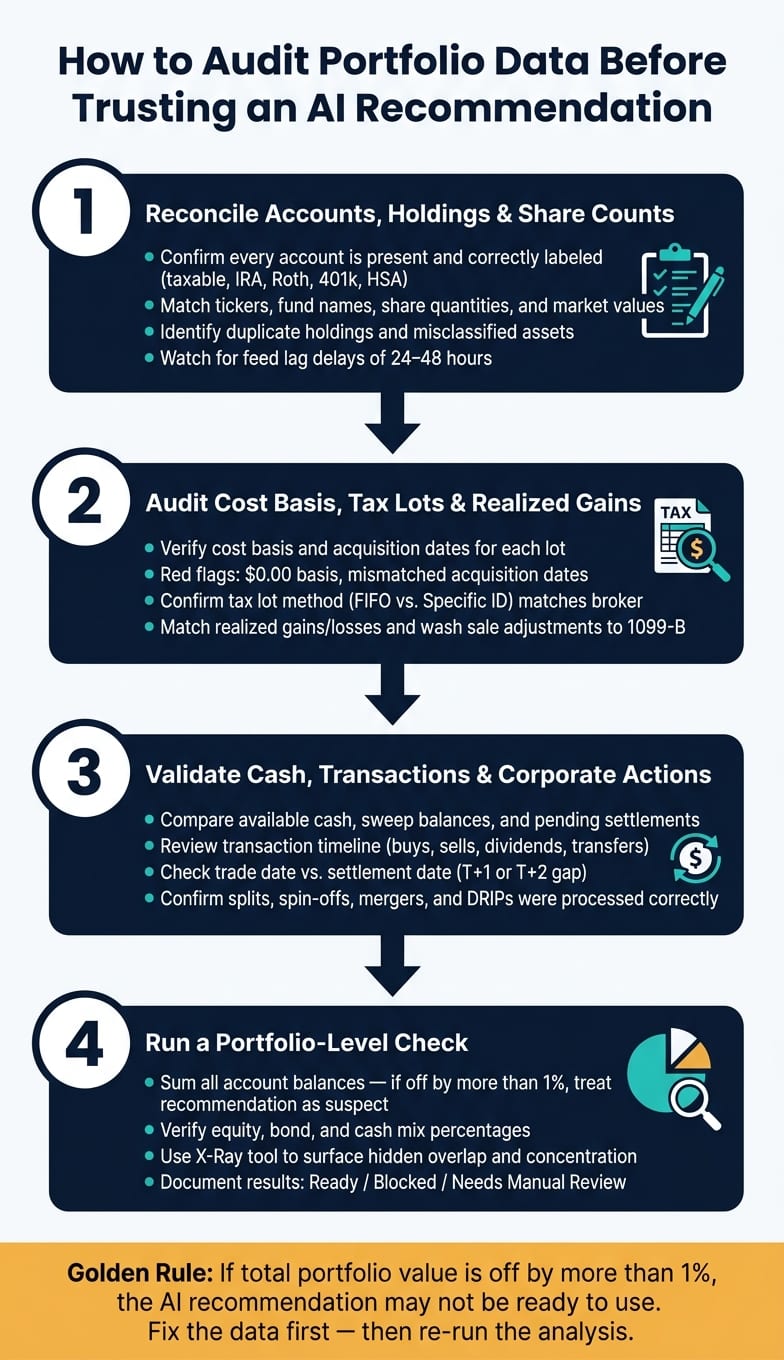
If the data is off, the AI output may be off too. Before I rely on any portfolio suggestion, I may want to check four things: accounts, holdings, tax data, and recent activity.
Here’s the short version:
I may compare every account in the app against my broker and plan portals
I may match tickers, share counts, cash, and market values
I may review cost basis, acquisition dates, lot method, and realized gains
I may check pending trades, dividend reinvestments, splits, and spin-offs
I may do one last portfolio-level review to see whether totals and asset mix line up
A few small errors may change the picture fast. A missing IRA, a $0.00 cost basis, or a delayed feed by 24–48 hours may affect tax views, allocation math, and trade ideas. Some people use a simple rule: if total portfolio value is off by more than 1%, the recommendation may not be ready to use.
What this comes down to is simple: first verify the records, then review the AI output. That may lower the odds of acting on a bad input.
Step 1: Reconcile accounts, holdings, and share counts
Confirm every account is present and correctly labeled
Start by listing every account in Mezzi. Then compare that list with your taxable account, Traditional IRA, Roth IRA, 401(k), HSA, and any held-away accounts.
If an account is missing or labeled the wrong way, your allocation view may be off. Tax treatment may also appear differently than expected. For example, a Roth IRA marked as a Traditional IRA may lead to the wrong tax treatment in any account-level suggestion tied to that account.
Match tickers, fund names, share quantities, and market values
Once the full account list checks out, go holding by holding. Use your latest statement as the source of truth for each position.
Compare every position in Mezzi with that statement. Check:
ticker
fund name
share count
market value, including fractional shares
If the same fund shows up in more than one account, make sure it lines up as one fund held in multiple places, not as a bad duplicate. Feed lag may delay updates by 24–48 hours [1], so small timing gaps may happen. But big mismatches, or closed positions that still appear active, may point to a data issue.
Find duplicate holdings and misclassified assets
After the account list matches, look for hidden duplication and asset mix errors.
Cash sweeps may show up as securities. The same ETF may also appear twice across accounts. That may distort allocation, drift, and tax-related views.
The table below shows the most common discrepancies to check at this stage:
| Data Item | Source of Truth | Mezzi View | Typical Discrepancy | Impact on Advice |
|---|---|---|---|---|
| Ticker Symbol | Brokerage Statement | Aggregated Dashboard | Mismatched symbols for the same fund | Double-counting or gaps in allocation |
| Share Count | Custodial Dashboard | API Feed | Fractional share rounding errors | Incorrect total value and drift math |
| Market Value | Real-time Broker View | Aggregated View | Stale or delayed position data | False rebalancing or harvesting alerts |
| Asset Class | Fund Prospectus | AI Classification | Money market funds labeled as securities | Skewed risk and concentration scores |
| Cash Balance | Bank or broker ledger | Aggregated Feed | Stale cash or pending-settlement data | Incorrect rebalancing or dry powder calculations |
If any account, holding, or balance fails this check, stop here. Then audit cost basis, tax lots, and realized gains next.
Step 2: Audit cost basis, tax lots, and realized gains
Once holdings and share counts line up, the next step is to review the tax data tied to each taxable lot.
Verify cost basis and acquisition dates for each lot
Compare each taxable lot against brokerage statements, trade confirmations, Form 1099-B, and year-end realized gains reports. Check the purchase price, acquisition date, and whether reinvested dividends were added to basis.
Dividend reinvestment is easy to miss. If those amounts aren't included, basis may be understated, and any AI-calculated gain may look higher than it should.
A few red flags tend to show up again and again:
$0.00 basis or missing basis
An acquisition date that doesn't match the holding period
A $0.00 or missing basis often appears in older positions, securities moved between brokerages, or inherited accounts [1]. The acquisition date matters too. If a lot held for 13 months shows up as 11 months old, the AI may treat a long-term gain as short-term, which may be taxed at a higher ordinary income rate.
Then check that the broker's lot method matches the way shares may be sold.
Check the tax lot method and lot-level assignment
Your broker's lot method, such as FIFO or specific ID, determines which shares get sold when you place a trade. If Mezzi's view doesn't match the method your broker actually uses, a tax-aware sale suggestion may go sideways.
For example, if your broker is set to FIFO but Mezzi assumes specific ID, the AI may flag a loss-harvesting move that doesn't line up with the trade you place.
Match broker lot detail to trade confirmations, and verify the lot method on file before using any sale suggestion.
Match realized gains, losses, and dividend history to tax records
After the lot setup looks right, review the realized results reported for the account. Compare year-to-date realized gains and losses with the broker gain/loss report, and compare prior-year results with Form 1099-B.
Pay close attention to wash sale adjustments. A disallowed loss may throw off the tax math. Cross-account wash sales may be especially hard to track when IRAs are involved.
This quick check may catch common tax-data problems:
| Field | Broker or 1099 Value | Mezzi Value | Potential Tax Impact if Wrong |
|---|---|---|---|
| Cost Basis | $50.00/share | $0.00 (Missing) | Overstated capital gains; excess tax liability |
| Acquisition Date | 13 months ago | 11 months ago | Long-term gain misclassified as short-term; taxed at a higher ordinary income rate |
| Tax Lot Method | Specific ID | FIFO | AI sells the wrong shares, realizing a gain instead of a planned loss |
| Realized Loss | $2,000 | $0.00 | Missed tax-loss harvesting chance to offset gains |
| Wash Sale Adj. | $500 disallowed | $0.00 | Claiming a loss the IRS disallows, which may lead to penalties or interest |
| Dividend Reinvest. | Included in basis | Omitted | Basis understated; AI calculates an artificially high taxable gain |
If any field looks off, correct the data before reviewing AI tax or rebalancing suggestions.
Step 3: Validate cash balances, transactions, and corporate actions
After tax lots, check whether the latest cash activity and corporate actions have fully posted. Even when holdings and tax lots look clean, unsettled cash or unprocessed corporate actions may still sit in the background. That may skew an AI recommendation.
Check cash, sweeps, and pending settlements
Compare available cash, sweep balances, and pending settlements in your broker dashboard with Mezzi. If a stock sale has already settled at the broker but still shows as pending in Mezzi, your allocation percentages and rebalancing view may be off.
Also check how sweep holdings appear. They may need to be classified as cash or cash equivalents, not stock positions.
If cash and sweeps match, move to the recent transaction log.
Review the recent transaction timeline for missing activity
Pull the recent transaction history from your broker’s activity feed and compare it with Mezzi. Go line by line. Look for buys, sells, transfers, contributions, withdrawals, fees, and dividend reinvestments in the right order and on the right dates.
Trade date and settlement date need a separate check:
Trade date: when the order executes
Settlement date: when cash and securities actually change hands, often T+1 or T+2
That gap matters. Recent activity may still be pending until settlement happens.
Then review any splits, mergers, spin-offs, and reinvestments tied to those dates.
Confirm splits, spin-offs, mergers, and dividend reinvestment were processed correctly
Corporate actions are often where data issues stick around the longest. These events may change both share count and cost basis.
A stock split should update share count and adjusted basis. A spin-off needs a basis allocation between the old and new securities. If that allocation is missing, the new position may show a $0.00 basis. A merger may also leave a ghost position under the old ticker if the new ticker was not mapped the right way.
Use your brokerage’s corporate action notices and account history to verify each event, then compare the records line by line in Mezzi:
| Date | Event | Broker Record | Mezzi Record | Status |
|---|---|---|---|---|
| [Date] | Stock Split | [New Share Count] | [New Share Count] | [Match/Mismatch] |
| [Date] | Dividend Reinvest | [Shares Added] | [Shares Added] | [Match/Mismatch] |
| [Date] | Merger/Spin-off | [New Ticker/Qty] | [New Ticker/Qty] | [Match/Mismatch] |
| [Date] | Cash Settlement | [Settled Balance] | [Settled Balance] | [Match/Mismatch] |
Any mismatch may be a sign to pause and fix the record before using the recommendation.
Step 4: Run a portfolio-level check before acting on any recommendation
Once you've checked the details, take one last step: zoom out. The goal here is simple. See whether the recommendation still makes sense when you look at the entire account picture, not just one holding or one account.
Compare total portfolio value and asset-class mix
Start by adding up every account balance:
Taxable brokerage
401(k)
Roth IRA
traditional IRA
HSA
cash accounts
Then compare that total with what Mezzi shows. If the numbers are off by more than 1%, or if the same account shows up twice, treat any AI recommendation as suspect until you find the gap [2].
Then check your mix of equities, bonds, and cash. If category labels are wrong, those percentages may be wrong too. And if those percentages are wrong, any rebalancing idea may be less reliable.
Use Mezzi X-Ray to check overlap, concentration, and hidden duplication
Once the totals line up, look for overlap that may not be obvious at first glance. Run Mezzi's X-Ray. It looks through your ETFs and mutual funds and shows your actual exposure to individual stocks.
That matters because fund names and labels may hide the fact that you own the same stocks in several places. X-Ray may surface overlap and concentration that account-by-account checks may miss.
This step matters even more if one account is missing. For example, if your employer 401(k) isn't connected, Mezzi may not factor it into the overlap and concentration check. Full account coverage is what gives the X-Ray review meaning.
Document what passed, what failed, and whether the recommendation is usable
After each check, write down what you found. A simple decision log - even a notes file - may help you track which data points passed manual review and why you decided to act or wait.
Use that log before any tax-sensitive trade.
Use the table below to sort the recommendation into one of three buckets: ready, blocked, or needs manual review.
| Check Type | What to Verify | Source Records | Common Problems | Can the AI Recommendation Be Trusted? |
|---|---|---|---|---|
| Total Value | Sum of all account balances in USD | Custodial dashboards | Missing accounts; stale data feeds | No, if value is off by more than 1% [2] |
| Asset Class Mix | Equity, bond, and cash percentages | Plan summaries | Wrong category labels | Only for broad allocation checks |
| Concentration | Top 10 individual stock exposures across all accounts | Fund prospectuses, Mezzi X-Ray | Hidden overlap across multiple ETFs | No, if risk is underestimated |
| Tax Lots | Cost basis and acquisition dates for every lot | 1099-B, unrealized gain/loss reports | Missing basis on transferred or inherited assets | No, for any tax-loss harvesting advice |
| Transactions | Recent buys, sells, dividends, and splits | Activity statements | Pending settlements; missed DRIPs | No, for wash sale detection |
If every row passes, the recommendation may be usable for review. If one or two rows show minor issues - like a 24–48 hour data feed delay on a stable account - some people may proceed with caution [1]. If total value is materially off, tax lots are incomplete, or a full account is missing, it may make sense not to rely on the recommendation yet. Fix the data first, then re-run the analysis.
FAQs
How often should I audit my portfolio data?
Audit your portfolio data at least monthly, especially after major transactions, so your holdings, cost basis, and balances may stay aligned with your financial statements.
A fuller review quarterly may make sense to check whether your tax settings still line up with current rules and your financial goals. Some people also revisit their portfolio sooner after major life events, such as retirement or a major income change.
What errors matter most before I review an AI recommendation?
Focus on the data issues that may change the math.
That usually means checking for:
Missing accounts or accounts that may not be linked
Wrong or missing cost basis data and lot details
Stale tickers or tickers that may not match the current holding
Incorrect tax lots
Duplicate holdings or duplicate transactions
Cash balance errors
For taxes, review wash-sale triggers across accounts and spouses too. A sale in one account may affect the tax treatment of a purchase in another, so the full picture may matter.
Before trusting any recommendation, confirm that the data matches your brokerage statements and tax records, including Form 1099-B.
Can I trust the recommendation if one account is missing?
No. If even one account is missing, the AI may not have a complete view of your finances, so its recommendation may be incomplete or less accurate.
A missing account may hide overlapping holdings, concentration risk, or possible wash sale issues. For more reliable results, it may help to make sure all accounts are connected and up to date.
Disclosures:
This content is for informational purposes only and does not constitute investment advice or a recommendation to buy or sell any security.
Past performance is not indicative of future results. No guarantee of future performance or outcomes is implied.
The use of artificial intelligence and algorithmic tools does not guarantee investment results. These tools are subject to limitations, errors, and market conditions that may affect performance.