
IRMAA surcharges can significantly increase your Medicare costs if your income exceeds certain thresholds. Here's how to avoid them:
- Understand the Lookback Rule: Medicare calculates IRMAA based on your income from two years prior. For 2026, your 2024 tax return determines your premiums.
- Stay Below Income Limits: Even $1 over the threshold triggers the full surcharge. In 2026, the base limit for single filers is $109,000 and $218,000 for joint filers.
- Use Roth Conversions Strategically: Convert IRA funds during low-income years to reduce future taxable income and avoid higher Required Minimum Distributions (RMDs).
- Leverage Qualified Charitable Distributions (QCDs): If you're 70½ or older, direct RMDs to charities to lower your MAGI.
- Coordinate Withdrawals: Use tax-free Roth IRA withdrawals and delay Social Security to manage your taxable income.
- Appeal Surcharges After Life Changes: File Form SSA-44 if retirement, divorce, or other qualifying events reduce your income.
8 Ways to Reduce Medicare IRMAA Payments
IRMAA Income Thresholds and Surcharges for 2026
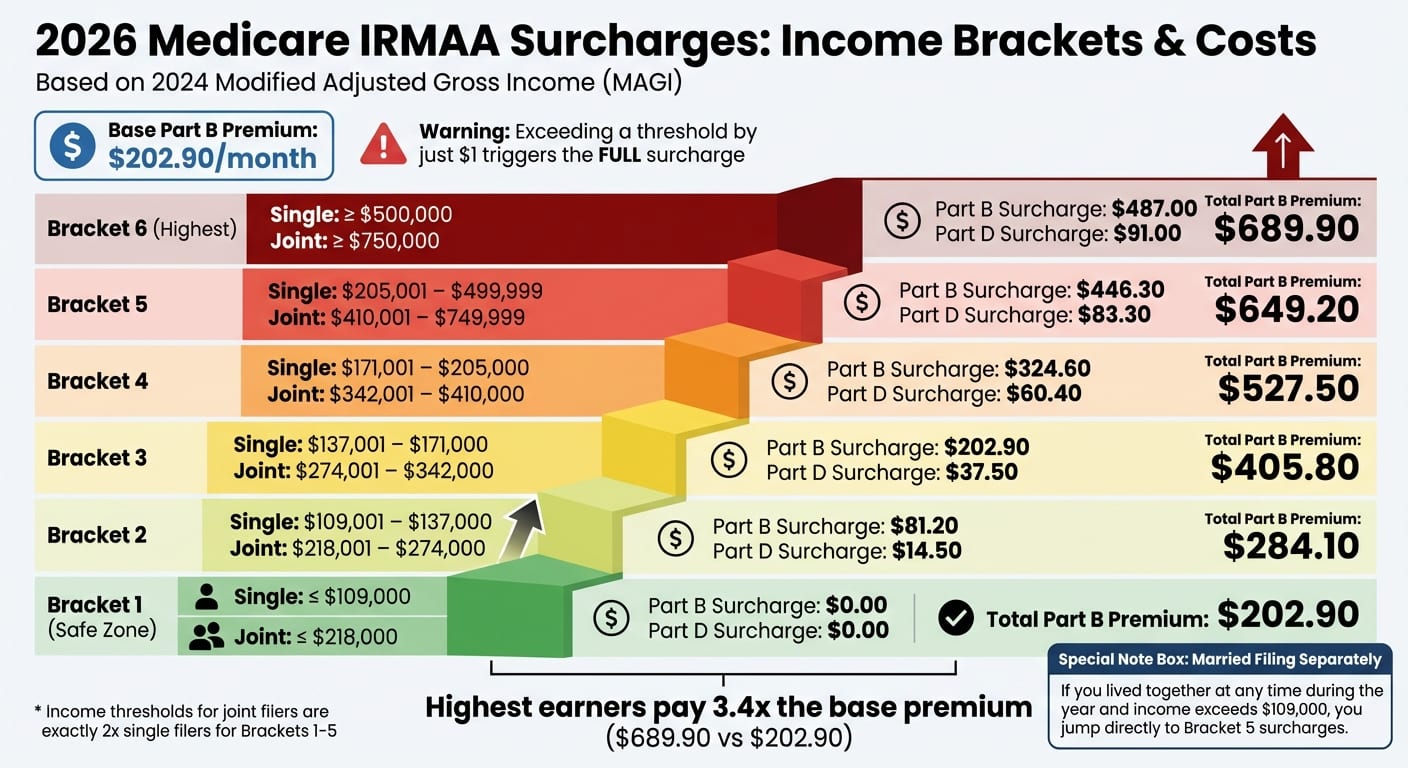
The Income-Related Monthly Adjustment Amount (IRMAA) operates on a "cliff effect", meaning that exceeding an income threshold by even $1 triggers the entire surcharge for that bracket. For 2026, the initial threshold has risen by 2.83%, increasing from $106,000 to $109,000. These surcharges are based on your 2024 Modified Adjusted Gross Income (MAGI), which includes your Adjusted Gross Income plus any tax-exempt interest.
In 2026, the base premium for Medicare Part B is set at $202.90 per month. If your income surpasses the thresholds, you'll face additional surcharges. Medicare Part D also has separate surcharges, which range from $14.50 to $91.00 per month. For individuals in the highest income brackets, total monthly premiums for Part B can climb to $689.90, over three times the standard rate. To put it into perspective, while the Social Security cost-of-living adjustment for 2026 is only 2.5%, the IRMAA surcharge amounts have increased by around 9%. This disparity means that Medicare premiums are rising much faster than Social Security benefits, potentially leaving retirees with less disposable income.
2026 IRMAA Brackets: Single vs. Joint Filers
For the first four IRMAA tiers, the income thresholds for joint filers are exactly double those of single filers. However, this symmetry doesn't apply to the top bracket, which begins at $500,000 for single filers and $750,000 for joint filers. Despite the varying income thresholds, the surcharge amounts are the same for each individual, regardless of whether they file singly or jointly.
For married couples who file separately and lived together at any time during the year, the rules are stricter. Once their income exceeds $109,000, they are immediately placed in the second-highest surcharge tier. This translates to $446.30 for Part B and $83.30 for Part D. Additionally, the fifth bracket remains frozen and won't be adjusted for inflation until 2028. These brackets highlight the importance of careful income planning and withdrawal strategies to avoid unexpected and costly surcharges.
How to Reduce Your MAGI and Avoid IRMAA Surcharges
Your 2024 tax return determines your 2026 premiums, but you can still manage your income for 2025–2026 to avoid future IRMAA surcharges. The key lies in keeping your Modified Adjusted Gross Income (MAGI) below specific thresholds. Even exceeding a bracket by just $1 can trigger the full surcharge for the entire year, so careful planning is essential. A smart way to manage this is by performing a Roth IRA conversion during years when your income is lower.
Convert to a Roth IRA During Low-Income Years
Roth IRA conversions can be a double-edged sword. On one hand, they increase your taxable income in the year you make the conversion, which can lead to IRMAA surcharges. On the other hand, converting during low-income "gap years" (before Required Minimum Distributions or RMDs kick in) can help reduce your future MAGI.
The strategy involves moving funds from Traditional IRAs and 401(k)s while your income is low. For example, if you're 68, retired, and holding off on Social Security until age 70, your income might be minimal. In this case, you could convert funds up to the top of your current IRMAA bracket - say $218,000 for joint filers in 2026 - without jumping into the next tier. This reduces your Traditional IRA balance, which means smaller RMDs when they start at age 73, keeping future MAGI lower.
"By reducing the balance in your traditional IRAs and 401(k)s, you are reducing future Required Minimum Distributions (RMDs). This reduces income, thereby minimizing the potential impact of IRMAA." - Kirk Hackbarth, Advisor, JMG Financial Group
To avoid surprises, aim to stay $5,000–$10,000 below the next IRMAA threshold. This buffer accounts for unexpected income like dividends or capital gains distributions. Tools like Mezzi can help by tracking your income in real time, giving you clarity on how much room you have to work with. Make sure to complete conversions by early December to meet the December 31 deadline.
Direct RMDs to Charity with QCDs
Another way to lower MAGI is by managing RMDs effectively. If you're 70½ or older, you can use Qualified Charitable Distributions (QCDs) to send up to $108,000 annually (starting in 2025) directly from a Traditional IRA to a qualifying charity. Unlike standard charitable deductions, which don't reduce MAGI, QCDs are excluded from gross income entirely, directly lowering the MAGI used to calculate IRMAA.
Once RMDs begin at age 73, QCDs become even more impactful. For instance, a $5,000 QCD on a $15,000 RMD reduces your MAGI by $5,000, potentially keeping you within your current IRMAA bracket.
Keep in mind the IRS's "first-dollar out" rule: the first withdrawal from an IRA each year is considered the RMD. To ensure your QCD satisfies this rule and remains tax-free, execute it before or at the same time as your RMD. If you wait until after the RMD, the QCD won't offset it and could double your taxable income.
The transfer must go directly from your IRA trustee to a 501(c)(3) organization. If the funds are paid to you first, the tax-free benefit is lost. Additionally, Form 1099-R does not label distributions as QCDs, so inform your tax preparer to ensure they’re reported correctly.
Coordinate Social Security and Account Withdrawals
Only the taxable portion of Social Security benefits counts toward MAGI. Delaying Social Security benefits from age 62 to 70 not only boosts your monthly payments by up to 77% but also extends the low-income years available for Roth conversions and other tax strategies.
Withdrawals from Traditional IRAs, 401(k)s, and 403(b)s are taxable and add to your MAGI, while withdrawals from Roth IRAs and Roth 401(k)s are tax-free and don’t affect MAGI. For example, if you need $50,000 to cover expenses and your MAGI is already at $105,000, withdrawing the full amount from a Traditional IRA would push your MAGI to $155,000, landing you in the second IRMAA bracket. Instead, you could withdraw $4,000 from the Traditional IRA (staying below $109,000) and the remaining $46,000 from a Roth IRA.
"Consider doing Roth conversions during your 'gap' years to reduce your future RMDs (and your future taxable income)." - Taylor R. Schulte, CFP, YouStayWealthy
Mezzi provides a comprehensive view of your MAGI across all accounts - Traditional IRAs, Roth IRAs, taxable brokerage, 401(k)s - allowing you to optimize withdrawals. This level of insight ensures you can make informed decisions, as traditional advisors often only see the accounts they manage. With this integrated approach, you can effectively manage your long-term IRMAA exposure.
Tax Strategies to Lower IRMAA Costs
Smart tax strategies for your investment portfolio can make a big difference in managing IRMAA (Income-Related Monthly Adjustment Amount) costs. Since capital gains from selling assets or rebalancing your portfolio contribute to your MAGI (Modified Adjusted Gross Income), they directly impact IRMAA surcharges. Thoughtful, year-round tax planning can help keep your MAGI below critical thresholds, potentially saving you a lot on Medicare expenses. Just as you carefully plan withdrawals, strategic tax moves are another key part of managing your MAGI.
Offset Gains with Tax-Loss Harvesting
Tax-loss harvesting is a technique where you sell investments at a loss to offset gains, effectively reducing your MAGI. This can be particularly helpful if you're close to crossing an IRMAA threshold. Why? Because exceeding a threshold by even $1 triggers the full surcharge for the entire year - there’s no partial charge here.
Mezzi continuously monitors portfolios for tax-loss harvesting opportunities. By identifying positions that, if sold, could offset gains, Mezzi helps you stay ahead of potential IRMAA bracket jumps.
Track Wash Sales Across All Accounts
The IRS wash sale rule can complicate tax-loss harvesting. If you repurchase a substantially identical security within 30 days of selling it for a loss, that loss becomes disallowed. This becomes trickier when you have multiple accounts - like taxable brokerage accounts, Traditional IRAs, Roth IRAs, or even accounts belonging to your spouse.
Mezzi simplifies this process by monitoring all linked accounts. It flags potential wash sale risks before they occur, ensuring that harvested losses remain valid and deductible for tax purposes.
Place Investments in the Right Account Types
Beyond harvesting losses, where you hold your investments can also affect your MAGI. Different types of income - like bond interest, stock dividends, and mutual fund capital gains - add to your MAGI, which could push you into a higher IRMAA tier.
Here are a few tips to manage this:
- Use tax-deferred accounts for income-heavy investments: Placing bonds or high-dividend stocks in accounts like Traditional IRAs or 401(k)s prevents that income from counting toward your MAGI.
- Favor ETFs in taxable accounts: Unlike mutual funds, ETFs generally avoid capital gains distributions, making them more tax-efficient.
- Hold high-growth assets in Roth IRAs: Assets like small-cap value stocks or emerging markets are ideal for Roth IRAs since qualified withdrawals from these accounts don’t count toward your MAGI.
"By choosing investments that mitigate those tax events, you can reduce your MAGI and potentially avoid an Income-Related Monthly Adjustment Amount (IRMAA) in the future." - Taylor R. Schulte, CFP
Mezzi provides a holistic view of your investments across all accounts, helping you optimize asset placement while minimizing the risk of unintentionally increasing your MAGI.
Disclaimer: The information provided in this section is for informational purposes only and does not constitute tax or financial advice. Please consult a tax professional or financial advisor regarding your specific situation.
How to Appeal IRMAA Surcharges After Life Changes
IRMAA surcharges are calculated using tax returns from two years prior. This means your 2026 Medicare premiums will reflect your 2024 income. But what happens if your financial situation changes - like retiring, divorcing, or losing a spouse? The Social Security Administration (SSA) doesn’t automatically adjust your IRMAA for these events. You’ll need to file an appeal to request a reassessment.
Appealing can save you a lot of money and may even lead to retroactive refunds. For instance, in June 2020, retired attorney Barbara Hughes successfully appealed after retiring. She submitted Form SSA-44 along with a letter from her employer confirming her retirement date and updated tax details. By following up with her local Social Security office, she reduced her monthly premiums by over $70 and received an $800 refund for premiums she’d already paid in late 2020.
Life Events That Qualify for IRMAA Appeals
The SSA recognizes eight specific life events that allow for an IRMAA appeal:
- Work stoppage (retirement) or reduction in work hours
- Marriage, divorce, or annulment
- Death of a spouse
- Loss of income-producing property due to disaster or fraud
- Loss of pension income
- Employer settlement payments
To qualify, the event must have occurred after the tax year used to calculate your IRMAA and must result in a significant drop in your Modified Adjusted Gross Income (MAGI). For example, if you’re appealing your 2026 premiums (based on 2024 income), the life event must have taken place after 2024.
"If it's not listed [as a qualifying life-changing event], it's considerably harder to get approved. Then you are fighting an uphill battle." - Danielle Roberts, Co-founder, Boomer Benefits
One-time income spikes - such as a large Roth conversion, capital gains from selling a home, or a big IRA withdrawal - generally don’t qualify unless directly tied to one of the eight recognized events.
Once you identify a qualifying event, it’s important to file your appeal promptly.
How to File an IRMAA Appeal
Filing an appeal is fairly simple. Here’s what you need to do:
- Complete Form SSA-44.
Provide details about the qualifying life event, including the event date and your updated, lower MAGI.
- Gather Supporting Documents.
Supply official proof for your claim. This might include a letter from your employer confirming your retirement, a death certificate, a divorce decree, or documentation from an insurance adjuster for property loss. If you’re self-employed, you may need to provide a signed statement or relevant business records.
- Submit Your Appeal.
Appeals can be filed in person at your local Social Security office, by mail, or through the SSA’s online portal.
- Follow Up if Necessary.
Appeals are typically processed within 30 to 90 days. If denied, you can request a hearing with an Administrative Law Judge within 60 days.
Tools like Mezzi can simplify this process by tracking your MAGI across connected accounts and identifying when a life event might make you eligible for an appeal. By monitoring income in real time, Mezzi helps you accurately estimate your updated MAGI - an essential step for completing Form SSA-44 and avoiding underpayment issues later. This kind of proactive tracking complements Mezzi’s broader retirement income diversification strategies for managing IRMAA costs.
Disclaimer: This content is for informational purposes only and should not be considered tax or financial advice. Consult a tax professional or financial advisor for guidance specific to your situation.
Plan Ahead to Reduce Medicare IRMAA Costs
Managing IRMAA surcharges requires careful planning. Because Medicare uses a two-year lookback period, your income in 2024 will determine your Medicare costs in 2026. That means every financial decision impacting your Modified Adjusted Gross Income (MAGI) today could affect your future premiums. By applying thoughtful strategies, you can better control your MAGI and reduce potential surcharges.
As previously mentioned, Roth conversions and Qualified Charitable Distributions (QCDs) are powerful tools to help manage IRMAA costs. For instance, converting portions of a Traditional IRA to a Roth during lower-income years - preferably before age 63 - can help lower your future MAGI and reduce surcharges. Once you reach age 70½, QCDs allow you to meet Required Minimum Distribution (RMD) obligations without increasing your MAGI. Additionally, timing your Social Security benefits strategically can create opportunities to manage capital gains or make tax-efficient Roth conversions.
Tax planning plays a crucial role in this process. Regular tax-loss harvesting can help offset capital gains, while holding high-yield investments in tax-deferred accounts protects your MAGI from unnecessary increases. If you experience a qualifying life event, such as retirement or the loss of a spouse, you may be eligible to request a premium adjustment to reflect your current income.
"Planning is the only way to fight the IRMAA surcharges." - Donna LeValley, Retirement Writer, Kiplinger
For a more dynamic approach, Mezzi’s AI-driven platform offers real-time MAGI monitoring by aggregating data from all your connected accounts. It alerts you when you’re nearing a bracket threshold and lets you test various strategies - like adjusting withdrawal schedules, fine-tuning Roth conversion amounts, or optimizing Social Security timing. This proactive guidance can help retirees avoid the $2,000 to $6,000+ in annual surcharges that often catch them off guard.
Disclaimer: This content is for informational purposes only and should not be considered tax or financial advice. Consult a tax professional or financial advisor for guidance specific to your situation.
FAQs
What counts in my MAGI for IRMAA?
Your Modified Adjusted Gross Income (MAGI) for IRMAA (Income-Related Monthly Adjustment Amount) is calculated by taking your Adjusted Gross Income (AGI) and adding certain types of income. These additions often include:
- Tax-exempt interest
- Untaxed foreign income
- Non-taxable Social Security benefits
However, Supplemental Security Income (SSI) and assets like savings accounts are not part of this calculation. MAGI is determined using the income details from your tax return filed two years ago, focusing specifically on the income sources reported in that return.
How can I estimate IRMAA before I file taxes?
Medicare determines your Income-Related Monthly Adjustment Amount (IRMAA) based on your Modified Adjusted Gross Income (MAGI) from two years earlier. For instance, the premiums you’ll pay in 2027 will be calculated using the information from your 2025 tax return.
To prepare, it’s helpful to review the IRMAA income brackets for the year in question. You can also explore strategies to manage your income, such as making tax-efficient withdrawals. If you experience an unexpected drop in income, you have the option to file Form SSA-44 to request a reconsideration of your IRMAA.
Keeping a close eye on your income throughout the year can help you avoid any unexpected surprises when it comes to your Medicare premiums.
Which moves create “one-time” income spikes that trigger IRMAA?
One-time income events, such as selling a property, executing a large Roth conversion, or realizing substantial capital gains, can lead to a temporary spike in your income. Medicare factors in this elevated income level two years later when determining IRMAA (Income-Related Monthly Adjustment Amount).
Disclosures:
- This content is for informational purposes only and does not constitute investment, tax, or financial advice. Please consult a tax professional or financial advisor regarding your specific situation.
- Past performance is not indicative of future results. No guarantee of future performance or outcomes is implied.
- Savings and performance examples are hypothetical and for illustrative purposes only. Actual results will vary based on individual circumstances, portfolio composition, market conditions, and fees.
- All links to external sources are provided for reference only.
Related Blog Posts
- Roth vs. Traditional IRA: Tax Implications for High Earners
- How can I minimize taxes when withdrawing from tax-advantaged accounts?
- How to Do a Roth Conversion Ladder in Early Retirement
- Should I Do a Roth Conversion in a Low-Income Year?
Your Modified Adjusted Gross Income (MAGI) for IRMAA (Income-Related Monthly Adjustment Amount) is calculated by taking your Adjusted Gross Income (AGI) and adding certain types of income. These additions often include:
- Tax-exempt interest
- Untaxed foreign income
- Non-taxable Social Security benefits
However, Supplemental Security Income (SSI) and assets like savings accounts are not part of this calculation. MAGI is determined using the income details from your tax return filed two years ago, focusing specifically on the income sources reported in that return.
Medicare determines your Income-Related Monthly Adjustment Amount (IRMAA) based on your Modified Adjusted Gross Income (MAGI) from two years earlier. For instance, the premiums you’ll pay in 2027 will be calculated using the information from your 2025 tax return.
To prepare, it’s helpful to review the IRMAA income brackets for the year in question. You can also explore strategies to manage your income, such as making tax-efficient withdrawals. If you experience an unexpected drop in income, you have the option to file Form SSA-44 to request a reconsideration of your IRMAA.
Keeping a close eye on your income throughout the year can help you avoid any unexpected surprises when it comes to your Medicare premiums.
One-time income events, such as selling a property, executing a large Roth conversion, or realizing substantial capital gains, can lead to a temporary spike in your income. Medicare factors in this elevated income level two years later when determining IRMAA (Income-Related Monthly Adjustment Amount).