
Even smart investors may make poor choices when money and stress mix. This article’s main point may be simple: AI may work as a second set of eyes by spotting bias, overlap, drift, tax issues, and employer stock risk before a decision turns into a trade.
Here’s the short version:
- Five biases may shape portfolio moves: loss aversion, confirmation bias, recency bias, overconfidence, and herd behavior
- These patterns may show up as holding losers too long, chasing hot funds, skipping rebalancing, or letting one stock get too big
- AI tools may flag risks across all linked accounts, not just one account at a time
- Cross-account tracking may show hidden concentration, wash sale risk, and fund overlap
- Rule-based alerts may lower emotional trading by comparing your current mix with your written targets
- Scenario modeling may turn a market drop into a retirement-timeline view, which may feel easier to judge than a raw loss number
A few examples from the article stand out:
- A portfolio that looks balanced account by account may still have 45%+ in large-cap U.S. tech
- Overlap analysis may show that a few names like Apple, Microsoft, and Nvidia make up about 28% of equity exposure
- A rebalancing rule may trigger when an asset class moves 5 percentage points away from target
- A 20% stock shock may look very different when viewed as a dollar impact and a possible recovery path
My takeaway: this isn’t about replacing judgment. It may be about using written rules and read-only AI monitoring so emotions may have less room to drive portfolio decisions.
If I were reading this for one answer, it would be this: behavioral mistakes may be predictable, and AI may help spot them early - especially across taxable accounts, IRAs, 401(k)s, and employer stock.
Stop Acting on What AI Tells You to Buy
5 investing biases that quietly damage returns
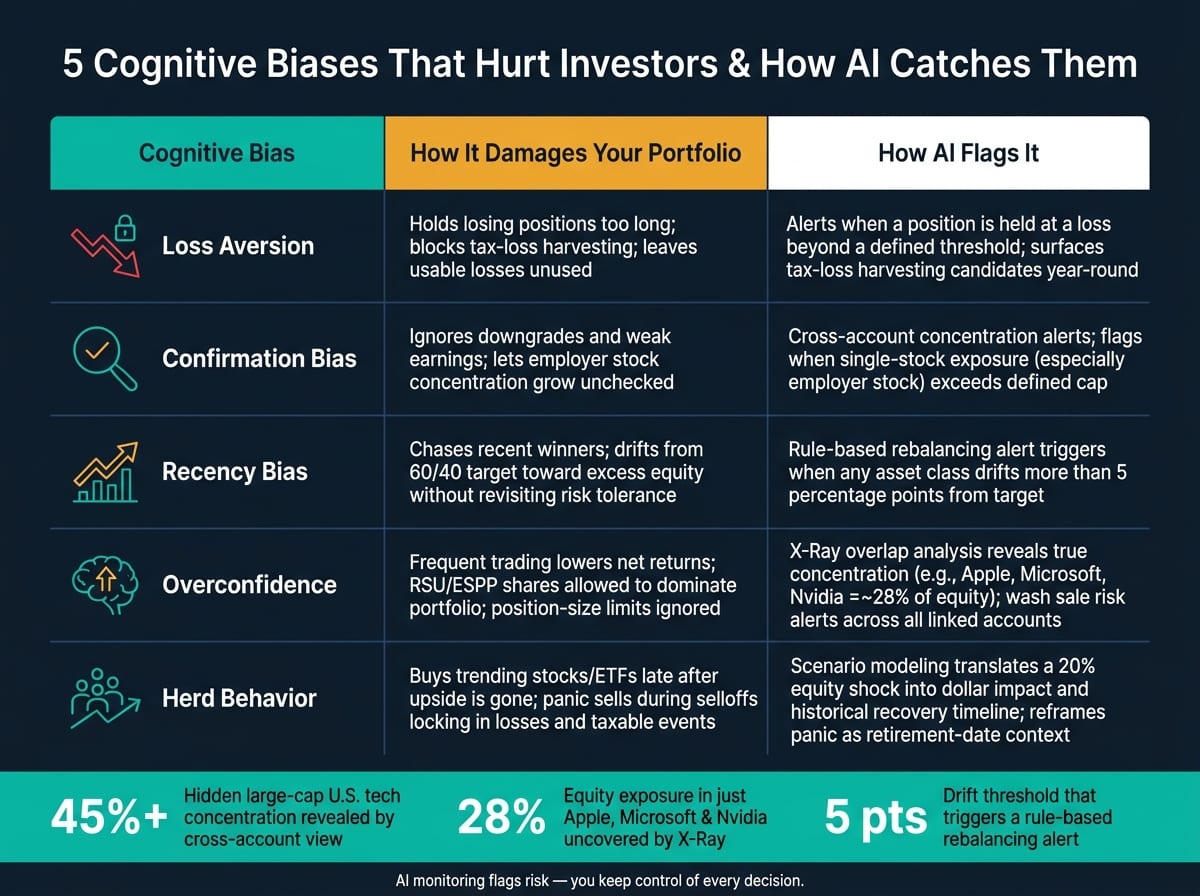
These five biases may chip away at returns without much warning. In real portfolios, they often show up as chasing recent winners, hanging on to losers, and brushing past concentration risk.
Loss aversion and confirmation bias
Loss aversion is simple: losing money feels worse than gaining the same amount feels good. That may lead some investors to hold losing positions for too long, treating an unrealized loss like it doesn’t count yet.
The tax impact may be real too. Waiting may block tax-loss harvesting and leave usable losses unused. A position may stay too large for too long.
Confirmation bias may make that even worse. Once investors own a position, they may spend more time with bullish research, follow upbeat analysts, and tune out downgrades or weaker earnings guidance. Employer stock may add another layer, because skepticism may feel disloyal even while concentration risk grows.
Recency bias and overconfidence
Recency bias is the habit of assuming that what just happened may keep happening. After a strong run in U.S. large-cap growth or a hot sector ETF, many investors may move money toward those recent winners. Sometimes that means drifting from a balanced 60/40 mix to a portfolio with much more equity exposure, without revisiting actual risk tolerance or time horizon.
That pattern may slide into overconfidence. Overconfidence may add fuel to the fire. Research suggests that frequent trading may lower net returns, especially when investors move away from position-size limits. For employees who analyze ESPP and RSU vesting schedules, recency bias and overconfidence may work together in a way that lets employer equity take over too much of the portfolio - putting both income and savings in the same single company.
Herd behavior
Herd behavior shows up when social proof takes over and independent analysis fades into the background. In practice, that may mean buying a trending stock or thematic ETF because it’s all over social media or online forums, not because it fits a long-term plan. The 2021 GameStop short squeeze is a clear example: investor behavior was driven heavily by sentiment and narrative on social platforms, pushing prices far beyond any fundamental justification.
During rallies, herding may pull investors into crowded trades late, after much of the upside may already have happened. During selloffs, the same pattern may lead to panic selling at the worst time, locking in losses and creating taxable events that may not have been needed. The portfolio may drift from plan simply because the headlines felt urgent.
AI may surface these patterns before they turn into costly trades.
How AI insights help investors catch bias before it costs them
AI may turn bias patterns into alerts before they become trades. In practice, that may mean spotting hidden risk before you act. Mezzi reads linked accounts in read-only mode, so it may flag risk without placing trades.
Cross-account monitoring reveals risk you may not see on your own
Many investors look at each account on its own, and that habit may create a blind spot. A technology-heavy mutual fund in a 401(k), a handful of individual tech stocks in a taxable account, and a growth ETF in a Roth IRA may each look balanced by themselves. But taken together, they may push more than 45% of a total portfolio into large-cap U.S. technology.
Mezzi's cross-account view calculates a true total portfolio allocation instead of a fragmented, account-by-account snapshot. It may also flag wash sale risk. For example, if you realize a loss in a taxable account and buy the same or a similar security in a linked IRA within 30 days, that loss may be disallowed by the IRS. These risks show up as alerts, not surprises.
Once hidden concentration becomes visible, rebalancing rules may make the next move less emotional.
Rule-based rebalancing alerts reduce emotional decisions
Recency bias and overconfidence may pull investors toward recent winners and away from their original targets. Headline-driven rebalancing may invite buy-high, sell-low behavior. A rule-based approach may flip that pattern.
With Mezzi, you define target allocations and drift thresholds - for example, rebalancing when any asset class moves more than 5 percentage points from its target. If U.S. equities move from a 60% target to 70% of the portfolio after a strong bull run, Mezzi generates an alert with specific guidance: which holdings are overweight, which are underweight, and suggested trade directions in dollar amounts.
Tax-aware guidance runs alongside this. Mezzi scans taxable accounts year-round for tax-loss harvesting candidates, not just in December. Each opportunity includes an estimated tax impact, so you may weigh the decision before acting. Mezzi also watches for wash sale exposure across all linked accounts before you act.
For deeper concentration risk, overlap analysis may show when different funds hold the same stocks.
X-Ray overlap analysis and scenario modeling support calmer decisions
Concentration risk often hides inside funds with different names. Mezzi's X-Ray breaks each fund into its holdings and aggregates exposure across the entire portfolio. An investor holding an S&P 500 index fund, a "U.S. growth leaders" ETF, and a "technology innovation" mutual fund might find that Apple, Microsoft, Alphabet, Amazon, and Nvidia together account for nearly 28% of total equity exposure - above what some investors may view as a typical concentration limit. That map may make it easier to add diversification instead of just adding another fund with a different label.
When markets get choppy, scenario modeling may show the cost of reacting too soon.
When markets swing, scenario modeling gives investors a way to evaluate a decision instead of reacting to a single day's move. Mezzi may show how a portfolio built from your connected accounts would have behaved during historical downturns - translating a 20% equity shock into a concrete dollar figure and a historically typical recovery timeline. Someone five years from retirement may see the impact on near-term withdrawal plans. A younger investor may see the long-run wealth projection. That context may make it easier to avoid recency-driven panic.
A practical behavioral finance playbook for self-directed investors
A written rulebook may matter more than good intentions when markets move fast. Once AI spots a bias, the next step may be to put the response in writing. For high-income households juggling 401(k)s, Roth IRAs, taxable accounts, and employer equity at the same time, the aim may be simple: make fewer judgment calls during volatile markets.
Write down your portfolio rules before markets test you
A written Investment Policy Statement (IPS) doesn't need to be long. It may just need to be specific enough to follow when stress kicks in. Include target ranges, concentration limits, rebalancing triggers, and sell or tax-harvest rules. Spell out whether those limits apply at the household level. Use a hard cap on single-stock exposure, with a tighter cap for employer stock.
AI may be most useful when it has a clear rulebook to check against. That way, it may flag breaks from the plan instead of guessing what you meant to do. Keep only a short drift band in the IPS, since the rebalancing mechanics may already be handled through alerts.
Employer stock may need its own guardrails because concentration risk may build fast.
Set guardrails for employer stock, RSUs, and taxes
Set a hard cap on total employer exposure and a schedule for selling vested RSUs. That cap may cover direct stock, RSUs, deferred compensation, and company stock inside a 401(k) across all accounts. Use X-Ray to see whether employer exposure may be amplified elsewhere in the portfolio.
On the tax side, taxes may work as a behavioral guardrail: rules set ahead of time may reduce reactive trades. Some investors place tax-inefficient assets in tax-deferred accounts and tax-efficient funds in taxable accounts, then use tax-loss harvesting and wash-sale alerts as review triggers. Tax rules are individualized, so Mezzi flags the opportunity and the risk for review rather than making the trade for you.
The same discipline may turn market moves into retirement impact, not just account loss.
Connect decisions to your retirement timeline
Translate a drawdown into retirement impact, not just a portfolio loss. Seeing that a 10% equity decline may change your projected retirement date by six months, one year, or not at all if you stay disciplined and rebalance may reframe the decision. The question shifts from how much am I down today? to what may this mean for my long-term plan?
Mezzi's retirement modeling pulls from your actual connected accounts, not hypothetical inputs, so the projection may reflect your real savings rate, current allocation, and withdrawal timeline. Real-account projections may be more tied to your situation than generic calculators - and when a drawdown is shown as retirement-date impact instead of a percentage loss, staying invested may feel more grounded in data.
Conclusion: Use AI as a second set of eyes, not an autopilot
Biases may be tough to spot. They often show up quietly through oversized positions, delayed sells, and crowded trades.
That’s where AI monitoring may matter. The point isn’t to replace judgment. It’s designed to lower the chance that bias shapes action.
Mezzi stays in read-only mode, so you keep control of every decision while AI flags risk and tax issues.
In practice, that may mean asking better questions about your actual accounts. Questions about employer stock exposure or retirement impact may return personalized answers from your connected accounts in a short amount of time.
The longer-term fix may come from a steady process: clear rules, defined guardrails, and continuous AI monitoring that may catch bias before it becomes costly.
FAQs
How does AI detect investing bias?
AI may detect investing bias by tracking trading habits, portfolio changes, and reactions to market conditions against logical, data-backed patterns.
It may look at transaction frequency, holding periods, and trades around market events to spot shifts from normal behavior, such as panic selling during volatility or holding losing assets for too long. It may also analyze emotional tone in investor communications to detect sentiment changes tied to irrational decisions.
What is cross-account concentration risk?
Cross-account concentration risk may happen when overlapping investments across multiple accounts create unintended, excessive exposure to certain sectors or individual assets.
If you manage brokerage accounts, IRAs, and 401(k)s separately, you may not realize you own the same security through different funds or direct holdings. Mezzi’s X-Ray feature is designed to help uncover these hidden concentrations, which may support more disciplined risk management and more informed diversification.
Can AI help without making trades for me?
Yes. AI may act as a guardrail while you keep full control of your trading decisions.
Instead of trading for you, Mezzi monitors your portfolio across accounts, analyzes patterns, and sends alerts that may help you spot biased behavior - like panic selling or overconfidence - before it affects your long-term wealth.
Disclosures:
- This content is for informational purposes only and does not constitute investment advice or a recommendation to buy or sell any security.
- Past performance is not indicative of future results. No guarantee of future performance or outcomes is implied.
- The use of artificial intelligence and algorithmic tools does not guarantee investment results. These tools are subject to limitations, errors, and market conditions that may affect performance.
Related Blog Posts
- AI vs. Human Bias in Portfolio Decisions
- AI in Behavioral Finance: Managing Investor Bias
- AI and Behavioral Data in Portfolio Management
- How AI Identifies Behavioral Triggers in Rebalancing
AI may detect investing bias by tracking trading habits, portfolio changes, and reactions to market conditions against logical, data-backed patterns.
It may look at transaction frequency, holding periods, and trades around market events to spot shifts from normal behavior, such as panic selling during volatility or holding losing assets for too long. It may also analyze emotional tone in investor communications to detect sentiment changes tied to irrational decisions.
Cross-account concentration risk may happen when overlapping investments across multiple accounts create unintended, excessive exposure to certain sectors or individual assets.
If you manage brokerage accounts, IRAs, and 401(k)s separately, you may not realize you own the same security through different funds or direct holdings. Mezzi’s X-Ray feature is designed to help uncover these hidden concentrations, which may support more disciplined risk management and more informed diversification.
Yes. AI may act as a guardrail while you keep full control of your trading decisions.
Instead of trading for you, Mezzi monitors your portfolio across accounts, analyzes patterns, and sends alerts that may help you spot biased behavior - like panic selling or overconfidence - before it affects your long-term wealth.