
A will may not control some of your biggest accounts. For many people, the name on the beneficiary form may control where the money goes, even if the will says something else.
I’d boil the article down like this:
A 401(k) or 403(b) may go to the person listed with the plan
An IRA may follow the custodian’s beneficiary form
A life insurance policy may pay the person named with the insurer
A TOD brokerage account may pass by the transfer-on-death form
A POD bank account may pass by the payable-on-death form
That mismatch may show up after divorce, remarriage, a new child, a death, a job change, or a rollover. And when it does, a stale form may send $100,000+ or even $620,000 to someone you no longer meant to name.
The short version: I’d review all five account types, check the primary beneficiary, backup beneficiary, and percentage split, and make sure each institution has the latest signed form on file. A will update alone may not change any of those records.
Quick Comparison
| Account | Where the name may sit | What may control payout | What to review |
|---|---|---|---|
| 401(k) / 403(b) | Plan administrator or recordkeeper | Plan form on file | Primary, backup, spouse rules, old job plans |
| IRA | IRA custodian | IRA form on file | Primary, backup, split percentages |
| Life insurance | Insurer | Policy form on file | Policy owner, primary, backup |
| TOD brokerage | Brokerage firm | TOD registration | Names, shares = 100%, backup |
| POD bank account | Bank | POD form on file | Names, spelling, shares = 100%, backup |
Bottom line: if these forms and your estate documents don’t match, the account may follow the form, not the will.
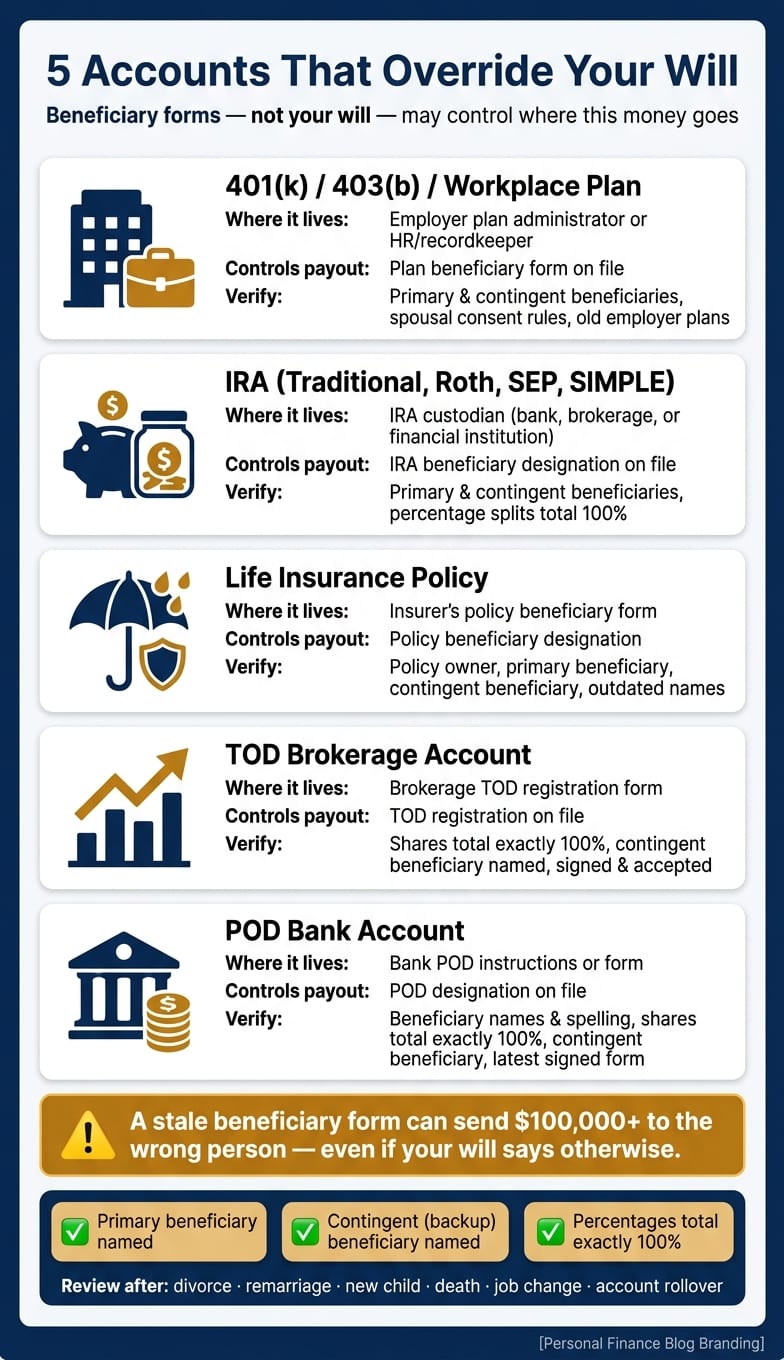
How a Beneficiary Designation Can Override Your Will
The five accounts to check first
Use this checklist to review the five account types that may pass outside your will. In many cases, these assets are controlled by the form or contract on file with the institution, not by the instructions in your will. The institution may pay the person listed there.
Start with workplace plans. Then move to IRAs, insurance, and bank or brokerage accounts.
| Account Type | Where the Designation Lives | What Controls the Payout | What to Verify |
|---|---|---|---|
| 401(k), 403(b), workplace plan | Employer plan administrator or HR/recordkeeper | The plan's beneficiary form on file | Primary and contingent beneficiaries, spousal consent, old employer accounts |
| IRA | IRA custodian's beneficiary form | The IRA beneficiary designation on file | Primary/contingent beneficiaries, coordination with will and any trust |
| Life insurance | Policy beneficiary form held by the insurer | The policy's beneficiary designation | Policy owner, primary beneficiary, contingent beneficiary, outdated names |
| TOD brokerage account | Brokerage TOD registration form | TOD registration on file | Account title, shares totaling 100%, contingent beneficiary, signed and accepted by the institution |
| POD bank account | Bank POD instructions or form | POD designation on file | Beneficiary names, spelling, shares totaling 100%, contingent beneficiary, latest signed and accepted form |
401(k)s, 403(b)s, and other workplace retirement plans
An employer-sponsored retirement plan usually pays the person named on its beneficiary form. The plan administrator may be required to follow those records. So if your will says your two children split your 401(k) equally, but the form on file names your ex-spouse, your ex-spouse may receive the money.
Two issues often make workplace plans messy.
First, a current spouse may have priority rights to a 401(k), and many plans may require a spouse's written consent before someone else may be named as the primary beneficiary. If you remarried and assumed your new spouse was already covered, it may make sense to confirm that the form on file says so.
Second, every former employer plan has its own separate record. A 401(k) from a job you left years ago may still pay the person you named back then, unless you rolled it over or updated the form. It may help to list every former employer plan and confirm both the primary and contingent beneficiaries.
Next come IRAs and life insurance, where separate beneficiary forms may create the same kind of mismatch.
IRAs and life insurance policies
IRAs work in much the same way as workplace plans, but the beneficiary form is kept by your IRA custodian - the bank, brokerage, or financial institution where the account is held. Each IRA has its own separate beneficiary designation.
A common example: a parent names only their oldest child as IRA beneficiary years earlier, then later has another child. The will says, "divide my estate equally", but the IRA may pass entirely to the oldest child. The younger child may share only in whatever other assets remain. Check the primary and contingent beneficiaries, and confirm the percentages total 100%.
For life insurance, old beneficiary designations may matter a lot because payouts are often large and immediate. Confirm three points:
Who owns the policy
Who is named as the primary beneficiary
Whether a contingent beneficiary is listed
If a policy names a deceased parent and no contingent beneficiary is on file, the benefit may be paid to your estate and may go through probate instead of going straight to your intended heirs. You may want to contact your insurer or HR benefits office and ask for written confirmation of who is currently on file.
Then review brokerage and bank accounts, which may also pass outside probate.
TOD brokerage accounts and POD bank accounts
Transfer-on-death (TOD) brokerage registrations and payable-on-death (POD) bank accounts are set up to skip probate. At death, the assets may go straight to the person named on the account.
Here’s a simple example. An investor sets up a TOD registration naming a sibling, then later writes a will leaving everything to a charity. When that person dies, the brokerage account may go to the sibling - not the charity - because the TOD registration may control.
For both account types, verify a few basics:
Beneficiary shares add up to exactly 100%
At least one contingent beneficiary is named
The names match current legal names on file
Each bank and brokerage usually needs its own updated, signed form. Changing the designation at one institution does nothing for accounts held somewhere else.
Mistakes that send assets to the wrong person
One old beneficiary form may override a will. And the five account types above often go off track in the same four ways.
Outdated names after divorce, remarriage, birth, or death
Life changes fast. Paperwork often doesn't.
Divorce, remarriage, a new child, or the death of a named beneficiary may leave the wrong person on file. In one case, a 401(k) worth $620,000 went to an ex-spouse instead of the account holder's children because the form was never updated after divorce.[1][4]
For workplace plans, the beneficiary form usually needs to be updated directly with the plan administrator. A will, divorce decree, or state law may not change the plan's record.
The same issue may come up when a named beneficiary dies and no replacement gets added. In that case, the account may pass through probate and may end up with someone you didn't intend. If a new child is born or adopted and never added as a contingent beneficiary, that child may receive nothing from the account, even if the will says otherwise.
The same check applies to backup beneficiaries and split percentages.
Missing contingent beneficiaries and percentage errors
A contingent beneficiary is the backup plan. If the primary beneficiary dies before you and no contingent is listed, many institutions may pay the asset to your estate. That may send it through probate and may increase the chance that it reaches the wrong person.
Percentage mistakes are easy to miss too. Each form should total exactly 100% and use clear percentages instead of vague notes like "split equally." If the total is more or less than 100%, an institution may reject the form or may apply its default rules.[2][6][7]
Naming minors directly or assuming the will fixes everything
Naming a minor child directly as a beneficiary creates an immediate issue across all five account types. Minors usually may not receive large assets outright. Some families use a trust or custodial account instead.[3][5]
A will does not override beneficiary forms. When one document gets updated and the others don't, large assets may end up with the wrong person.
Once these issues are corrected, review each form against your current estate plan.
How to review and update your beneficiary designations
Run a full beneficiary audit across all institutions
Go through every form and make sure the right account doesn’t still point to the wrong person.
Start with the five accounts above. Then add any other account that allows a beneficiary designation. That may include:
401(k), 403(b), or 457(b) plans at your current employer
Old workplace plans you never rolled over
Traditional, Roth, SEP, SIMPLE, and rollover IRAs
Life insurance through work and individual life insurance policies
Taxable brokerage accounts with TOD registration
Bank accounts with POD instructions
Then confirm the beneficiary designation on file with each institution.
For old employer plans, contact the prior HR department or the plan recordkeeper directly. Ask whether the account remains open and which beneficiary is listed. For current accounts, sign in to each institution’s portal and look for the Beneficiaries, TOD/POD, or Account Features section.
Match every designation to your estate plan
For each account, use this checklist before making changes:
| What to Check | Why It Matters |
|---|---|
| Full legal names (no nicknames) | May help prevent confusion among relatives with similar names |
| Primary and contingent beneficiaries listed | May reduce the chance that assets pass to your estate if the primary beneficiary dies first |
| Percentages total exactly 100% | May reduce delays or disputes |
| Designations match your estate plan | Beneficiary forms may override conflicting will provisions |
| New accounts after rollovers or bank changes | Fresh accounts often require a new form; older designations typically do not transfer |
Then check for blank fields and any entry that says “my estate.” Accounts with a blank beneficiary field or an estate listed as beneficiary may end up going through probate.
If your estate plan sends certain accounts to a revocable living trust, check that the trust’s full legal name and date appear exactly as written on the form. A shortened or casual version may create confusion.
Save proof and set a review schedule
After each change, save proof of the new designation. Download the confirmation page or take a screenshot that shows the new beneficiary names, percentages, and the date the change was processed. Save any mailed acknowledgment letters too.
Name each file clearly using U.S. date format. For example: “Fidelity IRA – Beneficiary Confirmation – 08/16/2026.” Keep everything in a secure folder with your will, trust documents, and powers of attorney.
Some people review all designations once a year and again after major life events, such as marriage, divorce, the birth or adoption of a child, the death of a named beneficiary, a job change, or an account rollover.
Conclusion: A 30-minute review can prevent a six-figure mistake
For these five accounts, the beneficiary designation may control who inherits - not your will. After you review all five, the next step may simply be fixing anything that looks off.
The most common mistakes may also be the most costly: stale names, missing backup beneficiaries, and uneven or unintended splits. That’s why this last check may matter so much. A small paperwork error may lead to an outcome that doesn’t match your plan, and it may be hard or impossible to reverse later.
Open each of the five accounts and verify the beneficiary names and percentage allocations. If anything looks wrong, file updates with the financial institution. Once the forms match your plan, save the confirmations and keep them with your records.
Some people set one annual reminder and review everything again after a major life change, like a marriage, divorce, birth, or death. Even a 30-minute review now may help you avoid a permanent error later.
FAQs
Does a beneficiary designation always override a will?
Yes, beneficiary designations generally override a will.
Assets with a named beneficiary or survivorship rights - like retirement accounts, life insurance policies, and accounts with payable-on-death or transfer-on-death designations - usually pass directly to the person listed on the account.
Because these assets are non-probate assets, they typically pass outside your will. That means the beneficiary form may control who receives them, even if your will says something else.
If those designations aren't kept up to date, assets may end up going to the wrong person.
What happens if my beneficiary dies before I do?
If a designated beneficiary dies before you, the asset transfer may not happen as intended. The funds may be left without clear payout instructions. And that may create confusion, sometimes to the point where a court may need to set up a resulting trust. If that happens, legal costs may be high.
One way some people try to reduce that risk is by naming contingent beneficiaries on all accounts and policies. It may also make sense to review and update those designations on a regular basis, especially after major life events.
Do I need to update beneficiaries after a divorce or rollover?
Yes. After a divorce, it may make sense to update beneficiary designations.
An ex-spouse may remain listed on accounts like 401(k)s, IRAs, life insurance policies, annuities, and some taxable accounts unless you change the forms.
That matters because beneficiary designations generally override a will or trust. So if those forms aren't updated, assets may go to someone you no longer intend to name.
In many cases, people contact the financial institution or plan administrator to submit the required forms.
Disclosures:
This content is for informational purposes only and does not constitute investment advice or a recommendation to buy or sell any security.
Past performance is not indicative of future results. No guarantee of future performance or outcomes is implied.