
A 3-fund portfolio is a simple, low-cost way to gain exposure to the global market. It includes just three index funds: U.S. stocks, international stocks, and bonds. Here's how to build and manage one effectively across multiple accounts:
- Decide Your Asset Allocation: Determine the percentage of U.S. stocks, international stocks, and bonds based on your goals, risk tolerance, and time horizon. For example:
Aggressive: 56% U.S. stocks, 24% international stocks, 20% bonds.
- Moderate: 42% U.S. stocks, 18% international stocks, 40% bonds.
- Conservative: 21% U.S. stocks, 9% international stocks, 70% bonds.
- Choose Low-Cost Index Funds: Look for funds with expense ratios under 0.10%. Popular options include:
Vanguard: VTSAX (U.S. stocks), VTIAX (international stocks), VBTLX (bonds).
- Fidelity: FSKAX, FTIHX, FXNAX.
- Schwab: SWTSX, SWISX, SWAGX.
- Allocate Across Accounts: Use tax-advantaged accounts (401(k), IRA) for bonds to minimize taxes and taxable accounts for international stocks to claim the Foreign Tax Credit. For U.S. stocks, any account works.
- Rebalance Annually or As Needed: Check your portfolio once or twice a year and adjust if any asset class drifts more than 5% from its target. Use new contributions or tax-advantaged accounts to make changes when possible.
This approach simplifies investing while providing broad market exposure, low fees, and tax efficiency.
How to Create a 3 Fund Portfolio | A Beginner's Guide
Step 1: Determine Your Asset Allocation
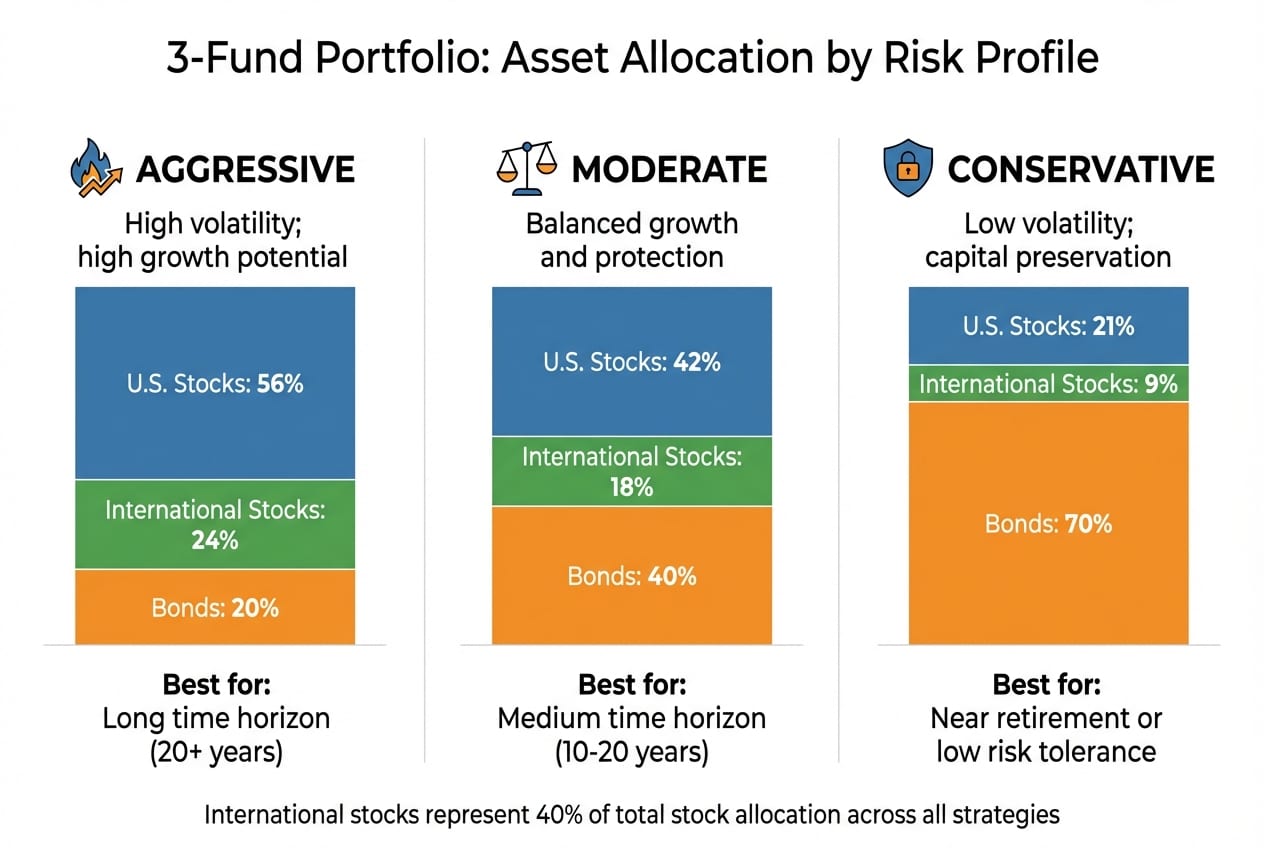
Your portfolio's performance and risk are largely shaped by asset allocation. This involves dividing your investments across U.S. stocks, international stocks, and bonds to strike the right balance between risk and return.
When deciding on your allocation, consider three key factors:
- Ability: Your financial capacity to handle losses.
- Willingness: Your emotional tolerance for market downturns.
- Need: The level of return required to meet your financial goals.
The goal is to find the lowest equity allocation that allows you to stay invested during tough times. This decision forms the foundation for later steps, like fund selection and account allocation.
Factors That Affect Asset Allocation
Two major factors influence your allocation: time horizon and risk tolerance. Younger investors, especially those with 20 or more years until retirement, can often take on higher stock allocations - typically 80% to 90% - because they have time to recover from market dips. For example, target-date funds designed for individuals in their 20s or 30s usually start with 90% stocks and 10% bonds.
But emotional resilience is just as important. Consider historical data: during the 2000–2002 bear market, a portfolio with 80% stocks and 20% bonds lost 34.35% after inflation, while a more conservative 20% stock/80% bond portfolio gained 6.29%. To find your comfort zone, try the "sleep at night" test: if a 50% drop in stock values would lead you to panic and sell, you might need to increase your bond allocation.
For international stocks, Vanguard's Target Retirement funds allocate 40% of the stock portion to international markets, though ranges between 20% and 40% are also common. A straightforward starting point for deciding your stock/bond split is the "Age in Bonds" rule: your bond percentage matches your age. Benjamin Graham, a legendary investor, advised keeping stock allocations between 25% and 75%, regardless of age or market conditions.
Adjusting Your Allocation Over Time
As you get closer to retirement or other financial goals, you’ll want to shift more toward bonds to safeguard your accumulated wealth. John Bogle, the founder of Vanguard, explained this approach:
As we age, we usually have more wealth to protect, less time to recoup severe losses, greater need for income, and perhaps an increased nervousness as markets jump around. All four of these factors suggest more bonds as we age.
This gradual adjustment ensures your portfolio aligns with your evolving financial priorities and risk tolerance.
Step 2: Select Low-Cost Index Funds
Once you've determined your asset allocation, the next step is selecting low-cost, broad-market index funds. These funds are designed to track entire markets, offering exposure to thousands of securities in a single investment.
How to Choose Index Funds
When picking index funds, focus on three key factors: low expense ratios, broad market coverage, and accurate tracking. Ideally, look for funds with expense ratios under 0.20%; many of the best options charge less than 0.10%[ [11]]. A "Total Stock Market" fund generally offers broader exposure than an S&P 500 fund because it includes small- and mid-cap stocks in addition to large-cap companies[ [1]]. Also, ensure the fund closely mirrors its target index with minimal deviation.
For easy identification, search for terms like "Total" or "Index" in fund names. If your 401(k) doesn't offer a total market fund, you can approximate one by combining an S&P 500 index fund (about 80% of your stock allocation) with a small-cap or extended market fund (the remaining 20%). Additionally, keep in mind that some international funds exclude emerging markets. For example, Schwab’s SWISX focuses only on developed markets, so you might need an emerging markets ETF to complete your global exposure.
Stick with established providers like Vanguard, Fidelity, Schwab, BlackRock (iShares), or State Street (SPDR). For example, Vanguard's average expense ratio of 0.08% - compared to the industry average of 0.47% - resulted in lower expenses for its investors, estimated at around $26 billion in 2022.
Where possible, select funds that are available across your accounts to simplify management and maintain consistency.
Mutual Funds vs. ETFs
Both mutual funds and ETFs work well in a three-fund portfolio. The choice often depends on your account type and investment preferences:
- Mutual Funds: These trade once daily at market close and allow you to invest exact dollar amounts, making them great for automated contributions. They're typically the only option in 401(k) plans. However, they often have minimum investment requirements (like $3,000 for Vanguard Admiral shares).
- ETFs: These trade throughout the day like stocks and can be purchased for the price of a single share, eliminating high minimums. ETFs are also more tax-efficient in taxable accounts due to in-kind redemption. Vanguard’s mutual funds are an exception, as they use a patented structure to match ETF tax efficiency.
Be cautious with Fidelity’s ZERO funds (FZROX, FZILX), as they are not portable and may trigger capital gains if sold during an account transfer. That said, the differences between low-cost mutual funds and ETFs are usually minor. For instance, a 15-year comparison showed Vanguard’s Total Stock Market ETF (VTI) outperformed Fidelity’s Total Market Index Fund (FSKAX) by only 0.07% annually (8.72% vs. 8.65%).
With these fund options in mind, you can now focus on allocating them across your accounts to meet your investment goals.
Step 3: Allocate Assets Across Multiple Accounts
Once you've chosen your funds and decided on an allocation, the next step is to arrange them across your 401(k), IRA, and taxable accounts in a way that maximizes tax efficiency. The trick is to stop seeing these accounts as separate entities and instead view them as parts of one cohesive portfolio. By doing this, you can place certain investments in the accounts where they'll be more tax-efficient, potentially improving after-tax returns. This approach is closely tied to asset location strategies, which we’ll explore further.
Understanding Asset Location
Asset location involves strategically placing investments in specific account types to minimize taxes and improve after-tax returns. Different funds are taxed differently, so where you hold them matters.
For instance, Total Bond Market funds are among the least tax-friendly. Bond interest can be taxed at rates as high as 37% annually. That’s why tax-deferred accounts like 401(k)s and Traditional IRAs are the best fit for bonds, as they allow interest to grow without the drag of yearly taxes.
On the other hand, Total International Stock funds are better suited for taxable accounts. Why? Holding them in taxable accounts lets you take advantage of the Foreign Tax Credit, which offsets taxes paid to foreign governments. This benefit may not apply if the fund is in an IRA or 401(k).
Finally, Total US Stock Market funds are highly tax-efficient, thanks to their production of qualified dividends and deferral of capital gains until sold. They work well in any account type but are especially effective in taxable or Roth accounts.
"Asset location is a key tax management strategy in the wealth management industry." - Betterment Investing Team
With these principles in mind, the next focus is aligning your portfolio allocation across all accounts.
Maintaining Your Allocation Across Accounts
Start by addressing your most limited account - usually your 401(k), which may have fewer fund options. Use the best low-cost index fund available there, then round out your allocation using IRAs and taxable accounts. For example, if your target allocation is 40% US stocks, 20% international stocks, and 40% bonds, and your 401(k) holds $40,000 in a US stock fund, you could place the international stock fund in a taxable account and the bond fund in an IRA to meet your overall allocation.
For rebalancing, use your largest account as a "hub." This allows you to make internal fund exchanges without triggering taxable events. When contributing new money, direct it toward the asset class that has dipped below its target percentage. This approach helps maintain balance by rebalancing without selling assets.
If your 401(k) doesn’t offer a Total Market fund, you can approximate one by combining an S&P 500 fund (covering roughly 80% of the stock market) with an extended market or small-cap fund in your IRA, which covers the remaining 20%. This "completion fund" method avoids overlap while keeping your desired exposure intact. Remember, the goal isn’t to perfect every individual account - it’s to ensure the right overall mix across all your accounts.
Step 4: Monitor and Rebalance Your Portfolio
Markets are always in motion, and over time, your portfolio's balance can shift away from your original plan. For example, a portfolio initially set at 60% stocks and 40% bonds might morph into 70% stocks and 30% bonds during a bull market. If you don’t monitor and rebalance regularly, you could end up with more risk than you intended - or miss opportunities for growth.
How Often Should You Rebalance?
Checking your portfolio daily isn’t necessary. Research suggests that rebalancing once or twice a year strikes a good balance between maintaining your desired allocation and keeping transaction costs in check. Rebalancing more frequently - like monthly or quarterly - adds complexity and trading costs without improving risk-adjusted returns.
Instead of sticking to a strict calendar, many investors prefer a threshold-based approach. A common rule is to rebalance when an asset class drifts 5% or more from its target allocation. For instance, if your target for U.S. stocks is 40%, you’d rebalance if it climbs to 45% or drops to 35%. Some combine both methods by reviewing their portfolio on a set schedule but only making changes when the drift exceeds 5%.
"For most broadly diversified stock and bond fund portfolios... annual or semiannual monitoring - with rebalancing at 5% thresholds - is likely to produce a reasonable balance between risk control and cost minimization for most investors." – Vanguard Investment Strategy Group
Historical data backs this up. Monthly rebalancing with a 1% trigger might require 389 adjustments, while annual monitoring with a 10% trigger would need only 15. Excessive trades can reduce returns through higher costs and increased complexity.
Once you’ve decided on a rebalancing frequency, apply the same approach across all your accounts.
Rebalancing Across Multiple Accounts
If your portfolio includes a mix of accounts like a 401(k), IRA, and taxable account, it’s best to treat them as one unified portfolio. By looking at your total allocation across all accounts, you can identify where adjustments are needed.
Whenever possible, use new contributions to rebalance. For example, if U.S. stocks are over their target allocation, direct your next contribution toward international stocks or bonds. This method avoids taxable events and minimizes transaction costs.
When buying or selling is necessary, prioritize trades in tax-advantaged accounts like a 401(k) or IRA. These accounts let you make adjustments without triggering capital gains taxes.
Here’s a real-world example: In April 2018, Jim Dahle rebalanced a $165,000 portfolio spread across seven accounts. He purchased U.S. and international funds in his taxable account while making exchanges in his 401(k) and Roth IRA to avoid capital gains taxes.
"I try very hard to never sell anything in a taxable account, at least anything with a gain. If it has a gain, I use it for my charitable contributions. If it has a loss, I tax loss harvest it." – Jim Dahle, Founder, White Coat Investor
A simple tracking spreadsheet can make this process easier. List each account in rows and asset classes in columns, then add a "Difference" column to see how far your actual allocation deviates from your target.
If you’re taking Required Minimum Distributions (RMDs), you can use them strategically. By withdrawing from overweight asset classes and reinvesting in underweight ones, you can rebalance while meeting your distribution requirements.
Managing rebalancing across multiple accounts helps keep your investments aligned with your goals while maintaining tax efficiency. Tools like Mezzi simplify this process by offering a unified view of your accounts and AI-driven insights to flag allocation drifts. Instead of manually updating spreadsheets, Mezzi continuously monitors your portfolio and suggests specific rebalancing actions, making it easier to stay on track without the hassle.
Conclusion
Creating a 3-fund portfolio across multiple accounts doesn’t have to feel overwhelming. The secret lies in viewing all your accounts as one unified portfolio. This mindset brings the strategy’s true strengths to life: simplicity, broad diversification spanning over 10,000 global securities, and tax efficiency.
Once you’ve nailed down your asset allocation and fund choices, the next step is focusing on tax efficiency. One of the most impactful strategies is strategic asset location. By placing tax-inefficient bonds in tax-advantaged accounts and holding tax-efficient stock funds in taxable accounts, you can potentially increase your after-tax returns by up to 0.75% annually. Additionally, international stock funds may offer additional benefits in taxable accounts, such as eligibility for the foreign tax credit - a benefit that doesn’t apply to IRAs or 401(k)s.
"With only these three funds... investors can create a low cost, broadly diversified portfolio that is very easy to manage and rebalance." – Laura F. Dogu, Boglehead and Author
When it’s time to rebalance, aim to use new contributions to adjust your allocation. This helps you avoid capital gains taxes. If buying or selling becomes necessary, prioritize doing so within tax-advantaged accounts. Tax-efficient fund rebalancing once or twice a year can help keep your portfolio aligned with your target allocation.
To streamline the process, consider tools that simplify portfolio management. Relying on spreadsheets can become tedious as your accounts grow. Tools such as Mezzi can provide a unified view of your portfolio, AI-driven insights to flag allocation drifts, and rebalancing suggestions, supporting tax efficiency and alignment with your goals.
FAQs
How do I pick my stock/bond split?
Choosing the right mix of stocks and bonds depends on your risk tolerance, how long you plan to invest, and your age. A general rule of thumb suggests allocating 40–70% to stocks for their growth potential and 10–30% to bonds for added stability. These percentages aren’t set in stone - adjust them to align with your financial goals and how much risk you’re comfortable taking. Don’t forget to consider the simplicity and balance offered by a three-fund portfolio when making your decisions.
What if my 401(k) doesn’t have a total market fund?
If your 401(k) doesn’t include a total market fund, you can still create a diversified 3-fund portfolio by combining broad index funds. Use a mix of a U.S. total stock market fund, an international stock fund, and a bond fund across your accounts. This method helps you maintain diversification while working with the options available in your 401(k).
How do I rebalance without selling in taxable accounts?
Rebalancing taxable accounts without triggering a taxable event is possible with a few smart strategies:
- Reinvest dividends strategically: Instead of automatically reinvesting dividends into the same assets, direct them toward investments that bring your portfolio closer to your target allocation.
- Use new contributions wisely: Allocate new funds to underweighted assets in your portfolio to gradually restore balance without selling existing holdings.
- Leverage tax-loss harvesting: Offset gains by selling investments at a loss, which can help you maintain your desired allocation while minimizing the tax impact.
These approaches allow you to adjust your portfolio effectively while keeping taxable events to a minimum.
Related Blog Posts
- 401(k) vs. IRA vs. Brokerage Account: How to Choose the Right Account for Your Goals
- How to Manage Investments Across 401k, IRA, and Brokerage Accounts
- Asset Location Strategy: Which Investments Go in Which Accounts
- VT vs VTI + VXUS: One-Fund Global Portfolio or Build Your Own
Choosing the right mix of stocks and bonds depends on your risk tolerance, how long you plan to invest, and your age. A general rule of thumb suggests allocating 40–70% to stocks for their growth potential and 10–30% to bonds for added stability. These percentages aren’t set in stone - adjust them to align with your financial goals and how much risk you’re comfortable taking. Don’t forget to consider the simplicity and balance offered by a three-fund portfolio when making your decisions.
If your 401(k) doesn’t include a total market fund, you can still create a diversified 3-fund portfolio by combining broad index funds. Use a mix of a U.S. total stock market fund, an international stock fund, and a bond fund across your accounts. This method helps you maintain diversification while working with the options available in your 401(k).
Rebalancing taxable accounts without triggering a taxable event is possible with a few smart strategies:
- Reinvest dividends strategically: Instead of automatically reinvesting dividends into the same assets, direct them toward investments that bring your portfolio closer to your target allocation.
- Use new contributions wisely: Allocate new funds to underweighted assets in your portfolio to gradually restore balance without selling existing holdings.
- Leverage tax-loss harvesting: Offset gains by selling investments at a loss, which can help you maintain your desired allocation while minimizing the tax impact.
These approaches allow you to adjust your portfolio effectively while keeping taxable events to a minimum.