
Old capital losses may cut or erase the tax on gains you realize in 2026. If I were planning sales this year, I’d first check my prior return for any carryforward, split into short-term and long-term amounts.
Here’s the short version:
Carryforwards may offset capital gains first
Then, if losses still remain, up to $3,000 may offset ordinary income
Any unused amount may move to a later tax year
Short-term and long-term losses keep their type, which may change which sale makes sense
A missed carryforward may lead me to overstate the tax cost of selling appreciated shares
Before any sale, I’d line up:
last year’s Schedule D
the Capital Loss Carryover Worksheet
this year’s realized gains/losses
lot-level unrealized gains/losses across all taxable accounts
I’d also check holding periods and wash sale risk before trading
A simple example shows why this check may matter: if someone has a $25,000 carryforward and realizes a $20,000 gain, that gain may be fully offset for federal tax purposes, with $5,000 left to use against ordinary income or later gains.
This article comes down to one idea: don’t judge a sale by the gross gain alone; judge it by the gain after old losses are factored in.
Capital Loss Carryover Explained: Tax Strategy for Investors
Why overlooked carryforwards lead to bad sell decisions
Once you know your carryforward balance, the next risk is using it the wrong way when you decide what to sell. A lot of investors miss these balances altogether. The reasons are pretty common: taxable accounts spread across multiple brokerages, old tax-loss harvesting activity they no longer remember, and prior-year returns sitting in different folders, portals, or filing cabinets.
If you don't check the prior-year Capital Loss Carryover Worksheet, it's easy to lose track of what may still be available - or whether you have separate short-term and long-term carryforwards. That split matters before you model any sale.
Short-term and long-term carryforwards keep their character when they move into future years.[10][6] If you use one combined carryforward number without separating short-term and long-term losses, you may choose the wrong asset to sell. Short-term losses offset short-term gains first, and long-term losses offset long-term gains first. That breakdown may determine whether a sale creates tax this year or not.
How carryforwards offset gains and income
It may make sense to model sales net of both carryforward types before choosing what to sell. Carryforwards may eliminate or sharply reduce the tax cost of a sale this year - and that may change which asset gets sold and when.
The tax cost of skipping a carryforward check before selling
Take a simple hypothetical example. An investor with a 15% long-term capital gains rate who sells $50,000 of appreciated stock - without knowing they have a $50,000 long-term loss carryforward on their prior-year Schedule D - may owe about $7,500 in federal capital gains tax on a gain that may have been fully offset.[2][5][8]
Skipping this check may also skew timing. Some investors spread sales across multiple years to manage taxes when they may already have enough carryforward to cover the full gain in one year. Others avoid selling a concentrated position and stay overexposed to a single stock because the tax cost appears too high, when available carryforwards may have made that exit far less expensive.[7][5][8]
The mistake is pretty simple: comparing a sale to gross gains instead of net taxable gains.
Find your exact carryforward numbers before modeling any sale
Before you model a sale, pull the exact short-term and long-term carryforward balances.
Start with last year's Form 1040, Schedule D, the Capital Loss Carryover Worksheet, and the Form 8949 detail pages.[1][4][12][13][14][15][16][19] To check whether a carryforward exists, compare prior-year Schedule D line 16 with line 21. If the loss on line 16 was larger than the deduction on line 21, the difference may carry into the current year.[16][17][18][9][20] The last lines of the worksheet - usually line 8 for short-term and line 13 for long-term - show the carryforward balances you'll need.[4][12][14][15][16]
Then check this year's Schedule D. The short-term carryforward appears on line 6, and the long-term carryforward appears on line 14.[11][13][14][3] If those numbers don't match the prior-year worksheet, reconcile them before you model any sale. Once you have the worksheet in front of you, line it up with this year's realized gains and your open positions.
Which tax forms and brokerage reports to pull
After the carryforward is confirmed, add your current-year data: year-to-date realized gains and losses from each taxable account, plus unrealized gain/loss detail by lot for any position you may sell.
| Document | What It Tells You |
|---|---|
| Prior-Year Schedule D + Capital Loss Carryover Worksheet | Short-term and long-term carryforward balances |
| Form 8949 summaries or detail pages | Transaction-level detail: proceeds, cost basis, holding period |
| Brokerage Realized Gain/Loss Report | Year-to-date realized gains and losses, including wash sale adjustments already triggered |
| Brokerage Unrealized/Lot-Level Report | Cost basis per lot, purchase date, unrealized gain or loss per position |
The realized data shows what has already been locked in for the year. The unrealized data shows what a sale today may add. Put the carryforward balances next to this year's realized and unrealized data, and you may get a cleaner estimate of the tax tied to a sale.
Why a full household view matters
One brokerage statement only shows activity inside that firm. If you have taxable accounts at more than one custodian, gains realized in one place may not appear on another firm's year-to-date report. That may make it easier to miss offsetting losses sitting elsewhere.
A read-only consolidated view may show taxable realized gains, open lots, and household concentration in one place. With the full household picture, you may be in a better position to test which sales fit inside the loss bank.
How to use carryforwards when deciding what to sell this year
Once you have your carryforward balances and your household gain/loss totals, you may use them to pressure-test each sale. The usual order is to match short-term losses against short-term gains first, then long-term losses against long-term gains. If losses remain after that, the extra amount may offset the other gain type and up to $3,000 of ordinary income.[6][22][3][21]
When to sell appreciated shares now if losses can cover the gain
A large carryforward balance may make it easier to realize gains that you might otherwise put off. Say an investor holds a concentrated position in employer stock, which may add single-stock risk, and that position has an $80,000 long-term unrealized gain. If that investor brings a $100,000 long-term loss carryforward into 2026, selling the full position in 2026 may produce $0 in federal capital gains tax on that sale. In that example, $20,000 of carryforward would still remain and may be used against later gains or up to $3,000 of ordinary income per year after that.
That math may support acting sooner instead of waiting when the carryforward is large enough to absorb the gain. This setup may come up when someone is:
unwinding a concentrated stock position to improve diversification
building cash for a near-term goal, like a home purchase
exiting older holdings that no longer fit the plan
When to spread gains across years if the carryforward balance is limited
If the carryforward balance is smaller than the gain you want to realize, splitting the sale across two tax years may reduce the total tax cost, or at least make one year's tax bill easier to handle. In that case, it may make sense to compare a one-year sale with a split sale.
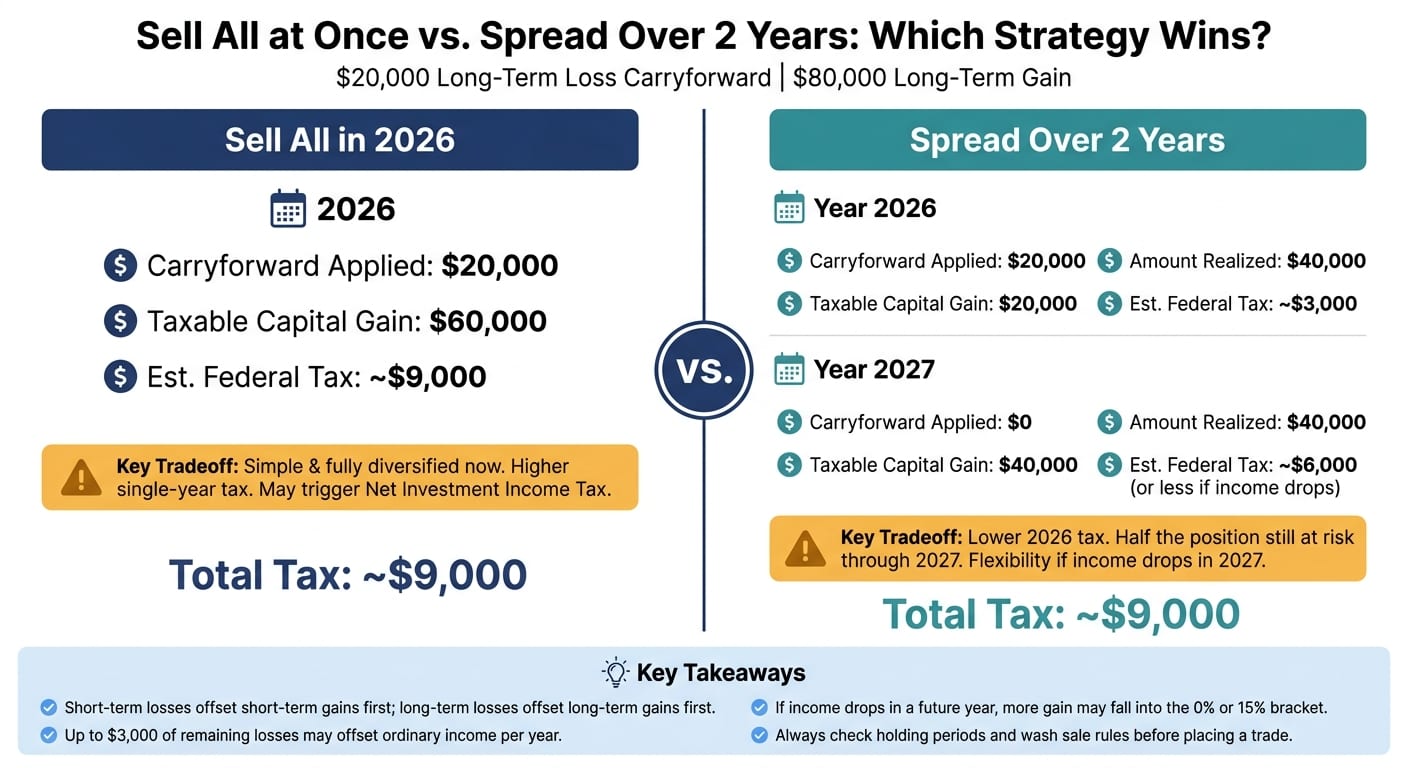
The hypothetical table below compares selling all at once versus spreading sales across two years for an investor with a $20,000 long-term loss carryforward and $80,000 of long-term gains.
| Strategy | Year | Carryforward Applied | Taxable Capital Gain | Est. Federal Tax | Key Tradeoff |
|---|---|---|---|---|---|
| Sell all in 2026 | 2026 | $20,000 | $60,000 | ~$9,000 | Simple; fully diversifies now; uses all carryforward at once; higher single-year tax; may increase exposure to the Net Investment Income Tax. |
| Spread over 2 years | 2026 | $20,000 | $20,000 (of $40,000 realized) | ~$3,000 | Lower 2026 tax; half the position still at risk through 2027. |
| Spread over 2 years | 2027 | $0 | $40,000 | ~$6,000 (or less if income drops) | Flexibility to time 2027 sale around income changes; requires monitoring future tax law changes. |
In this simplified example, the total estimated federal tax is similar either way, at roughly $9,000. Even so, income changes, bracket cutoffs, and the Net Investment Income Tax for higher earners may make the two-year route cheaper in some cases. If income is lower in 2027, perhaps because of retirement or smaller bonuses, more of the gain may fall into the 0% or 15% long-term capital gains bracket instead of the 20% tier.
Check wash sale rules and holding periods before acting
Before placing a trade, check two execution risks.
The first is holding period. Selling a position one day before it passes the one-year mark turns what would have been a long-term gain into a short-term gain taxed at ordinary income rates. If the carryforward does not fully cover the gain, that rate gap may matter a lot. It may be worth confirming the acquisition date for each lot before entering the order.
The second is wash sale exposure. The IRS disallows a loss if you buy a substantially identical security within 30 days before or after the sale that created the loss. That window applies across all accounts you own, including IRAs and, if filing jointly, a spouse's accounts. Automatic dividend reinvestment plans, or DRIPs, may also partially or fully disallow a loss if they trigger an unexpected repurchase inside the window.[23] Many investors check wash-sale alerts across linked accounts, then wait until the 30-day window has passed before buying back in.
Conclusion: Treat carryforwards as a starting point, not an afterthought
After you model the sale, the carryforward balance may be the last tax input worth checking. Those carryforwards may still offset this year's gains, so some investors start there before they sell.
A simple place to verify that number may be last year's tax return and your broker reports before trading. It may also help to look across the whole household, not just one account. That kind of view may reduce the chance of missing offsets or creating wash-sale issues across accounts. Mezzi may help with that by pulling accounts into one place and flagging wash-sale risk across the household.
Start with the loss bank, model the tax impact, then decide what to sell.
FAQs
How do I find my capital loss carryforward?
Review prior-year tax returns, especially Schedule D, to look for any unused capital losses. Those losses may carry forward indefinitely, and they may offset future capital gains or up to $3,000 of ordinary income per year.
Brokerage gain/loss reports may also help. A consolidated view across accounts may make things easier too. The main thing is keeping detailed records of past transactions and any cost basis adjustments, so carryforwards may be applied with accuracy.
Should I sell now or spread gains over two years?
It depends. Spreading gains over two tax years may reduce taxes for some people by lowering the chance of moving into a higher tax bracket. One common example: splitting a large sale between December and January.
It may also be worth considering a few other timing-related factors:
Holding investments for more than one year, which may qualify for lower long-term capital gains tax rates
Using losses to offset gains and up to $3,000 of ordinary income
Avoiding wash-sale issues across your accounts
Can wash sales reduce my carryforward benefit?
Yes. A wash sale may reduce your carryforward tax benefit.
If you buy a substantially identical security within 30 days before or after selling one at a loss, the IRS may disallow that loss for tax purposes.
That disallowed loss may not offset current gains or get added to your carryforward losses. Instead, the loss gets added to the cost basis of the newly purchased investment.
Disclosures:
This content is for informational purposes only and does not constitute investment advice or a recommendation to buy or sell any security.
Past performance is not indicative of future results. No guarantee of future performance or outcomes is implied.