
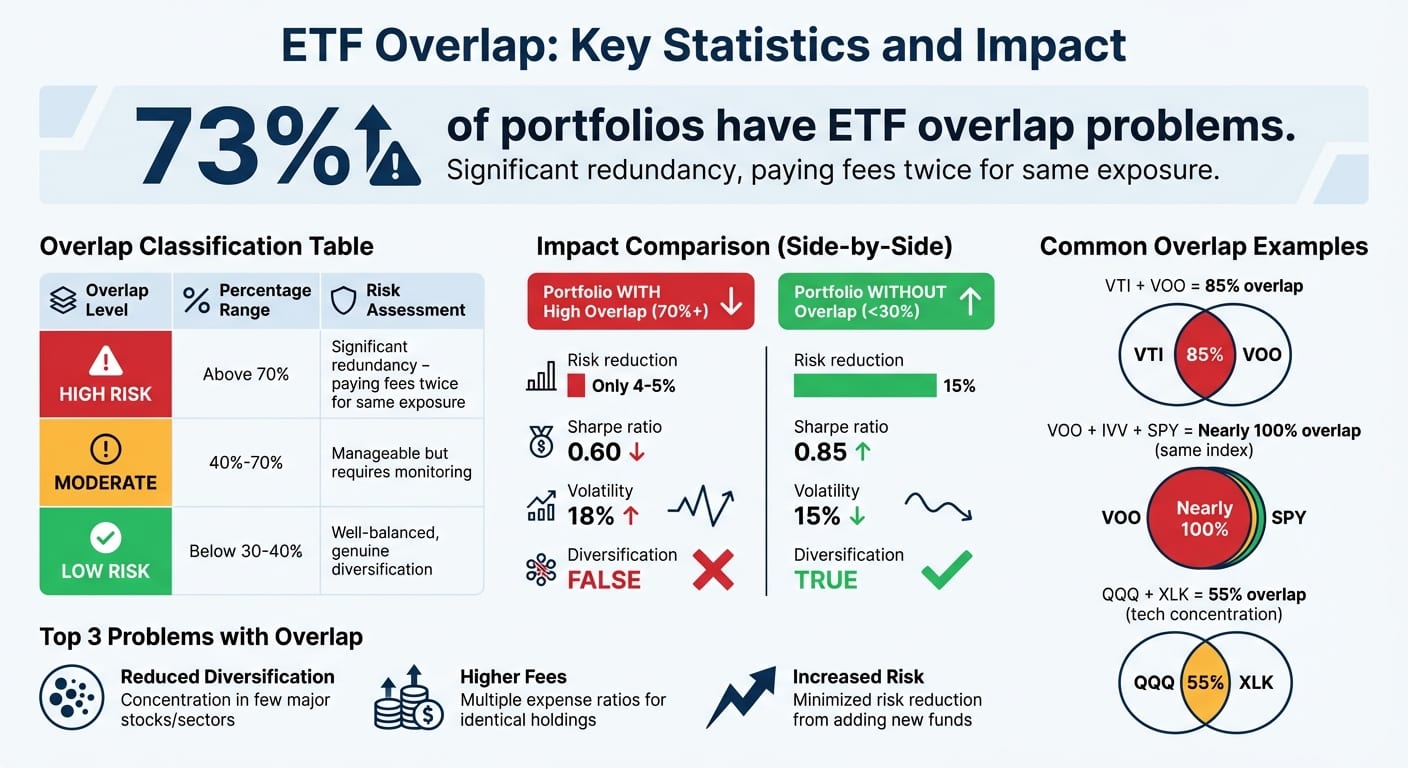
Most investors hold two funds that quietly hold the same stocks, thinning out the diversification they were paying for and doubling the fees. Own a Total Stock Market ETF (like VTI) and an S&P 500 ETF (like VOO), and you’re buying Apple and Microsoft twice, once through each fund. You feel diversified. You aren’t.
Key issues with ETF overlap:
- Reduced diversification: Overlap concentrates your portfolio in a few major stocks or sectors, like tech.
- Higher fees: You’re paying multiple expense ratios for nearly identical holdings.
- Increased risk: Overlap minimizes the risk reduction you expect from adding new funds.
Quick solution: Use tools like Mezzi's X-Ray to analyze your portfolio, identify overlaps, and rebalance without selling. By reducing overlap, you may improve diversification and reduce fees.
Read on to learn how to check for ETF overlap and fix your portfolio.
The ETF Overlap Nobody's Talking About
What Overlap Is, and Why It Quietly Costs You
ETF overlap happens when multiple funds invest in the same stocks or sectors, often focusing on major companies like Microsoft, Apple, and NVIDIA. Since ETFs are essentially collections of securities, it's common for these big names to show up across several indexes and funds.
Here's the catch: buying multiple ETFs doesn't always mean you're diversifying your risk. If those funds hold the same assets, your portfolio may become more concentrated rather than diversified. For instance, funds like VOO, IVV, and SPY, which all track the same index, have nearly 100% overlap. Essentially, you're holding the same stocks under different fund names.
Overlap can also lead to unintended sector biases. For example, combining an S&P 500 fund with a Nasdaq-100 fund can end up heavily weighting your portfolio toward tech stocks. A 2026 analysis of QQQ (Nasdaq-100) and XLK (Technology Select Sector) revealed they shared major holdings like Apple (10%), Microsoft (9%), NVIDIA (3%), Adobe (2%), and Cisco (2%), leading to a total overlap of about 55%.
How Overlap Weakens Your Diversification
When two ETFs share 70% of their holdings, the diversification benefit you expect from adding another fund is greatly reduced. The expected risk reduction may be lower than anticipated when significant overlap exists. Essentially, you're doubling down on the same companies without realizing it.
This overlap also impacts your portfolio's risk-adjusted returns. For example, a portfolio of truly diverse ETFs might achieve a higher risk-adjusted return may become more difficult to achieve when ETF overlap is significant. And when sector-specific news hits - like an earnings miss or regulatory issues with Apple or Microsoft - it can ripple through your entire portfolio if those companies dominate your holdings.
Some sources suggest overlap above 70% indicates high redundancy, while 40% to 70% is considered moderate.
The Cost of Paying Fees Twice for the Same Exposure
Every ETF comes with an expense ratio. When your funds overlap, you're essentially paying multiple management fees for the same stocks. This duplication eats into your returns without giving you any extra protection against risk.
"You're paying extra fees without gaining true risk-off protection." - Alphaex Capital
Take an investor holding IVV (S&P 500), QQQ (Nasdaq-100), and VUG (Vanguard Growth). These funds are all market-cap weighted and heavily influenced by tech, resulting in a concentrated exposure to companies like Apple, Microsoft, and NVIDIA. In this case, you're paying three separate expense ratios, but your diversification is still limited.
In the QQQ and XLK example, reducing overlap from 55% to 25% lowered volatility from 18% to 15%, even though expected annual returns dropped slightly from 14% to 13%. The improved risk profile and reduced redundant fees were considered beneficial in this example.
Recognizing these issues is the first step toward optimizing your portfolio. Next, you'll see how Mezzi's X-Ray tool can help identify overlaps and provide information to support your rebalancing decisions.
Step 1: Bring Every Account Into One View
Link all your financial accounts - brokerage, retirement, and taxable - to get a clear picture of your entire portfolio.
Why Seeing Your Full Portfolio Matters
Leaving out any account can give you an incomplete picture of your investments, leading to a false sense of diversification. For instance, if you hold a Vanguard S&P 500 ETF in your brokerage account and a tech-focused ETF in your IRA, you might not notice an overlap of 15% to 25% in major holdings like Microsoft and Nvidia. This could leave you more exposed to tech sector volatility than you intended.
Without a full view, you might assume your investments are well-diversified, but overlapping holdings can result in an over-concentration in certain stocks or sectors. For example, you could unknowingly have 20% to 30% of your portfolio tied up in a single stock or industry, defeating the purpose of diversification. By connecting all your accounts, you can avoid these blind spots and help manage your risk.
How to Connect Your Accounts Securely
Mezzi partners with trusted platforms like Plaid and Finicity to securely link your accounts. These tools use bank-grade encryption and provide read-only access, meaning Mezzi can view your balances and holdings but cannot make transactions, trades, or alter your account settings. Your login details are never stored, and you can revoke access whenever you choose.
With support for over 12,000 financial institutions in the U.S. - including Charles Schwab, TD Ameritrade, Fidelity, Vanguard, Robinhood, Chase, and Wells Fargo - connecting your accounts is straightforward. After signing up, click on "Connect Accounts", select your brokerages, and authenticate through Plaid or Finicity's secure interface. Once permissions are confirmed, your unified portfolio will appear instantly. From there, you can use Mezzi's X-Ray tool to identify and address any ETF overlap in your investments.
Step 2: Use Mezzi's X-Ray Tool to Find ETF Overlap
Once you have a complete view of your portfolio, Mezzi's X-Ray tool takes things further by analyzing your ETFs and mutual funds to pinpoint overlapping stocks. This helps you identify where you may be paying fees for duplicate exposure and how concentrated your investments may be.
How the X-Ray Tool Works
Mezzi dives into each ETF and mutual fund in your portfolio, breaking them down into their individual stock components. It calculates the percentage of shared holdings between funds and highlights the specific weight of each overlapping stock. For instance, if you own SPY (an S&P 500 ETF) and QQQ (a Nasdaq-100 ETF), the tool will show that NVIDIA is included in both - but with different weightings. As of March 13, 2025, NVIDIA makes up 5.64% of SPY and 7.84% of QQQ.
The analysis doesn’t stop at direct holdings. It also examines underlying holdings within ETFs, mutual funds, and similar products. This level of detail helps you identify situations where perceived diversification may not reflect actual holdings. The insights from this analysis prepare you to interpret your overlap report more thoroughly.
How to Read Your Overlap Report
The overlap report breaks your portfolio into three critical areas: top overlapping stocks, sector concentration, and geographic exposure. You'll see a detailed breakdown of every underlying company you own, along with its total weighted percentage across all your accounts.
To make it easier to assess risk, Mezzi classifies overlap into three levels:
For example, if you hold popular ETFs like VTI, SPY, and QQQ in equal amounts, the report might show that your top 10 holdings make up 38.34% of your total portfolio. This is due to the presence of large technology stocks like Apple, Microsoft, and NVIDIA. Such concentration may lead to unintended risks and duplicate fees, reducing potential diversification benefits. The report also highlights "sector drift", which occurs when overlapping holdings cause an unplanned focus on a single industry, such as technology.
Tip: Make it a habit to review your portfolio regularly. ETF holdings can shift over time as indexes rebalance, and staying on top of these changes ensures your investments remain aligned with your goals.
Step 3: Follow Mezzi's Guidance to Fix Your Portfolio
Once you've identified overlap in your portfolio, Mezzi steps in with tax-conscious suggestions. The platform analyzes your holdings and suggests specific changes to cut down on redundancy while ensuring your investments stay aligned with your goals and risk tolerance. Using the overlap report as a foundation, Mezzi provides steps to support your portfolio rebalancing decisions.
Rebalancing to Reduce Overlap
Mezzi focuses on tax-efficient strategies to rebalance your portfolio. It identifies overlapping ETFs and prioritizes selling positions with losses first, allowing you to take advantage of ETF tax-loss harvesting to offset gains elsewhere. For example, if both your S&P 500 ETF and Tech ETF have 15% exposure to Apple and Microsoft, Mezzi might suggest considering sale of the ETF with losses. This approach minimizes taxable events and reallocates funds to investments that better complement your portfolio.
The platform uses a threshold-based rebalancing method, suggesting adjustments only when your portfolio deviates 5–10% from your target allocation. This strategy helps reduce unnecessary taxable events that could chip away at your returns over time.
Choosing Better ETFs to Improve Diversification
Beyond just rebalancing, Mezzi helps you identify ETFs with low overlap scores (under 20%) that may complement your existing holdings. For instance, if you already hold a U.S. large-cap ETF, Mezzi might suggest adding an international small-cap or a clean energy thematic ETF. You'll also get side-by-side comparisons of holdings, expense ratios, and potential diversification benefits to make informed decisions.
To avoid over-concentration, Mezzi may suggest limiting any single holding to a set percentage of your portfolio. If you have a large allocation to U.S. tech stocks, it may suggest considering other funds to diversify exposure. In one case from March 2025, Mezzi found significant overlap between QQQM and FTEC (both tech-heavy ETFs) in their top 10 holdings. The solution was to replace one with a broader S&P 500 ETF to achieve better diversification.
While Mezzi provides portfolio insights, you retain control over executing trades and managing taxes and fees. With Mezzi's guidance, you can address overlaps in your portfolio and select ETFs that may further diversify your investments.
See What You Own, Then Own It on Purpose
ETF overlap may affect your diversification goals, increase risk, and result in unnecessary fees. For example, a portfolio with high overlap may not achieve intended risk reduction benefits. Additionally, high overlap can lower your risk-adjusted return, meaning you may be taking on additional volatility without corresponding benefit.
Identifying and addressing overlap is critical. Mezzi's X-Ray tool highlights exactly where you're doubling up on the same stocks. For instance, even equal allocations across ETFs can concentrate your exposure to a single stock without you realizing it. Mezzi goes further by offering tax-conscious suggestions to replace redundant funds. These could include adding international stocks, small-cap ETFs, or REITs to bring genuine diversification to your portfolio.
By eliminating redundant fees and gaining a clearer view of your portfolio's structure, you can protect your returns. Mezzi connects all your accounts - whether it's your 401(k), brokerage account, Roth IRA, or taxable account - to uncover overlap that traditional advisors might overlook. It also identifies tax-loss harvesting opportunities, flags wash sale risks across accounts, and suggests tax-efficient rebalancing strategies. Best of all, you retain full control of every trade while benefiting from insights comparable to those of a high-cost advisor.
73% of portfolios carry this hidden double-up. Connect your accounts, run the X-Ray, and you’ll finally see whether yours is one of them, with clear guidance on what to do next.
FAQs
What overlap percentage is too high?
An overlap percentage exceeding 70% is typically seen as excessive. When your portfolio has this level of overlap, it may indicate an over-concentration in certain assets. This reduces the potential advantages of diversification, which is key to balancing risk and return in your investments.
How often should I check my ETFs for overlap?
It's a good idea to review your ETFs for overlap on a regular basis. This helps ensure your portfolio stays diversified and manages risk more effectively. For most investors, checking ETF holdings annually or semiannually works well - especially if you've made big changes to your portfolio or the market has shifted significantly. Regular reviews can help spot redundancies, lower concentration risk, and monitor portfolio changes.
Can overlap increase my taxes when I rebalance?
Yes, ETF overlap can lead to higher taxes when rebalancing your portfolio. Selling funds with overlapping assets - especially if those assets have grown in value - can result in capital gains taxes. Additionally, overlap might create unintended concentration in certain assets, forcing you to sell more than needed and increasing your tax burden. Using tools like Mezzi’s overlap analyzer can help pinpoint redundancies, streamline your portfolio, and minimize avoidable taxable events.
Related Blog Posts
- What are the risks of having overlapping exposures in my fund investments?
- ETF overlap analyzer
- 3 ETF Portfolio Overlap: Why Your 'Diversified' Portfolio Might Not Be
- The Same Ten Stocks, Bought Three Times: An Overlap Checker for Your Retirement Accounts
An overlap percentage exceeding 70% is typically seen as excessive. When your portfolio has this level of overlap, it may indicate an over-concentration in certain assets. This reduces the potential advantages of diversification, which is key to balancing risk and return in your investments.
It's a good idea to review your ETFs for overlap on a regular basis. This helps ensure your portfolio stays diversified and manages risk more effectively. For most investors, checking ETF holdings annually or semiannually works well - especially if you've made big changes to your portfolio or the market has shifted significantly. Regular reviews can help spot redundancies, lower concentration risk, and monitor portfolio changes.
Yes, ETF overlap can lead to higher taxes when rebalancing your portfolio. Selling funds with overlapping assets - especially if those assets have grown in value - can result in capital gains taxes. Additionally, overlap might create unintended concentration in certain assets, forcing you to sell more than needed and increasing your tax burden. Using tools like Mezzi’s overlap analyzer can help pinpoint redundancies, streamline your portfolio, and minimize avoidable taxable events.