
A single stock above 20% of a household portfolio may be more common than it looks. I’d sum up the article this way: many households may not notice their concentration until they add up every account, and employer stock may be one of the main reasons the number gets high.
Here’s the short version:
20% in one stock may be a useful line for spotting concentration risk
Employer stock may push many retirement savers over that line
Small direct-stock portfolios may also drift above 20% with only a few holdings
Household-level math matters because one stock may sit in a 401(k), taxable account, IRA, and funds at the same time
A large drop in one stock may have a big effect on total wealth when that stock takes up a large share of the portfolio
Common ways people may lower exposure include staged sales, redirecting new money, stopping dividend reinvestment, donating shares, or using hedges in some cases
I’d also keep one idea front and center: a position that looks fine in one account may look very different when I add up direct shares, company stock funds, and fund overlap across the full household balance sheet.
| Topic | Main takeaway |
|---|---|
| Risk line | Many investors and firms treat 10% to 20% as a caution range |
| Main source | Employer stock may be one of the clearest drivers of 20%+ exposure |
| Hidden issue | Exposure may be split across accounts and funds |
| Portfolio effect | A big drop in one stock may pull down the total portfolio by more than many people expect |
| Next step | Measure total exposure first, then map out a tax-aware path to reduce it if needed |
If I wanted one takeaway from the full piece, it would be this: the problem may not be owning one stock - it may be owning more of it than I think.
How Common It Is for Households to Hold More Than 20% in One Stock
What U.S. Ownership Data Says About Concentration
Stock ownership in the U.S. reaches a lot of households. In 2022, 58% of families held stocks in some form, up from 53% in 2019.[9] But broad ownership and broad diversification are not the same thing.
A big share of stock wealth sits with higher-wealth households, which means concentration risk may land hardest there. The top 10% of households by wealth own roughly 87–90% of household stock wealth, while the bottom 50% own about 1%.[10][4]
And when people buy individual stocks directly, their portfolios may stay pretty small. Older brokerage-account studies found that the typical household holding stocks directly owns about four stocks, with a median closer to two. Newer app-based trading data points to an average of around three stocks per investor.[5][6][7] That matters because with only three to five names, one strong performer may end up making up more than 20% of the portfolio before the household even means for it to happen.
That same small-basket problem may get much more concentrated when the stock comes from work.
Employer Stock Is One of the Clearest Sources of 20%+ Exposure
You may see that pattern most clearly in retirement plans that include company stock. A congressional and policy review of 278 firms offering company stock in defined contribution plans found that the average company stock share was 38.0% of plan assets, with a median of 24.7%. In plain English, half of those plans were already above the 20% mark in a single stock.[8]
Very high concentrations may be less common than they once were, but large single-stock positions still show up.[3]
The biggest exposures may cluster in a few familiar places:
Tech workers with RSUs that grow as the stock price rises
Health-system employees whose retirement matches come in employer shares
Executives who receive company stock or may be required to hold it[1][2]
For the next section, the key point is simple: once a 20%+ position takes hold, it may shape the whole household portfolio in ways that aren't obvious at first.
Managing Concentrated Stock Risk: From Concentration to Confidence
Why a 20% Position Can Create Outsized Household Risk
Once a household moves past 20% in one stock, the issue may stop being upside alone. At that point, the bigger question may be how much damage a single company might do.
A concentrated position may lift total wealth if the stock rises. But the same setup may work in reverse. That downside may be the part that carries the most risk.
How One Stock Can Start Driving Your Entire Portfolio
The math is pretty simple. In a hypothetical $1,200,000 portfolio with 25% in one stock, that one position comes to $300,000. If the stock falls 50%, the household may absorb a $150,000 loss, or 12.5% of the entire portfolio, even if every other holding stays flat.[12] For some households, a loss of that size may delay retirement or lead to other plan changes.
Morgan Stanley calls 20%+ a concentrated holding and notes that losses land harder in less diversified portfolios.[14][15]
Why does this happen? In a diversified portfolio, one company's bad news may not move the needle much. In a concentrated portfolio, bad earnings, regulation, product issues, or leadership changes may hit the household more like a market shock. But the source of the risk may still be just one company.
The Employer Stock Double Exposure Problem
Employer stock may carry extra risk because it may affect both pay and savings. When salary, annual bonus, equity compensation, career advancement, and unvested equity all depend on the same company, a downturn may hit income and the portfolio at the same time.[11][13] In plain English, the same company risk may hit both investments and cash flow at once.
This risk may be highest for employees whose pay, bonuses, and equity are tied to the same company. If that company faces a serious setback, the household may deal with job risk, lower compensation, and a sharp drop in stock they already hold - all at the same time.[11] One company problem may turn into a full household money problem.
When Single-Stock Risk Becomes More Costly
Concentration risk may not look the same at every life stage. It may become more costly when it collides with timing, taxes, or overlap in other holdings:
Within 5–10 years of retirement: there may be less time to recover from a drawdown.
Before a major expense: a household may need to sell at the wrong time.
After a large run-up: equity compensation tax rules may make selling harder to stomach.
When fund holdings add to direct shares: total exposure may be higher than one account suggests.[12]
At that point, the risk may shift away from the market as a whole and toward one company.
How to Measure Your Real Exposure Across All Accounts
Once concentration gets big enough to matter, the next step may be to measure the full position the right way.
Add Up One Stock's Weight Across Your Full Household Portfolio
A stock that looks minor in one account may end up taking over your household portfolio once everything is viewed together. That’s why exposure may need to be measured across every account.
Start with a full list of household accounts: taxable brokerage accounts, 401(k)s, IRAs, Roth IRAs, HSAs with investment options, and any equity compensation such as vested RSUs or ESPP shares. Then total the current dollar value of the stock you’re checking across all of them.
Next, divide that number by your total investable assets across those accounts. The result may give you your total concentration percentage.[16][20]
Here’s a simple hypothetical example. A household holds $75,000 of employer stock in a taxable account and $45,000 in a company stock fund inside a 401(k). It also has $280,000 in diversified funds elsewhere. Total employer stock exposure comes to $120,000. Total portfolio value comes to $400,000. Real concentration may therefore be 30%.[16] Looking at each account on its own may miss that household-level concentration.
Keep portfolio exposure as the main number. Net worth exposure may still work as a second check.
Check for Hidden Exposure Inside Funds
After direct holdings, it may make sense to look for the same stock inside funds too.
The same company may show up quietly in an S&P 500 index fund, a technology sector ETF, and an active growth fund at the same time. The math is pretty plain. If you hold $50,000 in a large-cap index fund and one company accounts for 7% of that fund, that may equal $3,500 of indirect exposure to that company. Add a sector ETF where the same stock makes up 12% of holdings, plus an active fund where it makes up 5%, and those indirect positions may stack on top of any direct shares you own.[16][20]
In a hypothetical example, a tool like Mezzi's Portfolio X-Ray could show that a household's combined exposure to a large technology stock is 24% when direct shares, an S&P 500 index fund, a technology sector ETF, and an active growth fund are all taken into account.
A holdings X-ray may surface these embedded positions across linked accounts.
Set Monitoring Thresholds Before It Grows
Once you know the true percentage, the next move may be to set a rule for when to review, trim, or exit.
One framework some investors use looks like this:
At 10%, treat it as a review trigger and monitor the position quarterly.
At 15%, write down why you’re comfortable holding it at that size and what might lead you to start trimming.
At 20% or higher, some move from monitoring to action and build a concrete plan to reduce exposure over time.[18]
A scenario check helps explain those thresholds. At 33% concentration, a 50% drop in the largest holding may still reduce total assets by 17%.[17][18]
How to Reduce Single-Stock Risk Without Losing Control
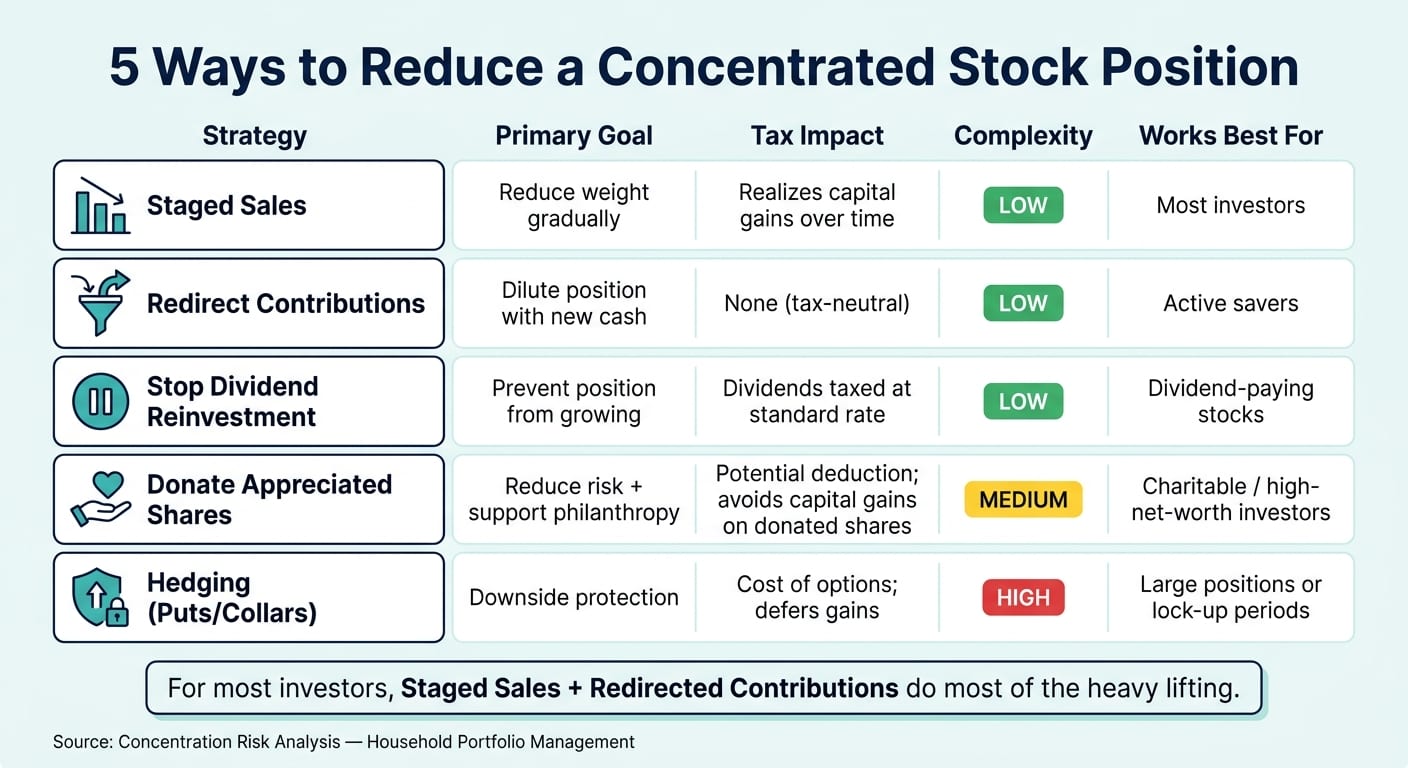
5 Ways to Reduce a Concentrated Position
Once total exposure moves above 20%, the focus may shift from measuring the position to bringing it down.
A big winner may be fine on its own. The issue is whether that one holding now leaves your household too concentrated. In many cases, there are five practical ways to reduce a concentrated position to a more manageable level without selling everything at once.
| Strategy | Primary Goal | Tax Impact | Complexity | Works Best |
|---|---|---|---|---|
| Staged Sales | Reduce weight gradually | Realizes capital gains over time | Low | Most investors |
| Redirect Contributions | Dilute position with new cash | None (tax-neutral) | Low | Active savers |
| Stop Dividend Reinvestment | Prevent position from growing | Taxed on dividends (standard) | Low | Dividend-paying stocks |
| Donate Appreciated Shares | Reduce risk + philanthropy | Potential deduction; avoids capital gains on donated shares | Medium | Charitable / high-net-worth |
| Hedging (Puts/Collars) | Downside protection | Cost of options; defers gains | High | Large positions / lock-ups |
For many investors, staged sales and redirected contributions may do most of the heavy lifting. Turning off dividend reinvestment may slow future buildup. Donating appreciated shares or using hedges may fit narrower cases.
The right mix may depend on taxes, the size of the gain, and whether the shares came from work.
How to Weigh Taxes Against Risk Reduction
Selling now may lock in tax. Waiting may preserve deferral, but it may also extend the period of risk.
A useful way to think about it is in dollar terms: model the downside, then compare that number with the tax cost of selling now. If a drawdown may delay retirement or throw off another goal, some households may choose to reduce risk before spending too much time trying to fine-tune taxes. Tax planning may work best inside a diversification plan, not as a reason to keep putting that plan off.
A few tools may lower the tax cost without changing the timeline much. Specific-lot selection may let you favor higher-cost-basis shares, which may reduce realized gains. Tax-loss harvesting in other parts of the portfolio may offset gains from trimming the concentrated position.[26] And spreading sales across two or more tax years may smooth the tax impact without meaningfully extending the risk period.[22][23][24][25]
Disclaimer: The tax information in this article is for general educational purposes only and does not constitute individualized tax, legal, or investment advice. Consult a qualified tax professional regarding your specific situation.
Conclusion: What to Do if You Are Over 20%
After a plan is in place, the goal may be to keep exposure moving down instead of letting it creep back up.
A position above 20% in one stock may be large enough to take seriously. At that level, it may drive a meaningful share of household outcomes.
For many households, the sequence may look like this: first, measure exposure across every account, including 401(k)s, IRAs, and equity compensation. Next, check for hidden overlap inside index funds, sector ETFs, and active funds. Then model what a severe drop in that stock may mean in actual dollars for net worth and the retirement timeline. After that, build a tax-aware plan to reduce exposure gradually, whether through staged sales, redirected contributions, or charitable giving, depending on the situation.[22][23]
Mezzi surfaces combined exposure across accounts, hidden overlap inside funds through Portfolio X-Ray, and tax-aware opportunities to consider as you build your plan. Mezzi surfaces the exposure so you may make the next move with more clarity.
FAQs
What counts as one-stock exposure?
One-stock exposure refers to the share of your portfolio connected to a single company’s stock across every account where you hold it, both directly and indirectly.
That may include:
Shares you bought yourself
Employer stock through an ESPP or 401(k)
ETFs or mutual funds that also hold that same stock
Some investors may view it as overexposure when one stock makes up about 10%–20% or more of a portfolio.
Does employer stock increase concentration risk?
Yes. Employer stock may add to concentration risk when you hold it through purchase plans, 401(k)s, or compensation grants.
That may leave both your income and your investments tied to the same company, which may increase losses during a downturn. It may also overlap with index funds you already own, which may push your exposure to that stock or sector above your target allocation.
How can I reduce concentration without a large tax bill?
Tax-aware moves may help. Some people start by rebalancing inside tax-advantaged accounts like 401(k)s or IRAs, where sales may not trigger capital gains taxes. In taxable accounts, tax-loss harvesting may help offset gains.
Another approach some investors use is to trim a position gradually over time instead of selling it all at once. Hedging moves like protective puts or collars may help manage downside risk while deferring a sale. Mezzi may monitor these moves and flag potential wash sale risks.
Disclosures:
This content is for informational purposes only and does not constitute investment advice or a recommendation to buy or sell any security.
Past performance is not indicative of future results. No guarantee of future performance or outcomes is implied.
Registration does not imply a certain level of skill or that the SEC has approved the company or its services.
Savings and performance examples are hypothetical and for illustrative purposes only. Actual results will vary based on individual circumstances, portfolio composition, market conditions, and fees.