
A brokerage transfer may move your shares, but the tax details may not move cleanly. If cost basis or holding dates show up wrong, your Form 1099-B may report gains that are too high, too low, or marked as short-term when they may belong in the long-term bucket.
Here’s the short version:
I may need to check each tax lot, not just the total position
Covered shares often transfer with basis, but errors may still show up
Noncovered shares may arrive with $0, blank, or unknown basis
DRIPs, partial transfers, gifted shares, and inherited shares may have a higher error rate
For illustration, a missing $5,000 of DRIP basis may overstate gain by $5,000
If that gain were taxed at 15% federal + 5% state, extra tax may be about $1,000
A wrong acquisition date may cause a long-term holding to be labeled short-term
What I’d take from this article is simple: don’t treat the new broker’s basis screen as final. The safer path may be to compare old statements, transfer records, tax-lot reports, DRIP history, and broker basis files before any sale.
Quick snapshot:
| Issue | What may happen |
|---|---|
| Missing lots | Several purchase dates may be merged into one line |
| $0 or blank basis | Gain may be overstated at sale |
| Wrong acquisition date | Long-term shares may be treated as short-term |
| Method reset | Specific-lot history may switch to FIFO |
| Gift or inheritance error | Broker may use the wrong basis or wrong date |
If I were summarizing the whole piece in one line, it would be this: the share transfer may be simple, but the tax-lot cleanup may take a separate review.
What Is Cost Basis and Why Does It Matter for Taxes & Retirement? - Ask an Advisor
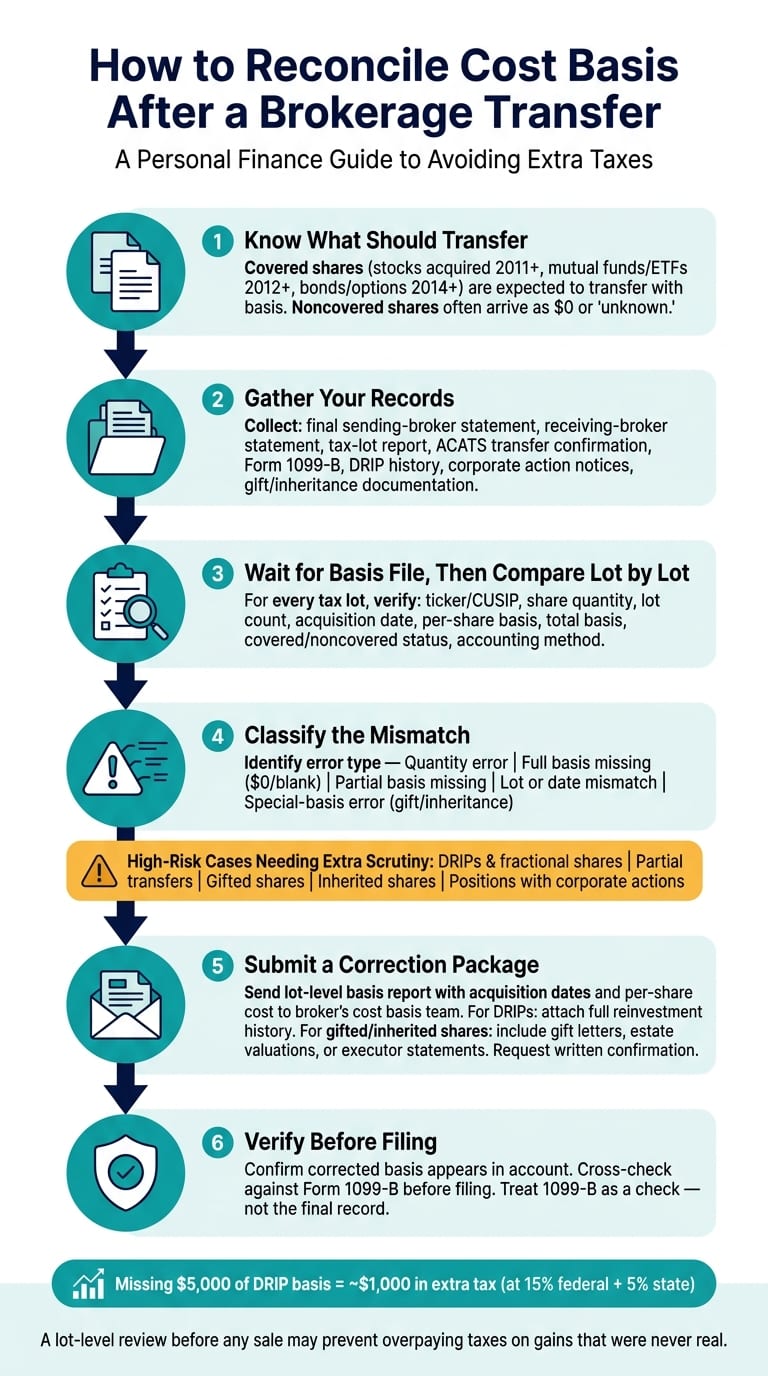
1. Know when basis transfers and when it does not
Before you start matching statements, first check which shares were supposed to bring cost basis into the new account.
Cost basis is the original purchase price, adjusted for dividend reinvestments, return of capital, stock splits, and similar corporate actions. Those adjustments are generally expected to move with covered shares during a transfer, but they may not always arrive cleanly. Basis may also change over time when reinvested dividends, return of capital, or splits affect the original purchase price.
Most brokerage transfers go through ACATS. Covered securities are generally expected to move with basis and acquisition dates, but the receiving broker may still load the file the wrong way.
Covered vs. noncovered shares
Whether basis is expected to transfer usually depends on when the shares were acquired. IRS rules phased in basis reporting by asset type: stocks generally became covered in 2011, mutual funds and ETFs in 2012, and certain bonds and options in 2014.[2][3][5]
| Security Type | Acquisition Date Threshold | Typical Result at the New Broker |
|---|---|---|
| Individual stocks | January 1, 2011[2][3][5] | Lots usually populate; corporate action adjustments may still need correction |
| Mutual funds & ETFs | January 1, 2012[3][4][5] | Basis usually transfers, but older reinvestment lots may be missing |
| Bonds & options | January 1, 2014[3][13] | Basis may transfer, but complex instruments may show errors |
| Noncovered shares (any type) | Before the applicable date[2][6][7][9][11] | Often shows as $0 or "unknown"; the investor may need to reconstruct basis |
One position may include both covered and noncovered lots, which is why the review needs to happen lot by lot, not just position by position.[2][7]
Once you know which lots were expected to include basis, compare the old and new records one lot at a time.
Common transfer failure patterns
Brokers are generally expected to send basis data with the transfer, but mistakes still show up. These are the main mismatch patterns you may spot right away in your account records:
Missing or merged lots: The total share count looks right, but several purchase dates from the old account were rolled into one lot with the transfer date.
$0, blank, or unknown basis: Share quantities appear, but the basis field is blank, $0, or marked "not available", especially for noncovered shares or older mutual funds with dividend reinvestment history.[10][1]
Wrong acquisition dates or covered/noncovered labels: All lots show the same recent date, often the transfer date itself, or mixed positions are labeled entirely covered - or entirely noncovered - which may affect what gets reported on Form 1099-B.[8][9]
Cost basis method reset: The old broker used specific-lot identification, but the new broker defaults to FIFO and may not preserve earlier lot selections.[10][12]
If the lot count, dates, or basis don't match, flag the mismatch before you contact the broker.
Next, gather the statements and transfer records needed to check each lot.
2. Gather the records you need before reconciling
Gather your records before contacting the broker. A full packet may speed up the fix and gives you support for the correction request. Cost basis and acquisition dates may shift, disappear, or get labeled the wrong way during a transfer, so each document below ties back to one part of the review. The next step is to match each old lot to the new broker's record.
Download statements, tax forms, and transfer records
Collect the following:
Final statement from the sending broker
First full statement from the receiving broker
Detailed cost basis or tax-lot report from the sending broker
Transfer confirmation or ACATS record
Most recent Form 1099-B
Prior-year 1099-Bs for the same positions
Realized gain/loss reports from both brokers
Purchase confirmations
These documents show what may have moved and how it may have been recorded.
Pull transaction history for adjustments brokers often miss
Statements often leave out basis adjustments. Pull these records on their own.
DRIP history. A DRIP history may create many small tax lots, each with its own purchase date and cost. If the receiving broker merged them into one lot, you may need every reinvestment date, share count, and price to rebuild the history.
Corporate action notices. Stock split, merger, spin-off, and return-of-capital notices explain why basis changed and may help fix lots that were posted the wrong way after the transfer. Save the original notices from transfer agents such as Computershare or Broadridge, along with any broker-issued basis reallocation schedules.
Special-basis documentation. For gifted shares, gather the donor's original cost basis records and the gift date. For inherited shares, gather the date-of-death valuation and estate documentation that established the stepped-up basis. Save any specific-lot sale instructions to show which lots were already sold before the transfer.
Use Mezzi to centralize the comparison

Mezzi's read-only aggregation lets you compare holdings, tax lots, and unrealized gain/loss totals across accounts in one place. That may make it easier to spot mismatches, like a position where the new broker shows $0 basis while your records show a clear cost, or where unrealized gain/loss figures differ for the same holding. Then compare each lot against the receiving broker's file. Use these records to match each lot line by line.
3. Compare old and new broker records line by line
Step 1: Wait for basis files, then compare positions and lots
Start the comparison only after the basis file has loaded at the receiving broker. Until that happens, the numbers may look wrong for reasons that have nothing to do with the actual records.
Use the statements, tax forms, and transaction history from Section 2 to check each lot. First, match the share count. Then compare the cost basis. And don't stop at the position level. Look at each tax lot on its own.
For every lot, check:
Ticker, and CUSIP if it's available
Share quantity for that lot
Lot count
Acquisition date
Per-share basis
Total basis
Covered or noncovered status
Accounting method
Once the basis file appears, compare each lot against the old broker's records line by line.
Step 2: Classify the mismatch before contacting the broker
Before reaching out, sort the problem into the right bucket. That may make it easier to show the broker what went wrong and what records may be needed.
Quantity error: Share counts don't match. This may need to be fixed before basis gets reviewed.
Full basis missing: Share counts match, but total basis is $0 or blank. The transfer file may not have arrived, or the shares may be noncovered.
Partial basis missing: Some lots show the right basis, while others are blank. This may happen with older lots, DRIP reinvestments, or positions adjusted for a corporate action.
Lot or date mismatch: Total basis looks right, but lot counts or acquisition dates don't line up. This may be tied to lot compression or an accounting method reset at the new broker.
Special-basis error: Gifted or inherited shares show the transfer date as the acquisition date, not the original date or date of death.
That classification shapes what goes into the correction packet.
Step 3: Submit a basis correction package and verify the fix
Send a correction packet to the receiving broker's cost basis team. Include the records that show the mismatch, such as a lot-level basis report with acquisition dates and per-share cost. For gifted or inherited shares, include any special records, like gift letters, estate valuations, or executor statements.
If DRIP lots are missing, attach the transaction history showing each reinvestment date, share count, and price. That may give the broker what they need to restore the individual lots instead of applying a blended average.
After the broker confirms the correction, some investors use Mezzi's account aggregation to check whether the corrected basis and unrealized gain/loss figures appear to match before making any sale or tax-planning move.
The remaining risk may be highest in partial transfers, DRIPs, and special-basis shares.
4. The scenarios most likely to cause tax errors
Use these high-risk cases as a final pre-sale check. This is where cost basis may break most often after a transfer.
Partial transfers and multiple tax lots
Partial transfers may be the easiest place for basis to split the wrong way, especially if the delivering broker does not follow specific-lot instructions.
A simple check may catch a lot here: compare the shares left at the old broker with the shares received at the new broker, then match that total against your original share count. Do the same with basis. If the numbers do not line up, something may be off.
It also may help to compare the old broker's lot-level position report from the day before the transfer with the new broker's basis file after settlement. Look at each lot date, share count, and per-share basis. If any item does not match your instructions, request a written correction from both brokers.
Wash sale adjustments may also disappear in this process. If a disallowed-loss addition goes missing, your basis at the new broker may be understated without much warning.
DRIPs may create the same issue on a smaller scale, but with many more lots to sort through.
Dividend reinvestments and fractional shares
DRIPs often lose basis because each reinvestment creates a separate lot. Brokers may also drop older reinvestment entries or round away fractional shares.
If a transfer drops $5,000 of DRIP basis, a later sale may overstate gain by the same amount and may create roughly $1,000 in extra tax at 15% federal plus 5% state.[14][15]
To check for that, pull a full transaction history from the old broker showing:
Every dividend date
Each reinvestment amount
Share quantity
Purchase price
Then compare the total reinvested basis with what the new broker shows. If there's a gap, some people build a spreadsheet with each DRIP lot and submit it with a basis correction request.
Special-basis shares tend to fail for a different reason. The broker may not apply the tax rule at all.
Gifted shares, inherited shares, and special basis rules
These shares often show up with $0 basis because the right figures rarely move through a transfer on their own.
For gifted shares, the shares usually keep the donor's basis and holding period, but loss basis may be capped at fair market value on the gift date.[18][19][20]
For inherited shares, basis steps up to date-of-death fair market value, using the average of the day's high and low price rather than the closing price.[6][16][17][21]
In either case, the receiving broker may default to $0 basis or use the wrong acquisition date. If that happens, submit your records in writing and ask for a lot-by-lot correction with the right dates restored.
Conclusion: A pre-sale checklist to avoid tax mistakes
Before you sell any transferred position, don't assume basis data is complete just because the shares arrived. Covered status only means the broker was required to report basis. It does not mean the file came through clean. A lot-level review may be the last check before a sale.
Pay close attention to DRIPs, fractional shares, partial transfers, gifted shares, and inherited shares. Those cases may be more likely to show missing lots, blank basis, wrong dates, or blended lots.
If you spot a mismatch, move to a written correction request right away. Mezzi may let you compare old and new lot data in one view, which may make mismatches easier to catch early. Ask for written confirmation, then verify the update shows up in the account before you sell.
Use this pre-sale checklist to confirm the transfer looks clean.
| Step | Action |
|---|---|
| Download old-broker records | Final statement showing positions, tax lots, acquisition dates, and cost basis; prior Form 1099-B; transfer confirmations |
| Download new-broker records | Current lot-level positions and basis report; post-transfer transaction history |
| Compare lot by lot | Match share counts, number of tax lots, acquisition dates, and cost basis per lot. Record any mismatch: missing lots, wrong dates, $0 basis, rounded values, or missing covered/noncovered status. |
| Prioritize high-risk cases | Give extra scrutiny to DRIPs, fractional shares, partial transfers, gifted shares, and inherited shares |
| Submit a correction package | Contact the broker's cost basis team with your documentation and request written confirmation |
| Verify before filing | Confirm the corrected basis appears in your account, then cross-check it against your Form 1099-B before filing your tax return |
Treat Form 1099-B as a check, not the final record. Your reconciled lot-level basis may matter more.
FAQs
How long should I wait for basis to appear after a transfer?
ACATS transfers usually finish within 5 to 7 business days. But your cost basis may not show up at the same time as your assets.
If the basis is still missing after that window, it may make sense not to assume it’ll appear on its own. Compare it with your records from your prior brokerage right away, and reconcile any gaps before any shares are sold.
What should I do if my new broker shows $0 cost basis?
A $0 cost basis usually means your acquisition data may not have transferred over the way it was supposed to. And that may create a tax reporting issue, because it may make the full sale amount look taxable.
A simple way to check: compare your final statement from the old brokerage with your first statement from the new one. If the cost basis is missing, some people reach out to the new brokerage or a tax professional to help reconstruct or estimate the cost basis records.
Can a wrong acquisition date increase my tax bill?
Yes. Your acquisition date may affect whether a sale qualifies for long-term capital gains rates. If that date is wrong, a long-term holding may be reported as short-term, which may mean higher ordinary income tax rates.
And if a transfer error also leads to a missing or $0 cost basis, you may be taxed on the full sale proceeds instead of only the gain you actually had.
Disclosures:
This content is for informational purposes only and does not constitute investment advice or a recommendation to buy or sell any security.
Past performance is not indicative of future results. No guarantee of future performance or outcomes is implied.
Savings and performance examples are hypothetical and for illustrative purposes only. Actual results will vary based on individual circumstances, portfolio composition, market conditions, and fees.