
If you want broad U.S. stock exposure, direct indexing may give you more tax and holding-level control than an ETF or mutual fund - but it may also bring more cost, more drift from the index, and more wash-sale issues.
Here’s the short version:
Direct indexing means you own many of the stocks in an index in a separate account, not one fund share.
It may be most relevant in taxable accounts, especially when someone also has a large single-stock position or wants to leave out certain names or sectors.
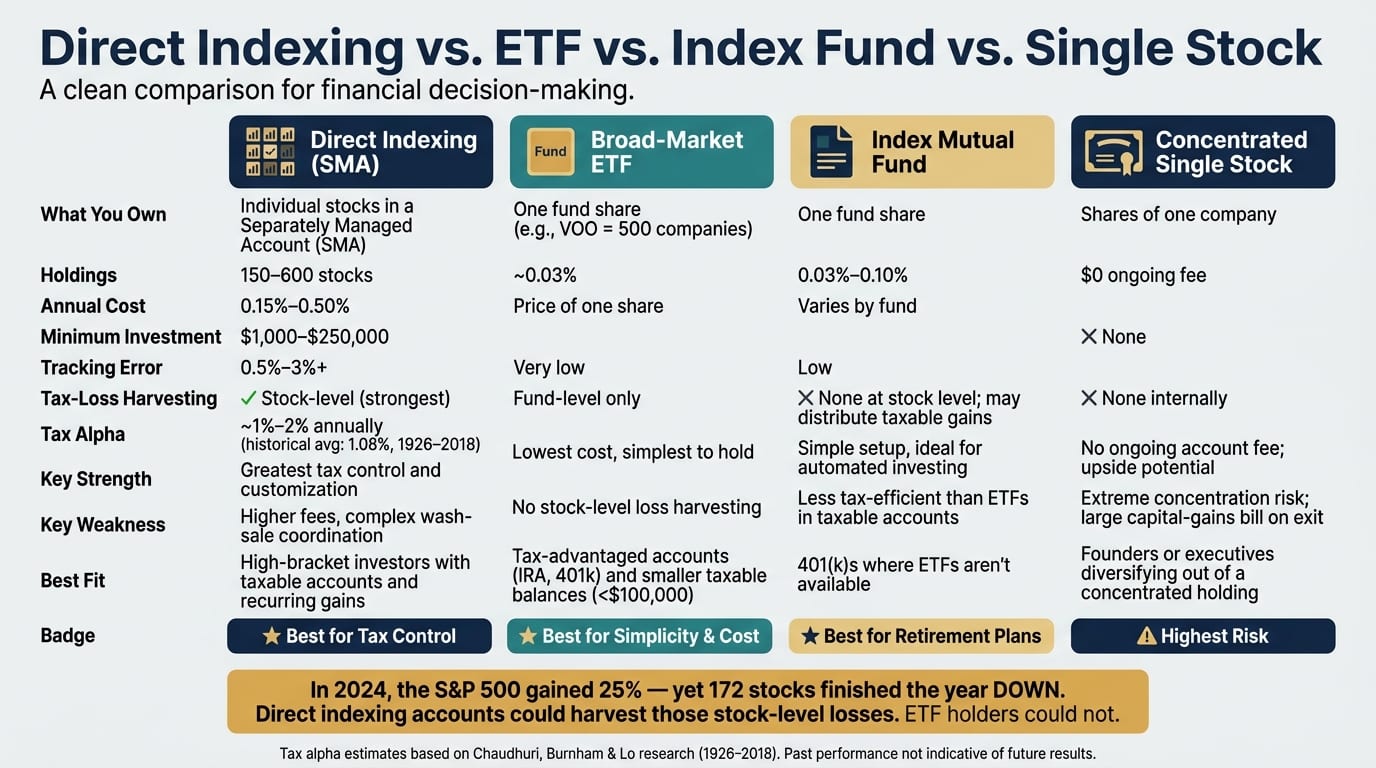
The main upside may be stock-level tax-loss harvesting. In 2024, the S&P 500 gained 25%, yet 172 stocks finished down. Those losses may have been harvested in a direct indexing account, but not inside a plain S&P 500 ETF.
The trade-off is simple: more control may mean more fees, more moving parts, and more tracking error.
In IRAs and 401(k)s, that tax feature may have little or no value, so a low-cost ETF or index mutual fund may be the simpler fit.
If someone is trying to cut a concentrated stock position, direct indexing may sometimes be used alongside staged sales to offset part of the gains over time. But taxes may still be deferred rather than removed.
Ask RWS: Is Direct Indexing Worth It? The Truth About Tax-Loss Harvesting
Quick comparison
| Approach | What you own | Main upside | Main limit | May fit best for |
|---|---|---|---|---|
| Direct indexing | Individual stocks in an SMA | Tax-loss harvesting and stock-level control | Higher fees, wash-sale coordination, tracking drift | Higher-bracket taxable investors |
| Broad-market ETF | One fund share | Low cost and simple tracking | No stock-level harvesting | Smaller taxable accounts and tax-advantaged accounts |
| Index mutual fund | One fund share | Simple setup, common in retirement plans | Less tax-efficient than ETFs in taxable accounts | 401(k)s and auto-invest setups |
| Single stock | One company | Simple to hold | Concentration risk and tax friction on sale | People already holding employer stock or founder shares |
Put another way: this is less about getting “more diversified” than it is about how you choose to build and tax-manage that diversification. For some investors, that extra control may be worth it. For others, a cheap ETF may do the job with less friction.
1. Direct Indexing (Separately Managed Account)
Diversification Control
A direct indexing SMA usually holds 150 to 600 stocks that track a benchmark like the S&P 500. That setup may let an investor leave out employer stock or whole sectors while still keeping most of the index in place. For some people, that may be a practical way to lower concentration risk without stepping too far away from broad market exposure.
Tax Management
This is where direct indexing may differ the most from pooled funds in taxable accounts.
The tax edge may come from harvesting losses in individual holdings even when the index itself is up. In 2024, 172 stocks in the S&P 500 finished the year down even though the index gained 25% [3]. In an SMA, those stock-level losses may be harvested. An ETF, by contrast, may be limited to fund-level tax management [9].
Those realized losses may offset capital gains from other sources, such as a real estate sale, a business exit, or a concentrated stock sale. They may also offset up to $3,000 of ordinary income per year. Unused losses carry forward indefinitely [2][5].
Research puts average annual tax alpha at about 1% to 2% [1][2][3]. Academic work by Chaudhuri, Burnham, and Lo found a historical average of 1.08% annualized from 1926 to 2018 [3].
Loss-harvesting potential may be highest early on and may fade over time as unrealized gains build.
Tracking Error and Cost
More customization usually means more benchmark drift. A well-run SMA may stay within about 0.5% to 1% tracking error per year, but heavier exclusions or factor tilts may push that to 2% to 3% or more [2][1][3].
Direct indexing usually costs around 0.15% to 0.50% annually, with minimums ranging from $1,000 to $250,000. That's higher than what investors may pay for a low-cost broad-market ETF [3][1].
This approach may fit best for investors in higher tax brackets, especially when taxable accounts hold concentrated positions, large employer stock stakes, or major sector exposure, and when the time horizon is measured in years rather than months [1][3].
2. Broad-Market ETF
If direct indexing is about control and tax management, a broad-market ETF is more about simplicity.
Diversification Control
A broad-market ETF like VOO gives you exposure to 500 companies through one ticker. That's simple. But it also means you may not exclude specific stocks or sectors.
Say you already own employer stock. An S&P 500 ETF still includes that same company. So the ETF may be easy to hold, but it may not be tailored around concentrated positions.
Tax Management
With an ETF, you don't own the individual stocks inside the fund. You own the fund itself as a single holding. Because of that, tax-loss harvesting at the stock level isn't available. A loss may only be realized if the ETF's market price falls below your purchase price [1][5].
That tradeoff may matter more than people expect. In 2024, 172 stocks inside the S&P 500 finished the year in negative territory even while the index gained 25%. Those stock-level losses were not available to ETF holders [5].
Tracking Error and Cost
ETFs are built to track the benchmark closely, and fees are low. VOO charges 0.03% per year [3][1].
"A simple VOO position at 0.03% achieves nearly identical pre-tax returns with vastly less complexity, and for the majority of investors, simplicity wins." - Robert Stowe, AAMS, Foxholm Financial [3]
In tax-advantaged accounts like IRAs or 401(k)s, tax-loss harvesting may provide no value, so a broad-market ETF may be the more sensible path. And for taxable accounts under $100,000, the upside from direct indexing may not outweigh added management fees and trading costs [1][4][7].
Index mutual funds may offer similar diversification, just with a different wrapper and fee setup.
3. Index Mutual Fund
Compared with direct indexing, an index mutual fund may give you much of the same broad market exposure, but without stock-by-stock control. You own shares of the fund, not the individual stocks inside it. That may keep things simple. It also means you may have less control at the holding level.
Diversification Control
You may get broad diversification, but there’s usually no way to leave out specific companies, lean into certain sectors, or lower concentration one holding at a time [2][5].
Tax Management
Index mutual funds generally do not offer stock-level tax-loss harvesting. If the fund is up overall, losing positions inside the fund usually may not turn into losses you can use on your tax return [1][7]. The fund may also distribute taxable gains tied to trading activity or shareholder redemptions [8].
Cost and Simplicity
Tracking error may stay low, and fees often run from 0.03% to 0.10% [2][3][6]. From an admin point of view, this setup is pretty straightforward: index mutual funds usually show up as one position and may create one tax reporting line [2][6].
Once diversification is set at the fund level, the next question is how much concentration risk one stock may add.
4. Concentrated Single-Stock Position
A concentrated single-stock position sits at the other end of the spectrum from direct indexing: no diversification, no tax-lot flexibility, and full exposure to one company. Even if there’s no fee to hold it, that alone may not offset the risk. In this setup, direct indexing may matter less as a way to add risk and more as a cleaner path for reducing it.
Diversification Control
One stock offers no diversification. Every dollar may rise or fall with the same company [2]. At that point, the main issue may be how to trim that exposure without creating a tax bill that feels larger than needed.
Tax Management
Selling to diversify may trigger a large capital-gains bill. That’s one reason many investors may stay concentrated longer than they intended [2].
Cost and Complexity
A single stock is simple to hold, but it doesn’t offer internal tax-loss harvesting. If someone wants diversification, that shift may require a sale [1][5].
The real question may be whether the tax cost of selling is small enough to justify reducing the concentration.
Tax-Aware Diversification and Concentration Reduction Trade-Offs
For investors selling a concentrated position, the big challenge may be how to diversify without creating a larger-than-needed tax bill. In a taxable account, taxes may be the main friction point, and each setup deals with that issue in a different way.
Direct indexing approaches this by using harvested losses to offset gains while a concentrated position is sold in stages. As tranches are unwound over time, the DI portfolio may harvest losses from individual stocks that fell, even when the index itself finished higher. In 2024, the S&P 500 returned 25%, yet 172 individual stocks in the index ended the year in negative territory [3][4]. That matters because spreading sales across several years, while harvesting stock-level losses along the way, may reduce the total tax bill versus selling the whole position at once.
The mechanics are pretty straightforward. Harvested losses offset gains first. Up to $3,000 may offset ordinary income each year, and unused losses carry forward. When someone is unwinding a large position over multiple years, that carryforward may be where much of the tax value builds up.
There’s also a limit here. Tax-loss harvesting may defer taxes, but it doesn’t erase them, and it resets the basis of the replacement holdings. ETFs and index funds don’t harvest losses at the stock level, so that part of the tax treatment may not be available in the same way. The flip side is that this stock-level tax work may come with some benchmark drift.
So the trade-off is fairly plain: more tax control may come with more tracking error and more wash-sale coordination. For investors in higher tax brackets, the historical 1% to 2% annual tax alpha tied to DI may justify some drift and a higher fee than a low-cost ETF [1][2]. But wash-sale rules still apply across taxable accounts, IRAs, and spouse-linked accounts. If a stock is sold in the DI account to harvest a loss while that same stock is bought elsewhere during the 30-day window, the deduction is disallowed [2][3].
That’s why tax-aware diversification may involve more than the DI account itself. It may require careful coordination across the full account set.
Pros, Cons, and Best Fit for Each Approach
Each approach tackles a different issue. The best fit may depend on taxes, account size, and how much complexity someone is willing to deal with.
The table below lays out how each option stacks up on cost, control, tax treatment, and concentration risk.
| Approach | Key Strength | Key Weakness | Best Fit |
|---|---|---|---|
| Direct Indexing (SMA) | Greatest tax control and customization | Higher fees and complex coordination | High-bracket investors with taxable accounts and recurring gains |
| Broad-Market ETF | Lowest cost and simple to hold | No stock-level loss harvesting | Tax-advantaged accounts and smaller taxable balances |
| Index Mutual Fund | Best for automated investing | Less tax-efficient than ETFs in taxable accounts | 401(k)s where ETFs aren't available |
| Concentrated Single-Stock Position | No ongoing account fee; upside potential | Extreme concentration risk and a large capital-gains bill on exit | Founders or executives diversifying out of a concentrated holding |
The core trade-off is pretty simple: more tax control may come with more complexity.
Direct indexing may offer tax value early on, but that benefit may be front-loaded. Later, it may leave an investor with a deferred tax bill. That ties back to the main theme of this article: reducing concentration risk while keeping broad equity exposure may call for a plan that still makes sense not just at entry, but across the full holding period and at exit.
Cross-account coordination is often where wash-sale conflicts show up. Overlap in another account, including an IRA or a spouse's account, may block a harvested loss entirely. Mezzi is an SEC-registered fiduciary that connects to your accounts through read-only access to help surface total portfolio exposure, flag hidden overlap, and identify potential wash-sale risks. Mezzi does not execute trades or move money; it advises, and you act. So account-wide visibility may be a big part of this decision.
Conclusion
The trade-off is pretty straightforward: more control may also mean more complexity. The best fit may depend on the account type, tax rate, position size, and how much complexity someone is willing to deal with.
Direct indexing may fit taxable accounts with meaningful gains and higher tax rates. Broad-market ETFs may fit tax-advantaged accounts and smaller balances. Index mutual funds may fit retirement plans. And concentrated single-stock positions are often the thing people may want to unwind, not the place they may want to end up. The goal isn't maximum customization. It's the right level of diversification and tax efficiency for the account.
Direct indexing may work best earlier, before gains build up and tax-loss chances become more limited. Tax benefits may support diversification decisions, but they don't replace the need for an exit plan. The tax edge may be strongest early, so it may make sense to plan the exit as carefully as the entry.
Mezzi is designed to help you assess concentration, wash-sale risk, and tax opportunities across all linked accounts through read-only access, so you may see the full tax and concentration picture.
FAQs
Is direct indexing worth it for small taxable accounts?
Usually not. For many investors with smaller taxable accounts, direct indexing may not be worth the added cost and complexity.
It often appears to fit better with larger portfolios - typically $100,000 to $250,000+ - where tax-loss harvesting may be more likely to outweigh higher fees and admin work. In smaller accounts, those costs may reduce or even erase the tax benefit.
How much tracking error is too much?
Tracking error is the gap between your portfolio and its benchmark index. It may show up when your holdings drift from the index because of tax-loss harvesting, wash sale substitutions, or custom exclusions.
A well-managed portfolio may stay below 0.5% to 1.0% per year. Heavier customization or sector exclusions may push that number up to 2.0% to 3.0% or more.
How much is too much? That may depend on your comfort with returns that differ from the index versus the tax benefits you may want.
How can I avoid wash sales across multiple accounts?
The IRS wash sale rule may apply across all accounts you own or control, including IRAs, 401(k)s, and your spouse’s accounts. If you sell a security at a loss and buy a substantially identical security within 30 days before or after the sale in any account, the loss may be disallowed.
That’s why some households try to coordinate trades across accounts, not just within one portfolio. Mezzi is designed to give you a read-only view of your linked accounts and to help flag potential wash sale risks before you execute trades.
Disclosures:
This content is for informational purposes only and does not constitute investment advice or a recommendation to buy or sell any security.
Past performance is not indicative of future results. No guarantee of future performance or outcomes is implied.
Registration does not imply a certain level of skill or that the SEC has approved the company or its services.
Savings and performance examples are hypothetical and for illustrative purposes only. Actual results will vary based on individual circumstances, portfolio composition, market conditions, and fees.