
Exclude a few stocks, and a direct index may stop acting much like the index it tracks. In many cases, restrictions may lead to higher tracking error, more weight in the names left behind, fewer tax-loss harvesting trades, and more wash sale friction across accounts.
Here’s the short version:
I may see little change if the exclusion is a small index holding.
I may see more drift if the exclusion is a mega-cap stock or a full sector.
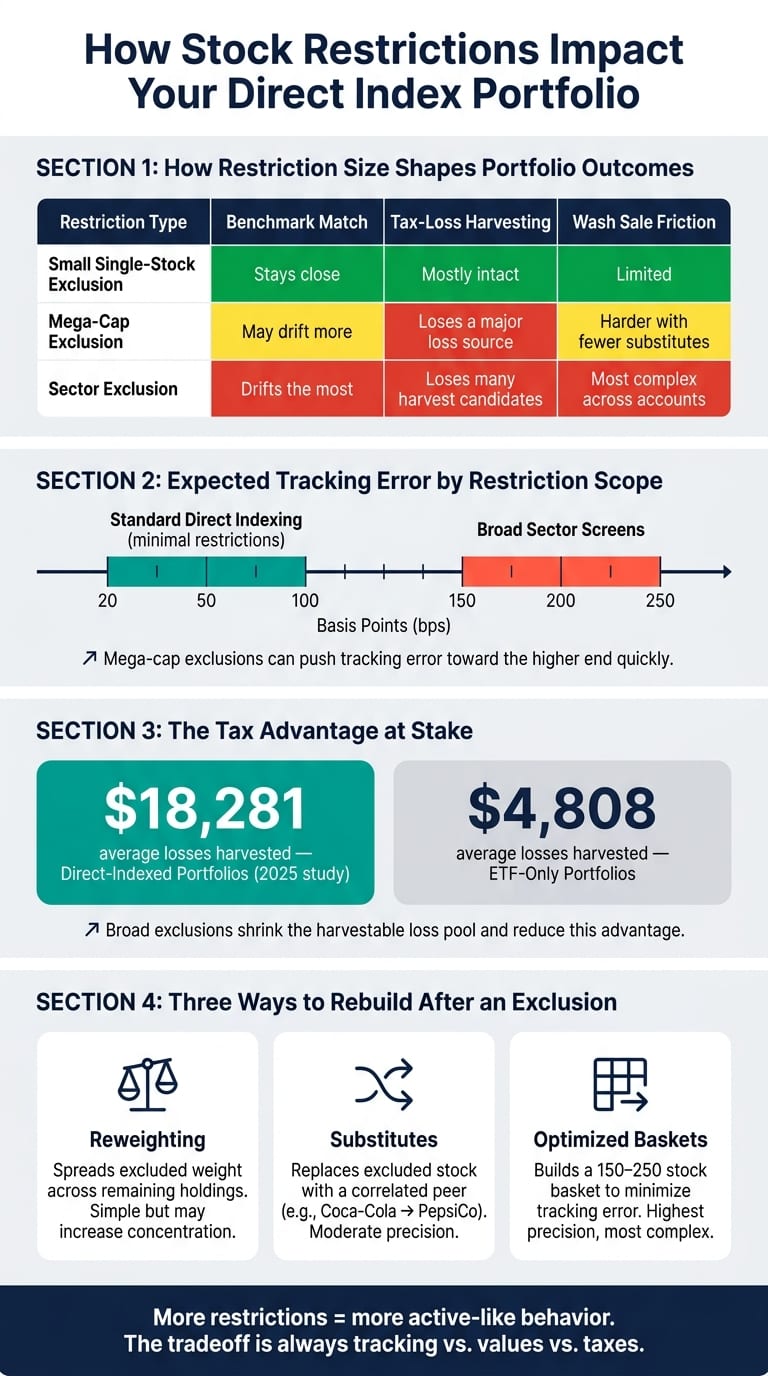
Tracking error in standard direct indexing may stay around 20 to 100 basis points, while broad screens may move closer to 150 to 250 basis points.
Tax-loss harvesting may weaken if excluded names or sectors would have produced losses.
Wash sale issues may spread across taxable accounts, IRAs, Roth IRAs, and even a spouse’s 401(k).
Rebuilding the portfolio usually comes down to reweighting, using substitutes, or using an optimized basket.
That’s the core tradeoff: more restrictions may mean less index-like behavior. And once taxes enter the picture, the stock list matters even more.
If I’m looking at direct indexing with limits in place, I’d frame it this way: the portfolio may still track the benchmark, but usually with fewer clean paths to do it.
Applications of Direct Indexing
Quick Comparison
| Restriction type | Benchmark match | Diversification | Tax-loss harvesting room | Wash sale friction |
|---|---|---|---|---|
| Small single-stock exclusion | May stay close | May change a little | May stay mostly intact | May stay limited |
| Mega-cap exclusion | May drift more | May concentrate other names | May remove a large loss source | May get harder if substitutes are limited |
| Sector exclusion | May drift the most | May shift portfolio mix more | May remove many harvest candidates | May get more complex across accounts |
A simple way to think about it: the more of the index I remove, the more the portfolio may start to look like an active choice instead of a close index match.
How exclusions affect diversification and benchmark tracking
When a stock or sector gets excluded from a direct index, that weight doesn’t just disappear. It has to go somewhere else in the portfolio. That shift may pull returns away from the benchmark, because the portfolio no longer matches the index in the same way. How much drift shows up may depend on the size of the excluded position and on how well the remaining holdings mirror the exposure that was removed. A tighter screen may also leave the optimizer with fewer ways to make up for that gap.
Single-stock exclusions vs. sector exclusions
Removing one stock may be easier to manage than cutting an entire sector or theme. If that stock has a small weight in the index, the effect may stay limited. But if it’s a large holding - especially a mega-cap name - benchmark drift may appear much faster. Direct indexing managers typically hold mega-cap tech stocks like Apple or Microsoft at full weight to keep tracking error lower [1].
The contrast stands out most when you put a single-stock exclusion next to a sector screen.
| Feature | Single-Stock Exclusion | Sector Exclusion |
|---|---|---|
| Tracking Error | Low unless the stock is a mega-cap | High |
| Concentration Risk | May increase weight in remaining holdings | May increase weight across the rest of the portfolio |
| Diversification Impact | Minor; mostly idiosyncratic risk | Major; broad economic sensitivity shift |
Why removing a large index weight can shift results fast
The effect may grow quickly when the excluded holding makes up a large share of the index. Liquid mega-cap stocks are usually held at full weight because removing them may create an immediate gap in the portfolio, and that gap then has to be spread across other holdings [1]. That’s why one large single-stock exclusion may move tracking error faster than some investors expect.
A sector exclusion may remove a broad slice of benchmark exposure all at once. In some cases, that may push tracking error into the 150 to 250 bps range [2]. The optimizer then has to use the remaining holdings to approximate the missing exposure as closely as possible.
How exclusions affect taxes, tax-loss harvesting, and wash sale risk
The same restriction that changes tracking also changes which losses you may be able to harvest. If a mega-cap stock, an employer stock position, or a sector such as fossil fuels gets excluded, you may not be able to harvest losses in those names when they drop sharply. Those exclusions may shrink the loss pool and leave fewer substitute holdings for the optimizer.
How exclusions can reduce or redirect harvesting opportunities
Direct indexing’s tax edge may come from owning many individual stocks that move on their own, so some positions may be down even when the broad market is up. A 2025 study found that direct-indexed portfolios harvested an average of $18,281 in losses per account, compared to $4,808 for ETF-only accounts [1]. That gap may depend on having a large pool of holdings available to harvest.
If you exclude a sector - say, technology - you lose access to losses in that part of the market. Then the rest of the portfolio may have to carry more of the load. If those names don’t fall enough, the portfolio may have fewer chances to generate that tax benefit.
Replacement trades add another wrinkle. After selling a position at a loss, a substitute holding may be used to keep market exposure through the 61-day wash sale window (30 days before and 30 days after the sale) [2]. If the restriction also limits substitutes, the optimizer may have to accept more tracking error or sit in cash until the window passes.
Why seeing all accounts before you trade matters
The next limit comes from what every account in the household may be buying. The IRS applies wash sale rules across every account under your control, including IRAs, Roth IRAs, and a spouse’s 401(k) [2]. That may create a cross-account coordination problem: if one account buys a stock while another account tries to harvest a loss in that same stock, the loss may be disallowed.
What makes this more serious is the IRA wash-sale rule under Rev. Rul. 2008-5. If you sell a stock at a loss in a taxable account and buy it back inside an IRA within 30 days, the loss may be permanently disallowed, with no basis adjustment to recover it later [2]. Many brokerage platforms only flag wash sales within one account, so cross-account issues may not show up until tax time.
Mezzi’s household view may surface overlapping holdings across taxable accounts, 401(k)s, IRAs, and Roth IRAs before you trade. If you’re planning to harvest a loss in a direct indexing account, Mezzi may help you see whether the same security is being bought elsewhere automatically, including through scheduled contributions or dividend reinvestment.
Once the tax rules are set, the portfolio still has to be rebuilt around the restriction set. After that, the basket has to be rebuilt without violating the screen or the wash-sale window.
This content is for informational purposes only and does not constitute tax advice. Tax-loss harvesting and wash sale rules involve complex IRS regulations, including IRC §1091. Consult a qualified tax professional before taking action.
How to rebuild the portfolio after exclusions
Once a holding is excluded, its weight still has to go somewhere. The tricky part is redirecting that weight without drifting too far from the benchmark. The best path may depend on what matters more to you: simplicity, tighter matching, or closer control of benchmark exposure.
Replacement methods: reweighting, substitutes, and optimized baskets
Reweighting is the most straightforward route. You spread the excluded stock’s weight across the holdings that remain. It’s simple and easy to carry out. The tradeoff is that it may add more weight to positions that are already large.
Substitutes add a bit more precision. Instead of spreading weight across the whole portfolio, you replace the excluded stock with a peer that moves in a similar way. For example, swapping Coca-Cola for PepsiCo may keep consumer staples exposure closer to where it was. That may reduce drift versus broad reweighting, though picking a good stand-in takes care.
Optimized baskets are the most rigorous option. Instead of making one-for-one swaps, an optimizer builds a basket of roughly 150 to 250 stocks with the goal of minimizing expected tracking error while staying within sector and factor limits [1].
Here’s how the three methods stack up:
| Method | Diversification Effect | Tracking Precision | Tax Flexibility | Operational Complexity |
|---|---|---|---|---|
| Reweighting | Low; increases concentration in remaining names | Lower; may lead to sector or factor drift | High; simple to execute | Low |
| Substitutes | Moderate; replaces excluded stock with a correlated peer | Higher; keeps sector exposure more stable | Moderate; requires careful substitute selection | Moderate |
| Optimized Baskets | High; uses mathematical models to balance the whole mix | Highest; minimizes tracking error across factors | Moderate; may require more frequent rebalancing | High; requires specialized software |
After the portfolio is rebuilt, it may make sense to keep checking whether the method you chose is still preserving the exposure you meant to keep.
What to monitor after a restriction is in place
Once a restriction is in place, the main job is watching for side effects. Drift may widen. Positions may become more concentrated. Tax-loss harvesting may get harder.
Tracking error is usually the first metric people watch. If it starts moving above your target band, the restriction may be pulling the portfolio farther from the benchmark than you intended. Sector drift comes next. Replacement holdings may slowly tilt the portfolio toward, or away from, sectors you never meant to lean into. Factor exposures may shift too, especially if the excluded stock carried a big style tilt on its own.
It also helps to watch concentration in top holdings. Reweighting, and even substitution, may push more weight into a small group of names without making that change obvious at first glance. On the tax side, embedded gains matter too, since harvesting opportunities may shrink as lots age.
Mezzi’s cross-account view may flag overlapping buys across taxable and retirement accounts before they turn into wash-sale issues.
Choosing restrictions that fit your goal
The right restriction may depend on what you're trying to solve for: values, taxes, or concentrated stock risk.
Size matters here. Excluding a small holding may have only a minor effect. But excluding a mega-cap or an entire sector may make a direct-indexed portfolio look less like an index and more like an active bet.
Broad screens may also push tracking error higher than a single-stock exclusion. Mega-caps are often held close to full weight, so removing one may move a portfolio away from its benchmark pretty fast. Because of that, the reason for the restriction tends to be the main factor.
That reason may also shape the tradeoff. Employer stock exclusions may be simpler to manage than broad ESG or sector screens, which may call for more rebalancing. Sector exclusions usually require the most adjustment because they remove a full slice of benchmark exposure.
Restrictions may also affect the tax engine behind direct indexing. Correlated replacements may help keep benchmark exposure more in line after an exclusion or a tax-loss sale.
Before any trade, it may make sense to check every household account for overlapping buys that may void the loss. Mezzi's cross-account view may surface those conflicts before they turn into disallowed losses.
FAQs
How much tracking error is too much?
Tracking error measures how far your portfolio’s return may drift from its benchmark. In direct indexing, many target ranges may fall between 20 and 100 basis points annualized - or, put more simply, within about 1 percentage point of the index.
That range may shift when the portfolio includes limits or custom choices. For example, ESG exclusions, sector tilts, or concentrated-stock offsets may push tracking error up to 150 to 250 basis points.
What counts as “too much” may depend on your comfort level. Some people may be fine with more distance from the benchmark if that trade-off better reflects personal values or tax limits. Others may prefer to stay closer to the index, even if that means using fewer custom screens.
When does an exclusion stop making sense?
An exclusion may stop making sense when the cost of keeping it outweighs the benefit tied to your original investment goals.
At that point, it may become counterproductive. That may happen if it pushes tracking error above an acceptable range - typically 150 to 250 basis points - creates meaningful concentration risk, limits tax-loss harvesting, or leaves you with large embedded gains that may be hard to manage without triggering tax events.
How do I avoid wash sales across accounts?
To avoid wash sales across accounts, it may help to know that the IRS may aggregate accounts under your control. That may include taxable accounts, IRAs, 401(k)s, and spousal accounts.
A wash sale happens when you sell a security at a loss and then buy the same, or a substantially identical, security within 30 days before or after the sale. Brokers may track wash sales only within one account; Mezzi is designed to help monitor household holdings and transactions in real time.
Disclosures:
This content is for informational purposes only and does not constitute investment advice or a recommendation to buy or sell any security.
Past performance is not indicative of future results. No guarantee of future performance or outcomes is implied.
Tax-loss harvesting and wash sale rules involve complex IRS regulations, including IRC §1091. Consult a qualified tax professional before taking action.