
If your direct indexing account may drift by more than its tax value, the tradeoff may no longer fit.
Here’s the short version:
Tracking error is the return gap versus the benchmark over time.
Drift is the gap in holdings, weights, sectors, or factor exposure.
A plain setup may target 20 to 100 basis points of annualized tracking error.
Heavier tax-loss harvesting, screens, or stock concentration may push that to 150 to 250 basis points or more.
Early tax value may run 0.5% to 2.0% annualized for some accounts, but that amount may fade over time.
If tracking error stays high after tax value drops, some investors may revisit the setup.
I’d frame it in plain terms: some drift may be fine when it has a job. But drift that comes from cash sitting idle, delayed rebalancing, wash sale issues, or stock concentration may change the portfolio in ways you did not mean to take on.
A simple way to think about it:
Low drift: often just watch it
Middle drift: compare tax value to benchmark slippage
High drift: some investors review risk, concentration, and rebalancing costs
One more thing: a direct index may look close to the benchmark on paper while still behaving differently in practice. That gap may come from stock substitutions, account limits, employer stock, or trades across taxable and retirement accounts.
Below, I’ll break down when drift may still make sense, when it may start to look expensive, and how some investors keep it intentional instead of accidental.
Direct Indexing Explained: How Does it Compare to Passive Indexing?
What tracking error and index drift mean in a direct indexing portfolio
In direct indexing, drift means the portfolio moves away from the benchmark’s holdings and weights. Tracking error refers to the return gap that may follow from that move.
| Metric | What It Measures | Role in Direct Indexing |
|---|---|---|
| Index Drift | Physical deviation in holdings, weights, sector mix, or factor exposure from the benchmark | The cause: tax trades, exclusions, and market moves |
| Tracking Error | The volatility of the return difference between your portfolio and the benchmark | The result: the return gap created by drift |
Tracking error measures consistency, not success. A portfolio may finish the year with the same return as the benchmark and still show meaningful tracking error if the path along the way looked very different. That range may help investors judge whether the portfolio is staying close enough to the benchmark for its intended use.
Index drift shows up in weights, sectors, and holdings
Drift shows up in the actual holdings. A stock may grow or shrink relative to its benchmark weight as prices move. Over time, a sector may also end up above or below target.
One common form is substitution drift. If a manager sells Coca-Cola to harvest a loss and buys PepsiCo as a correlated replacement, the portfolio may keep similar market exposure, but it no longer matches the index exactly [1]. And because direct indexing usually holds fewer names than the benchmark, some structural drift may be built in from day one.
These shifts usually come from a small set of portfolio moves and limits.
Why direct indexing portfolios drift from their benchmark
Drift rarely comes from one big choice. More often, it builds bit by bit.
A few trades here. A restriction there. A cash balance that sits for a while. Over time, those small gaps may add up and pull a portfolio away from its benchmark.
Tax-loss harvesting and wash sale rules create temporary substitutions
Tax-loss harvesting often means selling one holding at a loss and buying a similar security instead. That swap may keep market exposure in place, but it may also introduce tracking error for a period of time.
Cross-account wash sale risk adds another layer. A loss sale in a taxable account may be disallowed if a spouse's 401(k) or your IRA buys the same stock [1].
Delayed rebalancing, cash flows, and account restrictions widen the gap
Cash balances, contributions, withdrawals, and delayed rebalancing may all leave a portfolio out of sync with its benchmark.
Small account limits may make this even harder. Minimum trade sizes may force drift, especially in accounts without fractional shares, because the portfolio may not be able to buy the exact number of shares needed to match an index weight.
Concentration changes your portfolio's risk more than most investors expect
Some drift is mechanical. Some comes from risk.
A handful of oversized positions may shape portfolio risk more than many investors expect, even when the rest of the holdings stay close to the index. That may matter most when employer stock or another concentrated holding grows into a large share of the account.
The math is pretty plain: if a single stock makes up 25% of your portfolio and then drops 50%, the full portfolio may take a 12.5% hit from that one name alone, no matter how closely the rest of the holdings match the index [1].
The next question is whether that drift may still be worth the tax benefit or customization.
How much drift is too much
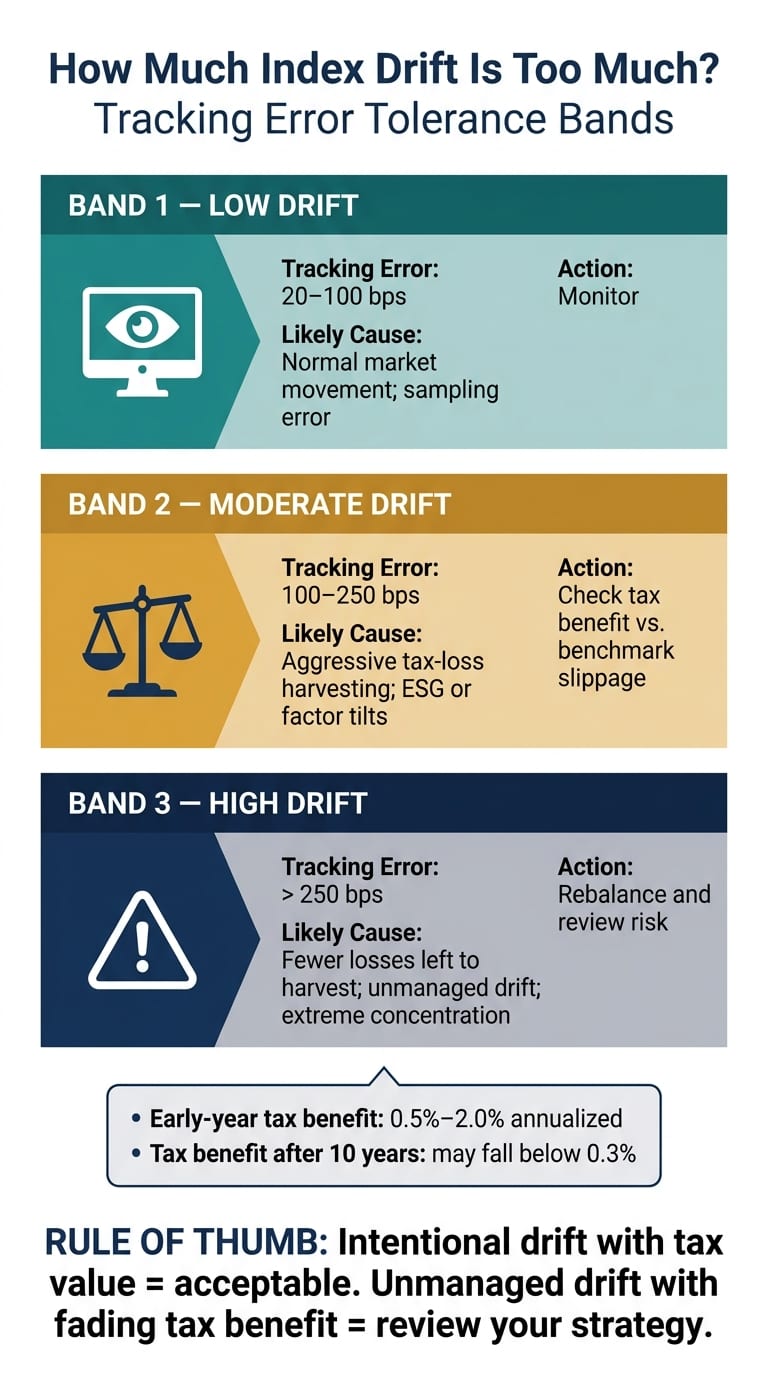
Drift may be fine if it still fits the portfolio's job.
A tax-harvesting direct index may tolerate more deviation than a portfolio built to stay close to a benchmark. The same things that often create drift - tax-loss harvesting, delayed rebalancing, and concentration - may also be the reason that drift exists in the first place. So the question isn't just how much drift is there? It's whether that drift may still line up with the portfolio's goal.
Use tolerance bands to classify low, moderate, and high divergence
These bands may help sort drift by impact, not just by the name attached to it.
| Drift Level | Tracking Error | Likely Cause | Action |
|---|---|---|---|
| Low | 20–100 bps | Normal market movement; sampling error | Monitor |
| Moderate | 100–250 bps | Aggressive TLH; ESG or factor tilts | Check tax benefit vs. slippage |
| High | > 250 bps | Fewer losses left to harvest; unmanaged drift; extreme concentration | Review risk; consider whether rebalancing fits |
Cash drag also deserves its own check. Under 1% may be minor. Above 5% may start to matter more.
Judge drift by its purpose, not by one number alone
The main test may be whether the tax benefit still exceeds the return drag.
A tracking error of 1.0% to 2.0% may be acceptable when it comes from deliberate tax-loss harvesting and the portfolio may still be producing meaningful tax savings. In the early years of a direct indexing account, after-tax benefit has been estimated at 0.5% to 2.0% annualized [1]. At that point, this level of drift may still make sense.
The bigger issue is whether the drift was planned or accidental. Persistent sector or factor tilts that were never intended may call for a closer look.
One signal to watch: when fewer losses remain to harvest, tax savings may decay over time, often falling below 0.3% after 10 years [1]. When that happens, the same tracking error may be harder to justify.
How to decide if the tax benefit is worth the benchmark slippage
Compare tax savings in dollars to slippage, turnover, and missed exposure
After you measure drift, put it into dollar terms.
The basic tradeoff may look like this: tax benefit = harvested losses × your marginal tax rate. Benchmark drag may be viewed as portfolio value × tracking error. That side-by-side view may make the decision a lot less abstract.
A 2025 study found that direct-indexed accounts harvested far more losses than ETF-only accounts [1]. That extra tax value may matter. But it may matter less if tracking error, turnover, or missed market exposure start eating into it.
| Benefit Source | Risk / Hidden Cost |
|---|---|
| Tax-loss harvesting: captures losses at the individual stock level even in "up" years [1] | Tracking error and embedded gains: returns may lag the benchmark, and by years 7 or 8, a portfolio may carry 30% to 40% unrealized gains, which may make rebalancing costly [1] |
There's another cost that may slip past people.
If you sell a stock at a loss in a taxable account and buy it back in an IRA within 30 days, the loss is permanently disallowed under Revenue Ruling 2008-5, with no basis adjustment [1]. That's not a small technicality. It may wipe out the tax value you thought you locked in.
If the tax benefit no longer exceeds the benchmark drag, some investors tighten constraints, rebalance, or reassess the approach.
Set monitoring rules before drift becomes a surprise
Once the tradeoff is clear, set a review schedule ahead of time.
A simple framework may look like this:
Monthly: check for wash sale risk across connected accounts
Quarterly: review sector weights and your return gap versus the benchmark
If tracking error stays high while the tax benefit has faded, the strategy may no longer justify the tradeoffs.
Use Mezzi for cross-account oversight and tax-aware portfolio review
Cross-account drift may be hard to spot by hand, especially when taxable and retirement accounts interact.
Mezzi gives you one read-only view across taxable and retirement accounts, flags wash-sale risk, surfaces harvesting opportunities, and shows when drift has moved outside your target range. Mezzi flags the issue; you decide the trade.
Conclusion: Keep drift intentional, measured, and worth the cost
In direct indexing, some gap from the benchmark may be expected. In many cases, that's the point. Tax-loss harvesting and custom screens are designed to create drift [1].
After you set tolerance bands and weigh possible tax upside, the last check may be pretty simple: is the drift intentional?
If drift moves outside your target range without a clear tax or customization reason, that may call for action. In that case, some investors may rebalance or tighten constraints to bring the portfolio back toward its intended risk profile [1].
It also may make sense to set tolerance bands before you invest, so there's a clear line between drift you may accept and drift you may want to correct. If tracking error rises above your target without an intentional reason, tightening constraints or rebalancing may be one way to respond.
Tax benefits may justify some slippage. Early-year tax benefits may reach 0.5% to 2.0% annualized [1]. But if that benefit may be fading while divergence continues to grow, it may be worth reassessing whether the drift still lines up with the original tradeoff.
Intentional drift, measured on a regular basis, may be part of a strategy. Unmanaged drift may add hidden risk.
FAQs
How do I measure tracking error in my account?
Measure tracking error by comparing your account’s returns with your chosen benchmark. For many investors, annual ranges may fall around 20 to 100 basis points (0.20% to 1.00%). If a portfolio uses custom limits like ESG exclusions or sector tilts, that gap may run higher, sometimes around 150 to 250 basis points.
Some people use platforms with real-time oversight of holdings and allocations. These tools compare a current portfolio with a target benchmark, which may make it easier to see whether the deviation still lines up with your financial goals.
When should I rebalance a drifting direct index?
Some investors rebalance when their portfolio drifts beyond a preset threshold, often 5% to 10% away from their target. A threshold-based approach may help limit extra trades, transaction costs, and tax consequences.
Some investors also use a hybrid approach: they review the portfolio on a set schedule, but only trade if the drift moves past their limit. When possible, new contributions or dividends may be used first to rebalance before selling assets.
Can tax-loss harvesting stop being worth the drift?
Yes. Tax-loss harvesting may stop being worth it if the cost of portfolio drift outweighs the tax benefit.
As your portfolio matures and fewer tax lots remain underwater, any tax alpha may fade. If drift moves past your target threshold, or replacement securities underperform or come with higher fees, the strategy may no longer make sense.
Disclosures:
This content is for informational purposes only and does not constitute investment advice or a recommendation to buy or sell any security.
Past performance is not indicative of future results. No guarantee of future performance or outcomes is implied.
Savings and performance examples are hypothetical and for illustrative purposes only. Actual results will vary based on individual circumstances, portfolio composition, market conditions, and fees.