
If you’ve ever wondered whether to invest a large sum all at once or spread it out over time, here’s the quick answer: lump sum investing usually wins in the long run, but dollar-cost averaging (DCA) can help manage risk and emotions in uncertain markets.
- Lump sum investing maximizes market exposure and tends to outperform about 64-80% of the time, particularly in rising markets.
- Dollar-cost averaging reduces timing risk and provides peace of mind, especially in volatile or declining markets.
Key takeaway: Choose lump sum investing if you prioritize returns and can handle short-term volatility. Opt for DCA if you value emotional comfort and want to minimize regret during market downturns. A hybrid approach might also work, balancing returns and risk.
Lump Sum Investing: Why Most People Get This Wrong (vs Dollar-Cost Averaging)
When Dollar-Cost Averaging Works Best
Dollar-cost averaging (DCA) shines in markets that are volatile, declining, or hard to predict. If you're uneasy about investing a large amount right before a potential downturn, DCA provides a layer of protection that lump-sum investing lacks.
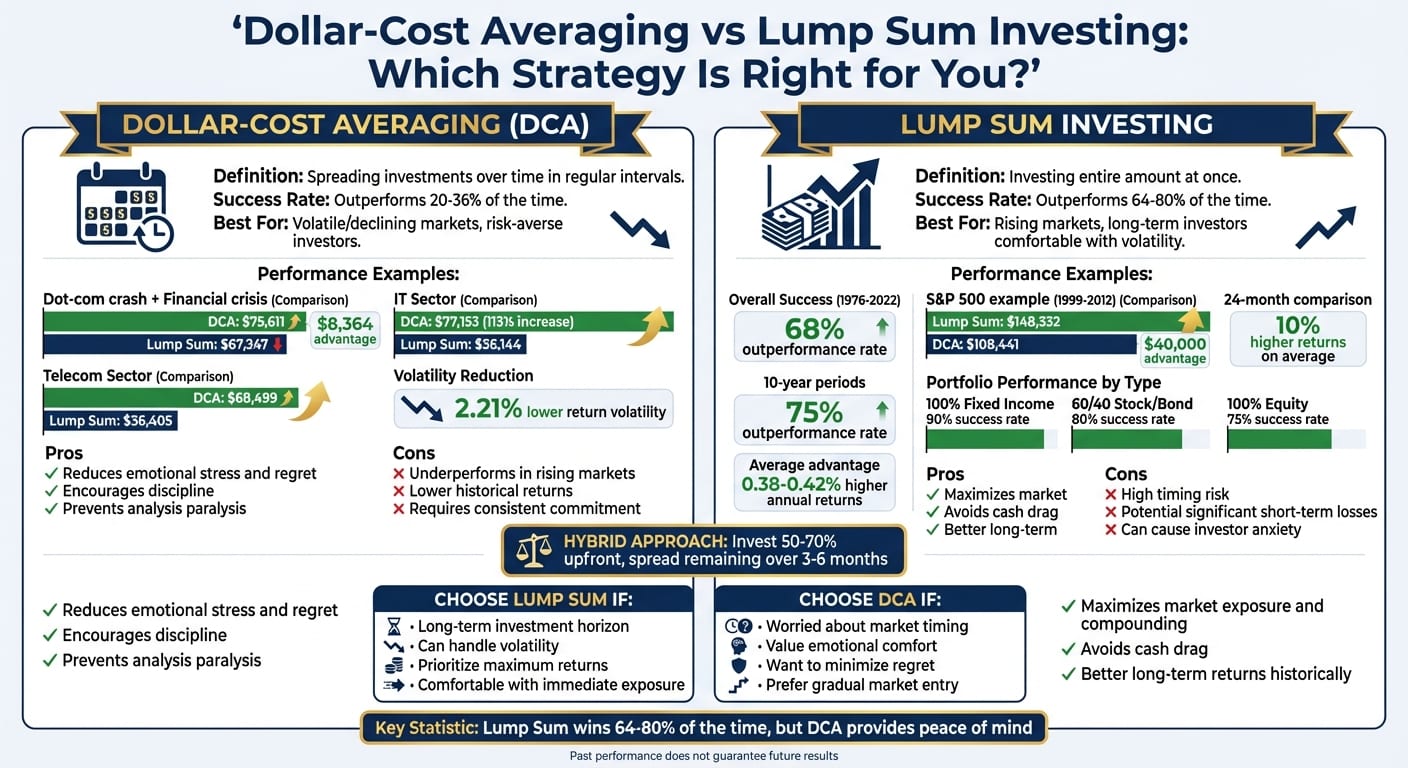
Take the dot-com crash and financial crisis as examples. An investor who started with $10,000 and added $1,000 each quarter - totaling $58,000 - ended up with $75,611. In contrast, a lump-sum investor who put the entire $58,000 in on day one finished with just $67,247. That’s a difference of $8,364.
The benefits become even clearer in sectors with high volatility. In the Information Technology sector, a DCA approach resulted in $77,153, while a lump-sum investor ended with only $36,144 - a staggering 113% increase. Similarly, in the Telecommunications sector, DCA produced $68,499 compared to $36,405 for lump-sum investing.
Dollar-cost averaging can be especially powerful in recessions and bear markets. It can save investors from their psychological biases.
James Royal, Ph.D., Former NerdWallet Writer
One of DCA’s strengths is its ability to limit losses to the funds already invested, which can help reduce regret and the temptation to sell in a panic. Research examining 20 one-year investment scenarios found that DCA lowered return volatility by 2.21% compared to lump-sum investing.
Up next, we’ll take a closer look at when lump-sum investing has the edge over DCA.
When Lump Sum Investing Works Best
Lump sum investing often shines in rising markets because it taps into growth right away, unlike dollar-cost averaging (DCA), which spreads out investments and can miss out on early gains.
Data backs this up: lump sum investing outperformed DCA in roughly 75% of rolling 10-year periods. During those times, the average annualized "cost" of choosing DCA over lump sum investing was about 0.38 percentage points.
Experts in the field echo these findings:
If you have a lump sum available to invest for the long-term, it is likely optimal to invest it as soon as possible in a portfolio that is appropriate to your risk tolerance.
Benjamin Felix, Portfolio Manager and Head of Research, PWL Capital
The performance of lump sum investing can also depend on your portfolio's composition. For instance, a 100% fixed-income portfolio using lump sum investing outperformed DCA 90% of the time. A portfolio with a 60/40 stock-bond mix came out ahead 80% of the time, while an all-equity portfolio had a 75% success rate. Even when markets were highly valued - trading in the 95th percentile of historical valuations - lump sum investing tended to deliver better long-term results.
Take this example: from December 31, 1999, to February 17, 2012, Sam Stovall of S&P Capital IQ analyzed the S&P 500 Dividend Aristocrats index. A $58,000 lump sum investment grew to $148,332, while the same amount invested using DCA reached only $108,441. That’s nearly a $40,000 difference, simply because the lump sum investor had their entire amount working from the start.
These insights provide a solid foundation for understanding when lump sum investing might be the better choice and set the stage for comparing both strategies.
Pros and Cons
When deciding between investment strategies, it's crucial to weigh their advantages and disadvantages against your financial goals and risk tolerance. Both approaches - Dollar-Cost Averaging (DCA) and Lump Sum Investing - come with trade-offs, as outlined below:
For example, a 24-month DCA strategy for the S&P 500 underperformed lump sum investing by an average of 10% by the end of the buying period. Similarly, Morgan Stanley reported that aggressive portfolios using lump sum investing earned a 0.42% higher return over 12 months.
But DCA isn’t solely about returns - it’s also about emotional management. As Tony, Managing Director at Johnson Investment Counsel, explains:
"DCA is less about expected return maximization and more about regret minimization".
If you're someone who might panic and sell during market downturns, DCA provides a safety net by easing you into the market gradually. On the other hand, if maximizing returns is your priority and you can handle short-term volatility, lump sum investing might be the better choice.
Ultimately, the decision comes down to what you value more: the logical, data-backed potential of lump sum investing or the emotional reassurance offered by DCA. Understanding these trade-offs can help guide you toward the strategy that aligns best with your needs.
Conclusion
Deciding between dollar-cost averaging (DCA) and lump sum investing isn't about finding a universal solution - it’s about choosing what fits your unique situation. Historical data shows that lump sum investing outperforms DCA around 64% to 66% of the time. This highlights the need to align your strategy with your financial goals, market perspective, and risk tolerance. If you’re comfortable with immediate market exposure and have a long-term horizon, lump sum investing may offer greater compounding potential. On the other hand, if you’re worried about timing the market or prefer to ease into investing, DCA can provide peace of mind, even if it typically yields lower returns.
Beyond performance statistics, your decision should account for factors like your comfort with risk, current market dynamics, investment timeline, and personal behavior. A hybrid approach - where you invest 50–70% upfront and spread the rest over 3–6 months - can combine the higher returns of lump sum investing with the psychological ease of gradual entry. As Stefano from FinanceHalo wisely said, "A slightly 'less optimal' plan you stick with beats the perfect plan you abandon".
Modern tools, like Mezzi's Monte Carlo simulations, make it easier than ever to tailor investment strategies. These tools turn theoretical concepts into actionable insights, helping you assess your portfolio, optimize for capital gains deferral and tax loss harvesting, and evaluate potential risks. By running simulations with your own numbers, you can better understand which strategy aligns with your financial goals.
Whether you choose DCA, lump sum investing, or a hybrid method, the most important thing is that it supports your long-term objectives and matches your ability to handle market ups and downs.
FAQs
How long should I DCA a lump sum (3 months or 12 months)?
When it comes to dollar-cost averaging (DCA), keeping the timeframe short - ideally no more than 12 months - is often the smartest move. Many experts suggest even shorter periods, like 3 to 6 months, as these strike a good balance between reducing market timing risks and enjoying the smoothing effects of DCA.
Stretching a DCA plan beyond 12 months can sometimes backfire. It may dilute the strategy’s effectiveness and leave you exposed to greater market risks over time. A 3-month plan, on the other hand, is often considered a safer option and aligns with widely recognized best practices.
When does a hybrid strategy beat lump sum or DCA?
A hybrid strategy offers a middle ground that can outshine both lump sum investing and dollar-cost averaging (DCA). By splitting your capital, you invest a portion right away to gain immediate market exposure, while the rest is deployed gradually over time. This method strikes a balance - allowing you to tap into potential gains early while reducing the risks associated with market timing. It’s particularly useful in volatile conditions or when market valuations feel unpredictable, giving you a way to participate without the full weight of regret if the market moves against you.
How do I choose between DCA and lump sum based on my risk tolerance?
When deciding between dollar-cost averaging (DCA) and lump-sum investing, it comes down to how comfortable you are with market ups and downs.
Lump-sum investing tends to perform better in rising markets, making it a good choice if you have a higher tolerance for risk. On the other hand, if you’re more cautious or worried about market volatility, DCA might be a better fit. By spreading your investments over time, DCA helps soften the impact of potential market downturns.
Ultimately, the right approach depends on factors like your risk tolerance, investment timeline, and your ability to stay steady during market fluctuations.
Disclosures:
- This content is for informational purposes only and does not constitute investment advice or a recommendation to buy or sell any security.
- Past performance is not indicative of future results. No guarantee of future performance or outcomes is implied.
- Savings and performance examples are hypothetical and for illustrative purposes only. Actual results will vary based on individual circumstances, portfolio composition, market conditions, and fees.
Related Blog Posts
- 11 ETF Investment Strategies (and How They Work)
- AI vs. Traditional Asset Allocation Strategies
- If I add a lump sum to my portfolio, how would it change my annual investment income?
- Is it smart to add to a lagging large-cap growth stock if it has trailed the S&P 500 recently?
When it comes to dollar-cost averaging (DCA), keeping the timeframe short - ideally no more than 12 months - is often the smartest move. Many experts suggest even shorter periods, like 3 to 6 months, as these strike a good balance between reducing market timing risks and enjoying the smoothing effects of DCA.
Stretching a DCA plan beyond 12 months can sometimes backfire. It may dilute the strategy’s effectiveness and leave you exposed to greater market risks over time. A 3-month plan, on the other hand, is often considered a safer option and aligns with widely recognized best practices.
A hybrid strategy offers a middle ground that can outshine both lump sum investing and dollar-cost averaging (DCA). By splitting your capital, you invest a portion right away to gain immediate market exposure, while the rest is deployed gradually over time. This method strikes a balance - allowing you to tap into potential gains early while reducing the risks associated with market timing. It’s particularly useful in volatile conditions or when market valuations feel unpredictable, giving you a way to participate without the full weight of regret if the market moves against you.
When deciding between dollar-cost averaging (DCA) and lump-sum investing, it comes down to how comfortable you are with market ups and downs.
Lump-sum investing tends to perform better in rising markets, making it a good choice if you have a higher tolerance for risk. On the other hand, if you’re more cautious or worried about market volatility, DCA might be a better fit. By spreading your investments over time, DCA helps soften the impact of potential market downturns.
Ultimately, the right approach depends on factors like your risk tolerance, investment timeline, and your ability to stay steady during market fluctuations.