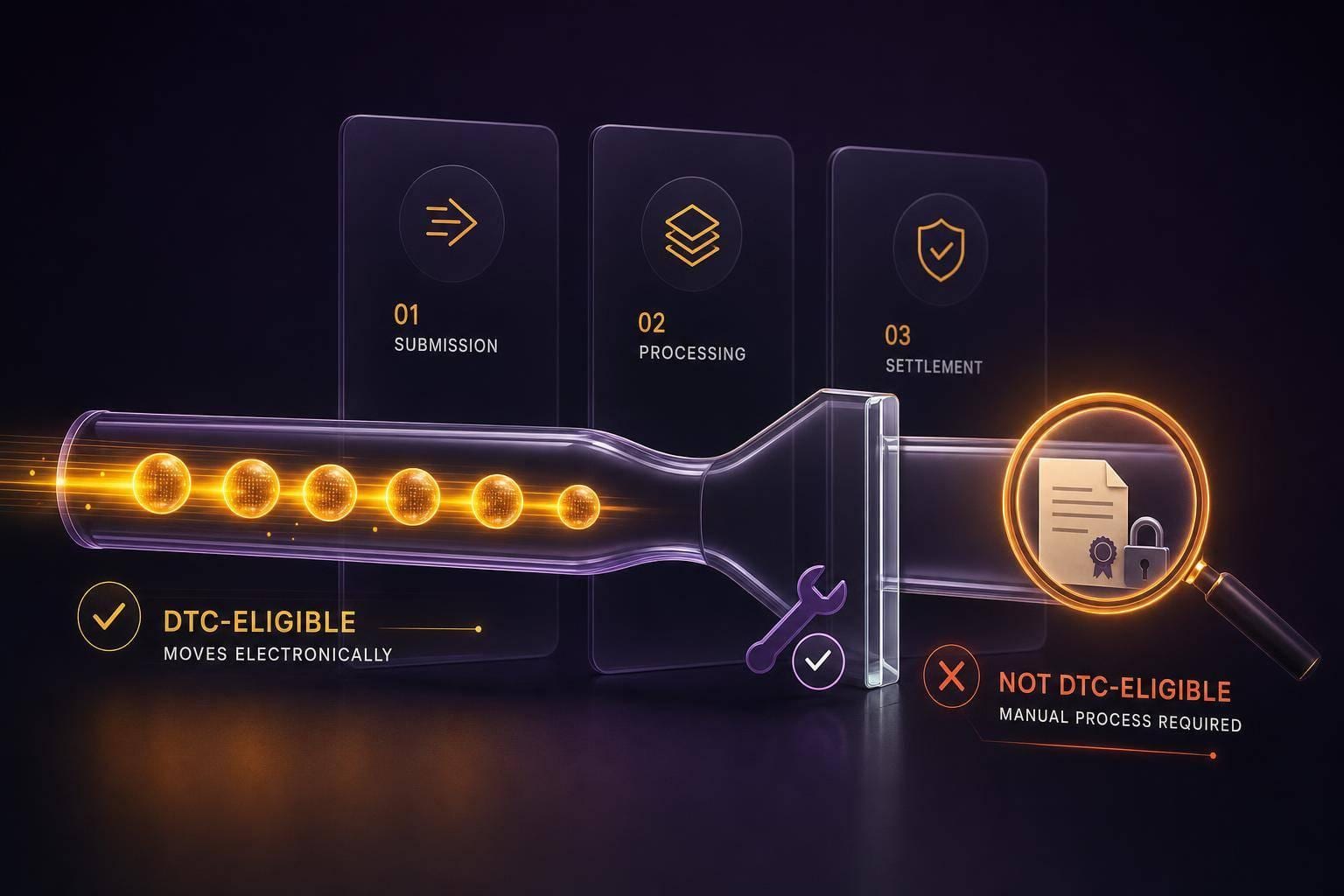
If one holding stays behind during a brokerage transfer, the issue may be the asset’s transfer setup, not the transfer request itself. In many cases, stocks, ETFs, and many bonds may move through ACATS in about 3 to 6 business days, while private placements, annuities, restricted shares, and paper certificates may need manual processing or may not move at all.
Here’s the short version:
DTC-eligible assets may move electronically
Not DTC-eligible assets may need forms, transfer-agent review, or issuer approval
A holding may still stall even if it is eligible, often due to:
unsettled trades
account name mismatches
broker custody limits
transfer restrictions
Some transfers may split, with eligible assets moving first and other positions staying behind
In some cases, the delivering firm may need to forward later-transferable assets for up to 6 months
If I were trying to sort out a stuck transfer, I’d usually separate each position into three groups:
electronic
manual
not accepted / unclear
That may make the next step easier to spot.
Quick comparison
| Asset or issue | May move electronically? | Usual path | Common reason it stalls |
|---|---|---|---|
| Public stocks, ETFs | Usually yes | ACATS | Trade not settled, DTC chill, account mismatch |
| Many bonds | Usually yes | ACATS | Firm may not hold that CUSIP |
| Non-proprietary mutual funds | Often yes | ACATS | Receiving firm may not support the fund |
| Private placements, LP interests | Often no | Manual re-registration | GP consent or issuer records |
| Restricted shares | Often no | Manual transfer | Legends, lockups, resale limits |
| Annuities | No | 1035 exchange or assignment | Carrier paperwork |
| Physical certificates | No | Transfer agent process | Medallion guarantee, paper handling |
So the main question usually isn’t just “What type of asset is this?” It may be “How is it held, and does the receiving firm accept it?”
The Depository Trust Company and DTC Eligibility Requirements
What DTC eligibility means
A DTC-eligible security is one that may be held and moved electronically through DTC's book-entry system. Ownership is recorded electronically, which may make brokerage transfers faster and less error-prone. Securities that aren't DTC-eligible may need manual transfer steps, or they may not move electronically at all. That setup, not the asset's label, determines whether it may move through ACATS.
It’s worth noting that DTC eligibility is an operational and custody status, not a measure of investment quality. A position may still matter a great deal financially and yet remain ineligible if it isn’t set up for electronic settlement. When a transfer stalls, DTC eligibility may help show whether the issue is electronic routing or a manual exception.
Why book-entry status matters more than the asset label
Calling something a "stock" or a "bond" doesn’t guarantee that it may transfer electronically. What matters more is how the security was issued, registered, and serviced, and whether it exists in a form that DTC and its participants may process electronically.
A security generally needs to be transferable in DTC's book-entry system and held in Cede & Co.'s nominee name. If either condition isn’t met - for example, if shares carry resale restrictions or the issuer hasn’t set up the right transfer-agent workflow - the asset falls outside DTC's book-entry system, no matter what label it carries.
| Aspect | DTC-Eligible | Not DTC-Eligible |
|---|---|---|
| Form of holding | Book-entry at DTC or through a participating transfer agent; freely tradable in interchangeable book-entry form | Physical certificates or records outside DTCC's main systems; often restricted or customer-registered |
| Typical transfer path | Electronic, faster, less error-prone | Manual review, paper steps, or limited portability |
Where FAST and DWAC fit in
FAST keeps eligible shares in electronic form at a participating transfer agent. DWAC lets those shares move electronically between that transfer agent and DTC. If a security isn’t supported by these two transfer-agent workflows, the position may still exist, but it may need a manual transfer. The next section shows which common holdings usually have that path and which ones do not.
DTC-eligible vs. not DTC-eligible: which assets fall on each side
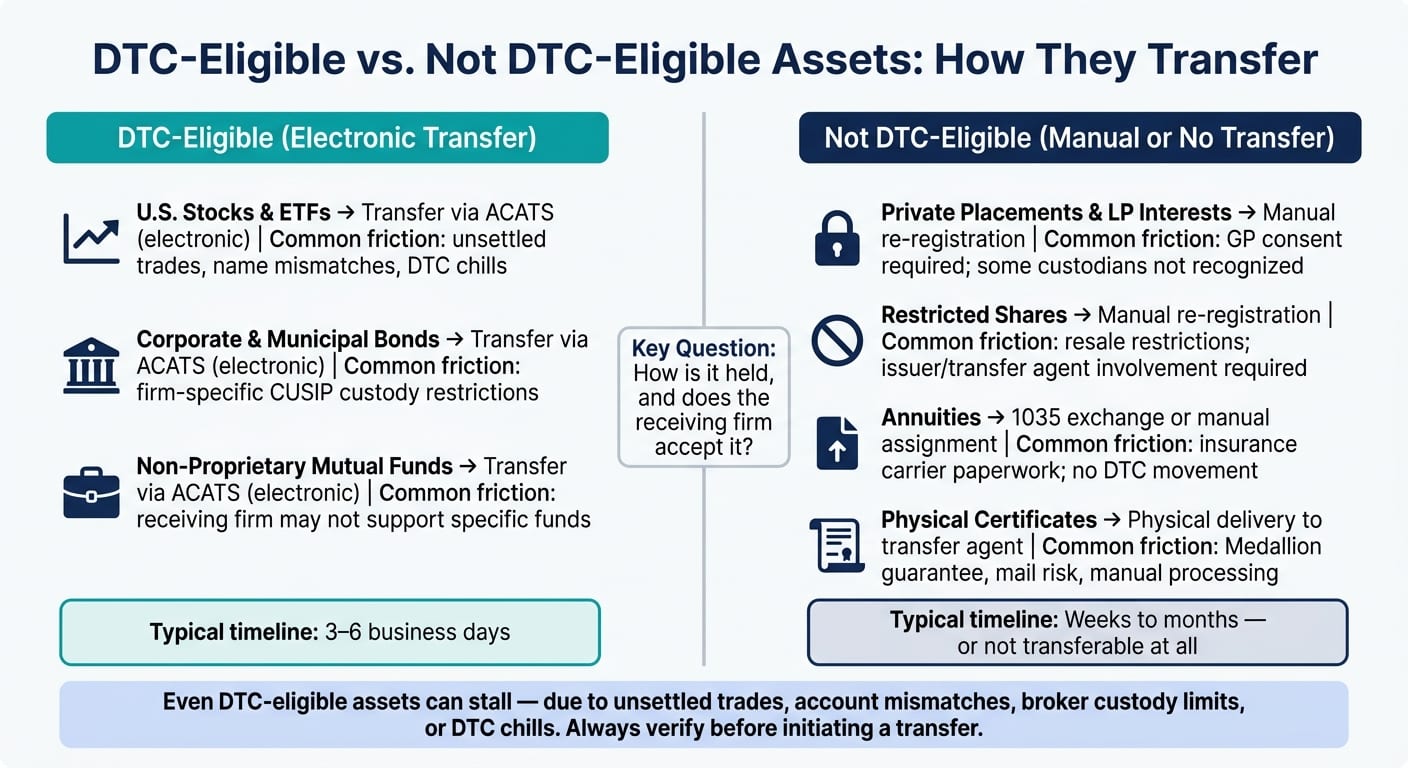
Some holdings usually move with an electronic transfer. Others may not. That split often shapes the timeline, the paperwork, and who needs to step in.
Assets that usually move electronically
Most publicly traded U.S. common and preferred stocks, ETFs, corporate bonds, municipal bonds, U.S. Treasury and agency securities, and many money market instruments are DTC-eligible. If the account details match, these positions usually transfer within a few business days.
That said, DTC eligibility does not always mean the transfer goes through. DTC chills, unsettled trades, or a brokerage's product limits may still block it. When a transfer stalls, the issue may be tied to the account setup or the brokerage rather than the asset class itself.
Assets that often cannot move electronically
Private placements, limited partnership interests, non-traded REITs, restricted shares, and similar alternatives are often not DTC-eligible at the instrument level. In those cases, ownership may be tracked on issuer registers, fund ledgers, or transfer agent systems outside DTC's book-entry system. So the move usually involves assignment forms, general partner consent, and manual re-registration with the issuer or transfer agent instead of an ACATS request.
That process may take weeks or even months. And sometimes the problem gets even narrower: some general partners may only recognize certain custodians, which may make a transfer effectively impossible.
Annuities sit in a different bucket. They are insurance contracts, so they do not transfer through DTC. A move usually goes through the insurance carrier by way of a 1035 exchange or contract assignment, with timing tied to paperwork and carrier processing. Physical stock or bond certificates also fall outside the electronic path. Those usually require a Medallion signature guarantee and transfer agent processing.
The table below shows the most common examples:
| Asset Type | Typical DTC Status | Usual Transfer Method | Common Source of Friction |
|---|---|---|---|
| U.S. stocks & ETFs | Eligible | ACATS (electronic) | Unsettled trades, name mismatches, DTC chills on micro-caps |
| Corporate & municipal bonds | Eligible | ACATS (electronic) | Firm-specific custody restrictions on certain CUSIPs |
| Mutual funds (non-proprietary) | Usually eligible | ACATS (electronic) | Receiving firm may not support specific funds |
| Private placements & LP interests | Not eligible at the instrument level | Manual re-registration | General partner consent required; some custodians not recognized |
| Restricted shares | Not eligible at the instrument level | Manual re-registration | Resale restrictions; issuer or transfer agent involvement required |
| Annuities | Not eligible | 1035 exchange / manual | Insurance carrier paperwork; no DTC movement |
| Physical certificates | Not eligible | Physical delivery to transfer agent | Medallion guarantee, mail risk, manual processing |
A security may be DTC-eligible and still stall because of a trade, registration, or firm-policy issue. More specifically, it may be DTC-eligible but still blocked by the receiving firm. That distinction may tell you whether the next step is electronic, manual, or not available at all. It also points to who may need to handle the issue: the brokerage, the issuer, or the transfer agent.
Why a transfer gets delayed or blocked
Once you know which assets may move electronically, the next step may be figuring out what stops the ones that do not. Most transfer delays may trace back to one of five issues: the asset may not be DTC-eligible, the position may be held in certificate form, the issuer may restrict transfer, paperwork may be incomplete, or the receiving broker may not custody it. That difference may shape whether the transfer gets delayed, split, or stopped entirely.
ACATS usually moves eligible assets first, so a transfer may split. Holdings that qualify may leave first, while restricted or unsupported positions may stay behind. Under SEC guidance, the delivering firm must forward later-transferable assets for up to six months after the main transfer.[5]
Manual transfer vs. nontransferable: what the difference means
Not every blocked position is stuck for the same reason. That distinction matters.
A manually transferable position may still move, just not through ACATS. It usually calls for transfer forms and back-and-forth between the delivering broker, the receiving broker, and the transfer agent. The process may take longer, but the position may still reach the receiving account.
A nontransferable position may not move right now; it stays where it is until it is sold, matures, is distributed, or is exchanged.[1][3][4][6] Spotting that difference early may save time: manual transfer means slow but still possible, while nontransferable means nothing may move unless the situation changes.
What to check before escalating a stalled transfer
Before contacting either firm, it may help to verify the details that often cause a blockage. These five items are usually worth checking first.
Verify the CUSIP. If the security lacks a valid CUSIP, or if the identifier does not match across both brokers' systems, the transfer instruction may not have a matchable identifier.
Confirm how the position is held. Check whether it is held in street name or as a physical certificate registered in your name. Certificate holdings almost always need separate handling.
Check FAST or DWAC support. Ask whether the issuer or transfer agent supports FAST or DWAC. If not, electronic movement may be off the table no matter how the position appears on a statement.
Look for restrictions. Confirm whether the shares carry lock-up agreements, restricted stock legends, or private placement terms that may block movement until the restriction expires or the issuer gives consent.
Confirm broker acceptance. Verify that the receiving broker accepts that asset type. Firms that do not custody certain alternatives may mark them nontransferable before processing.
It may also help to save statements, screenshots, and offering documents before reaching out, so operations teams may have a simpler time identifying the block.
What to do next and how Mezzi can help you spot transfer complexity

Start by pulling a position list from each account: ticker, CUSIP, share count, and security type. Then sort each holding into three buckets:
electronic
manual
needs confirmation
That simple map may show which holdings may move electronically and which ones may need a separate process.
For manual or unclear positions, contact both firms before filing any transfer request. Ask whether the receiving firm may take the asset electronically, manually, or not at all. Getting those answers in writing before the paperwork starts may help you tell the difference between a slow process and a true dead end. If the answer is manual, gather issuer paperwork before you begin.
Pull together subscription agreements, offering documents, LP agreements, and transfer-agent contact details. Transfer agents often require medallion signature guarantees or issuer consent before re-registering an interest, so having those documents ready may help the receiving firm review whether it may custody the asset and what manual process may be required. [2]
A simple triage process for households with multiple accounts
If your household has accounts at more than one firm, the same triage process may help you spot bottlenecks before you file anything. One hard-to-move position inside a single IRA may quietly delay an otherwise clean consolidation.
Mezzi's read-only account view lets you see brokerage, retirement, and other investment accounts in one place - without making changes. That may make it easier to spot where private funds, LP units, or certificates are sitting before you initiate a transfer request.
Because Mezzi uses read-only connections, it serves as a planning and monitoring tool rather than a transaction platform. Some households may use it to map which accounts contain straightforward, electronic-only holdings and which ones carry positions that may need separate timelines or may not move at all. From there, some people may choose to move clean accounts first and handle complex positions on a separate track.
FAQs
How can I tell if a holding is DTC-eligible?
Confirm it with your custodian. Most publicly traded stocks, ETFs, and standard corporate bonds are typically DTC-eligible, so they may transfer electronically.
Other holdings may be a different story. Private placements, limited partnership interests, some alternative investments, and physical certificates often aren't DTC-eligible. When that happens, the transfer may need manual processing or the asset may need to be liquidated first.
Mezzi may help you track these holdings across accounts.
Can a DTC-eligible asset still be rejected in a transfer?
Yes. A DTC-eligible asset may still be rejected during a transfer if there are admin errors or mismatches between brokerages.
Common issues may include incorrect details on the Transfer Instruction Form, such as your name, Social Security number, or account type. Incomplete paperwork or missing signatures may also lead to a rejection.
The transfer request may go through more smoothly if it matches your current account records exactly. That may help reduce avoidable rejections.
What should I do if part of my account transfers but some positions stay behind?
If some positions stay at your old brokerage, those assets may not be eligible for an electronic transfer. Common examples include proprietary mutual funds, fractional shares, and alternative investments such as private placements.
It may make sense to confirm with your new custodian why those positions were left out. From there, there may be two main paths: liquidate the holdings and transfer the cash, or leave them in the original account.
If you keep them where they are, you may still manually add those holdings to your Mezzi dashboard.
Disclosures:
This content is for informational purposes only and does not constitute investment advice or a recommendation to buy or sell any security.
Past performance is not indicative of future results. No guarantee of future performance or outcomes is implied.