
A dynasty trust may let family wealth move across children, grandchildren, and later descendants without repeated transfer tax at each generation. But the catch is simple: state law may change almost everything.
If I had to boil the full article down, I’d say this:
- A dynasty trust is an irrevocable trust built for long-term family wealth transfer.
- The 2026 federal GST exemption is $15,000,000 per person and $30,000,000 for a married couple, and a proper allocation may let future trust growth pass without repeated GST tax.
- The main tradeoff is estate-tax savings vs. lost step-up in basis, which may leave more capital gains tax later.
- The trust’s situs - its legal home - may shape:
how long the trust may last,
- whether trust income may face state income tax,
- how much creditor protection may apply,
- and how much room trustees may have to change terms later through tools like decanting, directed trusts, and trust protectors.
- A few states tend to draw the most attention: South Dakota, Nevada, Delaware, and Alaska.
- Some states allow perpetual or very long trusts, while many still limit trusts to about 90 years.
- Setup and annual costs may be high, so these trusts may fit families with large, long-term assets more than smaller estates.
Dynasty Trusts Explained - Protect Family Wealth for Generations
Quick comparison
Here’s the short version: if a family is looking at a dynasty trust, the trust document alone may not tell the full story. State duration rules, tax treatment, privacy, and asset-protection law may shape the result just as much as the drafting. That’s why situs selection tends to sit near the center of the planning discussion.
Dynasty Trust Basics: Structure, Tax Logic, and Duration Rules
A dynasty trust is an irrevocable long-term trust set up to hold and protect assets across multiple generations, including children, grandchildren, and later descendants. Once it’s funded, the grantor usually may not take the assets back, which may remove them from the taxable estate. At a basic level, the structure has four roles.
- The grantor funds the trust, often using lifetime gift and GST tax exemptions.
- The trustee handles investments and administration, sometimes through a corporate trust company in a trust-friendly state.
- The beneficiaries receive distributions under the trust’s terms.
- Some trusts also name a trust protector with limited powers, such as changing situs, replacing trustees, or making narrow adjustments.
Distributions are often discretionary. That may give trustees room to direct income to beneficiaries in lower tax brackets or cover specific needs, while the assets remain inside the trust and protected. But that setup may only work as intended if the tax rules and the duration limits fit the state where the trust sits.
How a Dynasty Trust Preserves Wealth Across Generations
Because the trust owns the assets, those assets may pass to later generations without being included in a beneficiary’s estate. Spendthrift provisions add another layer of protection. They may make it harder for a beneficiary’s creditors, a divorcing spouse, or the beneficiary’s own money mistakes to reach trust assets. In practice, that structure may avoid repeated estate tax at each generational transfer.
GST Tax, Estate Tax, and the Basis Tradeoff
When a grantor funds the trust and properly allocates the GST exemption on Form 709, the trust may achieve a zero inclusion ratio. That means distributions to grandchildren and later descendants may remain exempt from the 40% GST tax, even if the trust grows over time. Without that allocation, transfers to grandchildren and later descendants may face a combined effective tax rate of up to 58%.
The catch is basis. Assets held in a dynasty trust do not get a step-up in cost basis at a beneficiary’s death because they are not included in that beneficiary’s taxable estate. So families may end up weighing possible estate tax savings against later capital gains tax exposure of up to 23.8% on appreciated assets.
One workaround some families use is a swap power. This may let the grantor exchange low-basis trust assets for high-basis personal assets before death, which may partly offset the lost step-up. State law may shape how these rules play out, which is why situs gets so much attention.
Rules Against Perpetuities and Why Some States Allow Long-Term Trusts
The rule against perpetuities (RAP) is a common-law rule that has usually capped trust duration at about 90 years. Many states still use that framework, including California, New York, and Illinois. Other states have removed it or stretched it out to attract trust business and administration fees.
Duration limits vary a lot by state.
The trust’s situs determines which duration rules apply. The next section compares how those rules differ across all 50 states.
The 50-State Framework: Duration, Taxes, Asset Protection, and Flexibility
Four factors tend to shape dynasty trust situs decisions: duration, income tax, creditor protection, and flexibility. Taken together, these variables may do a lot to shape how a dynasty trust functions over time.
Trust Duration by State Category
Once duration rules are clear, the next issue may be which states also reduce tax and administrative friction.
Some states treat real estate differently from personal property. In Delaware, directly held real estate is capped at 110 years, while personal property may last indefinitely. In states such as Delaware, Virginia, and Wyoming, families often hold real estate through an LLC or partnership inside the trust so the asset is treated as personal property for duration purposes.
Duration may matter a lot, but tax treatment often ends up being the deciding factor when people weigh whether a situs is worth using.
State Income Tax and Beneficiary Tax Exposure
Trust-friendly laws do not remove state income tax by themselves. Trust income tax may depend on trustee location, administration, income source, and beneficiary residency. Alaska, Nevada, South Dakota, Wyoming, and Tennessee impose no state income tax on trust income. Delaware exempts trust income when beneficiaries are not Delaware residents.
Once tax exposure is mapped, the next issue may be how much control and creditor protection a state allows.
Asset Protection, DAPTs, Decanting, and Directed Trusts
Top jurisdictions also offer DAPTs, which may shield self-settled trusts from future creditors. DAPTs may allow a grantor to remain a discretionary beneficiary while assets are shielded from future creditors. In Nevada, the look-back period is two years.
Only a subset of states permits that structure, including:
- Alaska
- Delaware
- Nevada
- New Hampshire
- Ohio
- South Dakota
- Wyoming
South Dakota stands out on privacy because it offers automatic sealing of trust-related court records.
Decanting lets a trustee move assets into a new trust with updated terms. Directed trusts split investment, distribution, and administration roles. These tools are not just add-ons. Over long stretches of time, they may be part of what keeps a trust usable across changing family, tax, and legal conditions.
These four factors drive the state-by-state comparison that follows. Those differences may separate the top jurisdictions from the rest.
Comparing All 50 States: Top Jurisdictions, Common Tradeoffs, and Situs Selection
South Dakota, Nevada, Delaware, and Alaska: Why They Lead
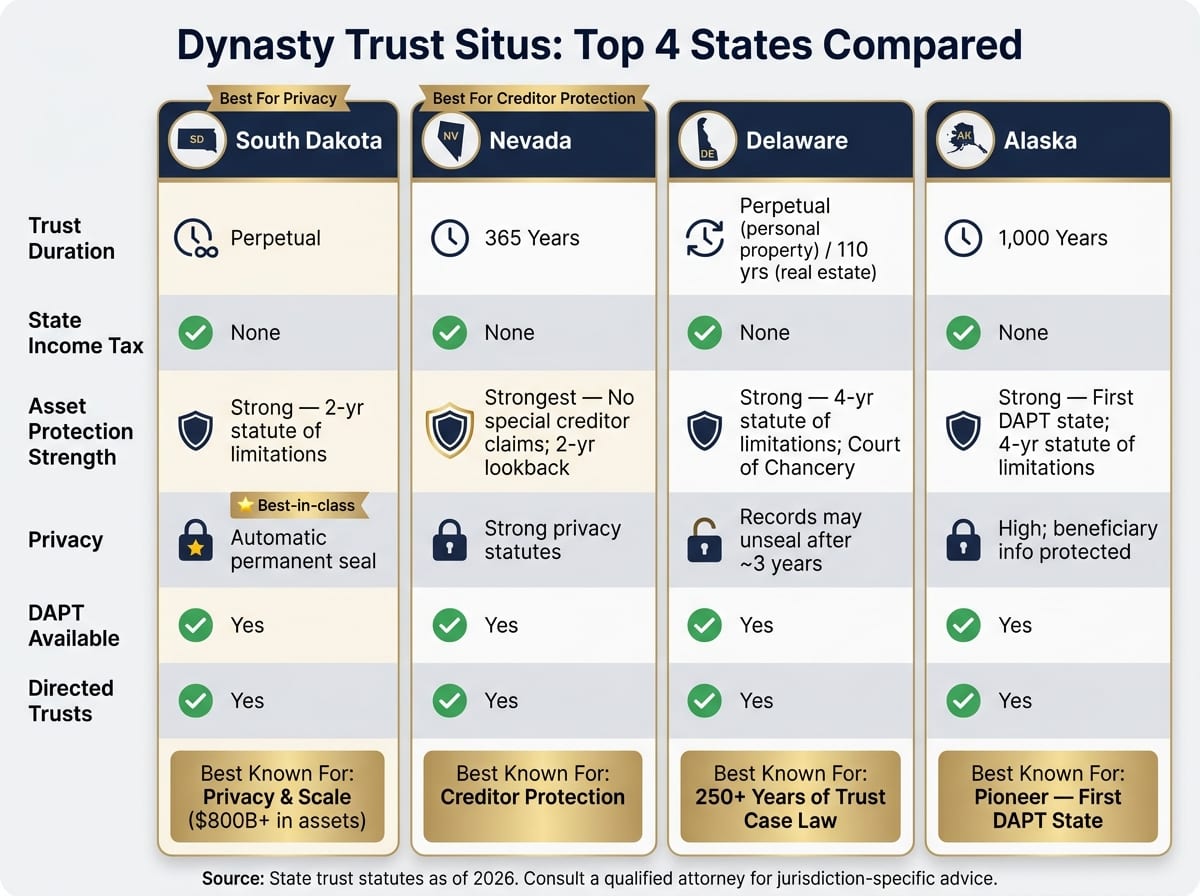
These four states tend to come up again and again for one reason: they combine long or perpetual trust duration, no state income tax, strong asset-protection rules, and modern trust administration options. For many families, the choice may come down to a simple tradeoff: privacy, creditor protection, tax treatment, or day-to-day control.
South Dakota often stands out for privacy and scale. Trust records are automatically and permanently sealed, and the state had more than $800 billion in trust assets by 2026. Nevada is often viewed as the strongest on creditor protection. It recognizes no creditors with special claims, so even child support and alimony may typically not reach assets in a properly structured spendthrift trust. Delaware is known for its Court of Chancery and more than 250 years of trust case law. Alaska holds a different kind of first-place status: it was the first state to allow Domestic Asset Protection Trusts.
The table below lays out the main tradeoffs among these four states.
How the Other 46 States Compare
Most of the other states may fit into three practical groups.
One wrinkle tends to matter more than people expect: real estate. If a trust holds real property outright, some states may shorten the allowed duration for that asset. In Delaware, Wyoming, and Virginia, for example, some families hold real estate through an LLC owned by the trust so the asset may fall under the longer personal-property term.
State income tax may also shape the result over time. Alaska, South Dakota, Nevada, and Wyoming impose no state income tax on trust income, and Delaware may also avoid state tax for non-resident beneficiaries. For families thinking in decades, that tax drag may matter just as much as the trust term on paper.
On the asset-protection side, DAPT statutes are available in Alaska, Delaware, Nevada, New Hampshire, Ohio, South Dakota, and Wyoming. Tennessee and Ohio have also updated their statutes with directed trust and decanting rules. So while trust duration gets a lot of attention, administration rules and situs law may end up doing just as much work.
How to Choose a Trust Situs Without Overlooking Residency and Administration Rules
After the state is picked, the small-print details start to matter. Many top trust states do not require the grantor or the beneficiaries to live there. But they usually do require real in-state administration, often through a resident corporate trustee plus local records and accounts.
For non-grantor trusts, state income tax exposure may depend on where the trustee lives, where the beneficiaries live, or where the trust is administered. Directed trust structures may let families keep an outside investment advisor while using a local corporate trustee for administration. A trust protector may add more room to adjust things later by allowing changes to situs or trustees without returning to court.
Privacy rules also vary more than the marketing language sometimes suggests. South Dakota remains unusual because its trust records are automatically and permanently sealed. In other states, privacy may depend on a judge's choice or on a later unsealing period. Delaware, for instance, has a window of about three years.
Existing trusts may sometimes be moved through decanting or by changing trustees, though consent or court approval may be required in some cases.
Funding Strategy, Ongoing Oversight, and Key Takeaways
Which Assets to Contribute and Which to Keep Outside
The usual fit for a dynasty trust may be assets with long time horizons and room to grow over time, such as private business interests, concentrated stock, and real estate.
The big tradeoff may center on basis, not just transfer tax. Assets inside a dynasty trust usually may not receive a step-up in basis at a beneficiary's death. So if those holdings have large unrealized gains, future capital gains tax may be higher. One way some families address that issue is with a swap power, which may let the grantor exchange low-basis trust assets for high-basis personal assets.
Liquidity also matters. Cash, bonds, and assets that may be needed in the near term are often kept outside the trust. That approach may leave more flexibility for spending, taxes, and other short-term needs.
When a Dynasty Trust Makes Sense - and When It Does Not
Once the funding mix is set, the next issue is simpler: does the structure justify the cost?
A dynasty trust may make sense when long-term transfer-tax savings and creditor protection are enough to offset setup and upkeep. Setup costs often run $20,000 to $75,000, with annual administration costs of $10,000 to $50,000 and corporate trustee fees of 1% to 2% of assets. For smaller estates, those costs may not pencil out.
Creditor protection may also shape the decision. Families focused on that goal may find the structure more appealing, especially in DAPT states like Nevada or South Dakota, where the statute of limitations for creditor challenges may be as short as two years.
A read-only portfolio view may help spot concentrated, fast-growing holdings before funding. After assets are transferred, periodic reviews may help track concentration, liquidity, and any changes tied to beneficiaries.
FAQs
How do I choose the best state for a dynasty trust?
Choose the state whose trust laws may best match your family’s goals for wealth preservation, taxes, and privacy. You do not have to live in the state where the trust is established.
A side-by-side review often looks at:
- Trust duration
- Asset protection
- State income tax on undistributed income
- Privacy and flexibility
- Court system and trust administration rules
This may be a key planning decision, and many families coordinate it with specialized legal counsel.
Which assets should go into a dynasty trust?
A dynasty trust may hold assets like stocks, mutual funds, and real estate. Since the main goals usually center on long-term wealth preservation and tax efficiency, assets with higher growth potential may be a better fit in some cases. The reason is fairly simple: future appreciation may sit outside your taxable estate.
It may also make sense to focus on assets that may gain from the trust’s shield against creditors and divorce settlements. With real estate, there’s one extra wrinkle. Some states, including Delaware, may apply different duration rules to real property than they apply to personal property.
When does a dynasty trust make sense for my family?
A dynasty trust may make sense if your main goal is to preserve wealth across multiple generations while reducing federal estate and GST taxes. It may be especially useful if your estate meets or nears the federal exemption threshold.
It may also fit if you want long-term asset protection for descendants, more control over how heirs access wealth, and a way to avoid repeated taxation. Because the trust is irrevocable, it may be best used for assets you’re confident you won’t need later.
Disclosures:
• This content is for informational purposes only and does not constitute investment advice or a recommendation to buy or sell any security.
• Past performance is not indicative of future results. No guarantee of future performance or outcomes is implied.
Related Blog Posts
- Any suggestions to minimize Massachusetts estate taxes given my current asset mix and titling?
- Generation-skipping trust: how it works and who should consider it
- Spousal Lifetime Access Trusts (SLATs): Gift and Estate Tax Benefits
- Intentionally Defective Grantor Trusts (IDGTs): Advanced Estate Planning
Choose the state whose trust laws may best match your family’s goals for wealth preservation, taxes, and privacy. You do not have to live in the state where the trust is established.
A side-by-side review often looks at:
- Trust duration
- Asset protection
- State income tax on undistributed income
- Privacy and flexibility
- Court system and trust administration rules
This may be a key planning decision, and many families coordinate it with specialized legal counsel.
A dynasty trust may hold assets like stocks, mutual funds, and real estate. Since the main goals usually center on long-term wealth preservation and tax efficiency, assets with higher growth potential may be a better fit in some cases. The reason is fairly simple: future appreciation may sit outside your taxable estate.
It may also make sense to focus on assets that may gain from the trust’s shield against creditors and divorce settlements. With real estate, there’s one extra wrinkle. Some states, including Delaware, may apply different duration rules to real property than they apply to personal property.
A dynasty trust may make sense if your main goal is to preserve wealth across multiple generations while reducing federal estate and GST taxes. It may be especially useful if your estate meets or nears the federal exemption threshold.
It may also fit if you want long-term asset protection for descendants, more control over how heirs access wealth, and a way to avoid repeated taxation. Because the trust is irrevocable, it may be best used for assets you’re confident you won’t need later.