
Selling everything in one year may trigger a large tax bill. A phased exit may let you spread gains across tax years, stay invested, and cut down on single-stock clutter without doing a full liquidation at once.
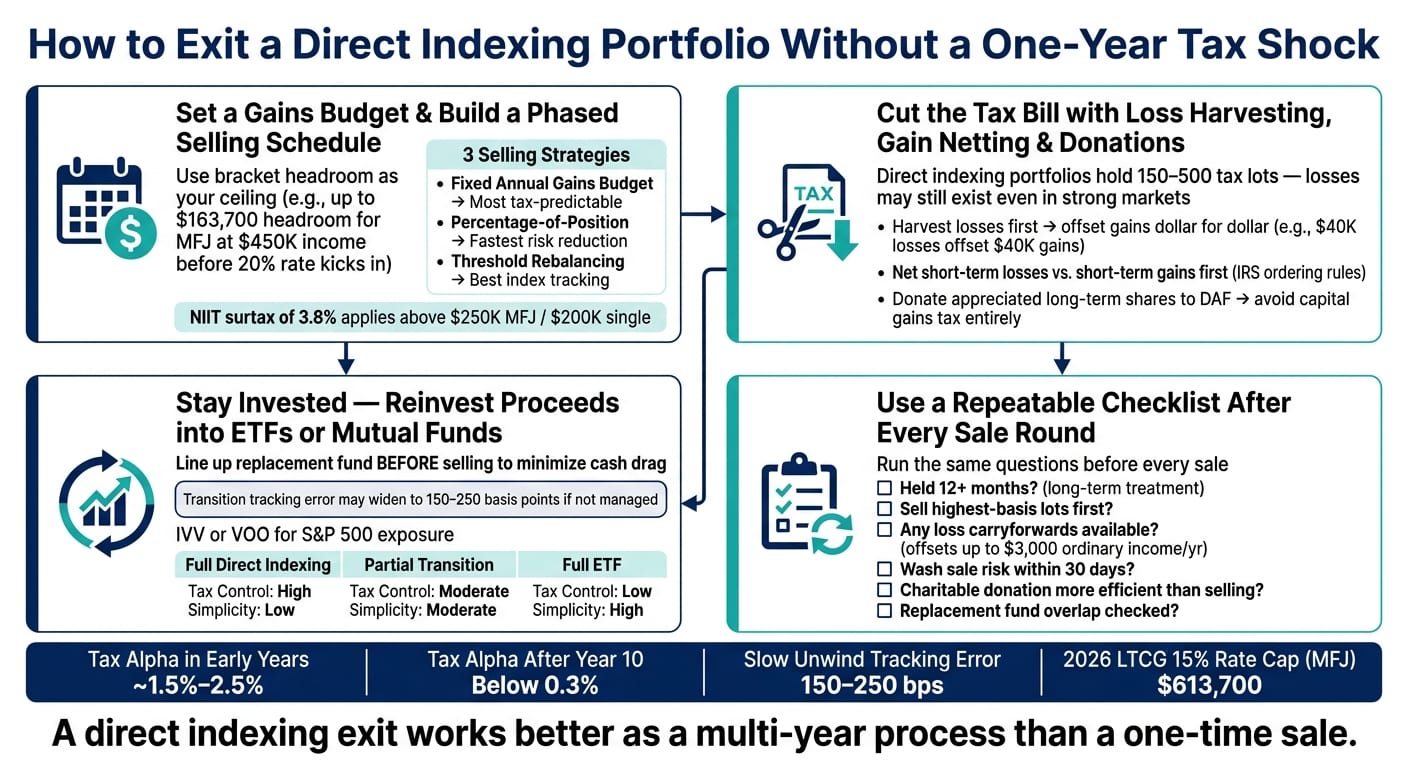
Here’s the short version:
I’d frame the exit around three limits: tax, tracking drift, and timing
Many investors start with a yearly gains budget based on tax-bracket room
High-basis lots and long-term shares may reduce the tax hit on each sale
Loss harvesting, gain netting, and donating appreciated shares may lower taxable gains
Moving proceeds into broad ETFs or mutual funds soon after selling may reduce cash drag
A simple repeatable checklist may keep the process organized from one sale round to the next
A few numbers from the article stand out:
For illustration, early direct indexing tax alpha may run around 1.5% to 2.5% in the first few years
After year 10, that edge may fall below 0.3%
A slow unwind may push tracking error toward 150 to 250 basis points
For 2026, the 15% long-term capital gains rate may apply up to $613,700 for MFJ and $545,500 for single filers
The 3.8% NIIT may apply above $250,000 MFJ or $200,000 single
What this adds up to: if I wanted to simplify a direct indexing portfolio, I may not focus on whether to exit first. I may focus on how much gain to realize each year, which lots to sell, and how to stay invested during the switch.
Unwinding a concentrated stock position with Direct Indexing
Quick comparison
| Part of the exit | What it focuses on | What some investors may do |
|---|---|---|
| Gains planning | Keeping yearly gains within a target range | Use bracket headroom and NIIT thresholds |
| Lot selection | Lowering tax per sale | Sell highest-basis and long-term lots first |
| Gain offsetting | Trimming the tax bill | Harvest losses, net gains, donate appreciated shares |
| Reinvestment | Limiting drift and cash drag | Move proceeds into index ETFs or mutual funds |
| Review process | Keeping the plan consistent | Recheck carryforwards, wash sales, and allocation after each round |
If I had to sum up the article in one line, it would be this: a direct indexing exit may work better as a multi-year process than as a one-time sale.
Step 1: Set a gains budget and build a phased selling schedule
With your tax and timing limits in place, the next step is to decide how much gain you may realize this year. A gains budget means the maximum taxable gain you plan to realize in a single year. Setting that number before you sell may help put a ceiling on this year's realized gain.
A common starting point is bracket headroom: the gap between your taxable income and the next capital-gains or surtax threshold. For 2026, the 15% long-term capital gains rate applies up to $545,500 for single filers and $613,700 for married filing jointly (MFJ). If your estimated taxable income is $450,000 MFJ, you may have about $163,700 of headroom before the 20% rate applies [1].
It also may make sense to watch the Net Investment Income Tax (NIIT). This is a 3.8% surtax that applies once modified adjusted gross income (MAGI) goes above $200,000 for single filers or $250,000 for MFJ. So gains above those levels may face an extra 3.8% tax [1]. That ceiling may give you a rough way to spread sales across tax years instead of doing everything at once.
Choose a selling method that fits your tax and risk limits
Your gains budget may also shape how fast you unwind the position. Three common approaches come up often:
| Strategy | How It Works | Tax Impact | Tracking Error Impact |
|---|---|---|---|
| Fixed Annual Gains Budget | Realize a specific dollar amount of gains each year (for example, $50,000) | More predictable; may keep you in your target bracket | Low to moderate; depends on which lots are sold |
| Percentage-of-Position | Sell a fixed % (for example, 20%) of the concentrated position each year | May trigger larger tax bills if the stock price jumps | Higher reduction in single-stock risk |
| Threshold Rebalancing | Sell only when a position goes above a set % of the portfolio (for example, 5% deviation) | Taxes are triggered only by market moves | Lower; may keep the portfolio closer to target |
The choice often comes down to your main limit:
If tax rate matters most, a fixed annual gains budget may feel easier to manage.
If concentration risk feels like the bigger issue, a percentage-of-position plan may reduce single-stock exposure faster.
If staying close to an index matters more, threshold rebalancing may be a better fit.
Sell highest-basis lots first and wait for long-term treatment when possible
No matter which method you use, specific-lot sales may give you more control. In plain English, that means choosing the shares with the highest cost basis first, which may trim the taxable gain on each sale.
Holding period matters too. Shares held for one year or less produce short-term gains, and those gains are taxed at ordinary income rates. Those rates may be much higher than long-term capital gains rates [1]. Because of that, waiting until shares qualify for long-term treatment may change the tax result in a meaningful way.
Rank positions by gain size, concentration, and account type
It may help to sort positions using three filters: unrealized gain, portfolio weight, and account type.
Positions with lower unrealized gains are often the easiest place to start because the tax hit may be smaller. But tax cost isn't the whole story. A position with a large portfolio weight may need more attention even if selling it creates a bigger tax bill, since concentration risk may matter just as much.
If two positions look similar, some investors start with the least tax-efficient account first.
Once you have the sale order mapped out, losses and donations may widen the gains budget.
Step 2: Cut the tax bill with loss harvesting, gain netting, and donations
Losses and donations may expand how much you’re able to sell in a given year.
Harvest losses first, then realize gains against that loss cushion
After you set your sale order, look for losses that may widen your gains budget. Direct indexing often holds 150 to 500 tax lots, so even in strong markets, some positions may still be sitting at a loss. Selling those positions first may offset later gains dollar for dollar. The idea is to lower realized gains before you start unwinding other positions.
For example, $40,000 in realized losses can offset $40,000 of gains later in the year.
Apply short-term and long-term gain netting deliberately
The IRS nets losses in a set order: short-term losses offset short-term gains first, then long-term losses offset long-term gains, and only after that do any leftovers carry over between the two buckets.
That order may matter more than people expect. A loss isn’t just a loss on paper. Its tax use may change based on whether it’s short-term or long-term.
Donate appreciated shares instead of selling them
For positions with large embedded gains that you want to keep trimming, donating shares directly to a qualified charity or a donor-advised fund (DAF) may be more tax-efficient than selling them first. Donating long-term appreciated shares may avoid capital gains tax and may preserve the full fair market value deduction. That may let you reduce low-basis positions without triggering a taxable sale.
One small detail may have a big effect: some investors tell their broker to transfer the exact high-appreciation lots, not FIFO shares by default.
Some investors then move the proceeds into replacement funds soon after, with the goal of limiting cash drag.
Step 3: Stay invested while moving into ETFs or mutual funds
Once you sell, the next step may be to put that money back to work without leaving it in cash for too long or adding new drift. Selling is only half the process. The bigger issue during a switch may be cash drag and benchmark drift while the portfolio moves from one setup to another.
Reinvest sale proceeds quickly to avoid cash drag
It may help to line up the replacement ETF or mutual fund before selling, so sale proceeds may be reinvested right away.
For example, if you're unwinding S&P 500 direct indexing positions, funds like IVV (iShares Core S&P 500 ETF) or VOO (Vanguard S&P 500 ETF) may be broad, liquid options for restoring large-cap exposure.
Manage tracking error during the transition
Speed may matter, but the match between what you sell and what you buy may matter too.
During the transition, tracking error may widen if exposure is sold faster than it is replaced. One way some investors handle that is by using similar ETFs or mutual funds that keep roughly the same sector exposure. The fewer mismatches there are between the positions sold and the replacement fund, the cleaner the shift may be.
| Feature | Full Direct Indexing | Partial Transition | Full ETF/Mutual Fund |
|---|---|---|---|
| Tracking Error | Low (vs. benchmark) | Moderate (potential drift) | Low (vs. benchmark) |
| Tax Control | High (lot-level) | Moderate | Low (fund-level) |
| Number of Holdings | High (hundreds of stocks) | Moderate | Low (few funds) |
| Simplicity | Low | Moderate | High |
| Rebalancing Ease | Complex | Moderate | Simple |
Check for overlap before buying replacement funds
The last step may be making sure the new fund actually simplifies the portfolio instead of duplicating it. Before buying a replacement fund, check the remaining holdings for overlap so exposure isn't repeated by accident. Mezzi's X-Ray tool shows duplicate holdings before you trade.
Step 4: Turn the exit plan into a repeatable checklist
Once your replacement funds are in place, use the same checklist for each sale. That way, your moves may stay tied to your gains budget instead of turning into one-off calls.
A position-by-position checklist for deciding what to sell first
Before selling any position, run through the same set of questions:
Holding period: Has it been held for more than 12 months?
Embedded gain or loss: Is there a loss or only a small gain?
Cost basis: Would selling the highest-basis lots first make sense?
Concentration risk: Does this position still take up too much of the portfolio?
Duplicate exposure: Does the replacement fund already hold it?
Account type: Is it in a taxable account?
Charitable suitability: Might donating it make more sense than selling?
Simplification: Would this sale make the portfolio easier to manage?
What to review before year-end and after each round of sales
After each round of sales, pause before the next trade and reset your limits. Check how much of your gains budget has been used, whether you have any loss carryforwards left, whether a wash sale may apply, and whether the replacement funds brought your allocation back to target.
Prior-year capital-loss carryforwards may offset current gains and up to $3,000 of ordinary income each year. Before making a large sale, confirm the carryforward balance.
Also, watch for purchases of the same security in an IRA or Roth IRA within 30 days of a taxable loss sale. If that happens, the loss may be disallowed.
Conclusion: Simplify your portfolio without a one-year tax shock
One approach is to use the same sequence each time: set the gains budget, choose lots deliberately, use losses and donations to offset gains, and reinvest into replacement funds soon after. Then review your progress after each round and again before year-end.
FAQs
How long should a phased exit take?
There’s no single required timeline, but 2 to 5 years may be a common phased-exit approach for people trying to limit tax impact. Spreading sales across multiple years may keep annual capital gains smaller and may make tax-bracket management easier.
When setting your timeline, many investors may give priority to holding investments for more than one year so they may qualify for lower long-term capital gains tax rates. It may also make sense to review the plan on a regular basis so it stays aligned with your risk tolerance, tax thresholds, and market exposure goals.
Should I sell high-gain or concentrated positions first?
Not necessarily. Selling concentrated positions with large unrealized gains first may trigger capital gains taxes, especially if those gains are substantial.
A different approach may be to keep your near-term tax bill as low as possible. If appreciated assets need to be sold, some people consider donating those shares to charity or using harvested tax losses to offset gains.
When reducing exposure, it may also make sense to start with holdings that have been owned for more than a year, since long-term capital gains tax treatment may be more favorable than short-term treatment. Some investors also use new contributions or dividends to move closer to a target allocation instead of selling right away.
What mistakes trigger unexpected taxes during the transition?
Unexpected taxes may come from a few common slipups: wash sales, selling appreciated holdings, or selling positions held for less than a year. In some cases, that shorter holding period may mean gains are taxed at short-term capital gains rates.
Wash sales may be triggered more easily than people expect. The rule may apply to activity across accounts you control, including IRAs, 401(k)s, and your spouse’s accounts.
Other mistakes may show up when assets are moved from a retirement account to a taxable account, since that may create a taxable distribution. And when selling or donating investments, not specifying high-basis lots may also lead to a larger tax bill than intended.
Disclosures:
This content is for informational purposes only and does not constitute investment advice or a recommendation to buy or sell any security.
Past performance is not indicative of future results. No guarantee of future performance or outcomes is implied.
Savings and performance examples are hypothetical and for illustrative purposes only. Actual results will vary based on individual circumstances, portfolio composition, market conditions, and fees.