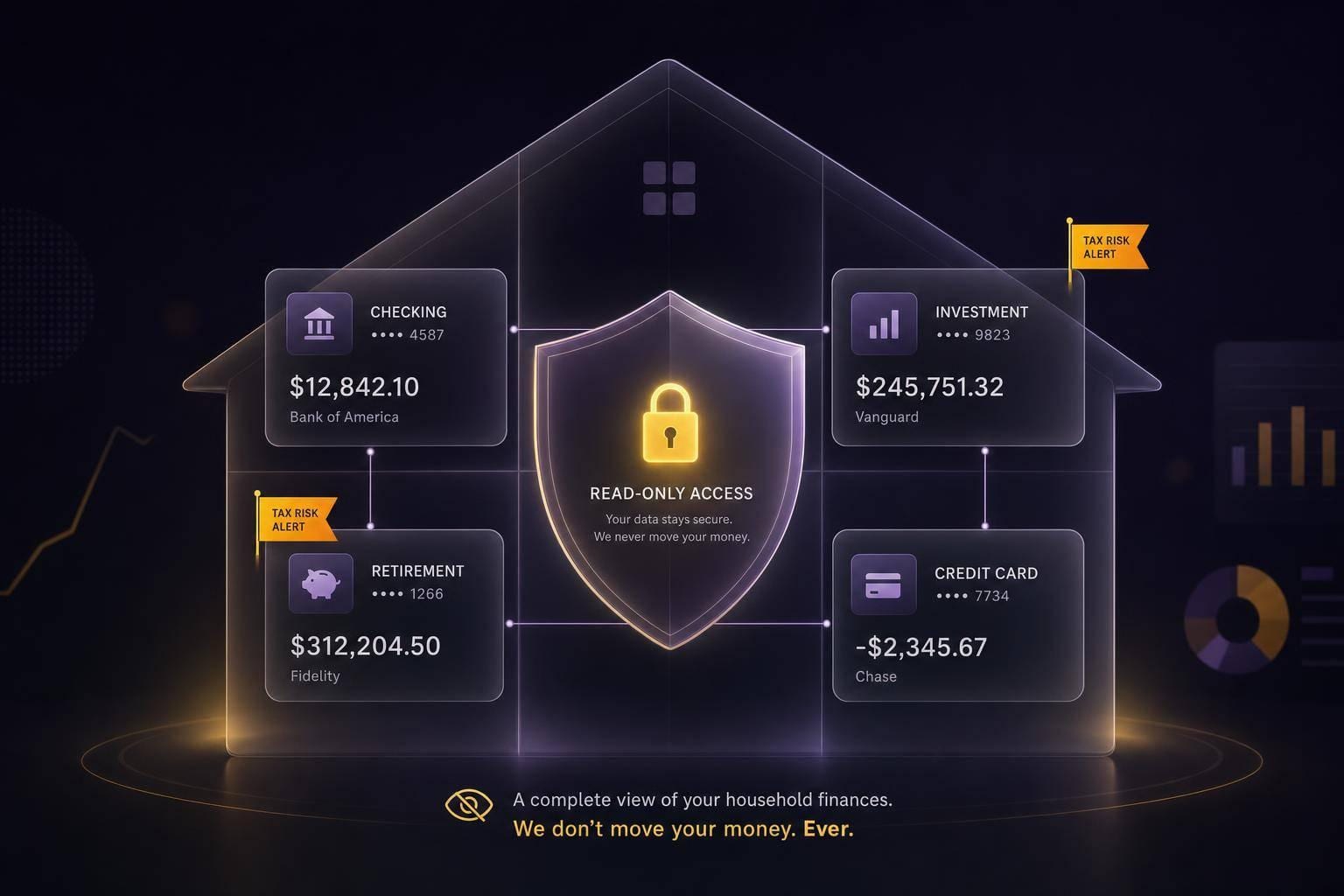
You may get financial input without transferring a single account. The short version: some platforms may read your accounts, but they may not hold your money or place trades. That setup may lower friction, but it only works if the platform sees the right data, updates it often enough, and stays clear about fees, tax limits, and security.
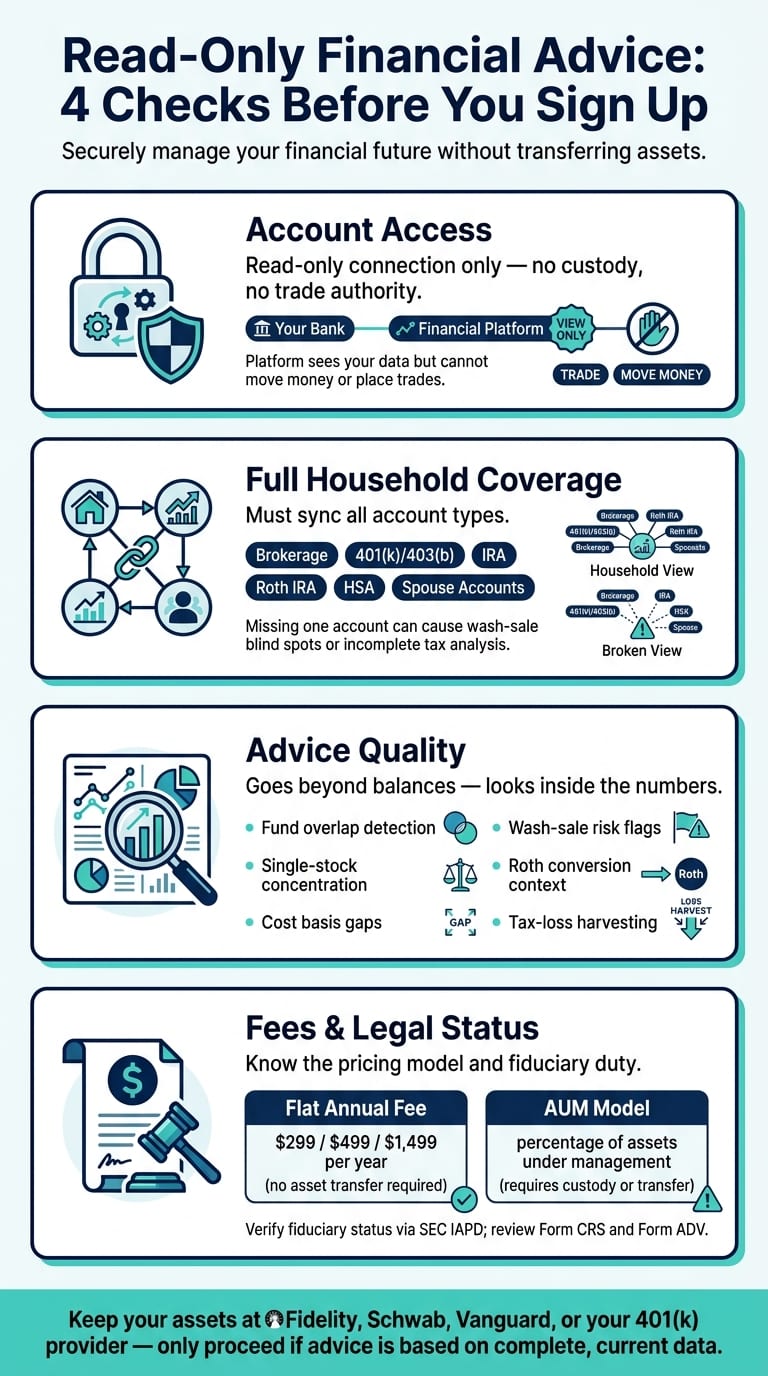
Before I’d sign up, I’d narrow it to four checks:
Access: the service may have read-only access, with no power to trade or withdraw cash
Coverage: it may need to see brokerage, IRA, Roth IRA, 401(k), HSA, cash, and spouse accounts to avoid partial analysis
Advice quality: it may flag things like fund overlap, concentration, cost basis gaps, gains, and wash-sale risk across linked accounts
Terms: pricing, fiduciary status, data storage, and disconnect controls may change the deal more than the dashboard does
Here’s the core idea in plain English:
If a platform only sees balances, the advice may stay shallow
If it misses one account, tax or allocation review may miss part of the picture
If it trades for you, the service may be very different from a read-only tool
If the fee is a flat $299, $499, or $1,499 per year, that may differ a lot from an AUM model
AI Is Giving Financial Advice Now
Quick comparison
| What I’d check | What I’d want to confirm |
|---|---|
| Account access | Read-only only; no custody, no trade authority |
| Data quality | Holdings, transactions, cost basis, contributions, and update timing |
| Household view | Taxable, retirement, HSA, and spouse accounts in one view |
| Tax review | Wash-sale flags, gain tracking, tax-loss review, Roth conversion context |
| Portfolio review | Fund overlap, single-stock concentration, asset-location issues |
| Fees and legal status | Flat annual price, fiduciary status, Form CRS/ADV details |
| Security | Aggregator used, MFA, deletion policy, and link-revoke process |
That’s the filter I’d use: who may see my data, who may touch my money, what the advice may be based on, and what it may cost.
Checklist 1: Account linking, data coverage, and refresh frequency
Once you know the platform leaves your assets where they are, the next step is simpler: compare account aggregators to see if they can actually see enough of your finances to be useful. Read-only access matters, but it’s only part of the picture. You also need to check what the platform can read, how often that data updates, and whether it covers the full household.
That means reviewing every account you want in scope, including brokerage, 401(k), IRA, HSA, and cash.
What data each linked account exposes
Linking an account and fully reading it are not the same thing. A platform may connect successfully and still miss data you’d care about.
Ask two direct questions:
What data does it read? Look for holdings, share counts, cost basis, transactions, and contributions, not just balances. Many brokerage connectors may not expose cost basis. If that happens, the platform may only show performance across a set time window instead of your full lifetime realized profit and loss [1][2].
How fresh is it? Ask how often the data refreshes. Also ask whether the connection relies on a trusted account-linking service and whether your credentials are stored by the platform.
Before signing up, it may help to make a simple list of each account’s owner, purpose, and balance so nothing gets skipped.
Whether the platform covers the full household
Coverage may matter even more when tax rules apply across accounts, not just inside one account. A single-account view may miss tax issues at the household level. For example, a spouse’s reinvestment or a separate retirement account may trigger a wash sale you wouldn’t see in isolation. That may create problems when trades in one account affect taxes in another.
This is where incomplete syncing may create the most risk:
| Account Type | Risk if Not Synced |
|---|---|
| 401(k) / 403(b) | Employer stock or high-fee funds stay hidden |
| Taxable Brokerage | Wash sales slip through |
| Roth / Traditional IRA | Asset location stays suboptimal |
| HSA | Investment capacity goes unused |
| Spouse Accounts | Household wash sales go unnoticed |
A strong platform shows accounts together and separately.
Checklist 2: Tax-aware and portfolio-level advice
Seeing all your accounts in one place may not be enough. The platform also needs to do something useful with that data, while your assets stay at Fidelity, Schwab, Vanguard, or your 401(k) provider. Once it has visibility into your accounts, the next step is simple: ask what the platform actually does with what it sees.
Whether tax guidance works across taxable, IRA, Roth, and 401(k) accounts
Ask whether the platform scans for tax-loss harvesting throughout the year, tracks cost basis and realized gains, and flags wash-sale risk across all linked accounts.
It also helps to ask whether wash-sale risk is flagged before you trade, not after. A trade in one account may create tax effects in another. Some platforms are designed to help you act on those insights without moving assets or giving up control over trading.
You may also want to ask whether it supports Roth conversion timing and asset-location guidance based on your linked accounts, rather than broad rules. Any tax-related guidance may be better treated as planning input and reviewed with a qualified tax professional when needed.
Tax-aware advice may matter most when it changes what you actually hold, not just what you report.
Whether portfolio advice goes beyond allocation percentages
Allocation by itself may not be much advice. The newer source of value may be figuring out what sits inside those percentages. For example, duplicate funds across accounts may add fees without adding much else. Mezzi's X-Ray tool may surface this across ETFs, mutual funds, and individual holdings.
Beyond overlap, ask whether the platform spots concentrated positions, like a single stock or sector taking up too much of your portfolio. That kind of concentration may build slowly over time and may leave you more exposed to one holding than you intended. Mezzi is designed to help identify these opportunities and offers guidance on how to act; it does not execute trades.
Next, check who is making the recommendations, how much it costs, and how your data is protected.
Checklist 3: Personalization, fiduciary status, fees, and security
After you’ve checked account coverage and tax detail, the next step may be simpler: find out who’s behind the advice and how your data may be handled.
When guidance is general education vs. personalized advice
Education stays broad. Personalized advice uses your data.
A suggestion like "increase bonds" may be general education. A recommendation based on your Roth IRA holdings, tax bracket, and time horizon may be personalized advice.
Before you sign up, ask the platform to spell out the inputs behind each recommendation. That may include:
account balances
holdings
cost basis
tax filing status
income
risk tolerance
retirement goals
If the platform can’t explain that clearly, the guidance may be more generic than it first appears.
It also may make sense to ask whether the platform flags missing or stale data, separates facts from estimates, and explains its assumptions. If a recommendation leaves out a linked account, that may not be personalized advice. A careful service may tell you when it doesn’t have the full picture and give you a way to fix bad or old information.
For decisions tied to concentrated employer stock, a large Roth conversion, retirement-income changes, or employer-plan restrictions, ask whether a qualified human may review the recommendation. Automated tools may not account for plan-specific restrictions, Medicare issues, or state tax rules. In that sense, some people may treat AI as decision support, not trade automation.
Next, check whether the firm may be legally required to act in your interest and who, if anyone, may place trades.
Pricing, fiduciary duty, and implementation boundaries compared
Fiduciary status isn’t just a marketing label. Before signing up, ask:
What is the total annual fee?
Does the firm act as a fiduciary for this advice?
Does anyone besides me place trades or manage accounts?
You may also verify SEC-registered adviser status in the Investment Adviser Public Disclosure database. Review the firm’s Form CRS and Form ADV for fees, conflicts, disciplinary history, and the scope of services. Confirm whether any fiduciary duty may apply to AI-generated recommendations, human support, or both.
Mezzi provides read-only advice across connected accounts and does not move money or place trades on your behalf. Pricing uses a flat annual subscription: Core at $299/year, Plus at $499/year, and White Glove at $1,499/year. No asset transfer is required at any tier. The Plus plan adds advanced AI, early access to new features, and concierge access by video, phone, and email. White Glove adds hands-on AI coaching and unlimited support calls.
Ask directly: do you execute trades, rebalance accounts, or have any discretionary authority over my accounts? If the answer may be yes, the relationship may be very different from read-only advice - and the risk profile may be different too.
Finally, check how the platform stores data, shares access, and handles disconnects.
Security, privacy, and account-disconnect controls
Before linking any account, ask which aggregator the platform uses, whether your login credentials are ever shared with the advisory platform itself, and how you may revoke access if you want to disconnect.
Mezzi connects accounts through Plaid and Finicity (Mastercard). It uses read-only access, and it never needs trading authority or custody. It may also make sense to use unique passwords and enable multifactor authentication at the institution level, regardless of which platform you use.
Also confirm the platform’s data-retention and deletion policies. Ask how long imported financial data may be stored, whether you may request deletion, and what happens when an account link fails. Does the platform exclude that account from its analysis, substitute a stale balance, or clearly flag the gap? Mezzi does not sell user data to third parties.
Conclusion: A simple sign-up decision checklist
After checking coverage, tax detail, fees, and security, use this final screen before you connect any account. If any answer above feels unclear, the table below may help you decide whether to proceed, pause, or stop.
| Outcome | When it applies |
|---|---|
| May proceed | Read-only connection, full household coverage, flat-fee pricing, and tax-aware advice based on current holdings - assets stay at Fidelity, Schwab, Vanguard, or your 401(k) provider. |
| May pause | The platform may trade for you, fees are AUM-based, or the advice lacks a multi-account view. |
| Ask for human review | Your situation involves large balances, estate complexity, or Medicare premium-surcharge risk. |
| May decide not to connect | The platform asks for your brokerage password inside the app instead of using your broker's secure login, has no clear privacy policy, or sells user data to third parties. |
The point is simple: keep your assets where they are and only move ahead if the advice is based on complete, current data.
Everything else comes down to fit. A flat-fee, read-only service that links your Fidelity, Schwab, Vanguard, or 401(k) accounts without requiring a transfer may come with a very different risk profile than a managed account that takes custody and charges a percentage of assets.
The checklist above gets to the four questions that may matter most: who may see your data, who may touch your money, what the advice is based on, and what it costs.
FAQs
How is read-only advice different from account management?
Read-only advice gives you analysis and guidance without giving the platform control over your assets. By contrast, with account management, an advisor or service may execute trades and move money on your behalf.
Read-only tools look at your linked accounts to spot things like tax-loss harvesting opportunities, wash-sale risks, and portfolio overlap. Your assets stay where they are, and you keep full control.
What account data do I need to link for useful advice?
Common accounts to link, because they may shape your overall allocation and taxes, include:
taxable brokerage accounts
401(k)s
Roth IRAs
Traditional IRAs
related investment accounts, where available
For tax-aware insights like wash-sale risk and tax-loss harvesting across custodians, it may make sense to link each relevant taxable and retirement account so holdings may be reviewed together. Mezzi uses secure, read-only connections through aggregators to view holdings without accessing your login details directly.
When should I ask for a human review?
Ask for a human review when any recommendation may affect your taxes, retirement withdrawals, or account-level strategy in a material way. The same goes if the platform’s answers feel generic.
It may also make sense to ask for a human review if you’ve linked multiple account types and want to confirm the analysis uses complete, accurate data. That may be especially useful for Roth conversion timing, wash-sale risk checks, or situations where support feels cookie-cutter and the limits of the guidance or the level of personalization aren’t clear.
Disclosures:
This content is for informational purposes only and does not constitute investment advice or a recommendation to buy or sell any security.
Past performance is not indicative of future results. No guarantee of future performance or outcomes is implied.
Registration does not imply a certain level of skill or that the SEC has approved the company or its services.
Savings and performance examples are hypothetical and for illustrative purposes only. Actual results will vary based on individual circumstances, portfolio composition, market conditions, and fees.