
A 1.00% AUM fee on a $500,000 account may cost $5,000 per year, and that fee alone may not tell me what service I’m getting. One advisor may be handling only my portfolio. Another may be looking at retirement income, taxes, insurance, estate items, and outside accounts too.
Here’s the short version:
Financial planning may cover my broader money life: spending, savings, debt, taxes, retirement, insurance, and estate documents
Investment management may focus on my portfolio: asset mix, fund selection, rebalancing, and tax-loss harvesting
The same fee model may apply to both, so the price alone may not show the scope
A simple test may help: if I stop asking about my investments, what else would my advisor still do?
The clearest place to check may be my engagement letter, Form ADV Part 2, or Form CRS
A few examples make the difference easier to see:
If someone builds retirement projections, reviews Roth conversion timing, and checks beneficiary setup, that may look more like planning
If someone selects ETFs, rebalances my account, and harvests losses, that may look more like investment management
If a platform gives guidance but leaves trade execution to me, that may sit somewhere in between
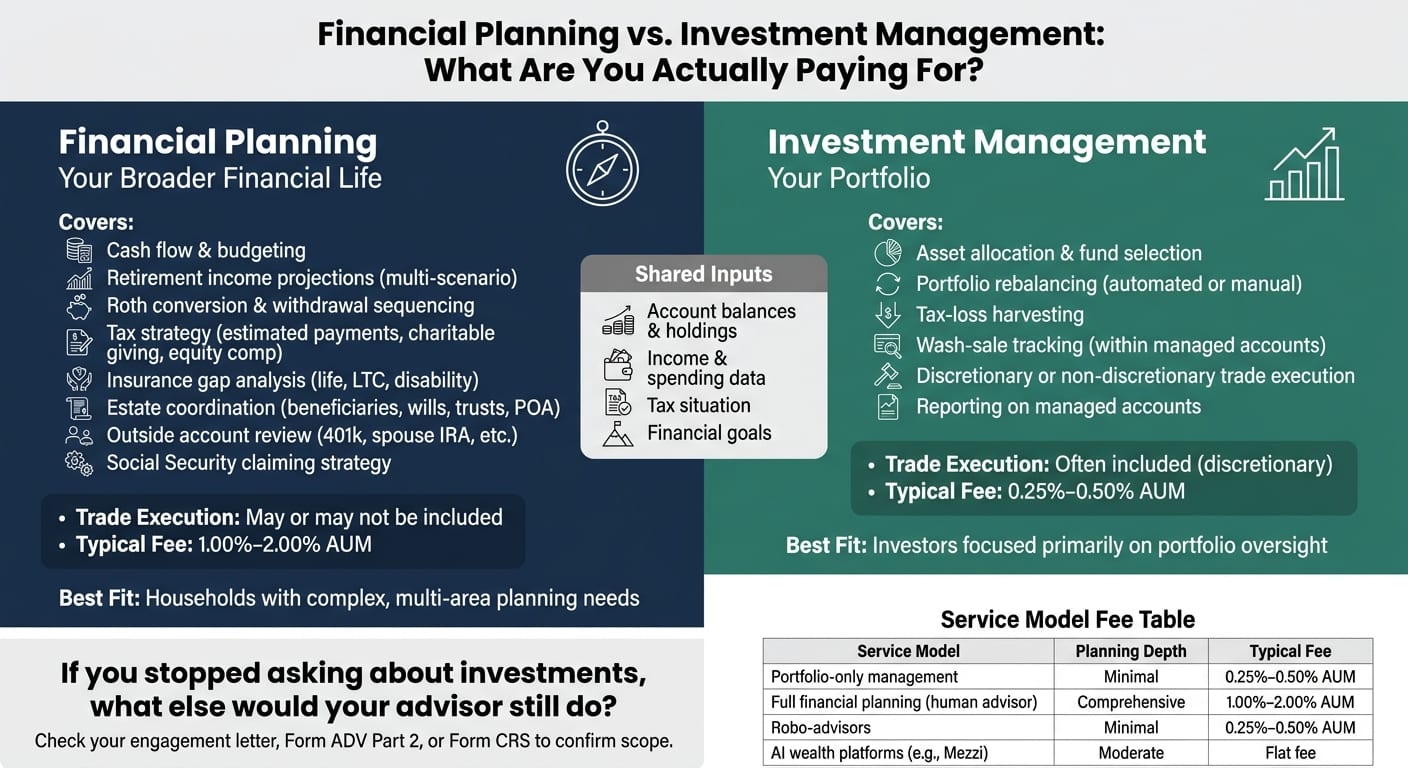
Financial Planning vs. Investment Management: What’s the Difference? | Montgomery Financial
Quick Comparison
| Area | Financial Planning | Investment Management |
|---|---|---|
| Main focus | My broader financial life | My portfolio |
| Typical work | Retirement projections, tax planning, insurance review, estate coordination | Asset allocation, fund selection, rebalancing, tax-loss harvesting |
| Outside accounts | May be reviewed | May be ignored unless managed |
| Trade execution | May or may not be included | Often included in discretionary setups |
| Best fit | Households that may want broader support | Investors focused on portfolio oversight |
Bottom line: I may be paying for planning, portfolio management, or some mix of the two. The article below breaks down what each service may include, where they overlap, what questions may help me check the scope, and how a platform like Mezzi may fit self-managing investors.
What Financial Planning Includes
Financial planning brings a lot of moving parts into one process: income, spending, savings, debt, taxes, insurance, retirement, and estate choices. The CFP Board defines financial planning as a collaborative process that integrates relevant personal and financial circumstances to help clients pursue life goals.[5][1] A portfolio recommendation by itself is not financial planning. That line stands out more when you look at the day-to-day work a planner may handle.
Cash Flow, Retirement, and Decision Coordination
A planning engagement often starts with a full household snapshot. That may include income, fixed and flexible spending, debt payments, savings rates, cash reserves, retirement accounts, taxable investments, real estate, insurance, and major upcoming expenses. From there, a planner may look at whether your household may be able to keep an emergency reserve, pay down high-interest debt, and fund near-term and long-term goals without having to sell investments at a bad time.
Retirement projections go past a rough account-balance estimate. A useful projection may turn current assets and savings into a realistic income view based on stated assumptions, such as retirement age, annual spending, inflation, investment returns, taxes, healthcare costs, and life expectancy. It may also test a few scenarios. Retiring at 60 instead of 65 may change the picture. Cutting spending during a market downturn may change it too. The goal is not just a projection on paper. It may be a savings target and withdrawal target that fits the household being modeled.
Withdrawal sequencing is where coordination gets very specific. A plan may map out which accounts to draw from, and in what order, with the goal of managing taxes and later required minimum distributions. For example, a retiree might spend from taxable assets during part of early retirement, do measured traditional-to-Roth conversions in lower-income years, and keep Roth assets for later flexibility or heirs. That sequence may depend on tax brackets, Medicare-related income thresholds, legacy goals, account beneficiaries, and market conditions, so it usually needs to be modeled at the household level.
Social Security may start at 62, but claiming before full retirement age reduces benefits; delaying until 70 increases them.[2][3][4] A plan may compare claiming ages, line up spousal benefits, and account for how benefits may interact with withdrawals and taxes.
The same kind of coordination may apply to taxes, insurance, and estate choices.
Taxes, Insurance, Estate, and Other Planning Work
Tax planning goes well beyond choosing tax-efficient funds. It may include:
Roth conversion analysis
Estimated tax payments
Charitable-giving strategies
Harvesting gains or losses
Reviewing how equity compensation or concentrated stock may affect taxable income
For example, a planner might model converting part of a traditional IRA to a Roth IRA during a low-income year, compare the near-term tax cost with possible future tax effects, and line up that move with charitable gifts or required minimum distributions. Tax planning and tax preparation are separate. The planner may model strategies and coordinate with your CPA, while the CPA files the return. It makes sense to verify who handles what before assuming it's covered.
A risk review may identify threats like premature death, disability, long-term care needs, and liability, then check whether current coverage may close those gaps. Estate coordination may involve reviewing beneficiary designations, account titling, wills, trusts, powers of attorney, and healthcare directives, then working with an estate attorney on legal documents. A financial planner cannot replace an attorney for drafting legal documents. If a firm's marketing mentions estate planning but the engagement agreement doesn't spell out what's included, who does the work, and how often it gets updated, that claim may be unconfirmed.
Once those broader choices are covered, the next question is what investment management actually includes.
What Investment Management Includes
Investment management is a narrower job than financial planning. It centers on your portfolio: how it’s built, how it’s watched, and how taxes may be handled along the way. It does not cover budgeting, retirement-income planning, insurance review, or estate coordination. That line matters when you compare services and fees later.
Portfolio Construction, Monitoring, and Tax-Aware Maintenance
The work usually starts with asset allocation. From there, the manager chooses the funds or securities that fit that mix and rebalances if the portfolio drifts away from target.
Tax-aware maintenance may also be part of the service. One common example is tax-loss harvesting. If a position falls below its purchase price, the manager may sell it to realize a loss that may offset gains elsewhere, then reinvest in a similar security so the portfolio may keep similar market exposure. Some services automate those moves. Others send alerts or recommendations and leave the trade up to you.
Anything outside the portfolio falls under planning, not investment management.
Advice vs. Discretionary Management
Management may be discretionary or non-discretionary.
A discretionary manager has written authority to place trades, rebalance, and make portfolio changes without calling you first.
A non-discretionary setup means the manager gives recommendations, but you approve each move before anything happens.
The right model may depend on how much control you want. Your advisory agreement may show whether the manager has discretion. After that, the next thing to check is whether the service also includes planning work outside the portfolio.
Account aggregation is not portfolio management. A dashboard may show your holdings, but it does not rebalance, monitor drift, or harvest losses. Aggregation is a visibility tool. Portfolio management is a separate service that may involve ongoing oversight. Use that line when you review the comparison table below.
Where They Overlap and How to Check What You Are Paying For
Start by separating the shared inputs from the actual service.
The overlap usually comes from the same raw data: account balances, holdings, income, spending, taxes, and goals. But that doesn't mean the work is the same. What matters is the deliverable.
For example, a planner may model Roth conversions and map out withdrawal timing. A manager may focus on tax-loss harvesting and wash-sale tracking. Same topic area. Different job.
Service-by-Service Comparison Table
Use the table below to spot the work you may be paying for, not just the label on the service.
| Service Area | Financial Planning Deliverable | Investment Management Deliverable | Questions to Ask Your Provider |
|---|---|---|---|
| Budgeting & Cash Flow | Budgeting and debt payoff strategy | Idle-cash monitoring | "Do you review my outside spending/bank accounts?" |
| Retirement Projections | Multi-scenario income projections | Retirement-oriented allocation | "Are projections built from linked accounts?" |
| Tax Planning | Roth conversion and withdrawal sequencing | Tax-loss harvesting and wash-sale tracking | "How do you coordinate my investments with my tax return?" |
| Estate Coordination | Beneficiary review and trust coordination | Beneficiary and account-registration review | "Will you work directly with my estate attorney?" |
| Insurance Review | Life, LTC, and disability gap analysis | N/A | "Do you sell insurance or just review my needs?" |
| Portfolio Construction | Household-level asset allocation | Selecting specific funds and securities | "How do you select the underlying funds?" |
| Rebalancing | Rebalancing tied to life changes and goals | Tactical shifts to maintain target weights | "Is rebalancing automated or manual?" |
| Wash-Sale Risk | Cross-account monitoring | Usually monitored only inside managed accounts | "Do you flag wash sales in my outside accounts?" |
| Account Aggregation | Holistic view of all assets for planning | Reporting limited to managed accounts | "Can I see my 401(k) and brokerage in one view?" |
| Trade Execution | No trade execution | Advisor-executed or automated | "Who places trades?" |
Fee-and-Services Checklist Before You Renew or Hire
Before you sign or renew any advisory agreement, pull the provider's Form ADV Part 2 or Form CRS. Both are public documents. They may show fees, conflicts of interest, and extra charges.
Then go line by line through the scope of work.
Fee type: Is the fee a percentage of assets under management (AUM), a flat annual retainer, or hourly? For flat fees, divide the annual dollar amount by your total portfolio value to estimate the effective percentage and compare it with the standard 1% AUM model.
Service scope: Does the fee cover both financial planning and investment management, or only one? Does it include tax strategy, estate coordination, insurance audits, and retirement optimization, or mostly portfolio rebalancing?
Outside accounts: Does the provider review accounts they don't manage, like your 401(k) or a spouse's IRA?
Who places trades: Who places trades?
Retirement projections: Are projections built from linked accounts?
Fiduciary status: Is the provider a fiduciary?
This part may sound simple, but it often clears up a lot. Two firms may talk about "retirement planning", yet one may be giving you a full income model while the other may be adjusting an allocation and stopping there.
Common Service Models and Who They Fit
| Service Model | Primary Job | Trade Execution | Planning Depth | Tax Guidance | Human Support | Typical Fee | Best Fit |
|---|---|---|---|---|---|---|---|
| Portfolio-only investment management | Asset allocation & trade execution | Advisor-executed (discretionary) | Minimal to none | Basic tax-loss harvesting | Limited or none | 0.25%–0.50% AUM | Portfolio-focused investors |
| Full financial planning (human advisor) | Goal coordination & life-decision support | Advisor-executed (discretionary) | Comprehensive | Roth conversions, withdrawal sequencing, estate tax strategy | In-person or video meetings & behavioral coaching | 1.00%–2.00% AUM | Households with complex planning needs |
| Robo-advisors | Automated portfolio management | Fully automated | Minimal to none | Automated tax-loss harvesting | Limited or none | 0.25%–0.50% AUM | Hands-off investors |
| AI wealth platforms | AI-driven insights & tax optimization | User-executed based on AI advice | Moderate | Advanced wash-sale monitoring and tax optimization | AI insights + optional human review | - | Self-managing investors |
That sets up the next question: how Mezzi may fit self-managing investors.
Where Mezzi Fits for Self-Managing Investors
For self-managing investors, the main question may be pretty simple: do they want guidance, portfolio oversight, or both?
Mezzi is an SEC-registered fiduciary platform for investors who want guidance without handing over trade control. You keep your assets where they are and connect accounts with read-only access through Plaid or Finicity.
What Mezzi Covers Across Planning and Portfolio Insight
Mezzi sits in the middle ground between planning insight and self-directed portfolio control. The Core plan at $299/year includes unlimited AI guidance, retirement analysis based on connected account data, and performance analysis across all accounts. The difference between tiers is about scope, not control.
The Plus plan at $499/year adds holding-overlap analysis, allocation and asset-location guidance, tax-loss harvesting identification, and wash-sale risk alerts across all accounts. The White Glove plan at $1,499/year adds video-call coaching and unlimited support calls.
Here’s the key distinction: Mezzi may inform the decision, but it does not place the trade. Mezzi may advise; you execute. If it flags a tax-loss or wash-sale issue, you place the trade. The guidance is fiduciary, but the trades stay in your hands.
Mezzi provides educational guidance, not tax or legal advice.
Conclusion: Match the Fee to the Actual Work
Financial planning and investment management are different services. One may coordinate your full financial picture. The other may manage the portfolio.
Before you renew or hire, it may make sense to compare the actual deliverables against the fee. If the gap is portfolio execution, a discretionary manager may be the right fit. If the gap is broader planning support, a full-service advisor may make more sense. If the gap is fiduciary guidance across all your accounts without giving up control, Mezzi is designed for that role.
FAQs
How can I tell what my fee actually covers?
Look past the headline percentage. Review your service agreement, Form ADV Part II, or Form CRS, then compare the fee with what’s actually included.
Some firms may bundle full-scope planning, such as tax strategy, estate coordination, insurance reviews, and retirement modeling. Others may charge for something much narrower, like portfolio management and basic rebalancing. That difference may matter more than the advertised rate.
It also may help to add up your total fee drag, not just the advisory fee. That may include:
Your advisory fee
Fund expense ratios
Platform fees
Transaction costs
If the services provided don’t line up with the total cost, the fee may not feel justified.
When do I need full financial planning?
You may want full financial planning when your finances become more layered and you need support that goes beyond portfolio management.
That often comes up around major life events, like marriage, divorce, or a career change. It may also apply when your situation involves estate planning, generational wealth transfer, business succession, tailored tax strategies, insurance analysis, or behavioral coaching during market volatility.
Does account aggregation count as portfolio management?
No. Account aggregation is a tool that links your financial accounts into one dashboard, so you may see a consolidated view of your net worth, holdings, and asset allocation.
It may help you keep an eye on your finances, but decisions and execution - like rebalancing, trading, or tax-loss harvesting - still stay with you. Portfolio management involves actively overseeing and adjusting investments to align with your goals.
Disclosures:
This content is for informational purposes only and does not constitute investment advice or a recommendation to buy or sell any security.
Past performance is not indicative of future results. No guarantee of future performance or outcomes is implied.
Mezzi provides educational guidance, not tax or legal advice.
Registration does not imply a certain level of skill or that the SEC has approved the company or its services.
Savings and performance examples are hypothetical and for illustrative purposes only. They do not represent the results of any specific investment.