
A taxable portfolio may have loss-selling openings far more often than many investors may think. Even when an account is up overall, some individual tax lots may still sit below cost basis - especially after dividend reinvestments, new deposits, or short market pullbacks.
Here’s the short version:
Account gains may hide lot-level losses.
Newer lots may slip into the red during normal dips.
Waiting until December may miss short-lived openings.
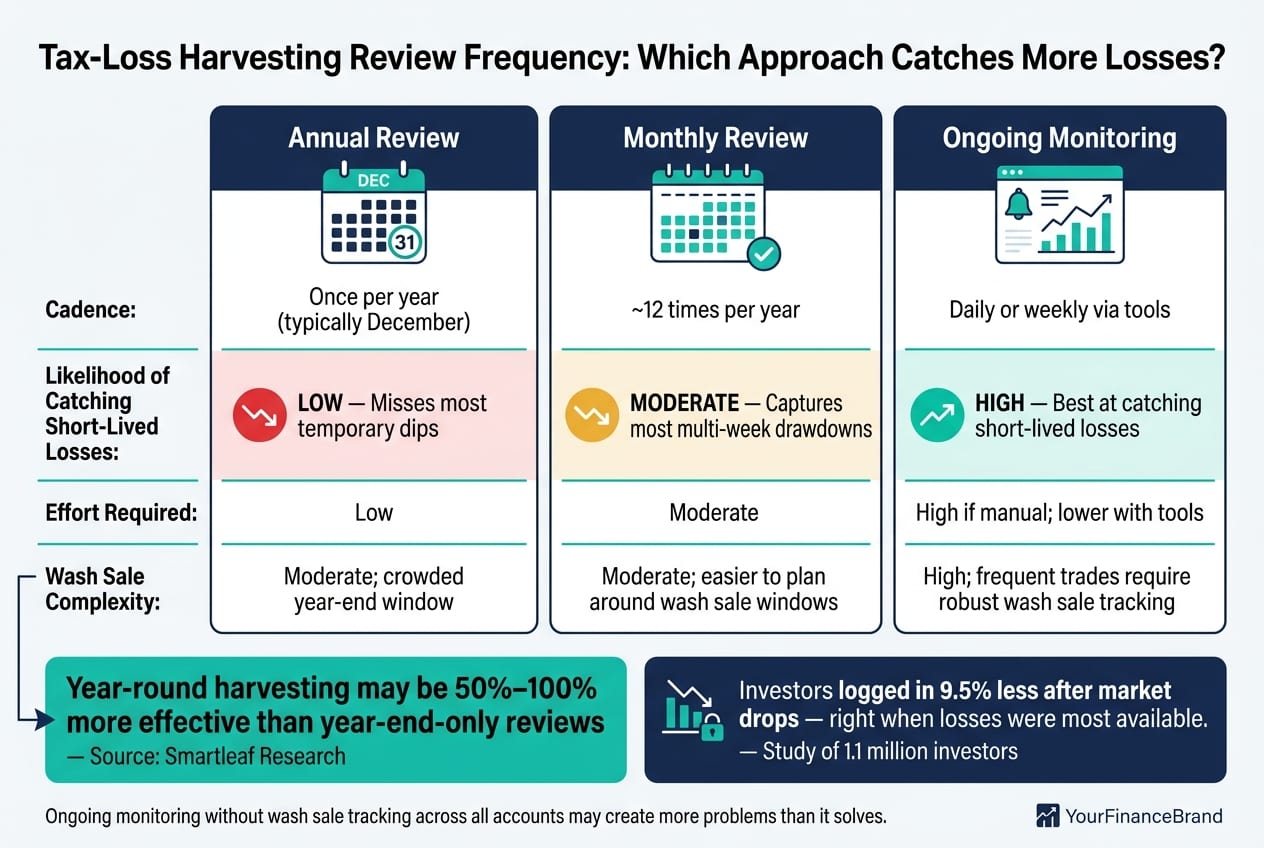
Smartleaf research found year-round harvesting may be 50%–100% more effective than year-end-only reviews.
A study of 1.1 million investors found logins fell 9.5% after market drops, right when losses may have been easier to find.
Wash sale rules may apply across all accounts, including IRAs, 401(k)s, spouse accounts, and dividend reinvestments.
That’s the core idea: the right question may not be “Is my portfolio down?” but “Which lots are down right now, and does another account create a wash sale problem?”
A simple way to think about it:
| What many investors check | What may matter more |
|---|---|
| Total account return | Losses at the tax-lot level |
| One brokerage account | All linked household accounts |
| December only | Reviews done during the year |
| Ticker-level gains/losses | Purchase date, basis, and wash sale timing |
I’d sum it up this way: harvestable losses may be common in diversified taxable portfolios, but they may stay hidden unless I look by lot, across accounts, and before the market bounce removes the opening.
Tax Loss Harvesting Explained: How to Use Losses to Offset Gains
Why investors miss losses that are available all year
Most investors may miss tax-loss opportunities for a simple reason: they look too late, not often enough, or only in part of the picture.
Waiting until December means missing most of the year
Treating tax-loss harvesting like a December cleanup job may cause investors to miss losses that showed up much earlier. Losses may appear during any rough patch in the market, then vanish before year-end. Research from Smartleaf found year-round harvesting may be 50%–100% more effective than year-end-only harvesting.[6]
That gap may come down to timing. Harvestable losses are time-sensitive. A December snapshot only shows what's still below cost basis at that one moment. It doesn't show the losses that appeared in March, June, or September and then recovered.
A monthly or continuous review process may change that. This doesn't have to mean opening every account every day and staring at charts. It may simply mean using a process or a tool that flags openings when they appear, instead of waiting for the calendar to say it's time.
So timing may be the first issue. Behavior may be the second.
Behavioral blind spots make losses easy to overlook
Many investors may hold losing positions longer than planned because they hope to get back to even. Realizing a loss may feel like locking in a mistake, even when the tax rules may make that sale worth considering. So even investors who know how harvesting works may still avoid selling positions that are underwater.
There's another pattern that may make this worse: people often check their accounts less when markets are down. A study of 1.1 million investors found logins fell 9.5% after market declines, right when losses were most available.[3][4][5] In choppy markets, reviews may get pushed off until later. By then, the opening may already be gone.
And even a solid review may miss losses if it only covers one account.
Checking only one account gives an incomplete view
Looking at one brokerage account may not be enough. A sector ETF in a second account may be trading well below its cost basis even if the main account looks fine.
The wash sale issue may matter even more. Wash sale rules apply across all accounts owned by the same taxpayer.[2] A loss may be disallowed if a substantially identical security is bought in another account within 30 days. That may include dividend reinvestment or activity in a retirement account.
Without a full view across accounts, investors may face two problems at once:
Missing losses that may exist in other accounts
Negating harvested losses without meaning to
Losses may be common, but they may stay hidden when each account is viewed on its own.
The next step is knowing how to screen all taxable accounts without triggering wash sale problems.
Where harvestable losses typically appear in a diversified portfolio
Once you know losses may sit inside taxable accounts, the next step is figuring out where they tend to show up.
Newer tax lots often go negative during normal market swings
Many investors picture a harvestable loss as something that appears only after a major market drop. But in practice, losses may show up more quietly - and more often - inside portfolios that still look healthy at the account level.
Each time you add cash, reinvest a dividend, or rebalance, you create a new tax lot at that day's price. Those newer lots often have higher cost bases than older ones, so it may take only a modest dip for them to fall below cost basis.
Here’s a simple hypothetical. Say you own a broad U.S. equity ETF and buy more shares each month. Shares bought in January at $100 may still show a gain after a 5% pullback. But shares bought in April at $120 may now trade at $113, which puts them below cost basis, even though the full position still shows a gain. That April lot may be a harvestable loss. The January lot may not be. In other words, recent lots may go negative even when the position as a whole remains up.
Each contribution or dividend reinvestment creates a new lot that may slip below cost during a normal dip.
Sector rotations and fund overlap can create hidden losses
A diversified portfolio rarely moves as one unit. When money shifts from growth to value, or from domestic to international, some holdings may fall while others rise. The total portfolio may be up 3% while a technology ETF inside it may be down 12%. That 12% loss may be real and potentially harvestable, but an account-level view may not show it.
Fund overlap may make this harder to spot. If you own a total U.S. market ETF alongside a large-cap growth ETF, one fund bought at a higher price may sit at a loss while the other shows a gain. That may create the impression that your U.S. equity exposure looks fine overall. Brief market dips may be worth watching for that reason.
Mid-year market dips can open short windows worth acting on
The S&P 500 has historically experienced intra-year drawdowns of more than 10% even in years that finished positive.[8][9] Those pullbacks may push recent, higher-basis lots below their purchase price for days or weeks before prices recover.
That window may close fast. A dip that creates harvestable losses in mid-June may be fully reversed by mid-July. The next step is finding those losses across taxable accounts without triggering a wash sale.
How to find losses across taxable accounts without creating new tax problems
Start with taxable accounts and review losses by lot, not by ticker
Tax-loss harvesting may apply only to taxable brokerage accounts. Retirement accounts may need to stay out of the review entirely.
After you've narrowed the list to the right accounts, look at the individual tax lot, not just the ticker symbol. Your broker's cost basis or lot detail screen may show each purchase date, share quantity, and cost basis. And that's the part many people miss.
A holding may look profitable overall while a newer lot may still sit at a loss. That lot may be harvestable even if the full position may not be. It often makes sense to focus on losses large enough to matter after spreads and trading effort.
Once you know which lot may be in play, the next step is less about the position itself and more about the rest of your household. Another account may create wash sale issues even if the taxable account looks clean on its own.
Check wash sale risk across all accounts before selling
Check the 61-day wash sale window: 30 days before the sale, the sale date, and 30 days after.[11][12] If you buy the same or a substantially identical security within that window, the loss may not be deductible now. Instead, the loss may be deferred by adding it to the replacement shares' basis.[10][11]
Wash sale risk may extend beyond one taxable account. It may reach other taxable accounts, IRAs, Roth IRAs, 401(k)s, spouse accounts, and dividend reinvestments. For example, if you sell a fund at a loss in your taxable account and a dividend reinvestment or other automatic purchase buys the same security in another household account within the window, the loss may be disallowed.[1][13][14][15][16]
A simple check may include:
Pausing DRIPs for the target security
Confirming there are no automatic buys across linked household accounts
That extra review may feel tedious, but it may prevent the kind of tax surprise that turns a clean loss-harvesting move into paperwork and deferred losses.
Annual review vs. monthly review vs. ongoing monitoring: a comparison
How often you check may matter more than many investors expect. A portfolio that goes through a several-week 10% drawdown in May or September may show no harvestable losses by December - but a monthly or ongoing review may be more likely to catch that dip while it's still there.[7][17]
| Review Approach | Cadence | Likelihood of Catching Short-Lived Losses | Effort Required | Wash Sale Complexity |
|---|---|---|---|---|
| Annual Review | Once per year (typically Dec) | Misses most temporary dips | Low | Moderate; crowded year-end window |
| Monthly Review | ~12 times per year | Captures most multi-week drawdowns | Moderate | Moderate; easier to plan around wash sale windows |
| Ongoing Monitoring | Daily or weekly via tools | Best at short-lived losses | High if manual; lower with tools | High; frequent trades require robust wash sale tracking |
More frequent monitoring may surface more opportunities, but it also may demand better tracking. Ongoing monitoring without a system for tracking wash sales across all accounts may create more problems than it solves.
A full-account view may make these checks much easier to manage. That's where connected monitoring may help.
How Mezzi helps you spot opportunities and avoid pitfalls across your full portfolio

Connecting all accounts gives you a clearer view of where losses exist
Mezzi turns that checklist into one connected review. Many investors may review accounts one by one, and that may hide losses that are available for harvesting. A position may look fine on its own, while a linked account may create wash sale risk.
Mezzi connects your accounts through read-only connections, including taxable brokerage accounts, 401(k)s, Roth IRAs, and traditional IRAs. No money moves, and you never share credentials. The result may be a single view of your household portfolio, which may make it easier to spot overlapping holdings and losses that only show up when accounts are reviewed together. That way, you may go from a broad household view to the exact lot worth a closer look.
Mezzi identifies tax-loss candidates and wash sale risk before you act
Mezzi surfaces positions trading below cost basis at the tax-lot level, not just by ticker. A fund you've held for years may have one newer lot at a loss while the overall position looks flat or slightly positive. Mezzi flags the specific lot, including its date, cost basis, and unrealized loss, so you know which lot may be worth reviewing.
Before you act, Mezzi also warns about cross-account wash sale risk. If selling a position in your taxable account may conflict with a recent or upcoming purchase in a linked IRA or a spouse's account, Mezzi surfaces that risk in advance. It monitors and flags opportunities; you place the trade. Used together, those checks may reduce the chance of acting on a false opportunity.
Conclusion: Harvestable losses are common, but only if you look at the right level
Diversified portfolios may often contain lot-level losses even when the account balance looks healthy. Those opportunities may appear well before December. A short-lived dip in March or July may open a window that closes fast, and a year-end review may miss it.
Catching those moments may require looking at all taxable accounts together, reviewing losses by lot instead of by ticker, and checking wash sale exposure across every linked account before selling. Skip one of those steps, and a clean harvesting move may turn into a deferred loss or an unexpected tax issue.
Mezzi is built to help you monitor that full picture on a continuing basis, with AI-driven, read-only guidance based on your connected account data. Tax savings may vary based on individual circumstances. Your tax bracket, income type, and broader tax picture may all affect the outcome. For more complex cases, some investors work with a qualified tax professional.
FAQs
How do I know if a loss is worth harvesting?
First, confirm that the loss appears real at the lot level by comparing the position with that lot’s cost basis. Then estimate the tax value based on whether the loss may be treated as short-term or long-term.
Harvesting may make sense only if the tax savings outweigh trading costs and any portfolio drift. Also check for a wash sale across all of your accounts. If you repurchase the same or substantially identical security within the 61-day window, the loss may be disallowed or deferred.
What counts as a wash sale across household accounts?
The wash sale rule may apply across all accounts you or your spouse own or control, no matter where those accounts sit or what type they are. That may include taxable accounts, IRAs, 401(k)s, and HSAs.
Here's the catch: brokers often track wash sales only inside each account. So they may miss issues that happen across different firms or between spouses.
That means a loss sale in one account may still run into the rule if a substantially identical security is bought in another account during the 61-day window around that sale. To lower that risk, some households monitor the full portfolio rather than looking at one account at a time.
How often should I review my taxable accounts for harvestable losses?
Some investors review their taxable accounts for harvestable losses daily, since monthly or quarterly check-ins may be too slow to catch market swings and may miss openings.
With continuous monitoring, losses may be spotted as they happen. That may improve tax savings over the course of the year, while also supporting wash-sale rule compliance across accounts.
Disclosures:
This content is for informational purposes only and does not constitute investment advice or a recommendation to buy or sell any security.
Past performance is not indicative of future results. No guarantee of future performance or outcomes is implied.
Tax savings and performance examples are hypothetical and for illustrative purposes only. Actual results will vary based on individual circumstances, portfolio composition, market conditions, and fees.
Registration does not imply a certain level of skill or that the SEC has approved the company or its services.