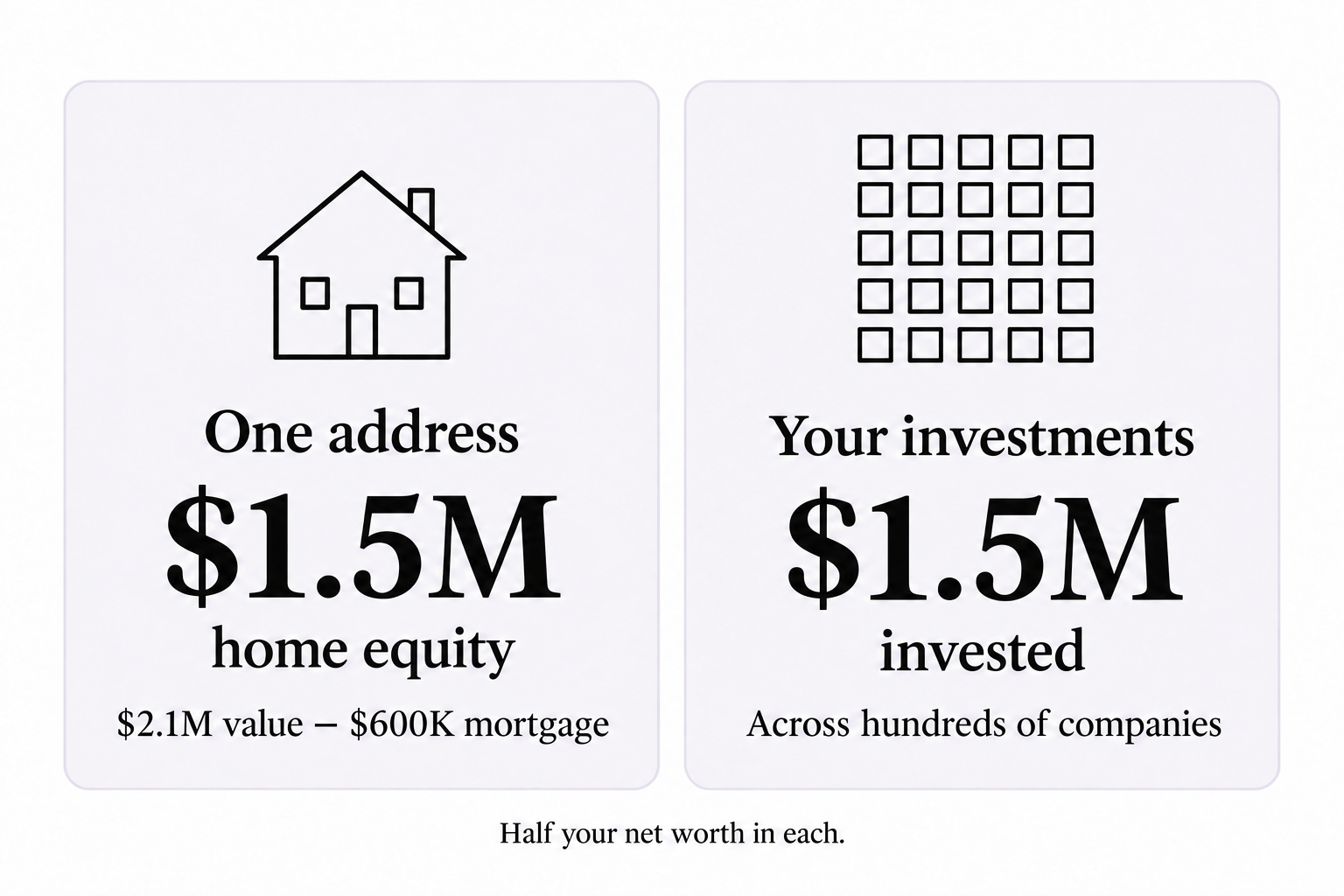
Your portfolio owns hundreds of companies. Your home owns one address.
Say you have $1.5 million invested and a $2.1 million home with a $600,000 mortgage. With no other assets or debts, half your net worth is home equity.
That equity counts toward your wealth. But you can’t sell a spare bedroom to cover an unexpected bill.
How does that change the way you invest the other half?
Should you include your home in your net worth?
Yes. Net worth includes what you own, including your home, minus what you owe. Count the home’s value as an asset and its mortgage as a liability. The difference is your home equity. FINRA’s explanation of net worth uses the same approach.
In this example:
| Item | Amount |
|---|---|
| Home value | $2,100,000 |
| Mortgage | −$600,000 |
| Home equity | $1,500,000 |
| Investments | $1,500,000 |
| Net worth | $3,000,000 |
That calculation tells you where your wealth sits. It does not tell you how much you can spend or how much investment risk you can afford.
Home equity is not the same as available cash. Selling takes time and can involve costs; borrowing creates debt and depends on approval and terms. A retirement account may also have taxes or withdrawal restrictions. Knowing an asset’s value is only the start.
A home, an investment, or both?
Whether your home is an investment is hotly debated. The more useful question is what you’re counting on it to do.
If you expect to sell, move somewhere cheaper, or rent it out to help fund your future, consider those plans alongside your investments. How much could remain after the mortgage, transaction costs, any taxes, and your next housing arrangement? How much of your plan depends on that amount being available?
If you plan to stay, ask whether your investments can fund your goals without selling the home. Your mortgage, upkeep, insurance, and property taxes still affect how much cash you need and how much investment risk you can take.
What matters is how the home fits your plan, not which label you give it.
Does owning a home let you take more investment risk?
It can go either way. Compare two hypothetical families with the same net worth.
One has more room to take risk. Their home is paid off, their income comfortably covers spending, and they have cash for repairs and emergencies. They won’t need their investments for at least ten years. Low housing bills and little need to sell investments may let them hold more stocks if they can stomach the swings.
The other has less room. They have a large mortgage, limited cash, and jobs in the industry that drives local home prices. A downturn could hit their income, home value, and stocks together. They may need more cash and a less aggressive investment mix.
The difference is what owning the home means for their bills, income, and ability to leave investments alone. There is no automatic stock-and-bond formula for homeowners. As Investor.gov explains, asset allocation depends on your investing timeframe and ability and willingness to take risk.
Four questions to ask before changing your investment mix
Asset allocation is how you divide your investments among stocks, bonds, cash, and other assets. Start with the demands on that money.
- What must stay accessible? List spending you can reasonably see coming, including major home repairs, along with the emergencies you need to cover. Identify where that money would come from.
- What can stay invested? Separate goals that require money soon from goals that give your investments more time. A large net-worth figure does not lengthen a short deadline.
- What happens if income falls? Look at the bills that continue, including your mortgage, and how long you could cover them without selling investments.
- What job does the home have? If your future plan relies on selling or renting it, write down the timing and assumptions. If it does not, check that the rest of your assets can do the work.
Then assess whether your current mix fits those answers. Consider taxes, trading costs, and account restrictions before making changes. The point is to choose a mix you can live with through a difficult period, not to react to every change in your home’s estimated value.
How Mezzi can help connect your home and investments
Start with your AI Personalization in Mezzi. Explain whether you expect your home to house you, help fund your future, or both. Add details about your income and major upcoming expenses, and make sure your home value and mortgage balance are listed.
Then use Diversification X-ray to see how investments add up across accounts, including stocks held inside your funds. That can reveal another piece of the picture: owning several funds does not necessarily mean you own different companies. See our example of NVIDIA exposure inside index funds.
That holdings check supports the broader question:
Given our home, mortgage, income, and upcoming expenses, does our mix of stocks, bonds, and cash fit our goals? How much should we keep accessible, and are we taking more investment risk than our situation supports?
Ask Mezzi about your asset allocation
Your home can give you room to take risk. It can also use that room up.
By Manish Jain, CFA, Co-founder and CEO of Mezzi. Adapted from The Boost.
This is general education, not personalized investment, tax, or legal advice or a recommendation to trade. Figures and households are hypothetical, not targets or forecasts. Investments can lose value. Diversification does not guarantee profits or prevent losses. Mezzi’s analysis depends on complete and accurate information.