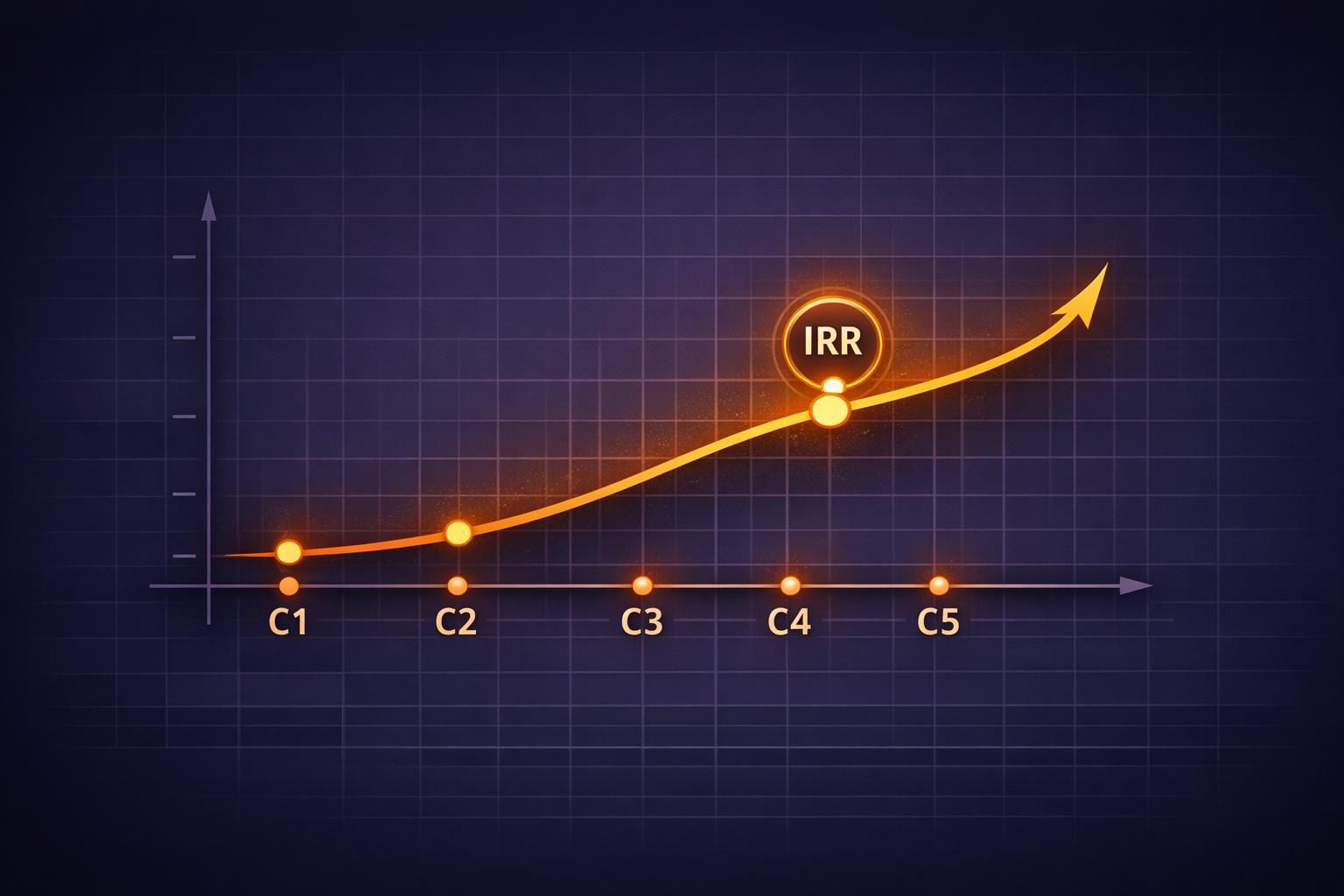
When comparing investments, understanding Internal Rate of Return (IRR) can help you evaluate potential returns. IRR is a percentage that shows the annualized return of an investment, factoring in both the timing and value of cash flows. It’s widely used by investors to make decisions about projects, real estate, and portfolios.
Here’s what you need to know:
- What is IRR? It’s the discount rate where the net present value (NPV) of cash flows equals zero.
- Why use IRR? It provides a standardized way to compare investments of different sizes and types.
- How is IRR calculated? You can calculate it manually, use Excel functions like
=IRR()or=XIRR(), or leverage tools like Mezzi to automate the process. - Real-world uses: IRR helps in evaluating rental properties, business expansions, and portfolio performance.
IRR is especially useful when paired with Net Present Value (NPV) to connect percentage returns to actual dollar gains. Tools like Excel or Mezzi simplify these calculations, saving time and reducing errors. This article explains how IRR works, why it matters, and how to calculate it effectively.
Benefits of Using IRR for Investment Decisions
Comparing Different Investment Opportunities
IRR simplifies the comparison of diverse investments by expressing potential returns as a single percentage. For instance, whether you're evaluating a $100,000 rental property or a $50,000 tech startup, IRR provides a common metric for assessment. In one analysis, a real estate project with five years of rental income followed by a final sale yielded an IRR of 18%, while a tech startup with four years of projected cash flows showed just 10%. Based on IRR alone, the real estate investment appeared more appealing.
This ability to standardize comparisons is what makes IRR so widely used. Take the case of FoolCo in November 2025: they analyzed two capital projects - expanding operations (IRR of 14.5%) versus purchasing new machinery (IRR of 26.5%). From an IRR perspective, the machinery investment stood out as the better choice. This consistency in ranking projects makes IRR a valuable tool for evaluating opportunities.
Evaluating Risk and Return
IRR provides insight into the discount rate at which a project's cash flows break even. By comparing your IRR to a hurdle rate - the minimum return required to justify the risk - you can determine whether the investment aligns with your goals.
For example, if your IRR surpasses your cost of capital or required rate of return, it suggests the project offers a sufficient margin to account for risks. Historically, European mid-market private equity funds have delivered average IRRs exceeding 17% for limited partners, while early-stage venture capital investments often aim for 30% or more to account for their higher risk levels. The gap between your IRR and the hurdle rate serves as a margin of safety, offering greater confidence in your decision. This balance of risk and return makes IRR a powerful tool for evaluating investment viability.
Making Informed Investment Decisions
One of IRR's strengths is its ability to factor in the timing of cash flows, which makes it particularly useful for decisions like launching new products or expanding operations. If the IRR exceeds your minimum required rate of return, the investment likely adds value and deserves consideration.
To enhance decision-making, pairing IRR with Net Present Value (NPV) ensures that a high percentage return also correlates with meaningful dollar gains. By connecting potential returns, associated risks, and actionable insights, IRR becomes an essential tool for managing investments with precision.
Internal Rate of Return (IRR) Explained with Example
How to Calculate IRR: Methods and Tools
The IRR Formula and Manual Calculation
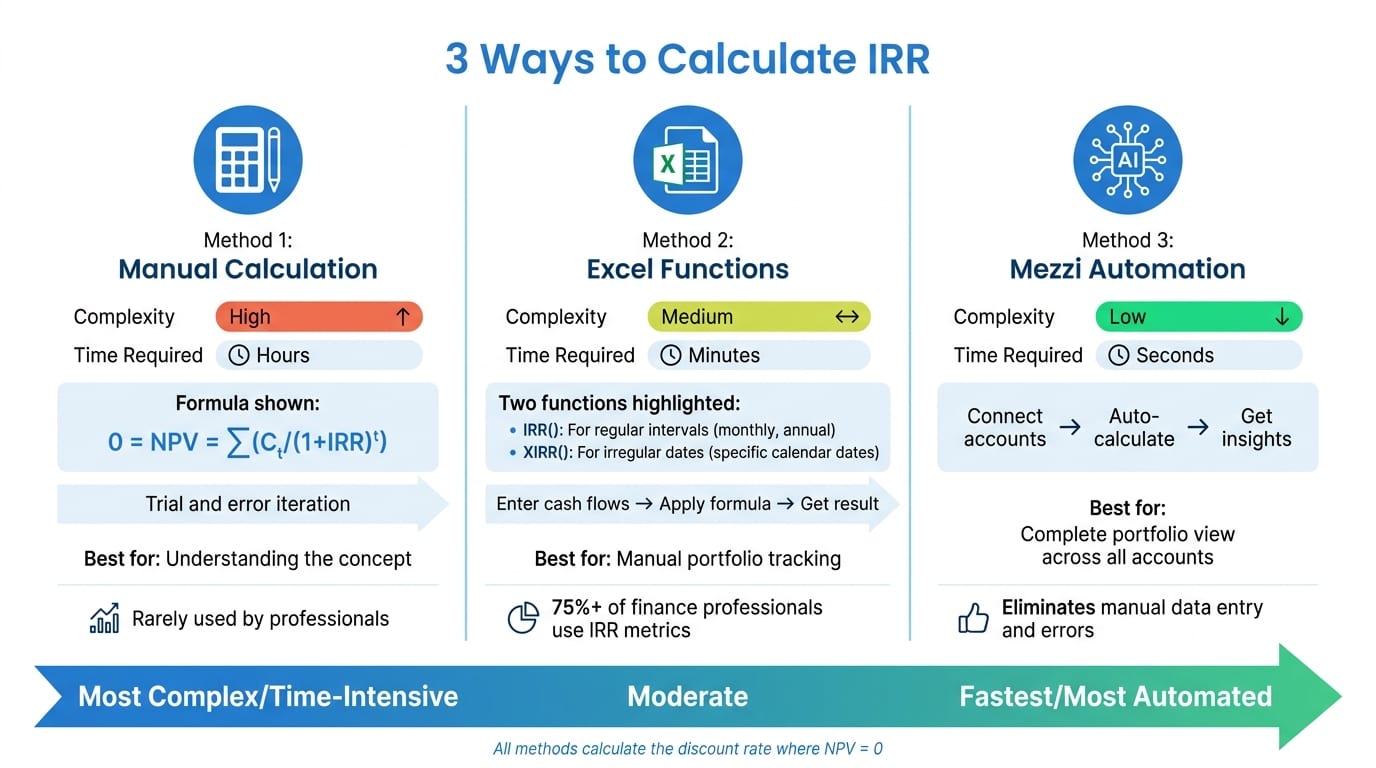
The formula for calculating IRR (Internal Rate of Return) is:
0 = NPV = ∑₍t=0₎ᴺ (Cₜ/(1+IRR)ᵗ),
where Cₜ represents the cash flow at time t, and N is the total number of periods. IRR is essentially the discount rate that makes the net present value (NPV) of all cash flows equal to zero.
To solve for IRR manually, you’ll need to use an iterative process. Start by listing your cash flows (negative for outflows and positive for inflows). Then, guess a discount rate (e.g., 10%) and calculate the NPV. If the NPV is positive, your guess is too low; if it’s negative, the rate is too high. Adjust the rate and repeat until the NPV equals zero. As Investopedia explains:
Internal rate of return (IRR) involves guesswork and trial and error in calculations.
Although manual calculation is possible, it’s rarely done today. Over 75% of finance professionals rely on IRR as a primary metric for comparing investments, but most use software or tools to handle the math.
Using Excel's IRR and XIRR Functions
Excel makes IRR calculations much easier with its built-in functions. =IRR() is ideal for cash flows that occur at regular intervals, like monthly rent or annual dividends. For cash flows tied to irregular dates - such as those from uneven investment funding or expenses - =XIRR() is the better option.
Here’s how they work:
- For IRR: Enter your cash flows in a single column (starting with the initial investment as a negative number), then use
=IRR(range_of_values). - For XIRR: Create two columns - one for dates (e.g., using
=DATE(2026,5,6)) and another for the corresponding cash flows. Then, use=XIRR(range_of_values, range_of_dates).
Excel calculates IRR by iterating until it finds an accurate value. If it fails to converge, you’ll see a #NUM! error. To fix this, you can include an optional "guess" parameter (e.g., 0.1 or -0.1) to help Excel start closer to the correct value.
The main difference between these functions lies in how they treat time:
- IRR assumes equal intervals between cash flows.
- XIRR calculates returns based on specific calendar dates, using a 365-day year.
For investments with regular cash flows, IRR works well. If your cash flows are irregular, XIRR provides a more accurate annualized return.
Using Mezzi's AI-Driven Insights
Mezzi takes the process a step further by automating calculations and eliminating the need for manual spreadsheets. By securely connecting to your investment accounts - whether it’s a 401(k), brokerage account, Roth IRA, or taxable account - Mezzi aggregates your transaction data and calculates metrics like IRR automatically.
This automation is especially useful when dealing with the complexities of real-world investing. Your portfolio might include regular contributions, dividend reinvestments, one-time transactions, or account conversions, all spread across multiple accounts. While traditional advisors can only see the assets they manage, Mezzi provides a complete view of your entire portfolio.
With Mezzi, you can quickly answer questions like, "What’s my IRR on tech stocks over the past three years?" - getting results in minutes instead of spending hours manually crunching numbers. This holistic approach simplifies tracking and gives you a clearer understanding of your performance across all accounts.
IRR in Practice: Investment Scenarios
Evaluating a Real Estate Investment
Real estate investors often rely on IRR to measure a property's annual growth, as it accounts for every cash flow over time. This sets it apart from simpler metrics like the cap rate, which only reflects one year's income relative to the purchase price. IRR incorporates both ongoing rental income and the eventual profit from selling the property.
Take this example: You purchase a rental property with a $200,000 down payment. Over seven years, you collect monthly rent (after accounting for operating expenses and mortgage payments) and later sell the property for a net profit of $150,000 after covering the remaining loan balance and closing costs. To calculate IRR, you record the initial $200,000 as a negative cash flow, add each year's net rental income, and include the sale proceeds at the end. Using Excel's XIRR function, the IRR comes out to 16%.
In commercial real estate, IRRs between 15% and 20% are often targeted, with 18% to 20% considered strong. As Ike Hoffman, Owner of Tactica RES, puts it:
The IRR is much more comprehensive than yield metrics like cap rates, cash-on-cash return, or yield on cost.
Seasoned investors often combine IRR with equity multiple to ensure that a high percentage return isn't based on a small capital base. For instance, while a 20% IRR on a fixer-upper property may seem appealing, the constant repairs and active management it requires might make a 15% IRR on a stabilized, lower-risk property a smarter choice. Next, let's see how IRR applies to business expansion decisions.
Analyzing Business Expansion Decisions
Businesses frequently use IRR to evaluate potential expansion projects, comparing each project's IRR to their Weighted Average Cost of Capital (WACC). This ensures that investments are likely to exceed the minimum required return.
For instance, a manufacturing company might consider two options: renovating an existing facility for $500,000 with cash flows yielding a 22% IRR or opening a new location for $1.2 million with a 19% IRR. While the renovation offers a higher IRR, the absolute profit from the new location might be greater. To address these nuances, businesses often pair IRR with Net Present Value (NPV), which measures the actual dollar value each project contributes.
It's worth noting that IRR assumes all interim cash flows are reinvested at the same rate, which can lead to overestimated returns for projects with very high IRRs (e.g., 30%). For projects with unconventional cash flows, the Modified Internal Rate of Return (MIRR) provides a more reliable alternative, avoiding the multiple IRR issue. These tools highlight how IRR-related metrics can offer deeper insights into investment decisions.
Beyond evaluating individual projects, IRR is also a powerful tool for comparing portfolio assets.
Comparing Portfolio Assets
IRR is particularly useful for analyzing portfolio holdings, as it accounts for the timing of cash inflows and outflows. Unlike CAGR, which is best suited for single lump-sum investments with one final value, IRR handles the complexities of portfolios with regular contributions, dividend reinvestments, partial withdrawals, and other transactions.
To compare assets, list every cash flow tied to each holding - such as the initial purchase (negative), dividends received (positive), additional share purchases (negative), and the current market value (positive). Then, use Excel's XIRR function to calculate the annualized return for each asset. Generally, the asset with the highest IRR is considered the most attractive, assuming similar risk levels.
This is where Mezzi’s portfolio tools prove especially helpful. Mezzi aggregates transaction data across all your accounts, saving you from manually tracking cash flows. With Mezzi, you can simply ask, “What’s my IRR on my tech stocks over the past three years?” and get an answer in minutes. By offering read-only access to all connected accounts, Mezzi can calculate IRR across holdings that traditional advisors - who often only see the assets they manage - might miss.
Conclusion: Using IRR for Better Investment Decisions
Key Takeaways
The Internal Rate of Return (IRR) offers a straightforward percentage that simplifies comparing different investment options. Unlike ROI, which looks at overall returns, IRR factors in the timing of cash flows. This makes it particularly helpful for real-world scenarios like contributing to a 401(k), collecting rental income, or analyzing a business expansion.
Understanding when IRR is most applicable is essential. It's especially useful for investments with complex cash flows, such as multiple deposits, withdrawals, or irregular timing. For simpler investments, like a single lump-sum deposit, measures such as CAGR might suffice. However, when comparing something like a real estate deal with ongoing rental income to a stock portfolio with dividend reinvestments, IRR provides a more insightful perspective. Notably, over 75% of finance professionals use IRR as their primary tool for comparing investments.
Pairing IRR with Net Present Value (NPV) can enhance decision-making by connecting percentage returns to the actual wealth generated. For instance, a 15% IRR on a $1,000,000 investment adds far more value than a 50% IRR on a $100 investment. For investments with irregular cash flow dates, Excel’s XIRR function is a handy tool. Additionally, the Modified Internal Rate of Return (MIRR) can offer a more realistic view by incorporating reinvestment assumptions.
This ability to evaluate investments with clarity makes tools like Mezzi particularly appealing.
Why Mezzi is the Right Tool for Investors
Mezzi builds on the advantages of IRR by automating these often-complicated calculations. Traditional IRR analysis can be time-consuming and prone to errors due to its iterative nature. Mezzi simplifies this process by pulling data from all your accounts and calculating IRR across your entire portfolio in just minutes.
What makes Mezzi stand out is its ability to provide a holistic view of your finances. Unlike traditional advisors who may only assess the assets they directly manage, Mezzi offers insights across all your holdings. With read-only access, it can identify tax-loss harvesting opportunities, flag wash sale risks across multiple brokerages, and calculate IRR for both individual assets and your overall portfolio. For example, if you want to know, "What’s my IRR on my tech stocks over the past three years?" Mezzi delivers an answer based on actual data, not assumptions.
This comprehensive approach ensures you have the tools to make informed investment decisions with ease.
FAQs
When should I use IRR vs NPV?
When comparing investments, IRR is a useful tool to evaluate the percentage return based on cash flows. It’s particularly handy when assessing profitability or deciding whether to move forward with a project. On the other hand, NPV is more suited for determining the total dollar value an investment may add, factoring in a specific discount rate. Essentially, IRR emphasizes the rate of return, while NPV focuses on the absolute monetary gains or losses, making it especially helpful when comparing projects of varying sizes or risk levels.
Why can IRR be misleading?
IRR may give an incomplete picture of an investment's performance. It doesn’t factor in total profitability, the timing of cash flows, or the associated risks. Additionally, structural elements in private markets can inflate IRR, making it appear more favorable. If factors like fees or liquidity risks are overlooked, the metric can be easily misunderstood. It's important to keep these limitations in mind when evaluating investments with IRR.
How do I calculate IRR with irregular dates?
To calculate IRR when cash flows occur on irregular dates, Excel's XIRR function is a practical tool. This function is designed specifically for handling non-periodic cash flows.
- Start by listing all cash flows, beginning with the initial investment as a negative value. Follow this with any subsequent inflows or outflows.
- Next, create a matching list of exact dates for each cash flow. Ensure these dates are formatted in a way Excel recognizes to avoid errors.
- Finally, use the formula:
=XIRR(values, dates)in Excel. This will calculate the IRR based on the irregular timing of your cash flows.
This method provides a straightforward way to handle scenarios where cash flows don't follow a regular schedule.
Disclosures:
- This content is for informational purposes only and does not constitute investment advice or a recommendation to buy or sell any security.
- Past performance is not indicative of future results. No guarantee of future performance or outcomes is implied.
- Savings and performance examples are hypothetical and for illustrative purposes only. Actual results will vary based on individual circumstances, portfolio composition, market conditions, and fees.
Related Blog Posts
- How Explainable AI Models Assess Investment Risks
- How AI Benchmarks Investment Performance
- AI Tools for Renewable Energy Investors
- How does my annual return compare to a balanced model portfolio?
When comparing investments, IRR is a useful tool to evaluate the percentage return based on cash flows. It’s particularly handy when assessing profitability or deciding whether to move forward with a project. On the other hand, NPV is more suited for determining the total dollar value an investment may add, factoring in a specific discount rate. Essentially, IRR emphasizes the rate of return, while NPV focuses on the absolute monetary gains or losses, making it especially helpful when comparing projects of varying sizes or risk levels.
IRR may give an incomplete picture of an investment's performance. It doesn’t factor in total profitability, the timing of cash flows, or the associated risks. Additionally, structural elements in private markets can inflate IRR, making it appear more favorable. If factors like fees or liquidity risks are overlooked, the metric can be easily misunderstood. It's important to keep these limitations in mind when evaluating investments with IRR.
To calculate IRR when cash flows occur on irregular dates, Excel's XIRR function is a practical tool. This function is designed specifically for handling non-periodic cash flows.
- Start by listing all cash flows, beginning with the initial investment as a negative value. Follow this with any subsequent inflows or outflows.
- Next, create a matching list of exact dates for each cash flow. Ensure these dates are formatted in a way Excel recognizes to avoid errors.
- Finally, use the formula:
=XIRR(values, dates)in Excel. This will calculate the IRR based on the irregular timing of your cash flows.
This method provides a straightforward way to handle scenarios where cash flows don't follow a regular schedule.