
Moving a brokerage account may not create tax. Selling before the move may. That’s the short version.
If I transfer investments in kind, the shares may move to the new broker without a sale, so current capital gains tax may not apply. If I sell first and transfer cash, the sale may turn unrealized gains into taxable gains for that year. A simple example: if shares bought for $10,000 are now worth $18,000, selling first may realize an $8,000 gain.
Here’s the whole article in plain English:
Taxable brokerage accounts: tax may show up only if investments are sold
In-kind transfer: holdings move without a sale, so tax may not apply at transfer
Cash transfer: selling first may trigger short-term or long-term capital gains tax
Forced sales: some assets, like proprietary mutual funds or fractional shares, may not transfer and may be sold anyway
IRAs: direct moves between like accounts may not trigger capital gains, but rollover or conversion mistakes may create tax
Cost basis: wrong basis data after the move may lead to the wrong gain later
Wash sales: selling at a loss before or during a move may create trouble if I buy a similar investment in another account
How To Transfer Your Investment Between Brokers | Without Selling
Quick Comparison
| Method | What happens first | Tax result in a taxable account | Main risk |
|---|---|---|---|
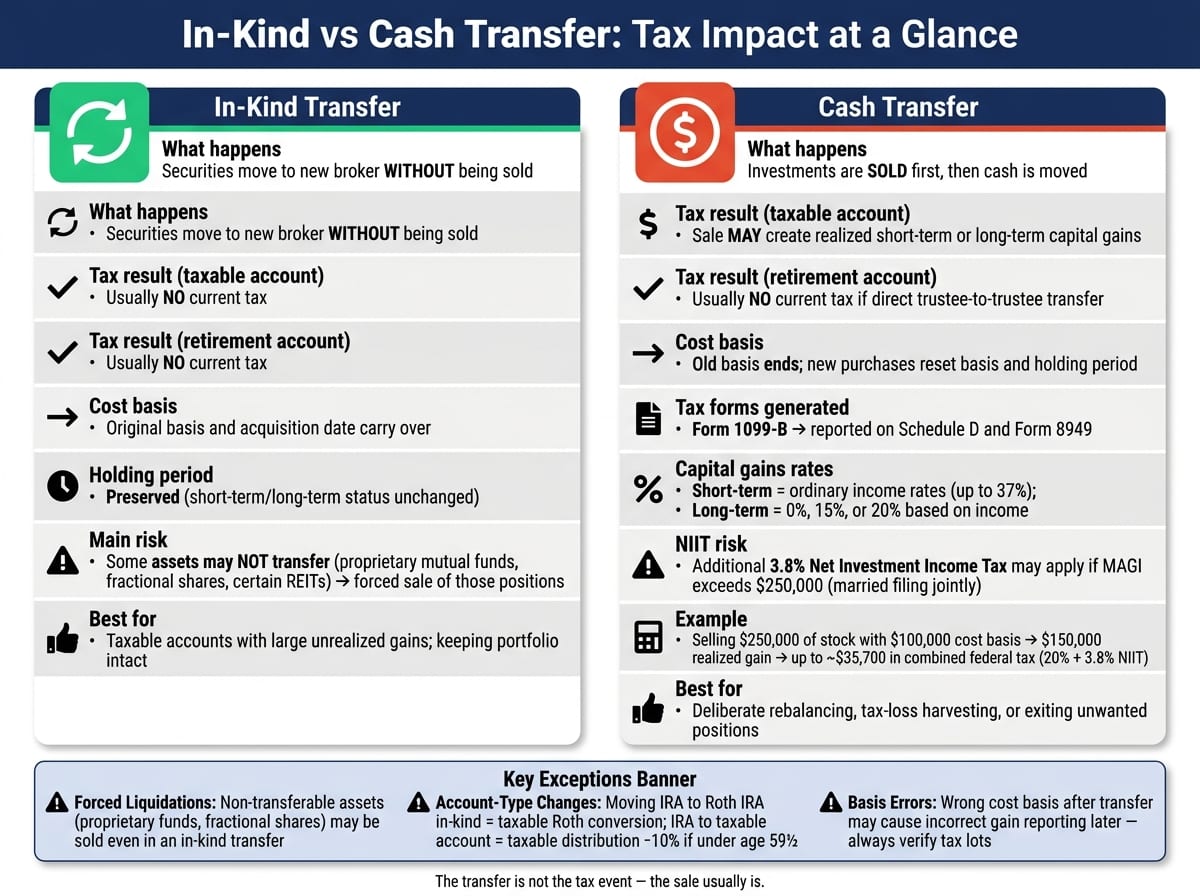
| In-kind transfer | Shares move as-is | Usually no tax at transfer | Some assets may not transfer |
| Cash transfer | Investments are sold | Sale may create taxable gains or losses | Gain may hit in the current tax year |
Bottom line: the transfer itself may be fine. The sale is usually the part that may lead to a tax bill.
In-Kind vs Cash Transfer: What Each Method Means for Taxes
A brokerage move may create taxes only if holdings are sold first. That’s the main line between an in-kind transfer and a cash transfer.
In-kind transfer: shares move without being sold
With an in-kind transfer, your securities - stocks, ETFs, and mutual funds - move from one brokerage to another without being sold first. Most eligible brokerage transfers move in kind.[1][5]
Because no sale occurs, there may be no realized capital gain or loss in a taxable account. Your cost basis and holding period generally carry over.[1][6]
Cash transfer: investments are sold, then cash is moved
A cash transfer sells your positions first, then moves the proceeds. In a taxable account, that sale may create realized capital gains or losses in the year it happens, and the sending brokerage will generally report the sale on Form 1099-B.[1][3][7]
Retirement accounts follow a different rule. For same-type retirement accounts, a direct transfer may not be taxable in many cases; taxes and penalties may arise when the move is treated as a distribution.[4][8]
The table below separates taxable brokerage accounts from same-type retirement account transfers.
| Transfer method | Taxable account | Retirement account (same type, direct transfer) |
|---|---|---|
| In-kind | Usually no current tax because no sale occurs | Usually no current tax |
| Cash | Sale may create realized gains or losses | Usually no current tax if transferred directly; taxable only if processed as a distribution |
When an In-Kind Transfer Does and Does Not Create a Tax Bill
Standard taxable brokerage transfer: usually not taxable
Most in-kind transfers may stay tax-free when the owner stays the same and the account type also stays the same.[1][6][7]
Exceptions: non-transferable assets, account-type changes, and basis errors
Three issues may lead to an unexpected tax bill.
Forced liquidations. Some positions may not transfer as-is. Proprietary mutual funds, certain non-traded REITs, private placements, and fractional shares are common examples. If the receiving brokerage does not support a holding, the sending firm may sell it before the transfer. When that happens, any built-in gain may become a realized capital gain for that tax year.[1][3][7]
For example, say you hold $30,000 of a proprietary mutual fund with a $10,000 cost basis, and the new brokerage may not accept it. That $20,000 gain may be taxable even if your only goal was to move the account.[3][7]
The same basic idea may apply when the account type changes.
Account-type changes. In-kind does not stay tax-free when the account type changes. Moving securities from a traditional IRA to a Roth IRA in kind may still be treated as a taxable Roth conversion. In that case, you may owe ordinary income tax on the fair market value of the converted assets for that year.[3][10]
Taking securities out of any IRA and moving them to a taxable account may be treated as a distribution, taxable as ordinary income. It may also come with a 10% early withdrawal penalty if you are under age 59½.[2][4][12] The securities may move, but the tax treatment may still follow the account rules.
Basis errors after the move. Wrong basis may not create tax at the time of transfer, but it may distort the gain reported later. The receiving brokerage may show incorrect cost basis, such as wrong purchase dates, missing tax lots, or a $0 basis on older positions.[6][9][11] It may make sense to review the new brokerage's lot history before selling.
Comparison table: in-kind taxable transfer vs in-kind retirement account movement
Here’s the key difference between taxable and retirement-account in-kind moves.
| In-Kind Taxable Transfer | In-Kind Retirement Account Transfer | |
|---|---|---|
| Sale occurs? | No | No |
| Can the move force a sale? | Yes - if the receiving brokerage does not support a holding | Rarely - the same risk may apply to unsupported assets |
| Taxable event at transfer? | No - if the same owner and same account type stay in place | No - if handled as a direct trustee-to-trustee transfer |
| Tax attributes that carry over | Cost basis, holding period, and tax lots | Tax-deferred or tax-free status continues; capital gains basis does not apply the same way |
| Common exceptions | Proprietary funds or unsupported assets may need to be liquidated; basis errors may show up after transfer | In-kind Roth conversions and IRA-to-taxable movements are taxable; indirect rollovers trigger 20% withholding and a 60-day deadline |
Cash transfers create a different risk: the sale itself may realize gains.
When a Cash Transfer Triggers Capital Gains - and When It May Still Make Sense
If a holding can't transfer in kind, the tax result usually turns on one thing: whether you sell before the move.
Taxable accounts: selling first can create short-term or long-term capital gains
If you liquidate taxable holdings before the move, the sale - not the transfer - creates the tax bill. Each realized gain or loss for that calendar year gets reported on Form 1099-B and then carried to Schedule D and Form 8949 on your federal return.[14][15][16]
The rate may depend on how long you held each position. Short-term capital gains are taxed at ordinary income rates. Long-term capital gains are taxed at 0%, 15%, or 20%, depending on income.[20][22]
That math may get big in a hurry. Say you sell $250,000 of stock with a $100,000 cost basis. That sale may realize $150,000 in capital gains for the year. If you're in the 20% long-term capital gains bracket and your MAGI exceeds $250,000 for married couples filing jointly, part or all of that gain may also be subject to the 3.8% Net Investment Income Tax (NIIT).[17][18][19] In that case, the combined federal tax on that gain may come to roughly $35,700 before any state taxes.
There's another wrinkle here. Bunching large gains into one year may push income above NIIT thresholds or into a higher capital gains bracket, even if the same holdings might otherwise have qualified for the 15% rate.[25][27]
When selling first may be reasonable
Sometimes the tax cost is intentional, not accidental. In some cases, selling first may still make sense.
A common example is tax-loss harvesting. If you hold losing positions alongside appreciated ones, selling both may offset gains dollar-for-dollar. Net capital losses beyond your gains may offset up to $3,000 of ordinary income per year, with any remainder carried forward to future years.[24][26][27]
Selling first may also fit a planned exit, like reducing a concentrated stock position or replacing high-fee funds with lower-cost ETFs.
Lower-income years and split-year sales may keep more gains in the 0% bracket or below higher NIIT thresholds.[25][27][28]
One trade-off: when you sell to cash and wait for the transfer to settle, you're out of the market for several business days. If markets move up during that window, you may miss those gains.
Comparison table: cash move inside a Traditional IRA or Roth IRA vs cash transfer from a taxable account
The same act - selling holdings and moving cash to a new custodian - may lead to very different tax results depending on the account type.[20][21][23]
| Factor | Cash Transfer (Taxable Account) | Cash Move Inside a Traditional IRA or Roth IRA |
|---|---|---|
| Is the sale a taxable sale? | Yes - capital gains and losses are realized immediately | No, if the cash stays inside a direct trustee-to-trustee transfer; taxes may apply only on distribution |
| Federal tax impact | Short- or long-term capital gains tax (0%–37%), plus potential 3.8% NIIT | None, if done as a direct trustee-to-trustee transfer |
| Tax forms generated | Form 1099-B; reported on Form 8949 and Schedule D | No 1099-B for internal trading; Form 1099-R only if funds are withdrawn |
| When taxes are ultimately owed? | In the year of sale | At distribution (Traditional IRA) or potentially never (qualified Roth IRA withdrawals) |
| Common use case | Consolidating taxable accounts, harvesting losses, or exiting unwanted positions | Moving a retirement account between custodians without triggering current tax |
Next, compare both transfer methods side by side before you move anything.
Direct Comparison and Pre-Transfer Checklist
In-kind transfer vs cash transfer: side-by-side comparison
After the tax basics, it may help to put both methods next to each other. The table below lays out the trade-offs in plain English.
| Factor | In-Kind Transfer | Cash Transfer |
|---|---|---|
| Current tax risk | Generally none in a taxable brokerage account - the securities move without being sold | High - selling positions may realize short- or long-term capital gains or losses |
| Tax records carried over | Original basis and acquisition date carry over; short-term vs. long-term status is preserved[33][36] | The sale ends the old basis; new purchases start a new basis and reset the holding period |
| Transfer constraints | Non-transferable assets such as proprietary mutual funds or certain alternatives may have to be sold[32][34] | Flexible, but taxable in a taxable account |
| Best suited for | Taxable accounts with large unrealized gains; keeping the current portfolio intact | Deliberate rebalancing, loss harvesting, or exiting unwanted positions |
A cash transfer may be useful when you intend to realize gains or losses. If you're only moving to a new custodian, an in-kind transfer may be the cleaner path.
Pre-transfer checklist to avoid unnecessary taxes
Once you know which method may fit, run through a few checks before you file the transfer paperwork.
Confirm account type and ownership. Taxable individual, joint, traditional IRA, Roth IRA, and trust accounts may follow different tax rules. Matching like account types may reduce the chance of avoidable issues.
Inventory every holding and review tax lots. List each holding, basis, purchase date, and unrealized gain or loss. Also flag anything non-transferable[32][34]. Mezzi may help aggregate holdings across accounts and flag low-basis lots.
Check for wash sale risk across all accounts. If you plan to sell losses, review wash-sale risk across every account you control, including IRAs and a spouse's accounts[13][30][31]. Mezzi may help flag cross-account wash sale conflicts before you act.
Verify cost basis after the transfer completes. For covered securities, basis information is typically sent to the receiving firm within 15 days after the transfer[36][6][35]. Before trading, confirm that each lot's basis and acquisition date came over correctly.
Conclusion: The move is not the tax event - the sale usually is
In-kind transfers usually remain tax-neutral. Sales are what usually create the tax bill.
That distinction matters. In a cash transfer, selling positions before the move may realize gains or losses in the year of sale, reported on Form 1099-B and carried to Schedule D. There are exceptions, though. Non-transferable assets may force a sale even inside an otherwise in-kind transfer, and changing account types may create very different tax results[32][34][29].
Before submitting paperwork, it may make sense to check which assets may transfer in kind, review low-basis positions, and confirm the tax impact.
This article is for educational purposes only and does not constitute individualized tax, legal, or financial advice. Tax rules are complex and vary by individual circumstances. Consult a qualified CPA or tax advisor before making decisions about transferring brokerage accounts or realizing capital gains or losses.
FAQs
How do I know if my holdings can transfer in kind?
Check with your new custodian first. Not every security may qualify for an in-kind transfer.
Common holdings like stocks, bonds, ETFs, and mutual funds often move through ACATS. Other assets may need to be sold first. That list may include proprietary mutual funds, fractional shares, foreign securities, private placements, and insurance-based products like annuities.
A quick review of your holdings before you start may help you avoid surprise sales and possible taxable events.
What if my cost basis is wrong after the move?
If your cost basis is wrong or missing after a brokerage move, your new custodian may report a $0 cost basis to the IRS. If that happens, tax may be calculated on the full sale price instead of just your actual gain.
Start by checking whether the data moved over correctly from your old brokerage records. If details are still missing, you may need to recover or estimate your cost basis, then contact your new brokerage or a tax advisor.
When does selling first make sense?
Selling first may make sense when your holdings may not transfer in kind. That may apply to proprietary mutual funds, fractional shares, or some alternative investments that your new brokerage may not support.
It may also fit if you're planning a full portfolio overhaul or if you have sizable unrealized losses you may want to realize for tax purposes. A tax review first may help you avoid triggering an unwanted capital gains tax bill.
Disclosures:
This content is for informational purposes only and does not constitute investment advice or a recommendation to buy or sell any security.
Tax rules are complex and vary by individual circumstances. Consult a qualified CPA or tax advisor before making decisions about transferring brokerage accounts or realizing capital gains or losses.