
If a household has a 401(k), IRA, Roth IRA, HSA, and taxable account, those accounts may work better when treated as one portfolio instead of separate piles of money.
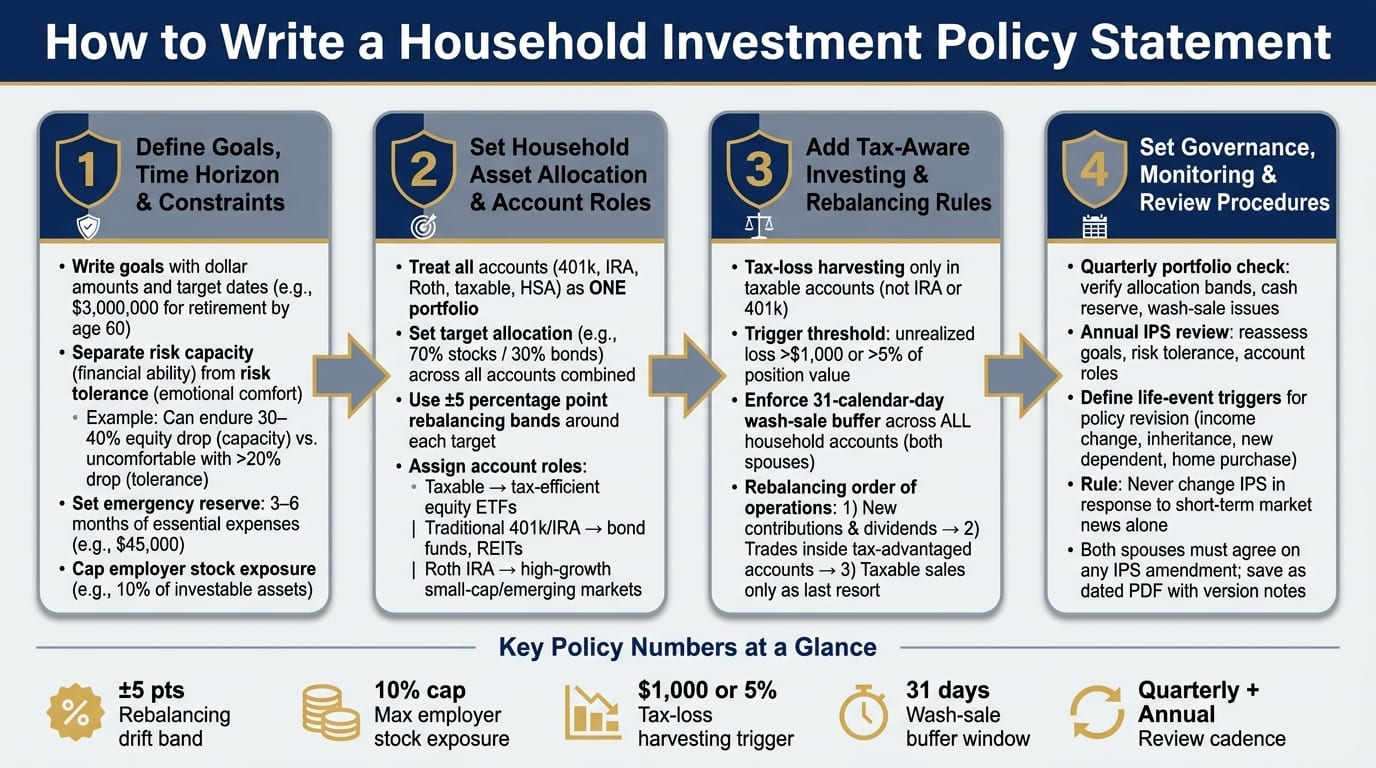
I’d sum up the whole article like this: a household investment policy statement may be a short written set of rules for goals, risk, cash needs, account roles, taxes, rebalancing, and review timing. The point may be to make investing decisions with less guesswork, especially during market swings or when two partners see risk differently.
Here’s the full idea in plain English:
I may write goals with dollar amounts and target dates, such as $3,000,000 for retirement or $80,000 by 09/18/2028 for a home project
I may separate risk capacity from risk tolerance, because a household may have the money to handle a 30%–40% stock-market drop but still feel uneasy with that ride
I may list cash needs and limits first, including an emergency reserve like 3 to 6 months of core expenses
I may set one household allocation, such as 70% stocks / 30% bonds, with drift bands like ±5 percentage points
I may give each account a role: taxable for tax-aware stock funds, pre-tax retirement accounts for bond holdings, and Roth space for higher-growth assets
I may add tax rules, including tax-loss harvesting only in taxable accounts and a 31-day wash-sale buffer across both spouses’ accounts
I may rebalance in an order that starts with new contributions, then retirement-account trades, and only then taxable sales if needed
I may set review rules, like a quarterly check and a yearly policy review, while avoiding changes based on short-term news alone
The big takeaway: this article is not about picking hot funds or guessing markets. It’s about writing a simple household rulebook that may keep taxable, IRA, 401(k), Roth, and cash decisions lined up under one plan.
A few numbers from the article stand out:
±5 percentage points for rebalancing bands
10% cap as one example for employer stock exposure
$1,000 or 5% unrealized loss as a sample tax-loss harvesting trigger
31 calendar days to avoid wash-sale trouble after harvesting a loss
Quarterly checks and an annual review as one sample schedule
If I wanted the shortest possible version, it would be this:
Write down what the money may be for
Set risk limits and cash minimums
Treat all accounts as one portfolio
Decide where each asset type may live
Add tax and rebalancing rules
Decide who reviews the plan and when
This gives the reader the full map up front, then the article walks through each part in more detail.
What is an Investment Policy Statement? Here's Why It Matters!
Step 1: Define goals, time horizon, and household constraints
Write down what the money may be for before setting a single allocation percentage. This step pushes you to get specific about what you may want to accomplish, when the money may be needed, and what limits may shape how you invest.
Write goals with dollar amounts and target dates
Vague goals like save for retirement or fund college don't give you much to work with. A useful IPS goal statement includes a dollar amount, a deadline, and the account or bucket that may fund it.
Here are three examples of clearer goal statements:
Retirement: Aim to accumulate $3,000,000 in the household's combined retirement accounts (traditional 401(k), Roth IRA, and taxable brokerage) by age 60 to support $120,000/year in pre-tax spending for at least 30 years.
College: We will fund $250,000 in a 529 plan for Child 1 by 09/01/2036, and $250,000 for Child 2 by 09/01/2039, to cover four years of tuition, fees, and living expenses at an in-state public university or equivalent.
Near-term spending: We will accumulate an $80,000 house renovation fund in our high-yield savings account by Sep. 18, 2028, separate from our emergency fund.
Different goals may call for different time horizons. Long-term goals may allow for more ups and downs. Near-term goals usually leave less room for that.
Once the goals are specific, test them against risk tolerance and liquidity needs.
Separate risk capacity from risk tolerance
Risk capacity refers to your financial ability to absorb losses. It may be tied to your time horizon, income stability, and how much of your spending may depend on the portfolio. Risk tolerance is your emotional willingness to sit through a 20% or 30% drop without selling. Your IPS may work better if it records both with numbers, not just labels.
For capacity, you might write: Given our savings, stable income, and 20-year retirement horizon, our household has high risk capacity; we can endure a temporary 30–40% decline in our equity portfolio without compromising essential goals. For tolerance, you might write: Alex has moderate risk tolerance and is uncomfortable with a yearly drop greater than 20%. Jordan has lower risk tolerance and prefers a portfolio unlikely to decline more than 15–20% in any single year.
When those two don't line up - and that may happen a lot - some households default to the more conservative number. A portfolio built for high capacity but low tolerance may be more likely to get dropped at the worst time. One way to turn this into a rule is to add a guardrail like: If the portfolio declines by more than 25% from a recent peak, we will hold a scheduled household review before making any changes, and will not sell equities solely due to short-term market fear.
Document liquidity, legal, and personal constraints
Constraints are the non-negotiables that may shape each implementation decision. Write them down before touching allocation or account structure.
Start with the emergency fund. A rule might look like this: We will maintain an emergency reserve equal to 6 months of essential expenses (currently $45,000) in FDIC-insured savings or money market accounts. Essential expenses include mortgage/rent, utilities, basic food, insurance, transportation, and minimum debt payments. If the emergency fund is used, we will prioritize replenishing it within 12 months by adjusting savings and discretionary spending until the target level is restored.
Beyond the emergency fund, note any other near-term cash needs, such as estimated tax payments, a scheduled tuition installment, a medical procedure, or a known large purchase. It may also make sense to set a cap on employer stock exposure. For example, RSUs and ESPP shares will not exceed 10% of total investable assets. If trading blackout periods apply across taxable, IRA, and 401(k) accounts, list those too. Add any ESG or charitable restrictions here as well.
These goals, time horizons, and constraints may shape the household's target allocation in Step 2.
Step 2: Set the household asset allocation and assign roles to each account
With your goals, time horizon, and limits written down, treat every account as part of one household portfolio. Then give each account a job as an implementation bucket. Step 1 gives you the inputs for this part: goals, time horizon, and risk capacity. From there, the household may choose its stock/bond mix. After that mix is set, the next move is deciding where each asset belongs for tax efficiency.
Set target allocation percentages and rebalance bands
Your IPS should list specific target weights for the household portfolio across all accounts combined. For example, a household with a long time horizon and strong risk capacity may target 75% equities and 25% fixed income. A more conservative household may use 60% equities and 40% fixed income. Inside the equity sleeve, the household may also split U.S. and international holdings, such as 60% U.S. and 40% international.
Once the targets are in place, use a ±5 percentage point band around each one. For example, if U.S. equities are targeted at 40%, the household would review whether that position has drifted outside a 35%–45% range.
Assign account roles across taxable, traditional, and Roth accounts
Once the household-level targets are set, assign each account a role based on tax treatment. That role shapes where each asset class belongs across taxable, IRA, and 401(k) accounts to reduce tax drag - not which investments to pick.
| Account Type | Common Household Role | Tax Treatment | Commonly Placed Asset Types | Trade Order |
|---|---|---|---|---|
| Taxable Brokerage | Liquidity and tax-efficient equity exposure | Dividends and interest taxed annually; capital gains taxed when realized | Broad stock index funds/ETFs, long-term individual stocks, municipal bond funds | Last |
| Traditional IRA / 401(k) | Core bond holdings and rebalancing hub | Tax-deferred growth; withdrawals taxed as ordinary income; RMDs apply | Bond funds, REITs, high-turnover funds or active funds | First |
| Roth IRA / Roth 401(k) | High-growth, long-term assets | After-tax contributions; qualified withdrawals generally tax-free; Roth IRAs currently have no RMDs for the original owner | Small-cap equity funds, emerging markets, other higher-growth equity funds | Second |
A common setup may look like this:
Use traditional accounts for tax-inefficient assets
Use taxable accounts for tax-efficient equities
Use Roth accounts for the highest-growth assets
Sample policy language for implementation
Write the rules in plain English so the household may follow them without guesswork:
The household portfolio target is 70% equities and 30% fixed income, measured across all accounts combined.
U.S. equities will represent approximately 60% of total equities, and international equities approximately 40% of total equities.
The household will review allocation at least annually.
Rebalance when any major asset class moves outside its tolerance band of ±5 percentage points from target.
Direct new contributions and reinvested dividends to the asset class currently furthest below target before selling appreciated positions.
Rebalance first in traditional 401(k) and IRA accounts.
Use taxable accounts for rebalancing only after tax-advantaged accounts are exhausted, and only after evaluating the tax cost of any sales.
Taxable brokerage accounts will primarily hold tax-efficient equity index funds and serve as the household's main source of liquidity.
Traditional accounts will primarily hold bond funds and other tax-inefficient or higher-turnover assets.
Roth accounts will primarily hold higher expected growth equity funds consistent with the household's overall risk profile.
Next, write the tax-aware rules that govern asset location, harvesting, and rebalancing order.
Step 3: Add tax-aware investing and rebalancing rules
Once your account roles are set, the next step is to write down the tax rules for placement, harvesting, and rebalancing across the full household portfolio.
Write asset location and tax-loss harvesting rules
Asset location means deciding which investments belong in which accounts with the goal of reducing your household's lifetime tax bill. In many cases, that may mean putting bond funds, REITs, and high-turnover funds in traditional accounts, keeping broad equity index funds in taxable accounts, and using Roth space for assets with more upside.
For tax-loss harvesting, your IPS should be very clear: harvesting only applies to taxable accounts. Selling at a loss inside an IRA or 401(k) does not create a usable capital loss. It may also help to set a minimum trigger so small moves don't lead to extra trading. For example, some households harvest only when an unrealized loss is more than $1,000 or 5% of the position's value.
Wash sales need household-wide coordination. Under IRS rules, if you sell a security at a loss and buy the same or a substantially identical security within 30 days before or after that sale in any account you or your spouse controls, the loss is disallowed. [1][2][3] That loss is permanently disallowed if the replacement purchase happens in an IRA or Roth IRA. [3][4][5] Because of that, many households track restricted securities in one shared log.
When we harvest a loss in a taxable account, neither spouse will purchase the same or substantially identical investment in any account - taxable, IRA, Roth, or 401(k) - for at least 31 calendar days. We will maintain a shared log of restricted tickers during each harvesting window.
Set a tax-efficient rebalancing order of operations
When your allocation drifts outside its tolerance band, the order you follow may matter just as much as the choice to rebalance. A written sequence may keep the household from making the easiest trade instead of the one with the lowest tax cost.
An IPS may spell out an order such as this:
Use new contributions and dividends first. Direct new money to the asset class that is furthest below target. If needed, turn off automatic dividend reinvestment so dividends may be used for rebalancing.
Rebalance inside tax-advantaged accounts next. Trades within a 401(k) or IRA do not create a current tax bill, so they may be the lowest-cost tool available for rebalancing.
Sell in taxable accounts only as a last resort. Before doing that, review the holding period, any available loss carryovers, and whether the drift may justify the tax cost.
We will sell taxable holdings only after using contributions, dividends, and retirement-account trades. If taxable-account sales are necessary, we will prioritize shares with the highest cost basis and prefer realizing long-term gains over short-term gains.
Tax rules by account type
Use the table below as a policy checklist when making household investment decisions.
| Account Type | Tax Treatment | Withdrawals | Common Use | TLH Eligible? | Wash Sale Risk |
|---|---|---|---|---|---|
| Taxable Brokerage | Dividends and interest taxed annually; realized gains taxed when sold | Long-term gains and qualified dividends taxed at 0%–20% (+ potential 3.8% NIIT); short-term gains taxed as ordinary income | Broad equity index funds, ETFs, international stocks (to preserve Foreign Tax Credit eligibility) | Yes | High - monitor all household accounts; disallowed loss is deferred |
| Traditional IRA / 401(k) | Tax-deferred; no annual tax on growth | Withdrawals taxed as ordinary income; RMDs required | Bond funds, REITs, high-turnover or actively managed funds | No | High - a retirement-account purchase can disallow a taxable loss |
| Roth IRA / Roth 401(k) | Tax-free growth | Qualified withdrawals tax-free; Roth IRAs have no RMDs for the original owner | Highest-growth equities: small-cap, emerging markets, aggressive equity funds | No | High - a retirement-account purchase can disallow a taxable loss |
Step 4: Set governance, monitoring, and review procedures
Once you’ve set allocation and tax rules, the next step is to write the review rules that keep them current. This part is about deciding who reviews the IPS, when they review it, and what may justify a change.
Define review schedule and change triggers
A simple setup may use two review cadences: a quarterly portfolio check and an annual IPS review. The quarterly check may confirm that your allocation stays within target bands, your cash reserve meets your minimum, and any tax-loss harvesting or wash-sale issues are addressed. The annual review may ask whether your goals, time horizon, risk tolerance, and account roles still fit your current situation. In practice, some households review quarterly and formally revise annually.
Your IPS may also name the household decision-makers and spell out their roles. One common setup uses one primary investment steward for day-to-day implementation, such as rebalancing trades and tracking realized gains, and one secondary steward who reviews the quarterly checklist with the primary steward and must agree to any IPS amendment. If spouses disagree, some households wait 30 days and revisit the change.
It also helps to list the life events that may justify revising the policy. Those may include:
A retirement date that shifts by several years
A major income change
An inheritance
A home purchase
A new dependent
A major health or legal event
The rule may be explicit: we will not change this investment policy in response to short-term market movements or news alone. Policy changes may be considered only when there is a major change in life circumstances.
Example household IPS language
Illustrative only.
| IPS Component | Sample Policy Language |
|---|---|
| Goals | Retire at 65 with a portfolio supporting $90,000/year in pre-tax spending (inflation-adjusted). Fund $150,000 per child (2026 dollars) for college starting 2038. |
| Risk limits | Equity allocation target: 65%, minimum 55%, maximum 75%. No single stock position above 5% of household investable assets, excluding employer stock, which follows a separate diversification plan. |
| Target allocation | 65% stocks (45% U.S. / 20% international), 30% bonds (investment-grade, short-to-intermediate term), 5% cash. |
| Account roles | Taxable: broad U.S. and international equity ETFs, used for tax-loss harvesting and near- to medium-term goals. Traditional 401(k)/IRA: bond funds and REITs. Roth IRA: small-cap and growth equity funds. |
| Liquidity minimum | Maintain 3–6 months of essential expenses in a high-yield savings account, separate from long-term investments. |
| Rebalancing rule | Review quarterly; rebalance when any major asset class drifts more than ±5 percentage points from target. |
| Review schedule | Quarterly portfolio check; annual IPS review each January; immediate review on defined life-change triggers. |
| Governance | Both spouses must agree on any IPS amendment. Changes are saved as a dated PDF with version notes (e.g., "IPS v1.2 – updated after 2026 home purchase"). |
Conclusion: A written policy makes shared investing decisions faster and more consistent
A household IPS doesn’t need to be long. It just needs to be clear enough that all decision-makers may apply it the same way.
That usually means putting the key rules in plain English: define goals with dollar amounts and dates, treat all accounts as one portfolio, assign each account a specific role, write down tax-aware rebalancing rules, and set a review schedule you’re likely to follow.
FAQs
How long should a household IPS be?
A household IPS doesn't have a fixed term. It's usually treated as a living document, reviewed on a regular basis and updated when circumstances change.
For many households, a yearly review may be enough to keep it aligned with long-term goals. But some situations may call for a fresh look right away, such as:
a job change or rollover
a major income increase
getting closer to retirement
The idea is pretty simple: when life shifts, your plan may need to shift with it.
Can we use one IPS if we have different risk tolerances?
Yes. A household may use one Investment Policy Statement (IPS) even if spouses have different risk tolerances.
The IPS may serve as a way to work through those differences. It may spell out each partner’s concerns, line up shared goals, and, when needed, allow separate asset allocations for individual accounts while still supporting the household’s overall strategy.
That matters for a simple reason: money disagreements may drift into every other part of life. A written plan may give both people something steady to point to when markets move or emotions run high.
Clear communication is key. It may keep decisions more consistent and may reduce conflict over time.
When should we update our household IPS?
Review your household Investment Policy Statement at least once a year so it may stay aligned with your financial goals.
It may also make sense to revisit it sooner after major life events. That may include a large income increase, a job change that leads to a 401(k) rollover, or getting closer to retirement. These check-ins may give you a chance to adjust for tax law changes, market shifts, and changes in your financial situation.
Disclosures:
This content is for informational purposes only and does not constitute investment advice or a recommendation to buy or sell any security.
Past performance is not indicative of future results. No guarantee of future performance or outcomes is implied.