
Which investment platform suits you? If you're an experienced investor managing a diverse portfolio, Mezzi offers AI-driven insights to optimize taxes, rebalance, and manage risks across accounts without moving your assets. For beginners, Stash simplifies investing with tools like fractional shares, automated portfolios, and educational resources to help you start small and grow over time.
Key Differences:
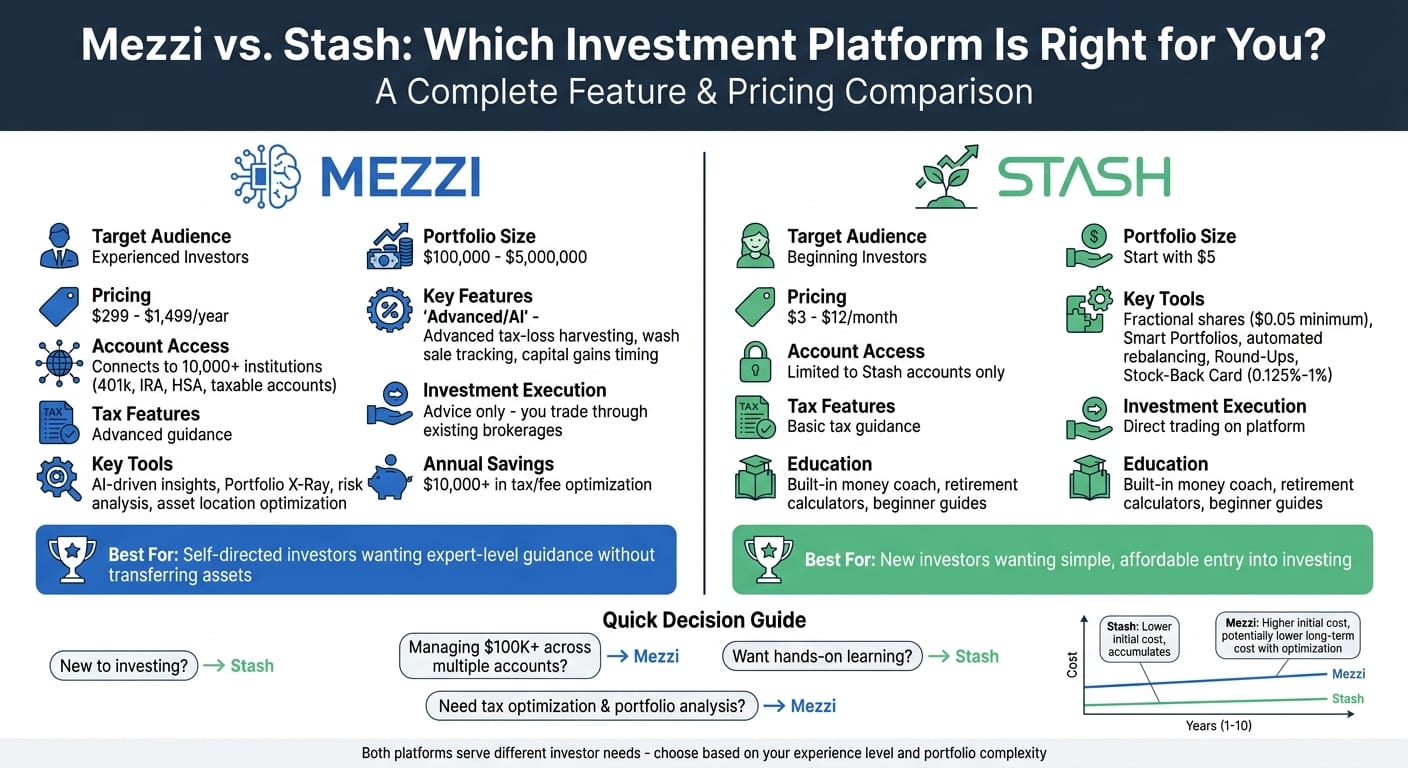
- Mezzi: Tailored for experienced investors with portfolios of $100,000–$5,000,000. It connects to over 10,000 institutions, offering tax strategies, portfolio analysis, and advanced AI tools for an annual fee starting at $299.
- Stash: Designed for beginners, it focuses on ease of use with features like micro-investing, automated rebalancing, and educational tools. Pricing starts at $3/month.
Quick Comparison:
FeatureMezziStashTarget AudienceExperienced investorsBeginnersPricingFree to get started; Advisory offers unlimited advice and advanced features for $39/month or $399/year; Concierge adds hands-on support for $99/month or $999/year$3–$12/monthAccount AccessConnects existing accounts (401(k), IRA)Limited to Stash accountsTax StrategiesAdvanced tools (e.g., tax-loss tracking)Basic tax guidanceInvestment ToolsAI-driven insights, risk analysisAutomated portfolios, fractional shares
Mezzi is ideal for those who want expert-level guidance without transferring assets, while Stash is perfect for anyone new to investing who wants a simple, affordable way to get started.
How Mezzi and Stash Approach Investing

Mezzi: AI-Driven Advice for Self-Managers
Mezzi offers a high-tech solution for investors who prefer managing their own portfolios but still want expert-level guidance. By securely connecting to your accounts with read-only access, Mezzi provides insights without moving your assets. It links to various account types like 401(k)s, Roth IRAs, and taxable brokerage accounts, giving you a comprehensive view of your financial landscape.
What sets Mezzi apart is its ability to analyze all your accounts together. Unlike traditional advisors, who typically focus only on assets they manage, Mezzi examines your entire portfolio. This allows it to highlight risks like wash sales across accounts or overlapping ETF holdings. The platform uses AI to deliver personalized advice on tax strategies, rebalancing without selling, and retirement planning - tailored to your actual financial data, not generic models. The best part? You stay in control, deciding when and how to act on the recommendations.
This approach is ideal for experienced investors who want a complete, data-driven view of their finances. On the other hand, Stash caters to those just starting their investing journey.
Stash: Making Investing Easy for Beginners
Stash takes a different route by focusing on simplicity and accessibility, making it perfect for new investors. One of its standout features is fractional shares, which let you start building a portfolio with just a small amount of money.
The platform also prioritizes education, helping users understand the basics of investing while they put their money to work. Through a combination of beginner-friendly content and tools, Stash teaches essential skills like portfolio building and consistent investing habits. Its automated features handle complex tasks like asset allocation and rebalancing, so users can focus on learning and growing their investments without feeling overwhelmed.
This user-friendly approach makes Stash an excellent choice for those dipping their toes into the market for the first time, offering a guided experience that builds confidence as they learn. Both platforms cater to different types of investors, which we’ll explore further in the feature comparison section.
Mezzi vs. Stash: Feature Comparison
Features Compared
After exploring the investing methodologies of Mezzi and Stash, let's dive into a side-by-side breakdown of their standout features.
Mezzi offers a comprehensive approach, pulling data from multiple account types - like 401(k)s, IRAs, HSAs, and taxable accounts - across more than 10,000 financial institutions through read-only access. This enables users to uncover risks such as wash sales and overlapping exposures. On the other hand, Stash focuses solely on accounts opened within its platform, offering a more limited scope. Here's how the two platforms stack up:
FeatureMezziStashAccount AggregationRead-only access to 401(k), IRA, HSA, and taxable accounts from over 10,000 institutionsLimited to Stash accounts onlyTax OptimizationYear-round insights for tax-loss harvesting, wash sale tracking, and capital gains timingBasic tax guidance; no tax-loss harvestingPortfolio AnalysisExposure X-Ray tool to identify overlapping stock concentrations in ETFs and fundsNot availableAI-Driven InsightsTailored financial advice based on connected account dataRelies on educational content and basic guidance, not AI-drivenUser InterfaceBuilt for experienced, self-directed investors managing portfolios of $100,000–$5,000,000Simplified interface aimed at beginnersInvestment ExecutionProvides actionable advice while allowing trades through existing brokeragesFacilitates trades directly on the platform
This comparison highlights Mezzi's focus on data-driven insights and advanced tools, catering to more experienced investors. In contrast, Stash simplifies the process for beginners, offering a more straightforward experience.
For instance, Mezzi users have reported saving over $1,000 annually in tax and fee costs, though actual savings will vary based on individual circumstances. Its Exposure X-Ray feature is a game-changer, helping investors uncover overlapping holdings within ETFs and funds - something Stash doesn’t provide. These differences make Mezzi a better fit for those seeking a detailed, strategic approach to investing, while Stash appeals to those just starting out.
Pricing: Mezzi vs. Stash
Cost Breakdown
When it comes to pricing, Mezzi and Stash take very different approaches. Stash opts for a monthly subscription model starting at $3 per month, making it appealing to beginners or those with smaller account balances. Mezzi is free to get started. Choose Advisory for unlimited advice and advanced features at $39/month or $399/year. Concierge includes the same, plus hands-on support, at $99/month or $999/year.
For investors with limited funds, Stash's $3 monthly fee (totaling $36 annually) might seem budget-friendly, but it can represent a noticeable percentage of smaller portfolios. Conversely, Mezzi's $39/month or $399/year starting fee is geared toward individuals with more substantial, diversified portfolios across multiple accounts.
To put this into perspective, Mezzi claims that its tax optimization and fee-reduction tools can potentially save investors with a $1 million portfolio between $10,000 and $20,000 annually, depending on individual circumstances. This is significant when compared to traditional advisors who charge 1% of assets under management (AUM) - a fee that could drain over $1.3 million in wealth over a 30-year period.
Here’s a quick comparison of the pricing and features:
Plan NameMezzi Pricing (USD/year)Stash Pricing (USD/month)Key FeaturesBase Plan$39/month or $399/year$3AI advice & tax optimization; includes $1K life insuranceMid-Tier$99/month or $999/year$12Advanced AI models & priority support; Kids Portfolios, 3% IRA match, 1% Stock-BackPremium$99/month or $999/yearNot offeredUnlimited calls with Mezzi team & hands-on AI support
Stash’s monthly billing structure keeps upfront costs low, which may appeal to newer investors. Mezzi, however, focuses on long-term wealth management, offering annual or semi-annual billing options. For example, Mezzi’s Advisory costs $39/month or $399/year or $39/month or $399/year if paid semi-annually. This approach reflects Mezzi’s emphasis on a more comprehensive, long-term strategy for managing wealth, setting the stage for the next section's deeper dive into its investment tools.
Investment Tools and User Experience
Mezzi's Advanced Tools and Customization
For investors who like to dive deep into their finances, Mezzi offers a powerful dashboard that consolidates all your financial accounts - 401(k)s, IRAs, taxable brokerage accounts, and even bank accounts - using read-only access. This setup gives you a complete view of your financial landscape without needing to move assets or juggle multiple apps.
Mezzi’s AI chat assistant is another standout feature. You can ask detailed questions at any hour - yes, even at 1 a.m. - and get tailored answers in minutes. The platform also provides real-time buy and sell signals, complete with key metrics, all accessible directly within the app.
One of Mezzi’s highlights is its Portfolio X-Ray tool, which uncovers hidden overlaps in your ETF and mutual fund holdings. On top of that, it offers year-round tax-loss harvesting, tracks wash sales, and suggests portfolio rebalancing strategies - though the actual execution remains entirely up to you. Now, let’s see how Stash’s more straightforward approach compares to these advanced offerings.
Stash's Simple Interface and Automation
In contrast to Mezzi's detailed tools, Stash focuses on simplicity, catering to those just starting their investment journey. With as little as $5, you can begin investing in Stash's Smart Portfolios, which handle both automated investing and rebalancing for you.
Stash includes features designed to make investing feel easy. For example, its "Round-Ups" tool invests spare change from your everyday purchases, while the Stock-Back Card rewards your spending with fractional shares (0.125% for Growth members and 1% for Stash+ members). Additionally, its AI-powered "money coach" offers educational resources, retirement calculators, and beginner-friendly guides to help new investors learn the ropes.
"Stash is a good robo to consider if you're a beginner who wants to dip your toes into picking your own investments but don't quite feel ready to pick all your investments on your own." - Bella Avila, Editor, Investing & Taxes
That said, Stash’s simplicity comes with trade-offs. Its tools are primarily designed for assets held within the platform, meaning it doesn’t offer the advanced tax strategies or comprehensive portfolio tracking that Mezzi provides. For those managing more complex portfolios across multiple accounts, Stash may fall short. However, its streamlined features are ideal for beginners looking to ease into investing without feeling overwhelmed.
Tax Optimization: Mezzi vs. Stash
Tax Features Compared
Mezzi takes tax optimization to another level by continuously monitoring your portfolio for tax-saving opportunities throughout the year - not just during tax season. This constant vigilance helps you take advantage of market dips by capturing losses before they recover, potentially creating savings that can grow over time.
With daily tracking, Mezzi keeps an eye on your holdings and provides alerts as positions approach the one-year mark, allowing you to benefit from lower long-term capital gains rates. It also monitors wash sale risks across all your connected accounts via Plaid, notifying you when the 30-day waiting period after a loss has passed.
Mezzi goes beyond just tax-loss harvesting. It offers asset location advice by analyzing your Roth, Traditional, taxable, and 401(k) accounts to recommend where specific holdings should go for optimal tax efficiency. Michael Flatley, a wealth management expert at Farther, highlights the power of AI in this context:
What might take a human advisor hours to analyze, AI can do in seconds - capturing small tax savings that enhance after-tax returns.
On the other hand, Stash provides more basic tax tools. Its features are limited to assets held within its platform, meaning it lacks automated cross-account optimization. Stash does not offer wash sale tracking across multiple brokerages or provide tailored advice on placing assets in Roth versus taxable accounts.
StrategyMezzi ApproachStash ApproachTax-Loss HarvestingYear-round opportunities with daily monitoring Limited to basic tax considerationsWash Sale Risk TrackingTracks across all connected accounts via Plaid Not availableAsset Location AdviceAnalyzes Roth vs. Traditional placement Not availableHolding Period TrackingAlerts near one-year threshold for long-term gains Basic reporting
These differences highlight Mezzi's advanced tax strategies. For investors managing complex portfolios across multiple accounts, Mezzi's tools can uncover savings that may far outweigh the platform's cost. While Stash provides a solid starting point for beginners, Mezzi is tailored for those who want to maximize after-tax returns using sophisticated strategies. By delivering advisor-level insights without the typical 1% AUM fee, Mezzi proves to be an appealing choice for more experienced investors seeking a comprehensive approach.
Which Platform Fits Your Investor Profile?
Platform Recommendations by Investor Type
Choosing the right investment platform depends on your experience level and the kind of support you need to achieve your financial goals.
Stash is perfect for beginners who are just starting to build their wealth. You can begin investing with as little as $5, making it an approachable option for anyone new to the process. Its Smart Portfolio feature takes the guesswork out of investing by automatically allocating your funds based on your risk tolerance. Plus, fractional share investing starts at just $0.05, and the platform charges modest monthly fees, keeping costs manageable for those still learning the ropes.
For seasoned investors managing complex, diversified portfolios, Mezzi offers a more advanced solution. Mezzi is designed for self-directed investors who want to take control of their investments while benefiting from sophisticated insights. If you’re managing assets through major brokerages like Vanguard, Fidelity, or Schwab, Mezzi acts as an AI-powered assistant, providing a comprehensive view of your wealth. It connects to over 10,000 institutions via read-only access and identifies opportunities like tax-saving strategies, high-fee fund detection, and asset location optimization across Roth, Traditional, and taxable accounts - all without the hefty 1% AUM fee charged by traditional advisors.
Here’s how to decide: If you’re new to investing and want a simple, all-in-one experience to help you learn the basics, Stash is the way to go. On the other hand, if you’re comfortable managing your own investments but want expert-level guidance to fine-tune your strategies, Mezzi is your ideal partner.
Investor TypeBest FitWhySelf-Directed InvestorsMezziOffers advanced insights for managing multiple accounts and making informed decisionsBeginner InvestorsStashProvides easy-to-use tools and lowers barriers to entryPortfolio OptimizersMezziDelivers guidance on tax-loss harvesting, fee analysis, and asset location strategiesMicro-InvestorsStashEnables fractional share investing and builds habits with investments starting at $5
For individuals in higher tax brackets with holdings spread across various accounts, Mezzi’s tax optimization and comprehensive portfolio view can justify its Advisory cost of $39/month or $399/year. Meanwhile, if you’re starting from scratch, Stash offers a structured, beginner-friendly approach to kickstart your investment journey. These options make it clear which platform aligns best with your financial needs and goals.
Could an AI Co-pilot be Better Than Your Financial Advisor?
Conclusion: Choosing Between Mezzi and Stash
Deciding between Mezzi and Stash comes down to understanding your current investment needs and goals. Each platform is tailored to a specific type of investor, depending on where they are in their financial journey.
Stash is a great option for beginners. Its approachable design and educational tools make it easy for new investors to learn the ropes while building their first portfolio. On the other hand, Mezzi is built for more seasoned, self-directed investors. Priced at $39/month or $399/year, Mezzi provides fiduciary-level insights without charging the typical 1% AUM fee, which may result in significant savings for some users depending on their portfolio size and circumstances. By linking to your existing accounts via read-only access, Mezzi delivers a holistic view of your finances. It offers advice on tax-loss harvesting, flags wash sale risks, optimizes asset location, and evaluates fees - services that traditional advisors usually limit to directly managed assets.
These advanced features make Mezzi an excellent choice for those looking to fine-tune their investments and leverage sophisticated tax strategies. If you're confident in managing your own portfolio but want expert insights to boost efficiency, Mezzi is a powerful tool. However, if you're just starting out and need guidance to build confidence, Stash might be the better choice for you.
FAQs
Is Mezzi safe to connect to my accounts?
Mezzi takes your privacy and security seriously. It doesn't access your login details and operates with read-only permissions only. This means your accounts remain secure while Mezzi provides its services.
Do I have to move my money to use Mezzi?
No, you don’t have to move your money to use Mezzi. This platform is designed for digital wealth management, offering investment tools and performance tracking while letting you keep your funds where they are.
How do I know if Mezzi’s fee is worth it for my portfolio?
Deciding whether Mezzi’s fee is worth it comes down to a few key factors: the size of your portfolio, its complexity, and how much you value AI-driven management. Fees in the industry generally fall between 1-2% of assets under management. Mezzi offers features like personalized insights and tax optimization, which can make the cost worthwhile if they help you save time or improve returns.
That said, if you have a smaller portfolio or prefer a more hands-on approach to managing your investments, it’s worth considering whether the fee aligns with your specific needs and goals.
Disclosures:
- This content is for informational purposes only and does not constitute investment advice or a recommendation to buy or sell any security.
- Past performance is not indicative of future results. No guarantee of future performance or outcomes is implied.
- Savings and performance examples are hypothetical and for illustrative purposes only. Actual results will vary based on individual circumstances, portfolio composition, market conditions, and fees.
- The use of artificial intelligence and algorithmic tools does not guarantee investment results. These tools are subject to limitations, errors, and market conditions that may affect performance.
- Registration does not imply a certain level of skill or that the SEC has approved the company or its services.