
Short answer: maybe - but mostly for the free $1,000 seed deposit or employer money. For many families, a 529 plan may fit college savings better, a custodial Roth IRA may fit working teens better, and a brokerage or UTMA/UGMA account may fit open-ended goals better.
Here’s the simple version:
530A “Trump Account” may work best for long-term savings
529 plan may work best for education
UTMA/UGMA may work best for general spending for the child
Custodial Roth IRA may work best for teens with earned income
Taxable brokerage may work best when parents want to keep control
A few facts stand out right away:
The account launched on July 4, 2026
Eligible children born from January 1, 2025, to December 31, 2028 may get $1,000 from the U.S. Treasury
Family and friends may add up to $5,000 per year
Employer deposits may go up to $2,500 per year, within that same cap
The tradeoff may be tight withdrawal rules, limited investments, and tax-deferred growth instead of tax-free growth
If I had to boil the whole article down into one line, it would be this: the new child savings account may be worth opening for free money, but it may not be the first place many families add extra dollars.
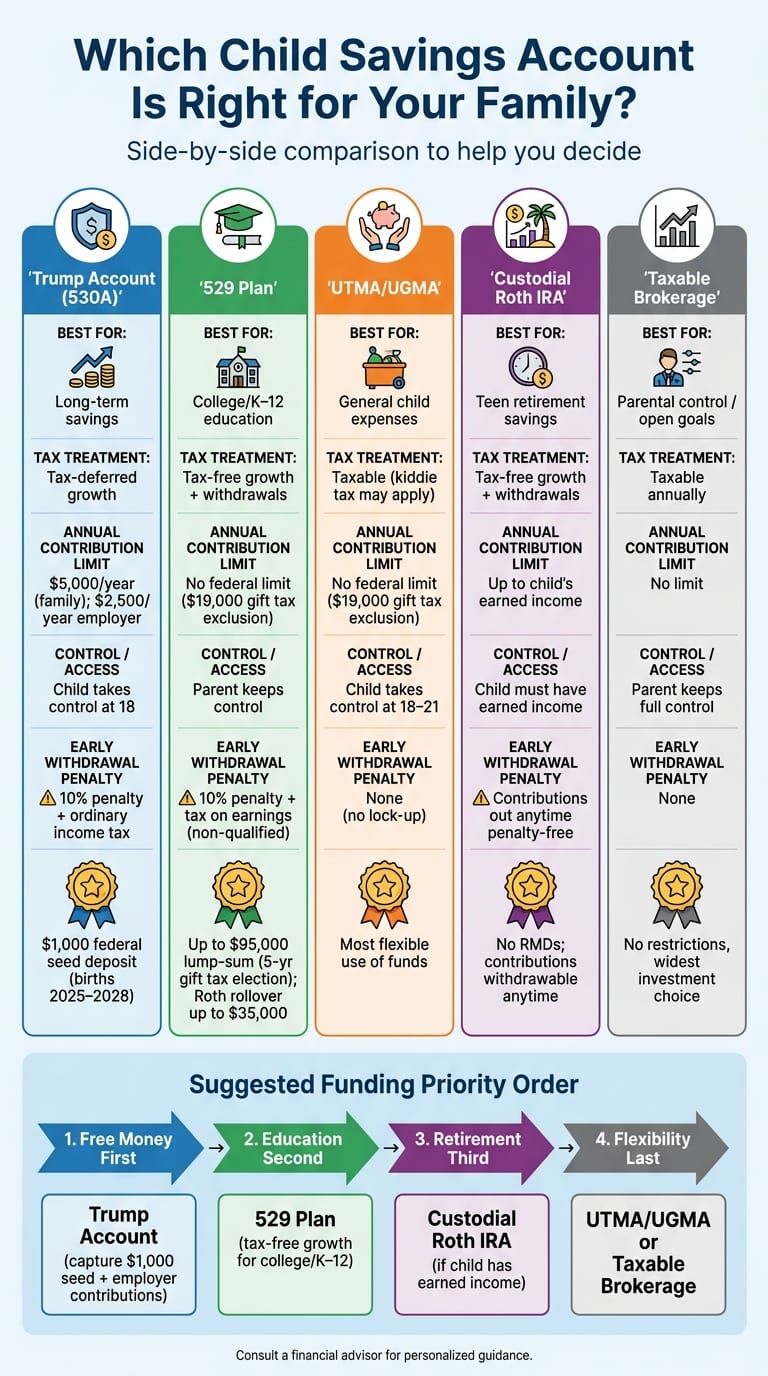
Don't Open a Trump Account Until You Compare These 7 Options
Quick Comparison
| Account | Main use | Tax treatment | Access/control | Main drawback |
|---|---|---|---|---|
| 530A / Trump Account | Long-term savings | Tax-deferred growth | Child takes control at 18; most early nonqualified withdrawals may face tax + 10% penalty | Less flexibility |
| 529 Plan | Education | Tax-free growth and qualified education withdrawals | Parent keeps control | Nonqualified earnings may face tax + 10% penalty |
| UTMA/UGMA | General child expenses | Taxable; may face kiddie tax | Child takes control at 18 or 21 | Less tax efficiency; may affect aid more |
| Custodial Roth IRA | Teen retirement savings | Tax-free growth; contributions may come out tax- and penalty-free | Child must have earned income | Narrow eligibility |
| Taxable Brokerage | Open-ended family goals | Taxable each year | Parent may keep full control | No special tax break |
So if you’re asking, “Should I fund the new account beyond the free $1,000?” the answer may depend on your goal, your child’s age, and how much access you may want later.
1. New Child Savings Account (Trump Account / 530A-style account)
For families, the key question may be simple: do the tax perks outweigh the limits?
The 530A account is a tax-advantaged account for minors that works a bit like a custodial IRA before age 18. All U.S. children under 18 with a valid Social Security number qualify [2][3].
Friends and family may contribute up to $5,000 per child per year. Employers may contribute up to $2,500 per year, and that amount counts toward the same $5,000 annual cap. Employer contributions are also excluded from the employee’s gross income [3][4].
There’s a catch, though. Contributions are not tax-deductible. Instead, the main tax feature is that the money grows tax-deferred [3][8].
Before age 18, the investment menu stays narrow. Funds are limited to low-cost mutual funds or ETFs that track broad U.S. equity indexes [3][5]. That may suit families who want a simple, hands-off setup. But it may feel restrictive for those who want more choice.
So the pitch is pretty clear:
Main upside: tax-deferred growth
Main downside: tight rules on access and investing
Access is also strict. Funds are locked until age 18, except in cases of death or to correct excess contributions. At that point, the account converts to a traditional IRA [2][3][4].
Withdrawals follow a split set of rules. Qualified withdrawals for education, a first home, or a business startup are penalty-free. Other withdrawals before age 59½ are taxed as ordinary income and may face a 10% penalty [2][4].
In plain English, this account may fit long-term savings better than short-term flexibility. That tradeoff may stand out even more next to a 529 plan, which is built for a different purpose and comes with a different set of rules.
2. 529 College Savings Plan
If the goal may be education, a 529 plan may be the cleanest fit. Any adult may open one for a child, and there’s no federal annual contribution limit [2]. Contributions still fall under gift-tax rules: the annual exclusion is $19,000 per recipient in 2026 [6], and families may use the 5-year front-loading election to contribute up to $95,000 for one beneficiary and treat that amount as spread over five years for gift-tax purposes [10]. Compared with the new child savings account, the 529 may be narrower in purpose, but it may offer more for education.
Money grows tax-free, and qualified withdrawals are federal-tax-free [1]. Qualified uses include:
Tuition
Room and board
Books
K–12 tuition up to $20,000 a year
Apprenticeships
Certifications
Many states may also offer income tax deductions or credits for contributions to a state-sponsored 529 plan [2].
"If your goal is education funding, this is a well-defined, rules-based system that's been in place for years." - Lacy Garcia, Founder & CEO, Willow [1]
The main tradeoff may be flexibility. Nonqualified withdrawals trigger ordinary income tax on earnings plus a 10% federal penalty [2][11]. Even so, there’s a useful safety valve: since 2024, unused 529 funds may be rolled into a Roth IRA for the beneficiary, up to a $35,000 lifetime limit, as long as the account has been open for at least 15 years [6].
The account owner keeps control. Unlike the 530A account - where the child takes over at 18 - the 529 account owner may change the beneficiary to another family member without penalty if plans change [6][3]. That kind of control may stand out most when you stack it up against a custodial account.
3. UTMA/UGMA Custodial Account
UGMA/UTMA accounts may offer more flexibility than the new child savings account, but they may be less tax-friendly and may get less favorable treatment for financial aid. These accounts let an adult manage assets for a minor, even though the minor owns the account [2][3]. UGMA accounts usually hold financial assets like cash, stocks, bonds, and mutual funds. UTMA accounts may also hold property, including real estate [2].
One big difference: UGMA/UTMA accounts have no federal contribution limit [2]. That said, the $19,000 annual gift tax exclusion per recipient still applies in 2026, so larger deposits above that amount may trigger federal gift tax reporting rules [6]. The money also isn't boxed into one use. Funds may be used for any purpose that benefits the child, not just education or retirement-related costs [2][6]. If the goal is broad use rather than tax treatment, that may matter a lot.
The tax side is less appealing than a 529. Earnings may be subject to the kiddie tax, and the account does not offer tax-free growth [9]. Because of that, custodial accounts may fit general-purpose savings more than college or retirement planning built around tax rules.
The main tradeoff comes down to control. Contributions are irrevocable, and the child takes control at age 18 or 21, depending on state law [2][3].
"A custodial account offers flexibility, but the child gains full control at the age of majority."
Custodial account balances count as student assets on the FAFSA, which may reduce aid eligibility more than a parent-owned 529 [9]. So while these accounts may give families more freedom in how the money gets used, they may be a weaker fit for retirement-focused saving.
4. Custodial Roth IRA
For families with a working teen, this account shifts the focus from general saving to retirement saving. There’s one big catch: the child needs earned income from a real job. And annual contributions may not go above the child’s earned income [2]. That rule makes this account more narrow than the other options here. Still, the tax treatment may make the tradeoff worth a look for some families.
Contributions go in with after-tax dollars, and any growth may be tax-free [2]. Roth IRAs also have no Required Minimum Distributions (RMDs), while the new child savings account follows traditional IRA rules that may require distributions starting at age 73 [4]. There’s also more flexibility on contributions: unlike the new child savings account, Roth IRA contributions may be withdrawn at any time without tax or penalty [3]. For children with earned income, that may make it the clearest option here when the goal leans toward retirement.
Families already using a 529 plan may have another path. Under current rules, unused 529 funds may be rolled into a Roth IRA for the beneficiary, up to a $35,000 lifetime cap, as long as the 529 account has been open for at least 15 years [6].
For working teens, this may be the strongest retirement-focused option in this comparison.
5. Taxable Brokerage Account
If the other accounts on this list feel too restrictive, a taxable brokerage account may be the most flexible option. There are no federal contribution limits, no rules for how the money must be used, and no withdrawal penalties [2][9]. For families juggling more than one future goal, that flexibility may be the main draw. The downside may show up at tax time.
The tradeoff is pretty simple: you may give up tax perks in exchange for more control. Dividends, interest, and capital gains may be taxed in the year they occur [9][11]. Investments held for more than one year may qualify for long-term capital gains rates, which are generally lower than ordinary income rates. If assets are sold before that one-year mark, those gains may be taxed as ordinary income. So there’s no tax deferral here, and no tax-free education withdrawals [9][11].
Ownership matters too. Parent-owned brokerage accounts avoid the kiddie-tax issue that may affect custodial versions. When a parent holds the account in their own name, they keep full control with no age-based handoff. In a custodial account, the child takes legal control of the assets at the age of majority, usually 18 or 21 depending on the state [3][9].
For families using a 529 for education, a taxable brokerage account may fill the gap for other goals. Custodial account balances are counted as student assets on the FAFSA and are assessed at a higher rate than parent assets, which may reduce financial aid eligibility more than a 529 would [9]. That may make a taxable brokerage account the fallback when flexibility matters more than tax breaks. From there, the next step may be figuring out which account lines up best with each family goal.
Which Account Fits Your Family's Goal?
No single account may fit every family. The better pick usually depends on what you want the money to do and how much control you may want to keep.
For college savings, the 529 may be the clearest fit. In that sense, it may serve as the benchmark for education funding.
For working teens with earned income, a Custodial Roth IRA may be the strongest match. Contributions are limited to what the child actually earns, but those contributions may be withdrawn tax-free at any time [2][9]. That may make it the most direct retirement-focused option in this group.
If broad flexibility matters most, a UTMA/UGMA custodial account may offer the most open-ended use of the money, as long as it benefits the child. The tradeoff is different: the child gets full control at the age of majority, usually 18 or 21 [2][9]. So the issue may be control, not flexibility.
If parents want to keep full control, a parent-owned taxable brokerage account may leave every option on the table. There’s no forced handoff to the child, but the tax perks tied to more specialized accounts may not apply [9].
| Goal | Best Fit | Why It Fits | Main Tradeoff |
|---|---|---|---|
| Saving for college | 529 Plan | Tax-free growth and withdrawals for education [1][6] | 10% penalty plus tax on earnings for non-qualified withdrawals [9] |
| Broad flexibility | UTMA/UGMA | Funds can be used for any purpose benefiting the child [2] | Child gains full control at 18 or 21; can reduce financial aid more than a parent-owned 529 [9][6] |
| Long-term savings with restrictions | Trump Account (530A) | Limited access before retirement age; $1,000 federal seed for eligible 2025–2028 births [2][3] | Child gains control at 18; 10% penalty on most withdrawals before 59½; limited to broad index funds [3][11] |
| Teen retirement head start | Custodial Roth IRA | Tax-free growth for decades; contributions can be withdrawn tax-free at any time [2][9] | Child must have verifiable earned income [9] |
| Keeping assets under parental control | Taxable Brokerage | Parent retains full ownership and can decide if and when to give the money [9] | No tax advantages; earnings are taxed annually [9] |
Some families may end up using more than one account. One common split may be a 529 for education and a Trump Account for long-term savings, especially if a child was born between January 1, 2025, and December 31, 2028, and qualifies for the $1,000 government seed [2][3]. That setup may separate education money from long-range savings, instead of asking one account to handle both. The next section breaks down the pros and cons of each account.
Pros and Cons of Each Account Type
If the goal-based comparison still leaves this as a close call, it may help to strip things down to the core tradeoffs: taxes, control, and flexibility. Using the Trump Account as the baseline makes those differences easier to see.
Here are the main distinctions at a glance:
| Account Type | Upside | Tradeoff | Best For |
|---|---|---|---|
| Trump Account (530A) | $1,000 federal seed deposit; tax-deferred growth; employer contributions excluded from employee taxable income [3] | Child gains control at 18; most withdrawals before 59½ may face tax and a 10% penalty; investment choices are narrow [3][11] | Long-term retirement savings |
| 529 Plan | Tax-free growth and qualified withdrawals for education [1][6] | 10% penalty plus taxes on earnings for non-qualified withdrawals [6][9] | Families with a clear college or K–12 tuition goal |
| UTMA/UGMA | No contribution limit; funds may be used for any child-benefiting expense [2][6] | Child takes control at 18 or 21, depending on state law; may affect financial aid more than a parent-owned account [6][9] | Flexible spending for goals like a first car or a business start |
| Custodial Roth IRA | Tax-free growth and tax-free withdrawals in retirement; contributions may be withdrawn tax- and penalty-free [2][3] | Child must have earned income from a real job; annual contribution limits apply [2][3] | Working teenagers who want a head start on retirement |
| Taxable Brokerage | Parent keeps control; no age-based transfer; widest investment flexibility [6][9] | No tax advantages; capital gains and dividends are taxed every year [6] | Parents who want maximum control or have uncertain goals |
The Trump Account’s long penalty window may be the biggest reason it appears less flexible than a 529, UTMA, Roth, or taxable brokerage account. That’s the sticking point. Money may go in with a retirement focus, and getting it out for other uses may come with friction.
The 529 may offer a bit more room than it used to, mostly because of the Roth rollover option. But that flexibility still has guardrails. The $35,000 cap and 15-year rule may limit how far that option goes.
That leaves one practical question: which account may make sense to fund first?
Is the New Child Savings Account Worth Funding?
Here’s the practical funding order that may follow from the comparison above.
A Trump Account may make sense first only when it unlocks free money. If your child was born between January 1, 2025, and December 31, 2028, opening the account may qualify for a $1,000 federal seed deposit. If your employer offers contributions to a 530A account, those deposits - up to $2,500 per year - are excluded from your gross income [3][8]. In those two cases, early funding may be worth a look. Outside them, other account types may come first.
For many families, a 529 plan may come first for education savings, with the Trump Account after that. If your state offers a tax deduction for 529 contributions, that may be one direct reason to put money into the 529 before adding to a Trump Account.
After education funding, the next issue may be retirement savings. If your child has earned income, a Custodial Roth IRA may come before extra Trump Account contributions because its growth and retirement withdrawals are tax-free rather than tax-deferred [2][9].
A simple way to think about the order:
Free money first
Education second
Retirement third
Flexibility last
| If Your Priority Is | Start With | Why |
|---|---|---|
| Capturing free money | Trump Account (530A) | $1,000 federal seed for children born 2025–2028, plus up to $2,500 in employer contributions excluded from gross income [3][8] |
| College or K–12 tuition | 529 Plan | Tax-free growth and withdrawals for qualified education expenses; potential state tax deductions [1][9] |
| Tax-free retirement savings | Custodial Roth IRA | Requires earned income, but growth and withdrawals in retirement are tax-free [2][9] |
| Maximum flexibility | UTMA/UGMA | No restrictions on how funds are used; broad investment flexibility [2][6] |
| Long-term savings before earned income exists | Trump Account (530A) | Converts to a traditional IRA at 18, with possible later IRA treatment [4][7] |
If you may plan to convert later, it may make sense to line up that move with the child’s earned income and tax bracket first.
FAQs
Who qualifies for the $1,000 seed deposit?
A child may qualify for the $1,000 federal seed deposit if they’re a U.S. citizen born between January 1, 2025, and December 31, 2028, and have a valid Social Security number.
To receive the deposit, an account must be formally opened for the child. That step may require action from a parent or legal guardian. Each eligible child may receive only one account and one seed deposit.
When should I choose a 529 instead?
A 529 plan may fit if your main goal is education funding. A 529 is built for that purpose. It offers tax-free growth and tax-free withdrawals for qualified education expenses, which may include college, K-12 tuition, and student loan repayments.
Compared with the 530A Trump Account, a 529 is designed specifically for education, has no contribution limits, and may also come with a state tax deduction or credit.
What happens if my child needs the money early?
Before age 18, access may be limited. In most cases, withdrawals may not be allowed during the growth period, aside from a few narrow situations, such as the account holder’s death or the correction of excess contributions.
At 18, the child gets full control of the account. But the account works like a traditional IRA, so withdrawals before age 59 1/2 may generally trigger income tax and a 10% penalty, unless an exception applies.
Disclosures:
This content is for informational purposes only and does not constitute investment advice or a recommendation to buy or sell any security.
Past performance is not indicative of future results. No guarantee of future performance or outcomes is implied.
Savings and performance examples are hypothetical and for illustrative purposes only. Actual results will vary based on individual circumstances, portfolio composition, market conditions, and fees.
Registration does not imply a certain level of skill or that the SEC has approved the company or its services.