The big change: the 2026 tax-bracket sunset may no longer be the main reason to rush a Roth conversion. After OBBBA, the federal 10%, 12%, 22%, 24%, 32%, 35%, and 37% brackets may stay in place under current law, so the question may shift from “How fast do I convert?” to “How much room do I have in my bracket this year?”
Here’s the short version:
Your Roth conversion window by age may not change.
Your yearly tax planning may be easier to model.
The best years for some people may still be the gap between retirement and RMDs at age 73 or 75.
What matters most each year may be your baseline taxable income and how much space may be left before the next bracket.
Other items - like Social Security, IRMAA, pensions, part-time income, state taxes, ACA subsidies, and the five-year rule - may still shrink that room.
A simple way to look at it:
Estimate your taxable income before any conversion.
Pick the highest tax bracket you may be willing to fill.
Some people convert only the amount that may fit inside that bracket.
Recheck next year, because inflation-adjusted bracket thresholds and your income may change.
One hypothetical example makes the point fast: if a married couple filing jointly has $180,000 of baseline taxable income in 2026, and the top of the 24% bracket is $408,900, they may have $228,900 of room before moving into the 32% bracket.
| Item | What may have changed | What may not have changed |
|---|---|---|
| 2026 bracket sunset | Removed under current law | Future tax law changes may still happen |
| Tax rates | Same seven-bracket structure may remain | Your personal tax bill may still vary |
| Conversion runway | More predictable year to year | Number of pre-RMD years may still be fixed by age |
| Annual conversion amount | May be easier to size | Other income and surtaxes may still limit room |
So the article’s core message is simple: OBBBA may make Roth conversion planning more predictable, but it may not give you more time. For many households, the main job may now be sizing conversions year by year, not racing a tax deadline.
What Permanent Brackets Change About Your Runway
Why the 'convert before the sunset' playbook no longer applies
Before OBBBA, Roth conversions were often pushed ahead of the 2026 sunset. OBBBA removed that deadline, so the focus may shift from moving fast to deciding how much bracket room to use in a given year.
That changes the frame in a pretty big way. Instead of trying to beat the tax-law clock, the main issue may be conversion size. In that sense, 2026 may look less like a last-call deadline and more like a planning year.
Permanent brackets mean more predictability, not more years
OBBBA does not add years to your runway. It removes the scheduled expiration.
Your usable conversion window may still depend on when you retire and when RMDs begin. And other income sources may shrink the space you have in a bracket year, including a pension, part-time income, Social Security, or Medicare IRMAA surcharges [2].
So "permanent" has a narrow meaning here. It means there is no scheduled expiration under current law, not that future changes are off the table.
2026 bracket thresholds: where conversion room actually sits
The 2026 standard deduction is $16,100 for single filers and $32,200 for married couples filing jointly, which may expand conversion room before taxable income reaches the brackets below [3]. The table shows the ceiling for each bracket. Your baseline income may determine how much room is actually left.
| Tax Rate | Single Filers | Married Filing Jointly |
|---|---|---|
| 10% | $0 – $12,400 | $0 – $24,800 |
| 12% | $12,401 – $50,400 | $24,801 – $100,800 |
| 22% | $50,401 – $107,450 | $100,801 – $214,900 |
| 24% | $107,451 – $204,450 | $214,901 – $408,900 |
| 32% | $204,451 – $259,650 | $408,901 – $519,300 |
| 35% | $259,651 – $648,350 | $519,301 – $778,000 |
| 37% | Over $648,350 | Over $778,000 |
Next, it may help to compare any conversion against your baseline taxable income before choosing which bracket to fill.
Roth IRA Conversion Strategy: How to Fill Your Tax Brackets Before RMDs and Cut Lifetime Taxes
How to Size Roth Conversions Under Permanent Brackets
Start by projecting your baseline taxable income
With the brackets now permanent, the main question each year may be simple: how much room do you have to work with?
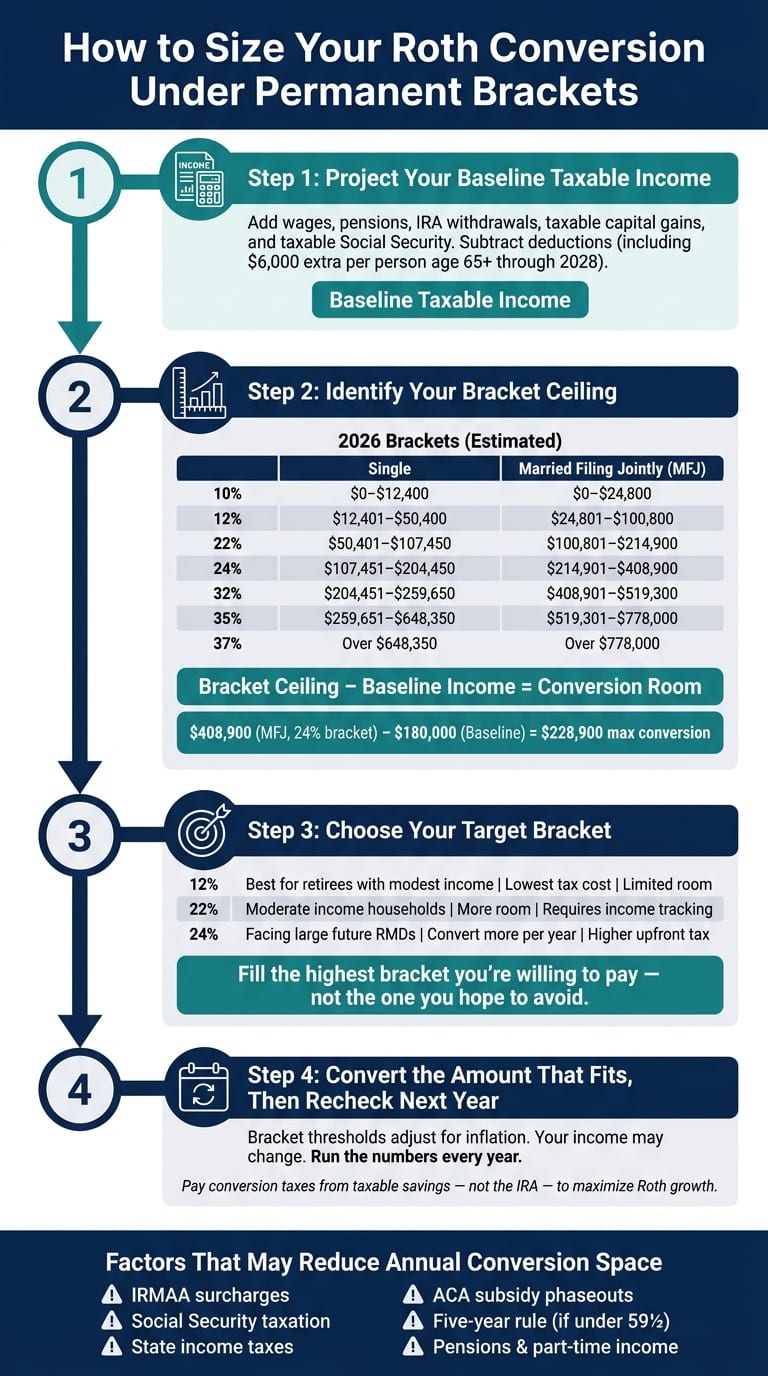
Start by estimating taxable income before any Roth conversion. That may include wages, pensions, IRA withdrawals, taxable capital gains, and taxable Social Security, minus deductions - including the additional $6,000 per-person deduction for taxpayers age 65 or older through 2028 [1][2].
What’s left is your baseline taxable income before conversion.
From there, conversion room is the gap between that baseline and the top of the bracket you want to fill. Once you know that number, you can decide how much bracket space you may want to use in a given year.
Pick the bracket you are willing to fill
The bracket you target may depend on a few things: your current income, your expected future income, and the size of your traditional IRA.
This table may help frame the tradeoffs:
| Target Bracket | Best Fit | Upside | Tradeoffs |
|---|---|---|---|
| 12% | Retirees with modest income | Lowest tax cost per dollar converted | Limited room each year, so large balances may take time to move |
| 22% | Households with moderate income | More room to convert without a big jump in rate | Requires careful income tracking |
| 24% | Taxpayers facing larger future RMDs | Lets you convert more each year | Higher upfront tax bill |
The key idea: some people frame this as the highest bracket they’re willing to fill, not the bracket they hope to avoid.
That target rate may shape the whole plan. For some households, one year may be enough. For others, it may make more sense to spread conversions across several years.
A hypothetical example showing the math
Example - Married couple with room in the 24% bracket
Suppose a married filing jointly couple has baseline taxable income of $180,000 before conversion. The 2026 top of the 24% bracket for married filing jointly is $408,900. Their conversion room in that bracket would be:
$408,900 − $180,000 = $228,900
So, $228,900 may be the maximum amount they could convert without moving into the 32% rate.
That math may look straightforward on paper. The harder part, for many people, is deciding whether to use that room all at once or spread conversions over a longer period.
How to Spread Conversions Across Multiple Years
The most flexible conversion years are before Social Security and RMDs begin
Once you know your bracket room, the next question may be how many years you have to use it. Bracket math may only cover half the call; timing may shape the result.
OBBBA does not lengthen the runway. It may make the annual conversion decision more predictable. The sunset is gone, but the yearly sizing question remains.
That gap between retirement and your first Social Security or RMD payment usually comes with lower baseline income. That may leave more room in the bracket you're targeting.
Short runway vs. long runway: what changes
Those two windows may call for different annual conversion sizes.
| Feature | Short Runway (Retire 70, RMDs 73) | Long Runway (Retire 60, RMDs 75) |
|---|---|---|
| Years Available | ~3 years | ~15 years |
| Conversion Pace | Large chunks; limited flexibility | Smaller amounts spread across years |
| Main Limits | Immediate IRMAA impact; Social Security income | 5-year rule if under 59½; ACA subsidy limits |
That difference in runway may shape whether you convert in large chunks or spread conversions across years.
With a short runway, some people may decide to accept a higher bracket to move a meaningful amount before RMDs force the issue. With a long runway, some people may fill lower brackets year after year, which may be more tax-efficient over time.
Paying the conversion tax from taxable savings, not the IRA, may allow the full conversion amount to land in the Roth.
What can still reduce annual conversion room
IRMAA, state taxes, phaseouts, and the five-year rule may still reduce how much you convert each year. Each one may shape how much of a given bracket you may actually use.
The next step is turning runway length into a simple annual conversion rule.
Conclusion: A Simple Framework for Deciding Whether to Convert
Once you know your bracket room, the choice may come down to timing: use that room now, or spread conversions across future years. OBBBA removed the 2026 bracket sunset, so Roth conversions may depend less on beating a deadline and more on how much bracket room you may have each year before Social Security and RMDs reduce it [1][2]. The runway may be more predictable, not longer.
Project your baseline taxable income. Measure the bracket room left. Some people convert only the amount that fits their target bracket. Then check the numbers again next year, because income may change, and your room may change with it.
That yearly review may be easier when your income and account data sit in one place. Mezzi may help you see your actual income and bracket room by pulling your connected accounts into a single read-only view.
Project income. Know how much room is left in your chosen bracket. Recheck the numbers next year.
FAQs
Does OBBBA make my Roth conversion window longer?
Not necessarily. OBBBA does not change the physical length of your Roth conversion window, but it may make that window more stable and predictable.
By permanently locking in the historically low tax rates from the 2017 Tax Cuts and Jobs Act, it may reduce uncertainty around the return of higher tax brackets. That may make it easier for some people to plan Roth conversions across several years with more confidence.
How do I calculate my bracket room for a conversion?
Find the top end of your target tax bracket, then subtract your projected taxable income for the year. What’s left may be your available bracket room for a Roth conversion.
When estimating taxable income, include all income sources, such as wages, dividends, and distributions. Some people also leave a $5,000 to $10,000 buffer for year-end income that may come in higher than expected. If IRMAA may apply to your situation, it may also make sense to check those thresholds as part of the estimate.
Should I convert before Social Security or RMDs start?
It may be worth considering. The years between retirement and the start of Social Security or required minimum distributions (RMDs) may be a strong window for Roth conversions because your taxable income may be lower.
Converting during those gap years may help you stay in lower tax brackets before mandatory income rises. It may also reduce future IRA balances, which may lower future RMDs, taxable income, and potential Medicare IRMAA surcharges.
Disclosures:
This content is for informational purposes only and does not constitute investment advice or a recommendation to buy or sell any security.
Past performance is not indicative of future results. No guarantee of future performance or outcomes is implied.