
A big retirement bill may not need to change your whole income plan. I’d sum it up this way: define the cost, set cash aside for that one bill, pick the account that may create the least tax friction, and then reset your plan after the payment.
A few numbers show why this matters. Research cited in the article says 83% of households may face at least one surprise expense each year, and the typical retired household may spend about 10% of annual income on those costs. And there’s a big difference between a one-time $30,000 hit and adding $2,500 per month to spending, which may turn into $30,000 per year before inflation.
Here’s the short version:
Name the expense correctly: one-time, irregular, or part of your normal budget
Estimate the full bill: quote, tax, fees, permits, deductibles, and a cushion
Check timing: due date, deposit schedule, and whether payment may be split
Pressure-test the plan: what if the cost runs 15% to 25% higher or the market drops?
Use a separate reserve: avoid turning a single bill into a monthly spending jump
Match the money to the timeline: cash and cash-like holdings may fit near-term bills better than stocks
Compare funding sources: cash, brokerage, IRA, Roth, HSA, or borrowing may each have different tax effects
Watch taxes and Medicare: a large IRA withdrawal may affect taxable income, Social Security taxation, and IRMAA later
Reset after payment: refill reserves, rebalance if needed, and update projections
A simple way to think about it: the bill itself may be only part of the cost. The other part may come from bad timing, extra tax, or selling investments at the wrong moment. That’s why the article focuses less on the expense alone and more on how the money gets sourced and staged.
If I were reducing the whole piece to one line, it would be this: treat a large one-time expense as a separate project, not as a reason to permanently increase retirement withdrawals.
Planning for Large Costs in Retirement | Beyond the 4% Rule
Define the expense and check whether it fits your retirement plan
Start by labeling the expense the right way. Recurring costs belong in your budget. Irregular costs may call for a separate reserve. A true one-time expense may need its own funding plan. If you label it wrong, you may take money out too early or come up short when the bill lands.
Once you define the expense, line it up against every other big cost on your calendar. That side-by-side check may show whether this bill fits cleanly into the rest of your retirement plan or whether the timing may get tight.
Document the full cost, timing, and payment flexibility
The quote may not be the full number. A complete estimate may also include taxes, permits, installation, deductibles, financing charges, and a contingency buffer. So a $20,000 home repair may be tracked with a planning range of about $17,000–$25,000, with a cash target up to $25,000.
For retirement planning, the key number may be the amount that needs to be available on the payment date, not just the quote on paper.
Timing matters. So does flexibility. Some expenses come with a hard deadline, like a medical bill, a tax payment, or a repair that may get worse if delayed. Others may have more room. A vehicle purchase may be pushed back. A renovation may be split into a deposit and a final payment. Spreading payments across months, or even across two calendar years, may reduce the need to sell investments during a market drop. That said, this may only make sense if it doesn't increase the total cost or create tax or financing issues.
Use a one-time expense worksheet before withdrawing funds
If you have more than one big expense coming up, compare them before you move any money. That may help you avoid a common problem: paying each bill one at a time, then finding out the cash left for living costs may be too low.
| Expense | Estimated Cost | Low-to-High Range | Due Date | Flexibility | Funding Priority |
|---|---|---|---|---|---|
| Roof replacement | $20,000 | $17,000–$25,000 | June 2027 | Can delay 3–6 months | High |
| Replacement vehicle | $32,000 | $25,000–$40,000 | Within 12 months | Can buy used or delay | Medium |
| Dental treatment | $8,000 | $6,000–$10,000 | March 2027 | May stage treatment | High |
| Family assistance | $15,000 | $10,000–$15,000 | Flexible | Can reduce or divide gift | Low to medium |
Rank each expense by need, deadline, and what may happen if you wait. A repair that gets worse over time may cost more later. A gift may wait. Looking at everything in one place may also show whether the total of several expenses is more than what's available without affecting the rest of the plan. From there, check whether the timing still holds up if the bill comes in higher or the market is weaker.
Stress test the plan before committing
Before you commit, test the plan under pressure. Run at least three scenarios:
The final bill comes in 15% higher than expected
The bill comes in 25% higher
The market drops before the payment date
A planned $30,000 expense should also be checked at about $34,500 to $37,500 to see whether the plan may absorb normal estimating error.
This stress test should also check whether paying the expense may leave you short on basics, including monthly living costs, quarterly estimated taxes, insurance premiums, healthcare out-of-pocket costs, and required minimum distributions if you're 73 or older. A portfolio balance may not be the same thing as cash available to spend in the next 12 to 24 months. If the plan still holds up, the next step may be deciding where to keep the money until you need it.
Build a dedicated cash reserve instead of raising ongoing withdrawals
Once the expense passes the stress test, set the money aside instead of lifting your monthly withdrawal. The goal is simple: keep a one-time cost from turning into a permanent spending increase.
It may help to use three separate buckets:
Routine cash for near-term bills
Emergency reserve for surprises
Sinking fund for one known future expense
Keeping these buckets separate may reduce the odds that a single bill quietly resets your monthly spending. A sinking fund is money set aside for one known future cost, so a one-time bill does not raise your monthly spending.
Match where you keep the money to when you need it
Where the reserve may belong depends on timing.
If the bill is due within days or weeks, the money may belong in checking or a high-yield savings account. If the payment is several months out, a money market fund or a Treasury bill maturing near the payment date may fit. Treasury bills are available in maturities from 4 to 52 weeks,[4][5] which may make it practical to line up a bill's maturity with a contractor's payment schedule or a planned purchase date.
If the expense is farther out and the payment date is flexible, and you have other liquid reserves, a short-duration bond fund may be considered - but only if you can tolerate the chance that the value may dip before you sell.
Trading payment certainty for a higher return carries risk, since a market drop right before payment is due may leave you short.
Compare cash, cash equivalents, bonds, and invested assets
The table below shows how common options may stack up when the expense is due within one year.
| Option | Liquidity | Volatility | Potential Return | Suitability for Expense Due Within 1 Year | Key Tradeoff |
|---|---|---|---|---|---|
| Checking / high-yield savings | Immediate | Very low | Low to moderate | Best for imminent bills or uncertain payment dates | Rates may change; large balances may exceed insurance limits |
| Government money market fund | Generally daily business-day liquidity | Low, but not risk-free | Tied to short-term rates | Good for needs within 6–12 months | Not a bank deposit or FDIC-insured; subject to fund rules and processing times |
| Treasury bills | At maturity; earlier sale possible | Very low if held to maturity | Short-term Treasury yield | Good when the maturity may be matched to the payment date | Less flexible if cash is needed before maturity |
| Short-duration bond fund | Usually daily | Low to moderate | Potentially higher than cash | Limited - only if timing is flexible and losses are acceptable | Share price may fall; no guaranteed maturity value |
| Stocks or balanced portfolio | Generally liquid, but timing may work against you | Moderate to high | Highest long-term expected return | Unsuitable for a bill due within one year | A market drop may force a sale at a loss right before payment |
Next, choose the account to withdraw from so the reserve does not create unnecessary taxes.
Choose the right account to pull from: taxable, tax-deferred, or Roth
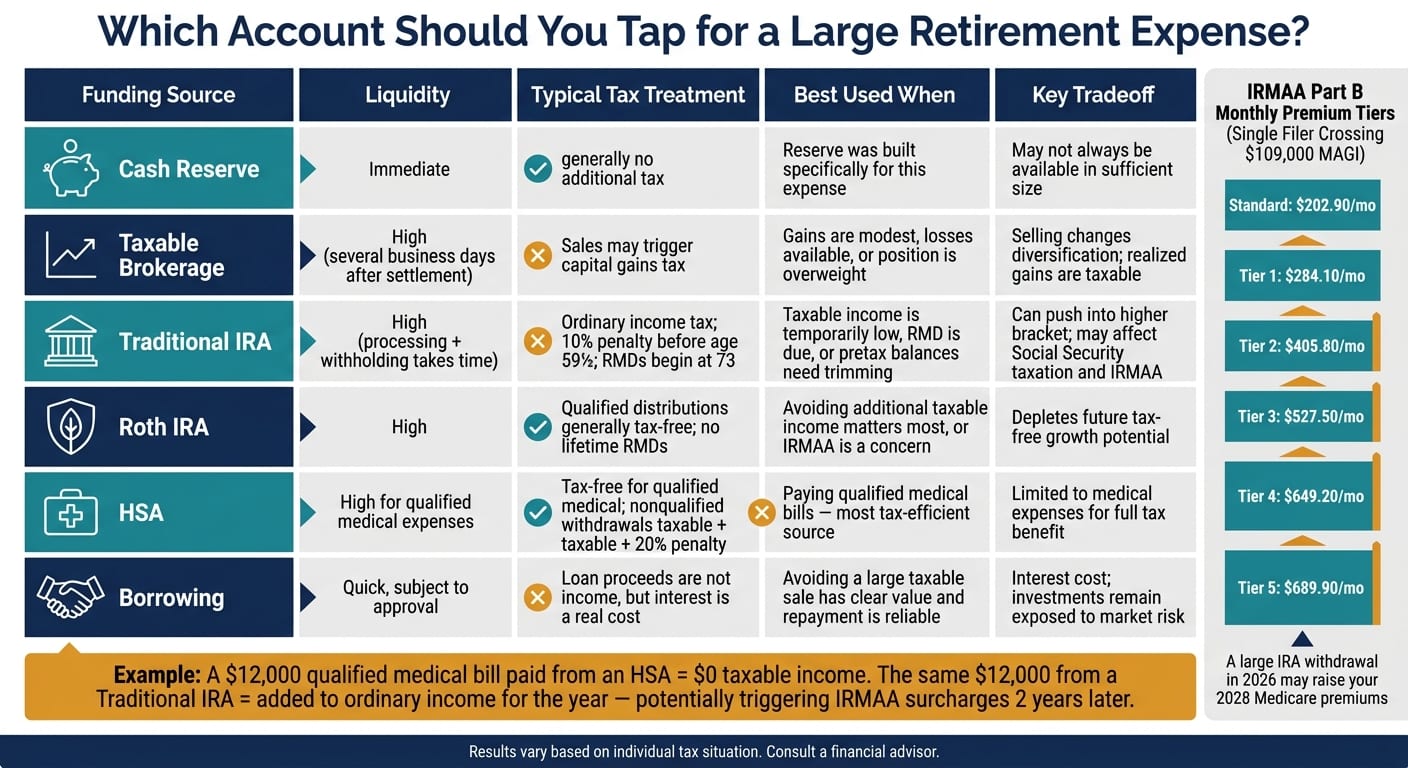
Once the reserve is in place, the next step may be deciding which account to tap so the expense doesn’t lead to avoidable tax. That choice may have very different tax and cash-flow effects. Pulling from the wrong place may create extra tax or leave your emergency cushion thinner than you meant.
Compare cash reserves, brokerage accounts, IRAs, Roth accounts, HSAs, and borrowing
The table below lays out the tradeoffs by funding source. Actual results may depend on your tax picture and the rules tied to each account, so this may work best as a planning framework.
| Source | Liquidity | Typical Tax Treatment | Market Impact | When It May Fit |
|---|---|---|---|---|
| Cash reserve | Immediate | Generally no additional tax | No investments sold | Best when the reserve was built for this expense |
| Taxable brokerage | High, usually within several business days after settlement | Sales may trigger tax on realized gains | Selling reduces exposure to the assets sold and may allow rebalancing | Useful when gains are modest, losses are available, or a position is overweight |
| Traditional IRA | High, but processing and withholding take time | Generally ordinary income; early withdrawals before 59½ may trigger a 10% additional tax; RMDs generally begin at 73[2][3] | Selling inside the account changes the portfolio but doesn't create capital-gains tax | May fit when taxable income is temporarily low, an RMD is due, or pretax balances need trimming |
| Roth IRA | High, but preserving the account may matter for future tax-free growth | Qualified distributions are generally tax-free; no lifetime RMDs for the original owner[2][1] | Sales change allocation without current tax | Useful when avoiding additional taxable income may matter most, or when IRMAA is a concern |
| HSA | High for qualified medical expenses | Qualified medical withdrawals are tax-free; nonqualified withdrawals may be taxable and face a 20% additional tax[6][7] | May require selling HSA investments | Often the most tax-efficient source for qualified medical bills |
| Borrowing | Quick, subject to approval | Loan proceeds aren't income, but interest is a real cost | Leaves investments in place but exposed to market risk | Worth considering only when avoiding a large taxable sale may have clear value and repayment appears reliable |
A simple example shows why this matters. A $12,000 qualified medical bill paid from an HSA creates no taxable income. The same $12,000 taken from a traditional IRA would generally be added to ordinary income for the year. That gap may matter if you're near an IRMAA threshold or if Social Security benefits may be partly taxable.
Ask four questions before choosing an account
These four checks may help narrow the choice.
How much cash remains after the withdrawal? You may still need enough for emergency savings, upcoming taxes, insurance, home repairs, healthcare costs, and the reserve level built into your retirement plan. Draining a reserve that took years to build may create a new problem right after solving the first one.
What tax will this create? It may help to estimate ordinary income, capital gains, withholding, state taxes, Social Security taxation, and Medicare premium effects such as IRMAA. Timing may matter too, especially if the withdrawal lands near a tax-year boundary.
Will the sale create gains or losses? In a taxable account, review each lot’s cost basis, holding period, and unrealized gain or loss. A sale may also change diversification. Only the realized gain is taxable.
Will this change your asset mix? A withdrawal may leave too much or too little in stocks, bonds, cash, or other assets. If rebalancing later would require more sales, that may add another layer of tax or timing issues.
Once the source is chosen, the next step may be managing taxes, Medicare effects, and portfolio recovery. It may help to write down your answers, compare at least two account-and-timing options, and confirm the tax impact before you withdraw - especially if the expense may affect your tax bracket or Medicare premiums.
Account for taxes, Medicare, and portfolio recovery after the expense
After you choose a funding source, the next step may be measuring the tax and Medicare impact.
Model your timing options before taking the withdrawal
A large distribution from a traditional IRA or 401(k) may generally be added to your ordinary income for the year.[12] That may push you into a higher tax bracket, increase the taxable share of Social Security benefits, and trigger state income tax.
Before withdrawing, compare at least three scenarios side by side:
Pay the full amount in the current tax year
Split payments across two tax years if the vendor and contract allow it
Mix account types to manage the income spike
For each scenario, estimate federal and state income tax, capital gains exposure from any taxable-account sales, the Social Security taxable amount, and IRMAA surcharges.
Medicare premiums matter here because IRMAA uses MAGI from two years earlier.[11] So a $60,000 IRA withdrawal in 2026 may raise your 2028 premiums, not your 2026 premiums. For a single filer, crossing the $109,000 MAGI threshold in 2026 may push Part B premiums from $202.90 to $284.10 per month in 2028.[10] Higher tiers may increase that monthly cost to $405.80, $527.50, $649.20, or $689.90.[10] That lag can be easy to miss if you only look at this year’s tax bill.
Splitting payments may reduce one-year income, but it may also add financing costs, market risk, or contractor constraints. The better fit may depend on the actual numbers, not a blanket preference for spreading costs.
After you compare timing scenarios, check withholding so the tax bill does not come out of nowhere later. Confirm withholding before processing. Nonperiodic distributions default to 10% federal withholding, while eligible rollover distributions paid to you trigger 20% withholding.[8][9] Neither rate may cover your full federal and state liability. If the gap looks large, some people increase withholding or make quarterly estimated payments to reduce the chance of an underpayment penalty. If RMDs apply, coordinate the withdrawal with your required amount; taking too little may trigger a 25% excise tax.[9]
Rebuild reserves, rebalance, and update your retirement plan
After payment, recalculate reserve coverage and set a replenishment target. Some households restore the reserve gradually from future cash flow, RMDs, tax refunds, or planned asset sales rather than automatically increasing an ongoing withdrawal rate.
If the withdrawal moves your allocation outside target ranges, rebalance with care. A one-time bill may not, by itself, call for a full rewrite of your long-term portfolio.
Update your retirement projections using the new balances, reserve level, and spending rate. Keep Form 1099-Rs, withholding records, cost-basis statements, medical receipts, and records tied to gifts or home improvements.
Use Mezzi to review all accounts and pressure-test the decision
A full-account view may help confirm the withdrawal still fits the rest of your plan. Mezzi is designed to show your linked bank, brokerage, IRA, Roth, and HSA accounts in one place before you withdraw. That full view may make it easier to compare funding sources, review asset location, and measure the effect on your allocation. Mezzi provides read-only analysis; you decide what to move.
FAQs
How much cash should I keep for a one-time retirement expense?
Some people keep this separate from regular monthly living expenses. General cash reserves for day-to-day needs may cover 6 to 12 months of expenses, but a one-time retirement expense may warrant its own liquid fund.
Some people estimate the full cost, including possible overruns, and set that amount aside in a high-yield savings account or money market fund. Doing so may reduce the chance of selling long-term investments during a market downturn.
Which account should I tap first for a large retirement bill?
Usually, some people start with taxable brokerage accounts. Those accounts may be taxed at the lower long-term capital gains rates of 0% to 20%, and using them first may let tax-deferred accounts keep growing for longer.
If more funds are needed, some then draw from traditional IRAs and 401(k)s, since those withdrawals may be taxed as ordinary income. When possible, some people preserve Roth accounts for last because qualified withdrawals may be tax-free, and those accounts have no RMDs.
Can one large withdrawal raise my Medicare premiums or taxes?
Yes. A large withdrawal from a traditional 401(k) or IRA may count as taxable income. That may increase your tax bill and may also lead to higher Medicare premiums.
Medicare bases IRMAA on your MAGI from two years earlier. So a one-time withdrawal from a traditional retirement account may push you into a higher IRMAA bracket.
Roth IRA withdrawals work differently. Qualified Roth IRA withdrawals are tax-free and do not count toward MAGI.
Disclosures:
This content is for informational purposes only and does not constitute investment advice or a recommendation to buy or sell any security.
Past performance is not indicative of future results. No guarantee of future performance or outcomes is implied.
Savings and performance examples are hypothetical and for illustrative purposes only. Actual results will vary based on individual circumstances, portfolio composition, market conditions, and fees.
Registration does not imply a certain level of skill or that the SEC has approved the company or its services.