
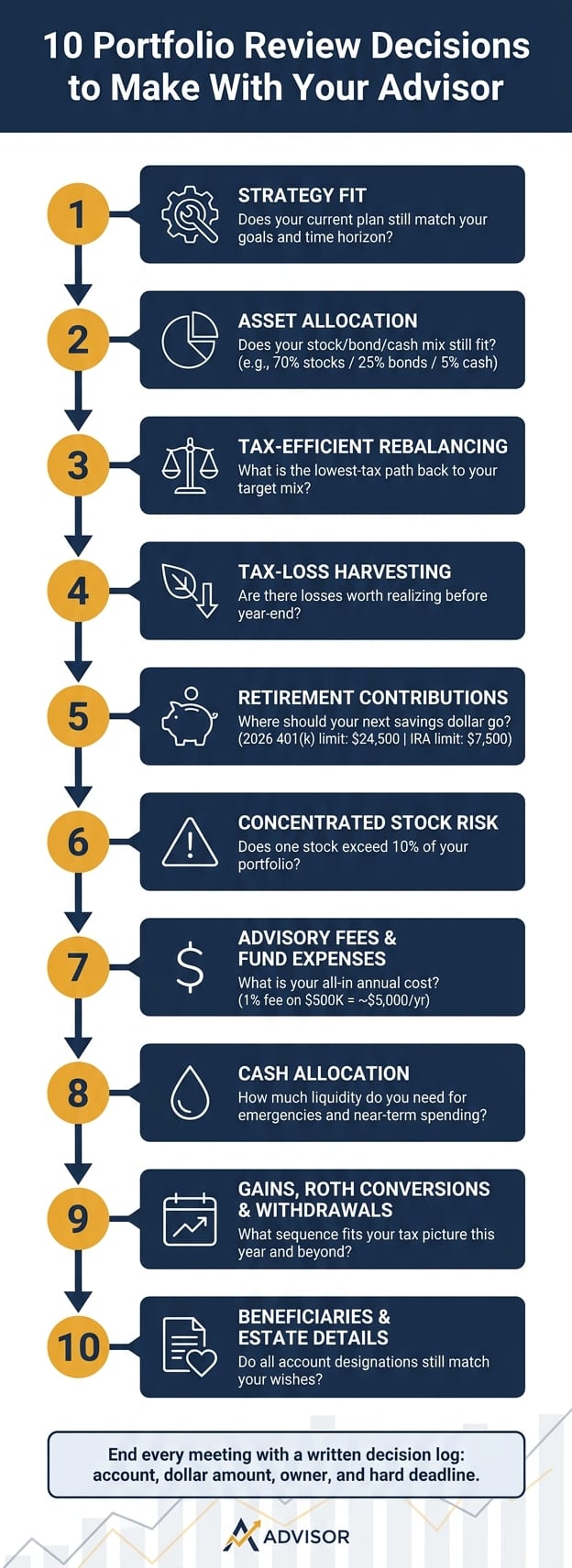
Most portfolio reviews may drift into market talk. A better meeting may end with 10 written decisions, named owners, and hard dates.
If I wanted to get more from a review, I’d walk in ready to decide:
whether my current plan still fits my goals
whether my stock/bond/cash mix may need to change
how to rebalance with lower tax drag
whether any losses may be worth harvesting before year-end
where my next retirement and HSA dollars may go
whether one stock or employer equity may take up too much of my net worth
what I may pay in advisor fees and fund costs each year
how much cash I may want for short-term spending and emergencies
when gains, Roth conversions, and withdrawals may make sense
whether beneficiaries and estate details still match my wishes
This article’s core idea is simple: a review may work better when every topic ends with a written action. That may mean exact accounts, dollar amounts, tax-lot notes, one owner, and a deadline like 10/09/2026 or 12/31/2026.
A few numbers stand out:
2026 401(k) deferral limit: $24,500
2026 IRA limit: $7,500
Up to $3,000 of net capital losses may offset ordinary income in some cases
A 1.00% advisory fee on $500,000 may come to about $5,000 per year before fund expenses
Some investors use 10% of portfolio value in one stock as a rough concentration line
2025 Annual Portfolio Review Checklist
Quick comparison
| Decision area | Main question | What I’d want to leave with |
|---|---|---|
| Strategy fit | Does the plan still match my goals and time horizon? | Keep, change, or replace the current plan |
| Asset allocation | Does my stock/bond/cash mix still fit? | A target mix with ranges |
| Rebalancing | What may be the lower-tax path back to target? | A trade sequence by account |
| Tax-loss harvesting | Are there losses worth realizing? | Lots to sell and replacements to use |
| Contributions | Where may the next savings dollar go? | Updated 401(k), IRA, Roth, and HSA elections |
| Concentrated stock | Is one stock too large? | A trim plan, cap, or hold decision |
| Fees | What do I pay all-in each year? | A dollar-and-percent fee summary |
| Cash | How much liquidity may I need? | A set cash target and account location |
| Gains/conversions/withdrawals | What sequence may fit my tax picture? | A year-by-year tax action plan |
| Beneficiaries | Do account designations still match my estate plan? | A list of any forms to update |
In short: this piece may be less about opinions and more about turning a portfolio review into a working session with clear next steps.
Before the Meeting: Gather Your Full Financial Picture
Showing up with the right paperwork may turn a vague chat into a working session. The goal is simple: walk in with a clear snapshot so the decisions that follow may be tied to actual numbers, accounts, and dates.
Start with every investment and retirement account you have. That may include taxable brokerage accounts, 401(k)s, 403(b)s, IRAs, Roth IRAs, HSAs, employer stock plans, 529 plans, and annuities. For each one, note the institution, account type, owner, balance, cash, holdings, ticker or fund name, contribution rate, employer match, and any restrictions.
You’ll also want unrealized and realized gain/loss reports by tax lot, plus acquisition dates, adjusted cost basis, and holding periods. Those details may matter for rebalancing and tax-loss harvesting. Cost basis includes purchase price, reinvested dividends, reinvested capital-gains distributions, and some transaction costs, so missing lots may skew tax-related choices.[1][2]
Bring your latest federal tax return, current pay stubs, year-to-date withholding, and any expected bonuses or equity compensation. Those items may shape contribution and withdrawal choices. If you have RSUs, stock options, or an ESPP, list each grant’s vesting date, share count, value, and any trading limits.
Bring a debt list too. Include the lender, balance, interest rate, minimum payment, debt type, and payoff date. Then add your checking, savings, emergency reserves, CDs, money-market funds, and any near-term cash needs over the next 1 to 5 years. That may give more context for cash allocation and withdrawal timing.
When all accounts sit side by side, patterns may show up that are easy to miss account by account. You may spot concentration, duplicate funds, large embedded gains, or wash-sale risk.
Mezzi’s consolidated, read-only view may surface allocation gaps, overlapping holdings, wash-sale risk, and account-location mismatches before the meeting - without trading access. It may make sense to bring that consolidated view along with your original statements. Your advisor should verify positions, cost basis, and beneficiary designations directly against custodian records before acting on any of it.
Use this packet as the basis for the decisions in the next section.
How to Use This Agenda During the Meeting
Treat each agenda item as a decision record, not just something to talk through. The goal is to leave each section with a defined choice, a named owner, and a deadline. The documents you gathered may help push each topic toward an actual decision.
For each of the 10 decisions ahead, use the same five-step sequence:
Define the choice in one sentence
Ask targeted questions
Review the account-level numbers tied to that decision
Confirm the tax and cost effects
Assign an action with a specific owner and deadline
The first step matters more than it may sound. Vague framing may lead to vague answers. Instead of asking, "Should we look at my retirement savings?" ask: "Should I raise the Roth 401(k) contribution from 6% to 10%, beginning January 8, 2027, subject to confirming the annual contribution limit and employer match?" That kind of wording makes it easier to accept, revise, or reject the choice.
When you review data, ask the advisor to show each change by account, in both dollars and percentages. For illustration, a proposed change might read: Sell $12,000 of Fund A in the taxable account - $8,000 into a total-market fund and $4,000 into short-term Treasuries. Before approving any action, ask:
Will this create ordinary income, a short- or long-term capital gain, or a nondeductible contribution?
Which tax lot will be sold?
How may the transaction affect my estimated tax payments or withholding?
Should my CPA or tax professional review it first?
Use this phrasing to turn vague advice into something concrete:
| What you might hear | What to ask instead |
|---|---|
| We should improve diversification. | Should we reduce this stock from 28% to 15% of investable assets? |
| Rebalance the account. | Which account, which securities, which tax lots, and what dollar amount? |
| The fee is 1%. | What is the annual dollar cost on my balance, including fund and transaction expenses? |
| This may have tax consequences. | What estimated short- or long-term gain will this create, and in which tax year? |
| We'll take care of it. | Who does what, by what date, and how will I receive confirmation? |
End every agenda item by turning the decision into a written action record: account name or last four digits, security or contribution type, dollar amount, transaction type, tax-lot instruction if needed, responsible person, and a hard deadline in U.S. format.
For illustration, a record might read: Taxable account ending 1174 - sell 40 shares of XYZ using specific-lot identification (highest cost basis) by October 9, 2026; advisor confirms execution by October 12, 2026.
Use this format for each item below.
1. Confirm Whether Your Current Strategy Still Fits Your Goals
Decision to make
Decide whether to keep, adjust, or replace your current strategy based on your goals, time horizon, liquidity needs, and risk tolerance. This may be the first call to settle during the review.
A strategy built for a 25-year horizon may no longer fit if retirement may now be five years away. Use those inputs to test the strategy against the questions below.
Strong returns do not prove the strategy still fits your needs. A portfolio may be doing well and still be out of line with your current spending timeline or your capacity for risk.
Questions to ask
"What goal is each account funding, and what return, savings-rate, withdrawal, and risk assumptions justify that plan?"
"Has my probability of meeting each goal changed since our last review?"
"How would a 20% or 30% market decline affect my plan and expected retirement date?"
"How much of my portfolio can be exposed to market volatility without jeopardizing near-term spending?"
"What would cause you to recommend changing this strategy?"
One point is worth stating plainly: risk tolerance and risk capacity are not the same thing.
Risk tolerance is your willingness to take losses. Risk capacity is your ability to absorb them. You may feel fine with volatility but still have limited room to take risk if you may need the money within two years. It may make sense to ask your advisor to assess both and explain which one may be driving the suggested allocation.
Documents to bring
Bring a written list of your goals with approximate dollar amounts and target dates, a recent household budget, pay stubs or pension and Social Security estimates, and notes about any life changes since your last review.
Include assets outside the advisor's management too. Looking at one account at a time may hide the full risk picture. Seeing the whole setup may help separate near-term cash needs from long-term capital.
Tax or risk impact
Near-term goals may call for a lower-risk profile than long-term goals. Money needed within five years may belong in more liquid, lower-volatility investments than long-term retirement assets.
If the time horizon is short, a mismatch here may lead to later sales, losses, or withdrawals.
Action record
Record the goal, current assumption, decision, account, owner, and next review trigger. If this strategy still fits, move next to how the portfolio may be allocated across asset classes.
2. Decide If Your Asset Allocation Should Change
Decision to make
After you confirm the strategy in Step 1, use this step to set the portfolio’s target mix. The key call here: does your mix of stocks, bonds, cash, and other assets still line up with the plan you’re trying to follow?
The aim may be simple: leave the meeting with a written target allocation - say, 70% stocks, 25% bonds, and 5% cash - along with tolerance bands for each piece.
Questions to ask
Start with the basic check. Which parts of the portfolio are overweight or underweight versus the current target? And if something looks off, does that mean the target itself may need to change, or does the portfolio just need to be rebalanced back to the existing mix?
Then go a level deeper:
If we shift the allocation, how may we do it in the most tax-aware way across taxable accounts, 401(k), IRA, Roth, and HSA accounts?
What specific event - retirement, a home purchase, or a sharp market move - may trigger the next allocation review?
Documents to bring
Bring current statements, or one aggregated holdings report, for every investment account:
401(k)s
IRAs
Roth IRAs
HSAs
Taxable brokerage accounts
Cash accounts
Employer stock plans
Look at the household portfolio as one combined set. Otherwise, overlap and concentration may stay hidden across separate accounts.[8]
Tax or risk impact
An allocation shift inside a 401(k), IRA, Roth IRA, or HSA generally may not trigger an immediate taxable event. A trade inside a taxable brokerage account may work differently. Holding period matters because short-term gains are generally taxed as ordinary income, while long-term gains may qualify for lower federal tax rates depending on taxable income.[7]
Before selling anything in a taxable account, ask whether the same rebalancing may be done by redirecting new contributions or dividends toward underweighted categories instead. In some cases, new contributions, dividends, or selective trades may move the portfolio back toward the target mix with less tax drag. The tax cost may depend on the account type and the tax lots sold.
If the target mix changes, the next step may be deciding how to rebalance with the least tax cost.
Here’s a simple example. A household with a $500,000 portfolio sitting at 80% stocks, 15% bonds, and 5% cash - when the written plan calls for 70% stocks, 25% bonds, and 5% cash - may be $50,000 overweight in stocks and $50,000 underweight in bonds. Before placing trades, review how each option may affect volatility, liquidity, and taxes. Once the target is set, move to the tax-aware trade plan.
3. Choose a Tax-Efficient Rebalancing Plan
Decision to make
Use the target allocation to choose the lowest-tax path back to balance.
Once the target mix is set, the next step is picking the trade sequence that may get you there with the least tax drag. That usually means agreeing on the order of moves: which accounts to use first, which tax lots to sell if sales are needed, and whether new contributions may close part of the gap. In many cases, the sequence goes like this: contributions first, then tax-advantaged accounts, then taxable sales.
Questions to ask
Ask your advisor to compare at least two paths side by side: a full rebalance now versus a lower-tax option that uses new contributions, trades inside retirement accounts, or sales spread over time. A tax-aware sequence may start by directing new contributions and dividends to underweight asset classes, then rebalancing inside tax-advantaged accounts like a 401(k), IRA, Roth IRA, or HSA, and only after that looking at taxable-account sales.[11]
If taxable sales may be hard to avoid, ask for the exact tax lots involved. A $10,000 sale with a $2,000 long-term gain may be taxed differently than the same sale with a $2,000 short-term gain. Short-term gains are generally taxed as ordinary income, while qualifying long-term gains may receive lower federal rates. Ask to see the after-tax result, not just the portfolio change.
It may also make sense to ask whether tax-loss harvesting fits this situation. If any taxable holdings sit at a loss, selling them may offset gains realized elsewhere. The IRS generally allows up to $3,000 of excess net capital losses to reduce ordinary income in a given year ($1,500 for married filing separately), with any unused amount carried forward.[10] The replacement fund should have similar exposure, but not be too similar, or the wash-sale rule may disallow the loss.[9]
Documents to bring
Bring current statements, holdings reports, gain/loss and cost-basis reports, realized-gain reports, contribution settings, automatic-investment details, and your investment policy statement. Add recent federal and state returns, or the capital-gains, carryforward-loss, and estimated-tax data tied to this choice. Those records may give your advisor what they need to choose the order of trades and the tax lots to use.
Tax or risk impact
The wash-sale window lasts 61 days: 30 days before the sale, the sale date, and 30 days after.[12][13] Review all taxable, IRA, Roth, and spouse accounts before any loss sale.[9]
Tax reduction may matter, but it may not make sense to let it keep a concentrated position in place if that position no longer fits the plan.
Use the table to choose the sequence before approving any trade.
| Rebalancing approach | Main benefit | Key consideration |
|---|---|---|
| Redirect contributions and dividends | No taxable sales required | May be too slow for large gaps. |
| Trade inside 401(k), IRA, Roth IRA, or HSA | Generally avoids an immediate capital-gains bill[11] | Does not fix taxable-account drift. |
| Sell higher-basis lots in taxable accounts | Realizes less gain than low-basis lots[14] | May still trigger gains and fees. |
| Partial rebalance | Addresses the largest drift while limiting sales[14] | Leaves some drift unresolved. |
| Tax-loss harvesting with a substitute | Offsets gains while maintaining broad exposure | Watch for wash-sale disallowance.[12][13] |
4. Review Tax-Loss Harvesting Opportunities
Decision to make
If Step 3 turned up loss positions, this step is where you decide which lots to harvest and what to buy in their place.
Start with the loss positions from Step 3 and sort out which taxable lots you may want to sell, how much loss you may want to harvest, and which replacement may keep your market exposure in place. The key point is simple: a loss may not be worth harvesting if the trade no longer fits the portfolio.
Questions to ask
Ask your advisor for a full list of unrealized losses across every taxable brokerage account. That may include jointly held accounts and accounts owned by a spouse. The list should be broken out by security, tax lot, purchase date, cost basis, and holding period. When estimating the tax value of a sale, short-term and long-term losses may need to be netted separately.
You may also want to ask what replacement security may preserve exposure without creating a wash sale across taxable accounts, IRA accounts, Roth accounts, and spouse accounts. Your advisor should document why any proposed replacement is different enough.
It also makes sense to ask whether harvesting fits your situation at all. It may be less useful if:
You already have large loss carryforwards
You expect no capital gains this year
Transaction costs may be high
You would need to make a large change to the portfolio to do it
Documents to bring
Bring realized gain/loss reports, tax-lot records, cost-basis records, dividend reinvestment settings, and statements for automatic purchase accounts. Also bring last year's federal tax return, including Schedule D and Form 8949, plus any record of unused capital-loss carryforwards.
If any position shows cost basis as unavailable or estimated, flag it. Older holdings and transferred assets may be common trouble spots.
Tax or risk impact
Once you've picked the lots, document the trade before any order goes in. Ask for a written trade plan that lists the security, tax lots, sale date, replacement, and earliest repurchase date.
If the tax treatment looks complicated, it may make sense to confirm the plan with a CPA or other tax professional before trading. You may also want to pause any automatic dividend reinvestment or recurring purchases for the sold security during the wash-sale window.
A tool like Mezzi may help identify harvesting candidates across connected accounts throughout the year and may notify you when the 30-day window has passed, which may help if you're considering buying back the original position.
5. Adjust 401(k), IRA, Roth, and HSA Contributions
Decision to make
After rebalancing, the next call may be where the next savings dollar belongs. The issue isn't whether to save more. It's which account may deserve the next dollar. This step sets how new savings may flow across different tax buckets.
A common starting point may be contributing enough to a 401(k) to get the full employer match. After that, some people fund an HSA if they're eligible. Then the choice may shift to traditional vs. Roth contributions, based on whether a tax deduction now or tax-free withdrawals later may have more after-tax value.
Questions to ask
Come in ready to ask whether your plan offers both traditional and Roth 401(k) contributions, and what split may fit your current and expected future tax rates. Ask your advisor to compare the projected after-tax value of each option instead of treating one account as the default.
It also may make sense to confirm IRA eligibility. A deductible traditional IRA contribution may be partly or fully limited if you're covered by a workplace plan and your income is above IRS thresholds. Roth IRA contributions also phase out at higher income levels, so it may be worth asking whether a backdoor Roth strategy may apply in your case. If your income is too high for a direct Roth contribution, pretax IRA balances may make a backdoor Roth less efficient.
Also ask: "Does my 401(k) have a true-up, and how much has my employer already contributed to my HSA this year?"
Documents to bring
Bring your current contribution elections, year-to-date pay stubs showing deferrals, your employer's matching formula and vesting schedule, a current-year income estimate, and your health plan documents confirming HDHP status and any employer HSA contributions already made this year. If Medicare enrollment may happen soon, bring that information too.
Tax or risk impact
For 2026, the employee 401(k) elective-deferral limit is $24,500[15][18], and the IRA contribution limit is $7,500[15][17].
| Account | 2026 Limit | Catch-Up |
|---|---|---|
| 401(k) / 403(b) elective deferrals | $24,500[15][18] | +$8,000 for most people age 50+[16][19] |
| Traditional + Roth IRAs (combined) | $7,500[15][17] | +$1,100 for eligible individuals age 50+[15][17] |
| HSA - self-only HDHP | $4,400[20][21] | +$1,000 for eligible individuals age 55+[20][21] |
| HSA - family HDHP | $8,750[20][21] | +$1,000 for eligible individuals age 55+[20][21] |
HSA limits include both employee and employer contributions, so any employer deposits should be subtracted before setting a payroll election.[20][21]
Traditional 401(k) and deductible IRA contributions may reduce taxable income today, but withdrawals in retirement are generally taxed as ordinary income. Roth contributions don't provide a deduction now, but qualified withdrawals are tax-free. HSA contributions made through payroll may also avoid Social Security and Medicare taxes, which may be worth factoring in if you're eligible.[20][22]
Leave with a written contribution plan that lists the account, amount or payroll rate, pretax or Roth treatment, employer match, and owner. Once contribution rates are set, move to concentrated stock risk.
6. Reduce Concentrated Stock Risk
Decision to make
Once your contributions are set, the next call may be whether to keep, reduce, or fully exit a single-stock position. And this usually isn't just a sell-or-don't-sell choice. The bigger issue may be how much to trim, how fast to do it, and where the money may go next.
A common screening threshold some investors use is 10% of total portfolio value in one stock. The right limit may depend on your risk tolerance, time horizon, and how much of your income or net worth is tied to the same company. For example, with a $500,000 portfolio, $125,000 in one stock would mean 25% concentration before factoring in any overlap from funds. This step may help define a target concentration, a sale pace, and which account or equity awards to use. If the position still makes sense to keep in part, the next issue may be how much tax drag might be avoided while trimming it.
Questions to ask
It may help to treat all company-linked holdings as one position. That may include:
Direct shares
Vested RSUs
Stock options
ESPP shares
Employer stock in your 401(k)
Overlapping fund holdings
It may help to review three exit paths: trim to a 10% cap now, sell a fixed dollar amount over time, or redirect future vesting and contributions into diversified funds. Each version may show the remaining concentration, estimated taxes, and how the portfolio might hold up during a sharp decline. Before any sale, it also makes sense to confirm whether a trading blackout, 10b5-1 plan, holding rule, or another employer restriction may apply.
Documents to bring
Bring statements for every account, a consolidated holdings report, recent trade confirmations, and the cost basis and acquisition date for each tax lot. For equity compensation, include grant agreements or plan records that show grant dates, vesting schedules, exercise prices, expiration dates, shares withheld for taxes, and any trading restrictions. A prior-year Form 1099-B and your most recent tax return may also help an advisor estimate the after-tax cost of reducing the position.
Tax or risk impact
Selling appreciated shares generally realizes capital gains. Shares held more than one year generally receive long-term capital-gain treatment, while shares held one year or less generally produce short-term gains taxed at ordinary-income rates.[23] Some investors ask whether specific-lot identification may reduce the taxable gain.
| Strategy | Tax Impact | Best For |
|---|---|---|
| Staged selling over multiple years | Moderate - may spread gains across tax brackets | Managing income thresholds |
| Tax-loss harvesting to offset gains | Low - losses offset realized gains; up to $3,000 offsets ordinary income[23][24] | Portfolios with underperforming positions |
| Donating appreciated shares to a charity or donor-advised fund | Lowest - may avoid capital gains on donated shares[27] | Investors with philanthropic goals |
| Exchange fund (swap shares for a diversified interest) | Deferred - original basis carries forward; about a 7-year lockup[25][26] | Large, highly appreciated positions |
7. Compare Advisory Fees and Fund Expenses
Decision to make
After concentration risk, the next place to look is cost.
The goal here is pretty simple: figure out whether your total annual cost in advisory fees and fund expenses may line up with the service you're getting. Then decide whether it may make sense to keep the current setup, swap funds, or revisit the advisor relationship.
A 1.00% advisory fee on a $500,000 portfolio equals about $5,000 per year before fund expenses. Over 10 years, that's $50,000 before considering the longer-term effect of fees reducing the amount left invested and compounding. That doesn't automatically mean the fee is too high. It does mean it's worth asking whether your current holdings and service level match that cost.
Questions to ask
Ask your advisor to break costs into four buckets:
advisory fee
fund expense ratios
trading costs
other account fees
Then get more direct about compensation. Ask:
Do you receive commissions, revenue sharing, or 12b-1 fees?
Would your compensation change if I moved to a lower-cost fund?
Request the firm's Form ADV Part 2A and Form CRS. These documents are required to disclose fee schedules, fees, and conflicts [3][4]. If any recommended funds are affiliated with the advisor's firm, that relationship should be disclosed and explained.
It also makes sense to ask whether lower-cost share classes or fund options are available within your current strategy. In 2025, the average expense ratio for index equity ETFs was 0.14%, compared with 0.40% for actively managed equity mutual funds [28].
A lower-cost option may not always be the right move, especially in a taxable account where selling appreciated holdings may trigger capital gains. That's why it's useful to ask for the payback period - how long the fee savings may take to offset any one-time switch cost.
Documents to bring
Bring current statements, your advisory agreement, fee invoices, trade confirmations, and fund fact sheets.
| What to bring | Why it matters |
|---|---|
| Advisory agreement and fee schedule | Shows how the fee is calculated and what's included |
| Form ADV Part 2A and Form CRS | Discloses fees and conflicts |
| Account statements (all accounts) | Reveals what was actually deducted vs. what was quoted |
| Fund prospectuses or fact sheets | Confirms expense ratios and share class options |
| Trade confirmations | Shows trading costs and execution details |
Try to leave with a written comparison of each current holding, its lower-cost alternative, estimated annual savings, and any one-time switch cost. That side-by-side view may make it easier to weigh the savings against any tax cost or service tradeoff.
Next, check whether your cash allocation matches near-term spending needs.
8. Set the Right Cash Allocation
Decision to make
After fees, the next call may be liquidity.
Set a dollar amount for cash that may cover emergencies, near-term spending, and any surplus you may want to invest later. Then decide where that cash may sit: a bank sweep, a money market fund, or a Treasury-backed account.
It may also make sense to pressure-test that reserve. One simple way to do that: look at what may happen if stocks drop 25% and income stops for six months.
Questions to ask
Ask your advisor to break cash into four buckets:
operating cash
emergency reserves
near-term spending reserves
investable cash
For example, a household may want $30,000 for emergencies and a separate $20,000 set aside for a planned renovation.
Also ask about your cash sweep default [32]: where idle cash goes, what yield it pays, and whether that sweep option may change over time.
Documents to bring
Bring recent bank and brokerage statements, along with:
current cash balances
CD maturity dates and early-withdrawal terms
money market fund names and yields
monthly essential expense totals
Tax or risk impact
Cash options differ in insurance, risk, and tax treatment.
A money market deposit account at an FDIC-insured bank is covered up to $250,000 per depositor, per FDIC-insured bank, per ownership category [29]. A money market mutual fund is not FDIC-insured because it's an investment product, and while losses have historically been rare, its value can decline [31]. Treasury bills are not FDIC-insured but are backed by the full faith and credit of the U.S. government [30].
Ask your advisor to compare after-tax yields, not just the advertised rate. Treasury bills may receive different state tax treatment than bank interest, so the better cash vehicle may depend on your account type and where you live.
Once the cash target is set, the next step may be timing gains, conversions, and withdrawals.
9. Plan the Timing of Capital Gains, Roth Conversions, and Withdrawals
Decision to make
With cash reserves set, the next step is to sort out the most tax-aware sequence for gains, conversions, and withdrawals.
That usually means deciding which assets to sell, whether to move traditional IRA funds into a Roth, and which accounts to pull from first.
The order matters. A Roth conversion may add ordinary income. A large capital gain may push income into a higher tax bracket. And a poor withdrawal sequence may increase Medicare premiums.
Questions to ask
Ask your advisor to model this year, next year, and a multi-year path. Looking at one year in isolation may miss how taxes stack up over time.
For capital gains, check whether total taxable income may still leave room for the 0%, 15%, or 20% long-term capital gains rates. For Roth conversions, test conversion amounts that may fill your current bracket without pushing income into the next one. Then confirm whether any RMD needs to happen first.
If you have RMDs, they generally must be taken before any Roth conversion; an RMD cannot be converted and a conversion does not satisfy the RMD. [34][35]
Some investors pay conversion taxes from cash outside the conversion itself rather than from the converted amount.
Use current tax lots, income estimates, and account statements to map the exact sequence.
Documents to bring
| What to bring | Why it matters |
|---|---|
| Most recent federal and state tax returns (Forms 1040, 1099-B, 1099-DIV, 1099-R) | Shows filing status, taxable income, gains, and deductions |
| Current-year pay stubs, pension and Social Security estimates | May improve the estimate of income still to come this year |
| Brokerage statements with tax lots, cost basis, and acquisition dates | Shows short- vs. long-term gains and which assets may be better candidates for sale |
| Traditional IRA, Roth IRA, 401(k), and rollover account statements | Shows pre-tax balances, prior conversions, and possible RMD sources |
| Form 8606, if applicable | Shows after-tax IRA basis and may prevent double taxation [33] |
| RMD notices or calculations | Confirms required distributions before any conversion attempt |
| Charitable-giving plans and major planned deductions | May help line up gain realization with offsetting deductions |
Tax or risk impact
One main risk is paying tax earlier than needed. Another is crossing into Medicare IRMAA territory, losing credits, or triggering estimated-tax penalties.
Assets held for more than one year usually receive long-term capital gains treatment. Shorter holding periods are generally taxed as ordinary income.
Ask your advisor to compare withdrawal order across taxable accounts, traditional IRAs, and Roth accounts. Some people then use the sequence that may best fit their tax bracket, RMDs, and estate goals, and write it down before the meeting ends.
10. Update Beneficiaries and Estate-Transfer Details
Decision to make
After you map allocation, taxes, and withdrawals, take one more pass through each account and confirm who would receive it if you die first. This step may sound administrative, but it often carries a lot of weight.
Beneficiary designations may control how an account transfers and, in some cases, may override a will. That means the name on file with the custodian may matter just as much as what your estate documents say.
Questions to ask
Beneficiary designations are the last check on whether the portfolio plan may pass the way you intend. It may make sense to review each account with your advisor and ask:
"Who is the primary and contingent beneficiary on each account, and does that still match my intent?"
"Should the designation be per stirpes so a deceased beneficiary's share passes to descendants?"
"If a nonspouse inherits my IRA, what withdrawal schedule and tax impact apply?"
Under current IRS guidance, most nonspouse beneficiaries who inherit an IRA from an owner who died on or after January 1, 2020, generally may need to fully distribute the account by the end of the 10th calendar year after the owner's death.[36][38] A surviving spouse may have more flexibility, including the option to treat an inherited IRA as their own in eligible situations.[36][37]
Documents to bring
| What to bring | Why it matters |
|---|---|
| Most recent statements for all relevant accounts | Confirms account types and balances |
| Current beneficiary confirmations from each custodian | Shows who is actually on file |
| Copy or summary of your will and trust, plus any amendments | Helps spot conflicts with beneficiary designations |
| Powers of attorney, marriage, divorce, adoption, or death records relevant to beneficiary status | Confirms whether any life event made a designation outdated |
| TOD forms for taxable brokerage accounts | Verifies probate-avoidance registrations |
| Contact information for your estate-planning attorney and tax professional | Supports coordination if legal or tax changes are needed |
Tax or risk impact
Missing or outdated beneficiary designations may force probate, delay transfer, and change inherited-IRA distribution rules.
If a beneficiary is a minor, has special needs, or has creditor concerns, naming them directly may not be the right fit. In some cases, a properly drafted trust may offer more control. Even then, the account designation and the trust terms may need to line up, which is why some families coordinate this review with a qualified estate-planning attorney.
Quick Reference Table: What to Bring and What Each Decision Clarifies
Use this table as a one-page meeting checklist. Bring the listed documents, ask the question, and leave with a numbered decision.
| Decision | Bring | Ask | What it clarifies |
|---|---|---|---|
| 1. Strategy fit | Written financial plan; current goals and target dates; expected retirement age; projected annual spending; income sources; major upcoming expenses; debt obligations; emergency-fund balance; and any change in employment, health, family circumstances, or risk tolerance | Has anything changed that alters my time horizon, withdrawal needs, or loss tolerance? | Confirm, revise, or replace the strategy |
| 2. Asset allocation | Current holdings report showing stock, bond, cash, and other asset percentages; target allocation; permitted ranges; performance since the last review; and updated time horizon and risk capacity | Which holdings are outside their target ranges, and may we correct the drift using new contributions, dividends, or withdrawals before selling? | Confirm the target mix and rebalancing method |
| 3. Tax-efficient rebalancing | Taxable-account statements showing each security's cost basis, purchase date, current value, unrealized gain or loss, realized gains and losses for the year, dividend income, and available tax lots | May we rebalance without creating unnecessary short-term gains, and are any losses worth harvesting while maintaining similar market exposure? | Use contributions first, then tax-advantaged trades, then taxable sales |
| 4. Tax-loss harvesting | 1099-B forms; year-to-date realized gains and losses; purchase dates; and tax lots for each taxable position | Which losses may be worth harvesting, and which replacement avoids a wash sale? | List the unrealized gain or loss, then compare sale, donation, gradual sale, or waiting |
| 5. Retirement contributions | Latest pay stub; current contribution percentages and dollar amounts across 401(k), IRA, Roth IRA, and HSA accounts; year-to-date contributions; employer-match rules; vesting terms; plan investment options; payroll frequency; expected annual compensation; tax-filing status; modified adjusted gross income when relevant; and HSA eligibility | May I increase my contribution rate, choose traditional versus Roth contributions, or prioritize my HSA after capturing the employer match? | Set the rate, tax treatment, HSA priority, and start date. For 2026, the 401(k) employee deferral limit is $24,500 and the IRA limit is $7,500.[15][16][39][17] |
| 6. Concentrated stock | Share count and market value; percentage of total household investments and net worth; cost basis and holding period; restricted-stock or option documents; vesting and expiration dates; employer trading restrictions; and expected future compensation in company stock | How much of my net worth may be tied to this employer, and how may we reduce it? | A scheduled sale plan, charitable donation of appreciated shares, tax-lot selection, hedging discussion, or a defined maximum position size |
| 7. Advisory fees and fund expenses | Advisory agreement; Form CRS; Form ADV brochure; fund prospectuses; account statements; and a list of all advisory, platform, transaction, and fund expenses | What am I paying, what services are included, and what lower-cost options may match them? | A written fee comparison showing dollar cost, percentage cost, services received, and any implementation or termination charges. At a $500,000 portfolio, a 1.00% advisory fee equals roughly $5,000 per year before fund expenses.[40] |
| 8. Cash allocation | Bank and money market balances; monthly essential expenses; emergency-fund balance; planned large purchases; expected withdrawals; debt interest rates; income stability; and the yield and account location of current cash | How many months of essential spending may remain in cash, and where may that cash be held? | A specific dollar target for emergencies, near-term spending, or investable cash |
| 9. Capital gains, Roth conversions, and withdrawals | Latest federal and state tax returns; year-to-date income; expected bonuses; realized gains and losses; required minimum distribution information; Social Security and pension income; charitable-giving plans; withholding and estimated-tax payments; and the balance and tax basis of traditional and Roth accounts | Would selling appreciated assets, converting part of a traditional IRA to a Roth IRA, or taking a withdrawal keep me within the target tax bracket? | The proposed amount, timing, estimated federal and state tax, withholding or estimated-payment steps, and the effect on future required distributions and Medicare-related income thresholds |
| 10. Beneficiaries and estate-transfer details | Beneficiary forms for every retirement account, annuity, life-insurance policy, and payable-on-death or transfer-on-death account; the current will; trust; power of attorney; health-care documents; recent marital or family changes; and contact information for the estate attorney | Do the beneficiary designations match my estate plan, and are the primary and contingent beneficiaries correct? | Every account requiring an update, the percentages or per-stirpes instructions to use, and who will submit each change |
Use these answers to complete the written decision log before you leave.
Also ask your advisor for a one-page account inventory. For every proposed trade, list:
the estimated tax impact
the transaction cost
the resulting allocation
Then bring that inventory into the decision log and assign each item an owner and deadline.
End the Meeting With a Written Decision Log
Before you leave the meeting, use the 10 decisions above to fill out a written log. Then turn each decision into a clear action item. That step may reduce mix-ups later.
Why bother? Because a spoken decision may sound clear in the room and still get fuzzy a week later. A written log puts the key details in one place: the decision, the reason behind it, the account involved, the tax effect, the owner, the deadline, and the current status.
A full entry might look like this: "Harvest losses in joint taxable brokerage account ending in 4821; reinvest in a replacement fund; realize about $6,000 in losses; advisor places trades; client confirms no identical security is bought elsewhere; complete by Dec. 31; pending." That level of detail makes timing and ownership much easier to track.
Group action items by timing, then use the matching label as the deadline tag for each one:
| Action | Hard Deadline | Log Label |
|---|---|---|
| Tax-loss harvesting | December 31 | Loss offset |
| Roth conversion | December 31 | Tax-bracket management |
| Required minimum distribution | December 31 | Regulatory compliance |
| 401(k) contribution change | December 31 | Payroll savings |
| IRA or HSA contribution | Tax Day (April 15) | Post-year-end adjustment |
| Portfolio rebalancing | Threshold-based | Risk realignment |
Give each action one owner. Not “client and advisor.” Just one person. If more than one step is involved, split them up.
For example, if the advisor places a trade but you need to confirm that no purchase in an outside account may trigger a wash sale, write those as two separate items with two separate owners. That may sound picky, but it often keeps tax-related tasks from slipping through the cracks.
For anything tied to a Roth conversion estimate or beneficiary language, don't mark it complete too early. Add a note like "waiting on CPA review" or "waiting on estate attorney review" until that piece is finished.
Keep the log with your statements and confirmations. At the next review, update each item as complete, partial, incomplete, obsolete, or still open. Then carry forward only the items that still need work.
That log may become the starting point for the next review.
Conclusion
A portfolio review may be most useful when it ends with a written decision log, not vague reassurance. The idea is simple: leave with a short record that spells out what may change, which account is affected, who owns the task, and when each action is due.
The agenda covers the decisions that may matter most. Use it to sort what matters most today.
For Roth conversions, capital-gains timing, and concentrated-stock sales, some people use a qualified tax professional. For beneficiary and trust questions, some people turn to an estate-planning attorney.
Ask for the all-in annual cost in both dollars and basis points, including advice, fund expenses, and transaction costs. If anything stays open, schedule the follow-up before you leave. Leave with the revised allocation, implementation steps, fee summary, tax follow-up items, and next review date.
A well-run review may not predict markets or guarantee outcomes. It may simply bring the portfolio back in line with your current goals and give you a clear next step.
FAQs
How often should I do a portfolio review?
Many investors plan for a formal portfolio review at least twice a year. Those check-ins may give you a little distance from the day-to-day noise and make it easier to see whether your investment mix still fits your goals, life changes, and risk tolerance.
They may also surface opportunities worth looking at, like tax-loss harvesting, while helping keep your portfolio balanced and tax-aware over time.
What should I bring to a portfolio review?
Bring a full picture of your finances so your advisor may review your portfolio in context.
Share recent statements for all accounts, key details on your holdings, any equity compensation records, cash-flow records, your latest tax return, and a short list covering your goals, risk tolerance, and major life changes.
Which portfolio decisions matter most first?
Start with a full inventory of all holdings across every account so you may see your actual asset mix and any stock positions that may be more concentrated than you want.
Then set priorities around a few core areas:
Rebalancing to better match your risk tolerance and goals, using tax-advantaged accounts first when that may make sense
Reviewing fees and tax inefficiencies, including idle cash or funds that may overlap or repeat each other
Disclosures:
This content is for informational purposes only and does not constitute investment advice or a recommendation to buy or sell any security.
Past performance is not indicative of future results. No guarantee of future performance or outcomes is implied.
Registration does not imply a certain level of skill or that the SEC has approved the company or its services.
Savings and performance examples are hypothetical and for illustrative purposes only. They do not represent the results of any specific investment.