
If a fund won’t transfer, the choice may come down to four paths: sell now, wait out the CDSC, convert or exchange first, or sell and move the cash.
When I read this piece, the big takeaway looked simple: first find the blocked funds, then compare the one-time exit cost against the fees and taxes that may come from staying put. For some people, that may mean paying a 1.00% CDSC now to leave a fund charging 1.50% a year. For others, it may mean waiting a few months if the charge is about to expire, or checking whether a share-class change may lower costs before the transfer.
Here’s the article in plain English:
Some proprietary mutual funds may be tied to one brokerage or plan, so they may not move in kind
Some load funds may come with sales charges, such as:
Class A: upfront load of up to 5.75%
Class C: often around 1% per year in 12b-1 fees, plus a CDSC if sold early
The main things to check are:
share class
CDSC schedule
account type: taxable account, IRA, or 401(k)
In a taxable account, selling may trigger capital gains tax
In an IRA or 401(k), the tax issue may be lower right away, so the focus may shift more to fees, loads, and plan rules
A conversion or same-family exchange may sometimes reduce friction, but treatment may vary by firm and account type
A short hypothetical example shows the tradeoff well: on $50,000, a 1.00% CDSC may cost $500 today, while a 1.50% expense ratio may cost about $750 per year before any move to a lower-cost fund. That doesn’t settle the decision by itself, but it may frame it fast.
Quick comparison
| Option | Main cost | When it may fit |
|---|---|---|
| Sell now | Tax in taxable accounts; CDSC if still active | When fee drag may be higher than the exit cost |
| Wait for CDSC to expire | Higher fund fees while waiting | When the CDSC window may end soon |
| Convert or exchange first | Tax treatment and firm rules may vary | When the fund family may allow a lower-cost or transferable version |
| Sell and move cash | Taxable sale plus any CDSC | When a lower-cost replacement may be available at the new custodian |
The article then walks through how I may sort blocked positions, check transfer rules, and compare taxes, fees, and fund options before making a move.
Step 1: Identify Which Positions Are the Problem
Start by listing every mutual fund position across taxable accounts, IRAs, and workplace plans. For each holding, note the fund name, ticker symbol, share class, current market value, and whether the fund name matches the provider name. If the fund name matches the provider, the receiving firm may mark it as "liquidate only." Then confirm which tickers the new custodian accepts for an in-kind transfer and which ones it does not carry.[6][7][8][9]
Once you know which positions are blocked, record the details that may shape your exit cost.
Check Share Class, CDSC Schedule, and Account Type
Three details may drive the exit decision: share class, CDSC schedule, and account type.
A shares come with a front-end load of up to 5.75% that was already paid at purchase, along with lower ongoing fees. C shares skip the upfront charge, but they add about 1% per year in 12b-1 fees, plus a 1% CDSC if sold within 12 to 24 months.[1][3][4][5]
The CDSC schedule may tell you whether selling now would involve an added cost. You can find the exact schedule in the fund's prospectus, on the fund company's website under "shareholder fees," or on your current platform's fund detail page. Check the purchase date for each lot. The CDSC may apply only to shares held for less than a set number of years, and some cases, such as disability or certain retirement plan distributions, may qualify for a waiver.
In taxable accounts, a sale may trigger capital gains or losses. In IRAs and workplace plans, the main issue may be the CDSC and the transfer rules. A simple worksheet may help here: one row per fund, one column per data point.
If the fund family allows a share-class change, that may lower costs before the account moves.
Confirm Whether a Conversion or Exchange Is Allowed
Ask whether you may convert share classes or exchange into another fund before the transfer. Some fund families allow automatic conversions from C shares to A shares after a set holding period. Some also allow a move to an institutional share class for accounts that meet the size requirement, without triggering a new sales load. Others allow exchanges within the same fund family that do not reset the CDSC clock.
It also makes sense to ask whether the conversion may be taxable in a brokerage account and how cost basis would carry over. Get the answer in writing through a secure message, since policies vary by firm and may change your exit cost in a meaningful way.[6][8][9]
If conversion is not allowed, the next choice may be whether to sell, wait, or transfer cash.
Use Mezzi to Map Restrictions Across All Accounts

Mezzi may help show blocked funds, high-fee share classes, and overlapping holdings across accounts without trading for you. That may make the fee and tax comparison faster in the next step.
With the blocked positions mapped, compare the cost of selling, waiting, or converting.
Step 2: Compare Your Four Main Exit Options
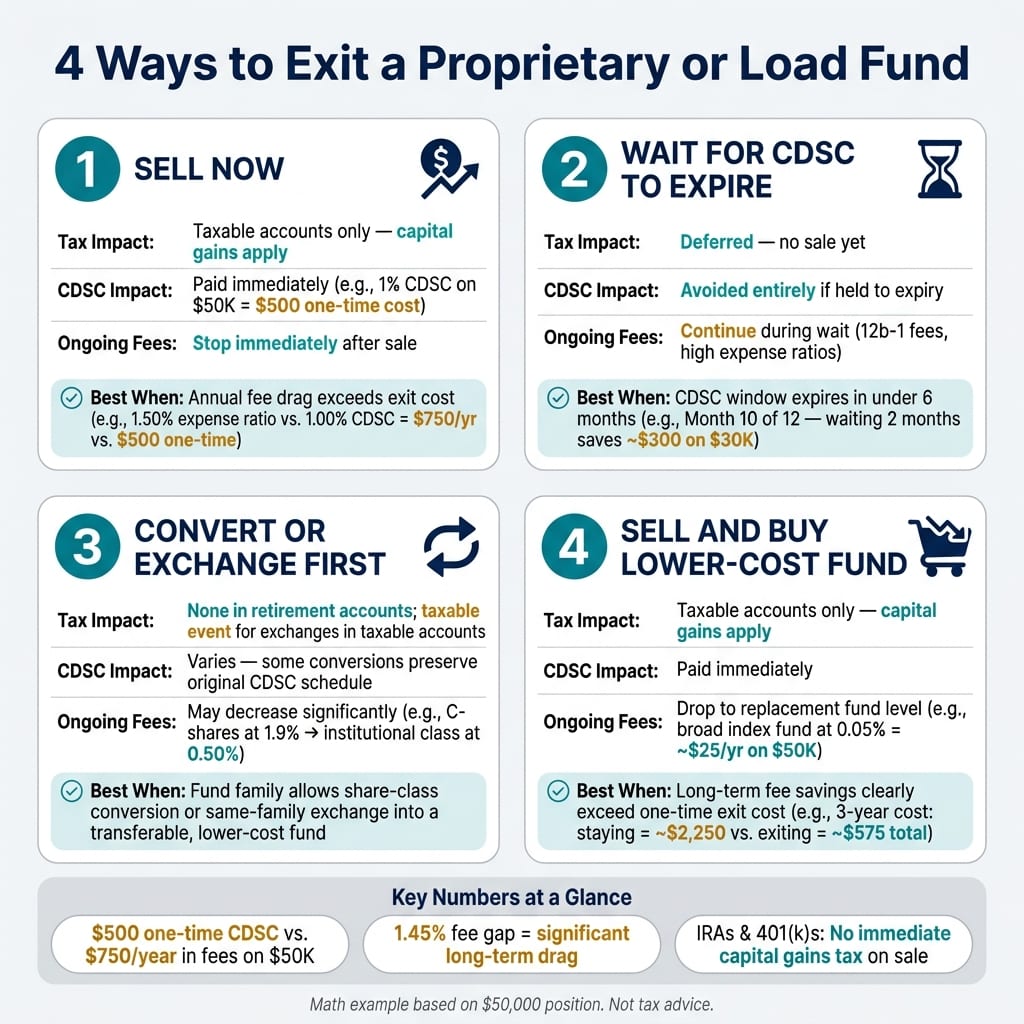
Once you've flagged the blocked holdings, line up each exit option by total cost: taxes, CDSC, and future fees. For proprietary funds or load funds that won't transfer, the core tradeoff stays the same: does the cost to leave outweigh the cost of staying?
Option 1: Sell Now
Selling right away may make sense when the exit cost looks clearly lower than the upside of moving on.
In an IRA or 401(k), there may be no immediate capital gains tax, so the main cost may be any remaining CDSC. Say a proprietary fund has a 1.5% expense ratio and the index fund you want charges 0.05%. That 1.45% annual gap on a $50,000 position comes to $725 per year, which may make a quick sale easier to justify.
Option 2: Wait for CDSC to Expire
Waiting may make sense when the CDSC window is short and the savings are plain.
For example, if you're in month 10 of a 12-month C-share CDSC window with $30,000 invested, selling now may cost about $300. Waiting two months avoids that fee. Over that short stretch, the extra expense ratio may be much lower than $300.
There is a tradeoff, though. Ongoing 12b-1 fees and high expense ratios may keep pulling money out of returns, and leaving assets at an old firm may add paperwork and account friction. This path may fit best when the window is short and the dollar savings are easy to see.
Option 3: Convert or Exchange First
Some fund families may let you convert share classes before the transfer.
A move from C-shares at 1.9% to an institutional share class at 0.50%, without a sale, may cut future costs before the account moves. In other cases, a fund company may allow an exchange into another same-family fund that the new custodian accepts, which may then transfer in kind.
In a taxable account, an exchange generally may be a taxable event. In an IRA or 401(k), it usually may not be. For example, if an IRA holds a proprietary target-date fund with a 1.4% expense ratio that the new brokerage won't accept, but the same fund family offers a broad-market index fund at 0.10% that is accepted, an exchange within the IRA may trigger no immediate tax and may cut future costs before the account even moves.
A few questions may help sort this out:
Does the conversion preserve the original CDSC schedule?
Is the conversion non-taxable in a brokerage account?
Will the new share class or fund be accepted at the receiving firm?
Option 4: Sell and Buy Lower-Cost Fund
Sometimes the cleanest path may be to sell the blocked fund, transfer cash, and buy a transferable, lower-cost replacement at the new custodian.
That choice comes down to comparing the one-time exit cost with the long-term fee savings of the replacement fund. In an IRA or 401(k), the decision may boil down to whether the lower-cost fund is worth the exit charge and the simpler account setup that comes with consolidation.
Here's how the options compare at a glance:
| Option | Tax | CDSC | Ongoing Fees | Best Use Case |
|---|---|---|---|---|
| Sell Now | Taxable only | Immediate | Stops immediately | High-fee funds with small gains, or any IRA/401(k) |
| Wait for CDSC to Expire | Deferred | Avoided if held to expiry | Continues (12b-1, etc.) | CDSC expires in under 6 months |
| Convert or Exchange First | None in retirement accounts; taxable for exchanges in taxable accounts | Varies | May decrease | Proprietary funds with a transferable share class or internal exchange option |
| Sell and Buy Lower-Cost Fund | Taxable only | Immediate | Lower | Clearly inferior funds where long-term savings exceed exit cost |
Comparing total cost across these paths may help narrow the field before you run the tax-and-fee math.
Step 3: Run the Tax and Fee Math Before You Act
Now put the tradeoff into dollars. For each exit path, compare any upfront cost - a CDSC or a tax bill - against the annual fund fees you may stop paying.
Compare Deferred Sales Charges Against Future Fund Costs
For a nontransferable Class C fund, the basic math may come down to the CDSC versus the fee drag you may avoid. Take a simple hypothetical example: $50,000 in a Class C fund with a 1.50% expense ratio and a 1.00% CDSC still in effect. Selling today may cost $500 as a one-time charge. Staying may cost $750 per year in fund expenses.
That sets up a plain tradeoff: pay $500 once vs. $750 each year. If the money moves into a broad U.S. index fund with a 0.05% expense ratio, the cost may drop to about $25 per year on the same balance.[2][11][12][13][14] Over three years, staying in the higher-cost fund may run close to $2,250 in expenses, while exiting now and moving to the index fund may cost around $575 total, including the CDSC and the lower fund costs.
The number to watch is the fee gap. A 1.45 percentage point difference may add up quietly over time.
Taxable Accounts vs. IRAs and 401(k)s: What Changes
Account type may change the math a lot. In a taxable brokerage account, selling the fund may create a taxable event. If you have a $50,000 position with a $40,000 cost basis, you may realize a $10,000 capital gain. At a 15% long-term capital gains rate, that may mean $1,500 in taxes on top of any CDSC.[15][10]
Inside a Traditional IRA, Roth IRA, or 401(k), selling usually may not trigger capital gains tax right away. You may be able to sell the proprietary fund, pay any CDSC that applies, and reinvest in a lower-cost option without an immediate tax bill. In those accounts, the decision may come down to fees, loads, and plan rules.
| Account Type | Capital Gains on Sale? | CDSC Applies? | Key Math Priority |
|---|---|---|---|
| Taxable Brokerage | Yes - short- or long-term rates | Yes | Tax + CDSC vs. future fee savings |
| Traditional IRA | No immediate capital gains tax | Yes | CDSC vs. future fee savings |
| Roth IRA | No immediate capital gains tax | Yes | Minimize long-run fee drag |
| 401(k) / Employer Plan | No immediate capital gains tax | Depends on share class | Plan restrictions vs. rollover to a flexible IRA |
For taxable accounts, it may also make sense to check whether the position sits at a loss. Realized losses may offset gains, and up to $3,000 of net capital loss may be deducted against ordinary income each year, with the rest carried forward.[16]
Then test the replacement fund, not just the exit cost.
Evaluate the Replacement Fund, Not Just the Exit Cost
The exit cost is only half the picture. The replacement fund needs to be accepted by the receiving custodian and track a similar benchmark, so your allocation stays in line rather than drifting into a different exposure.
Before you commit, check for duplicated holdings. Mezzi's X-Ray feature may help you compare positions across accounts and show whether the expensive fund duplicates exposure you already own elsewhere. If most of the holdings overlap with another low-cost fund, you may be paying a high fee for the same exposure.
Conclusion: Build a Clean Exit Plan and Avoid Unnecessary Costs
A stuck proprietary or load fund may come from a series of choices, not just one. The best next step may depend on the blocked fund, the CDSC, any conversion or exchange rules, and the account type holding the fund. In practice, the cleanest exit paths tend to follow the same pattern.
Use the same sequence each time: identify blocked positions, check for a conversion or exchange, then compare the exit cost with the fee savings that may come later. Once that path looks clear, the last step may be figuring out which account type makes the move least expensive.
Account type may change the math. In retirement accounts, the focus may stay on fees and CDSC. In taxable accounts, capital gains may also need a close look.
The goal may be simple: the lowest total cost over time, paired with a replacement fund that fits the same allocation. A full view across all accounts may make that comparison easier and faster.
Mezzi may help map blocked positions across taxable, IRA, and 401(k) accounts, show overlap with existing holdings, and model a lower-cost exit path.
This article is for educational purposes only and is not tax advice. Consider a qualified tax professional for your situation.
FAQs
How do I know if my fund is non-transferable?
Check with your new custodian or brokerage before you start the transfer to confirm whether the fund may move in kind.
Proprietary mutual funds that are managed only by your current firm often may not transfer if the new firm doesn't offer them. If that happens, you may need to sell the fund and move the proceeds as cash, which may trigger a taxable event.
Should I pay the CDSC now or wait?
It depends on your fund’s fee schedule and your timeline.
A CDSC may be around 1% to 2% in some funds. It also often declines over time and may eventually reach 0% if you hold the shares long enough.
The trade-off is pretty simple: the fee today versus what you may gain by moving into a lower-cost, more tax-efficient investment. Waiting may let you avoid the charge. But staying in a high-fee or underperforming proprietary fund may end up costing more over time.
When is selling in a taxable account worth it?
Selling in a taxable account may be worth considering if you want to harvest tax losses that may offset capital gains elsewhere. It may also make sense if you’re doing a complete portfolio overhaul and are willing to accept the tax consequences that may come with it.
Because selling may trigger capital gains taxes, it may be better to avoid it unless it feels necessary for your situation. If an investment is worth less than you paid, selling may let you realize a loss and potentially reduce your tax burden.
Disclosures:
This content is for informational purposes only and does not constitute investment advice or a recommendation to buy or sell any security.
Past performance is not indicative of future results. No guarantee of future performance or outcomes is implied.