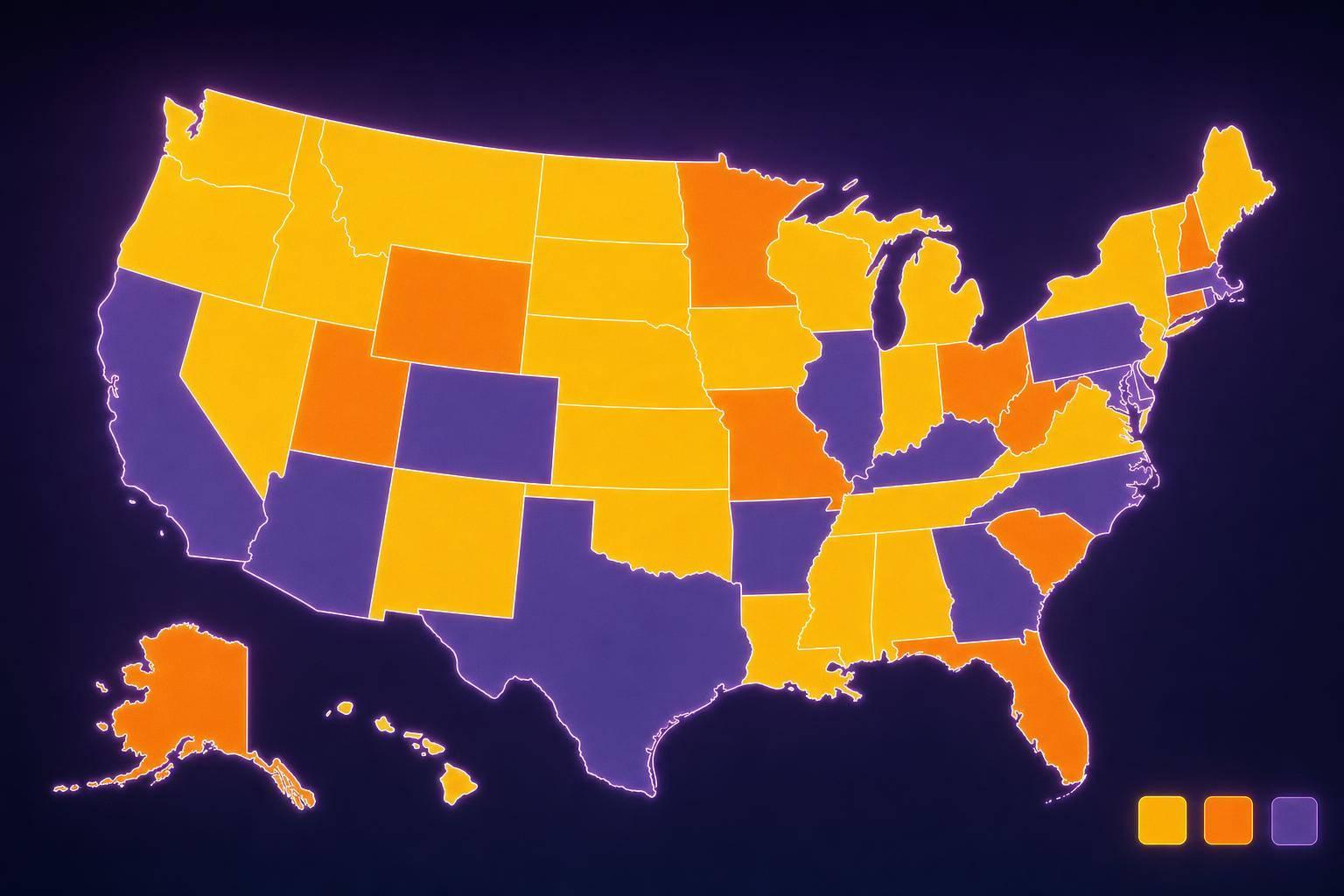
A federal QSBS exclusion may leave you with a state tax bill anyway. In 2026, that gap may range from $0 in a no-income-tax or fully conforming state to nearly $750,000 on a $15 million gain in Illinois, and up to about $1,995,000 in California, based on the rates used in the article.
Here’s the short version:
Federal treatment is only part of the story.
Your state of residence on the sale date may drive the state tax result.
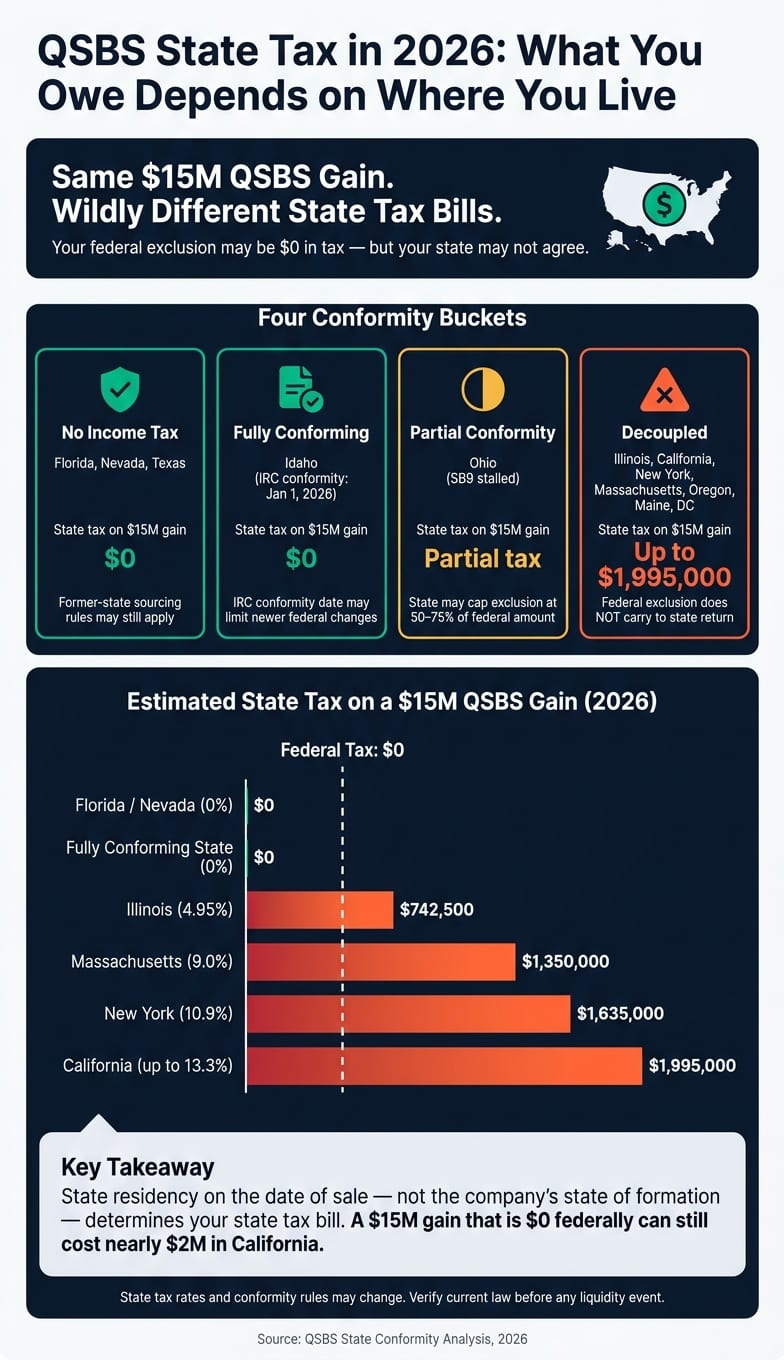
States may fall into four buckets:
Fully conforming income-tax states
No-income-tax states
Partial-conformity states
Non-conforming / decoupled states
Illinois now taxes QSBS gains excluded at the federal level starting in 2026.
Even after a move, a former state may still try to tax part of the gain if it views the equity as pay tied to work performed there.
In other words: a founder with the same $15,000,000 QSBS gain may owe $0 in Florida, but may owe a six- or seven-figure state tax bill in a decoupled state.
The $15 Million Tax Rule Most Founders Learn Too Late
Quick Comparison
| State bucket | State tax on federally excluded QSBS gain may be | Main issue |
|---|---|---|
| Fully conforming | $0 | IRC conformity date may limit newer federal changes |
| No-income-tax | $0 | Former-state residency and sourcing reviews may still apply |
| Partial-conformity | Partial tax | State may follow only part of Section 1202 |
| Non-conforming / decoupled | Full or near-full tax | Federal exclusion may not carry to the state return |
A few state examples from the article:
| Example state | 2026 treatment described | Tax on $15M gain using article figures |
|---|---|---|
| Florida / Nevada | No state income tax | $0 |
| Illinois | Decoupled | $742,500 |
| Massachusetts | Decoupled | $1,350,000 |
| New York | Decoupled | $1,635,000 |
| California | Decoupled | $1,995,000 |
Bottom line: if you are modeling a QSBS exit in 2026, the federal exclusion may not tell you the full after-tax result. The article’s core point is simple: where you live when the deal closes may matter almost as much as whether the stock qualifies in the first place.
1. Fully conforming income-tax states
In a fully conforming state, a QSBS gain excluded under Section 1202 may also stay off your state return. In plain English: the state generally follows the federal QSBS rules, so the excluded gain may not be taxed at the state level.
There’s one catch. A state’s IRC conformity date may affect whether a federal change applies in the year of sale. So even in a state that generally conforms, timing may still matter.
For example, Idaho updated its conformity to the IRC as of January 1, 2026, so QSBS gains generally track the federal exclusion rules [3]. Virginia took a different path. It fixed its conformity date to December 31, 2025, which means it may not automatically pick up federal QSBS changes enacted after that date [3].
Residency on the sale date also usually controls state tax. That’s a big deal. Founders or investors who relocated from a decoupled state like Illinois or Oregon to a conforming state before a liquidity event may eliminate state tax on that gain. That timing test is where fully conforming states start to part ways with partial-conformity and decoupled states.
Before selling, it may make sense to check the state’s IRC conformity date. Older conformity dates may leave newer federal QSBS changes out of state law.
2. No-income-tax states
At the simplest end of the spectrum, no-income-tax states usually make the QSBS state-tax issue go away. If a state has no income tax, there may be no state tax for the federal QSBS exclusion to offset. That’s one reason Florida and Nevada often come up in conversations among founders and investors planning a liquidity event [4].
Here’s the contrast in plain English: a Florida founder selling $15 million in QSBS gains may owe $0 in state tax. That same founder, if still living in Illinois after the 2026 decoupling, may owe nearly $750,000 in state tax even if the gain is fully excluded at the federal level [2].
For QSBS exits, residency planning may be one of the simplest ways to remove state tax from the picture.
That said, a no-income-tax state isn’t a perfect shield. Some high-tax states may still try to tax gains tied to work performed there, and some may treat part of the gain as compensation instead of capital gain. Massachusetts offers a clear example. In Welch v. Commissioner of Revenue, the court taxed post-move gains because it treated them as compensation tied to prior Massachusetts employment [4].
If someone expects a former state to review the move, the paper trail may matter a lot. Records that may support that position include:
Driver’s license updates
Voter registration
Vehicle registration
Workday tracking by state
Once a state does impose income tax, conformity rules come back into play.
3. Partial-conformity states
When a state taxes income but doesn't fully conform to Section 1202, QSBS relief may end up only partial. In plain English: even if the federal tax on a QSBS sale may be $0, part of that gain may still be taxed by the state.
That usually happens because the state follows only part of the federal rule. So instead of matching the full federal exclusion, the state may tax the portion that falls outside its own version of Section 1202.
Older conformity dates are a big part of the issue. In some states, those older dates may cap the exclusion at 50% or 75%, rather than the full federal amount. If a state hasn't updated its conformity date, it may not adopt the newer federal limits on its own.
Ohio shows how murky this may get in practice. Ohio's Senate Bill 9 would align state law with the federal rules, but the bill remains stalled [1][3]. Until that changes, some 2026 QSBS gains may still be taxable in Ohio. If Ohio makes the change retroactive, earlier 2026 sales may benefit. If not, taxpayers may need amended returns.
That leaves fully decoupled states, where no state QSBS exclusion survives.
4. Non-conforming and decoupled states
Then there are the fully decoupled states. In those places, the federal QSBS exclusion no longer carries over to the state return. So a gain that may be tax-free at the federal level may still be fully taxable at the state level. In 2026, that group includes Illinois, Oregon, Maine, and the District of Columbia.[2]
Illinois may be the clearest 2026 example. As Matthew Clark, MBA, CAIA, Trusted Advisor for Business Owners, put it:
"Starting in 2026, Illinois residents will owe state tax on QSBS gains that are excluded at the federal level - even on transactions that were already in the works before the rule change." [2]
At that point, the big issue may be your state of residence when the sale closes. A bona fide move before closing may remove exposure if you leave the decoupled state before the sale. But timing alone may not be enough. The move may need to hold up as a real residency change, on paper and in practice.
There’s another trap here too. If equity was granted for services performed while you were a resident, a former state may still tax the gain. Massachusetts often uses a service-connection test.[4] If a residency change is part of the plan ahead of a liquidity event, some people review their equity agreements and complete the residency change, along with the supporting records, before closing.
Residency, Timing, and After-Tax Outcomes: Key Planning Tradeoffs
State tax may follow your domicile at closing, not the company’s state of formation. So a Delaware C-corp may not create Delaware tax treatment. In practice, residency and closing date may be the two biggest variables behind the numbers below.
The gap may be easiest to see in dollar terms.
| State / Type | Approx. State Tax Rate | Tax on $10M Gain | Tax on $15M Gain |
|---|---|---|---|
| No-income-tax state | 0% | $0 | $0 |
| Fully conforming state | 0% | $0 | $0 |
| Illinois (Decoupled / no QSBS conformity) | 4.95% | $495,000 | $742,500 |
| Massachusetts (Decoupled / no QSBS conformity) | 9.0% | $900,000 | $1,350,000 |
| New York (Decoupled / no QSBS conformity) | 10.9% | $1,090,000 | $1,635,000 |
| California (Decoupled / no QSBS conformity) | up to 13.3% | $1,330,000 | $1,995,000 |
Those differences may be large enough that some people look at a residency change before a liquidity event. But a last-minute move may not be a dependable path. States often use a facts-and-circumstances review and may look for real life changes, such as:
Updating your driver’s license
Changing voter registration
Updating vehicle records
A rushed move may draw audit scrutiny.
And even then, a move may not fully remove state tax exposure. Residency alone may not control the outcome. A former state may still tax a compensatory gain associated with services performed there.
That’s why scenario modeling may matter before a liquidity event. Mezzi may help you model after-tax outcomes across state scenarios before a sale closes.
Pros and Cons by State-Conformity Bucket
The four buckets vary most in certainty, state tax cost, and planning risk. State tax treatment may depend on where someone lives when the sale happens and, for founders and employees, how the gain may be sourced. The table below lays out the tradeoffs.
| Conformity Bucket | Main Advantages | Main Drawbacks | Who Benefits Most | Key Watch-outs |
|---|---|---|---|---|
| Fully Conforming | High state tax certainty; simpler filing; lines up with the federal exclusion | May be sensitive to political shifts; legislative delays may leave tax status unresolved mid-year | Taxpayers in states that follow Section 1202 closely | Stalled legislation may delay conformity and may trigger amended returns |
| No-Income-Tax | 0% state tax on realized gains; more room for residency planning | Audit risk from former states; needs proof of a real domicile change | Founders and employees who relocate early in the vesting cycle (for example, FL, TX, NV) | Prior-state sourcing rules may still tax part of compensatory gains tied to where services were performed |
| Partial-Conformity | Some relief compared with full state taxation | Often frozen at older federal limits, which may create a gap with the 2026 federal rules | Taxpayers whose gains still fit the state's older limit | State asset rules may deny relief even when federal QSBS qualifies |
| Non-Conforming / Decoupled | Clear state rule, even if QSBS relief does not carry over | State tax may offset much of the benefit on the state return | No taxpayer benefit; the state keeps the tax base | Retroactive rules may affect deals already in motion |
Outside investors usually face cleaner state treatment. Founders and employees may run into equity compensation sourcing rules that pull part of the gain back to a prior work state.
Conclusion
Federal QSBS qualification may be only half the equation. In 2026, your state of residence at the time of sale may matter just as much as whether your stock qualifies for the federal exclusion. That leaves one practical question: where does your state fall in 2026? A $15 million gain that may be tax-free at the federal level may still produce a six-figure state tax bill - or $0 - depending on your conformity bucket.
Before any liquidity event, it may make sense to know your conformity bucket, model state tax separately from federal tax savings, and lock in residency and timing early. Illinois now taxes QSBS gains that remain excluded federally, which may make state residency a decisive part of the after-tax result. [2]
State rules may change before your next exit. Illinois decoupled from federal QSBS rules, and exits already in motion may be affected. [2] It may be worth verifying current state law before relying on any after-tax estimate, because QSBS state treatment may change before closing.
FAQs
Does my residency on the sale date control state QSBS tax?
Generally, yes. For QSBS capital gains, your state of residence on the sale date usually determines which state may tax the gain.
There’s one catch: state treatment may also depend on whether that state follows the federal QSBS exclusion. Some states do not. Illinois, Oregon, and DC are common examples.
So even if the federal exclusion applies, state tax may still apply in those places.
Can a former state still tax my QSBS gain after I move?
Yes. A former state may still tax your QSBS gain after you move, because state tax rules may differ from the federal QSBS exclusion.
If you lived in a non-conforming state, such as Illinois, Oregon, or the District of Columbia, part or all of the gain may still be taxable there. Some states may also apply allocation or pro-rata rules based on where you lived or worked when the equity was earned.
How do I know if my state conforms to Section 1202?
Check your state’s tax code. State conformity with Section 1202 and QSBS rules may not happen automatically.
Some states decouple from the federal exclusion. For example, Illinois, Oregon, and Maine tax gains that may be excluded at the federal level.
State rules may also change fast. Because of that, some taxpayers consult a tax professional to model possible state tax exposure before relying on the federal exclusion.
Disclosures:
This content is for informational purposes only and does not constitute investment, tax, or legal advice. Readers should consult a qualified tax professional regarding their specific situation.
State and federal tax laws are subject to change and may vary based on individual circumstances. The examples provided are illustrative and based on rates and laws as of the article's publication date.
Past performance or historical tax treatment is not indicative of future results. No guarantee of future tax outcomes is implied.