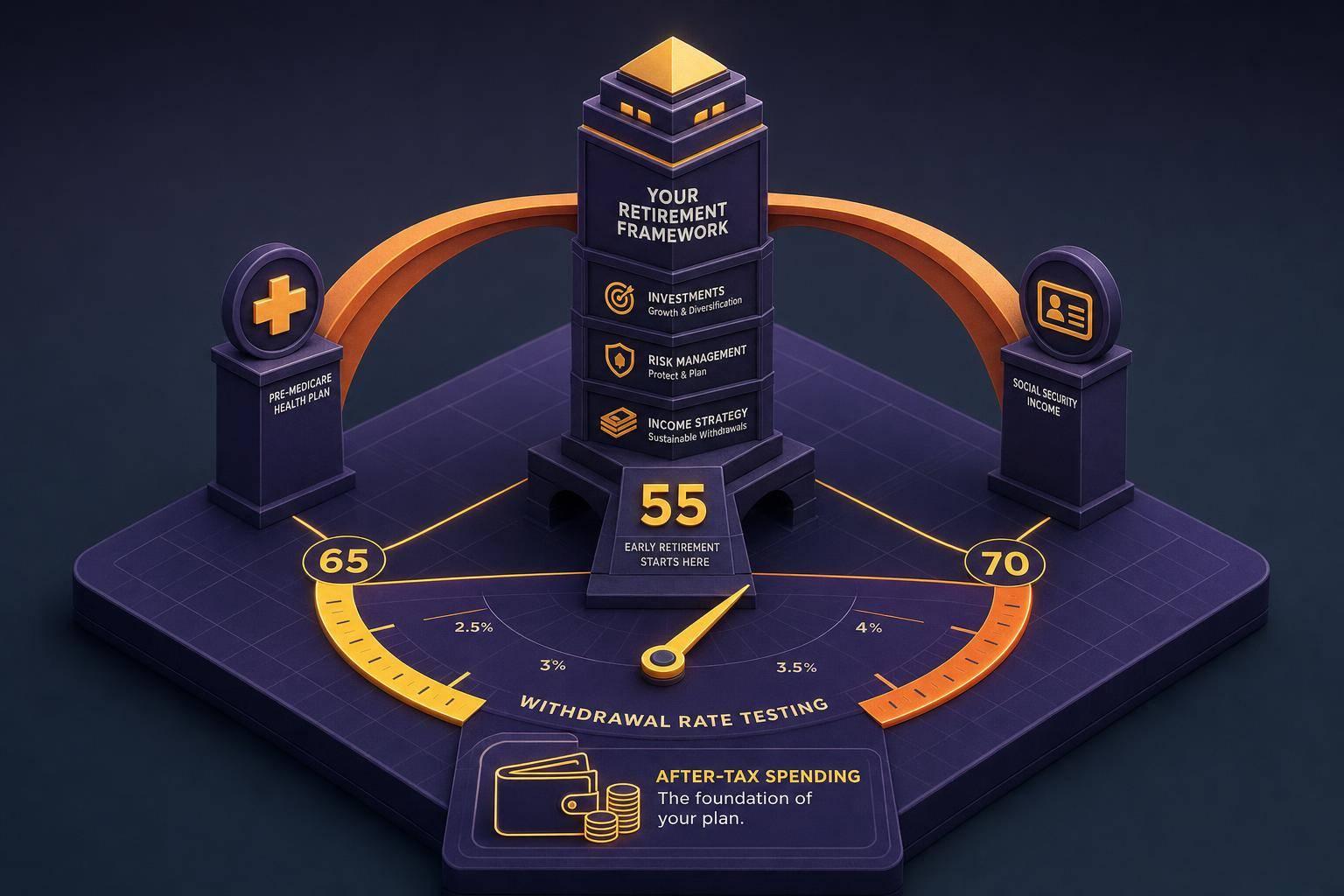
There may not be one retirement number for age 55. A more useful starting point may be: how much spending your savings may need to cover each year for 35 to 40 years.
Here’s the short version:
Start with annual after-tax spending, not a round portfolio goal
Consider testing a lower withdrawal rate than many age-65 rules of thumb
4.0% may imply 25× spending
3.5% may imply 28.6× spending
3.0% may imply 33.3× spending
Add pre-Medicare health coverage for ages 55 to 65
Map the Social Security gap, since benefits may not start until 62 or later
Adjust for account type, since pre-tax, Roth, and taxable dollars may not have the same spendable value
Stress-test the plan for inflation, taxes, and rough early market declines
A simple example from the piece: if I want $80,000 per year after tax and use a 3.5% starting withdrawal rate, the base portfolio target may be about $2.3 million before other adjustments.
That number may move up or down based on:
My healthcare cost before 65
When I claim Social Security
Whether my money sits in taxable, pre-tax retirement accounts, or Roth
How much spending I may cut in a weak market
Why Retiring At 55 Is Possible If You Have Saved This Much
Quick comparison
| Item | What it may mean at 55 |
|---|---|
| Spending | The main input behind the target number |
| Withdrawal rate | A lower rate may fit a 35- to 40-year timeline |
| Healthcare | Private or ACA coverage may add a large cost before Medicare |
| Social Security timing | Claiming earlier may shorten the gap, but monthly income may be lower |
| Account mix | Not all dollars may have the same after-tax value |
| Flexibility | A plan with room to trim extras may hold up better in weak markets |
Bottom line: retiring at 55 may be less about hitting a headline number and more about testing whether your spending, taxes, healthcare, and account mix line up for a long gap before Medicare and full Social Security.
Step 1: Build your retirement number from annual spending
At 55, the starting point may be your spending, not some big headline number. Your retirement number may come from what you expect to spend each year.
Estimate your essential vs. total spending at 55
Start by splitting retirement spending into two buckets: essentials and lifestyle extras.
Essentials may include housing, utilities, groceries, transportation, health coverage, debt minimums, and core insurance. Lifestyle spending - travel, dining, hobbies, and other nonessentials - may sit on top of that base.
As a rough, illustrative benchmark, households headed by someone 65+ were reported to spend about $61,432 per year in 2024, including $22,193 on housing and $9,538 on transportation. That figure may work best as a reference point, not a personal target.
To build your own estimate, pull three to six months of actual bank and credit card statements and sort each expense into essential or discretionary. From there, remove work-related costs. Then add pre-Medicare health insurance and out-of-pocket medical costs. Retirement may reduce work-related costs by $3,000 to $5,000 per year, but a 55-year-old couple may add $12,000 to $20,000 per year for ACA coverage before subsidies, plus deductibles and copays.[1][2]
That process may leave you with two numbers:
A minimum lifestyle figure
A full lifestyle figure
The gap between them may be your spending buffer. In a weak market, that may show how much spending you might trim without touching essentials.
Convert your annual spending into a portfolio target
Portfolio target = Annual after-tax spending ÷ Withdrawal rate
At a 4.0% withdrawal rate, the target may be about 25 times annual spending. At 3.5%, it may rise to about 28.6 times. At 3.0%, it may be closer to 33.3 times. Over several decades of withdrawals, that difference may add up.[3][4][5]
The table below shows what those rates may look like across three common spending levels, in today’s dollars, before Social Security, pension, or part-time income:
| Annual After-Tax Spending Goal | Portfolio at 3.0% Rate | Portfolio at 3.5% Rate | Portfolio at 4.0% Rate |
|---|---|---|---|
| $120,000 | $4,000,000 | $3,428,571 | $3,000,000 |
| $180,000 | $6,000,000 | $5,142,857 | $4,500,000 |
| $250,000 | $8,333,333 | $7,142,857 | $6,250,000 |
If your minimum lifestyle figure is $120,000 and your full lifestyle figure is $180,000, this range may make the tradeoffs easier to see. A portfolio of $4.0 million at 55, for example, may clear the minimum threshold at 3.5% but may fall short of the full lifestyle target. That may give you a more concrete sense of how much flexibility you might have.
Next, test whether 3.0%, 3.5%, or 4.0% may fit your time horizon and portfolio mix.
Step 2: Test your withdrawal rate and portfolio mix
Once you have a portfolio target, the next step is to test whether it may hold up over a 35- to 40-year retirement. The 4% rule may be a starting point, but it may not fit every situation.
When 3.0%, 3.5%, or 4.0% makes sense
A 3.0% withdrawal rate may fit people who want the most caution. A 3.5% rate may offer more of a middle ground. A 4.0% rate may be more workable when spending is flexible and later income may be strong. Over a 40-year retirement, rough historical success rates were about 99% at 3.0%, 97% at 3.5%, and 93% at 4.0%.[6][7][8][9][11] Fidelity's early-retirement guidance suggests saving about 33× annual expenses if you plan to retire before 62, which works out to roughly a 3% withdrawal rate.[14]
For a $60,000 annual spending target, here’s how that tradeoff may look:
| Withdrawal Rate | Implied Portfolio ($60k/yr) | Rough Historical Success (40 yrs) | Best Fit |
|---|---|---|---|
| 3.0% | $2,000,000 | ~99% | Most cautious; may fit a long time horizon and limited flexibility |
| 3.5% | $1,714,286 | ~97% | More balanced; may fit when spending may be adjusted if needed |
| 4.0% | $1,500,000 | ~93% | Higher-risk starting point; may fit better if flexibility or later income is strong |
Think of the withdrawal rate as a stress test, not a promise. If a plan only appears to work at 4.0% but starts to fail at 3.5%, that may be a sign the retirement plan is fragile and may need changes before leaving work.
How stocks, bonds, and cash affect how long your money lasts
At 55, allocation matters because the portfolio may need to carry spending before guaranteed income begins. A stock-heavy portfolio may have a better chance of supporting long withdrawals because equities may outpace inflation over time. But there’s a catch: more stocks may also bring more volatility and more sequence-of-returns risk. That’s the risk that a sharp early market drop, paired with withdrawals, may shrink the portfolio enough that recovery gets much harder.[10][13]
On the other hand, holding too much in bonds or cash may smooth out the ride, but it may also make a 35- to 40-year retirement harder to support.
A common setup keeps 1 to 3 years of spending in cash or short-term bonds, with the rest invested for growth.[12][15][16] The point of cash isn’t growth. It’s more like a buffer. It may let you avoid selling stocks at the worst possible time. One simple bucket setup looks like this:[16]
Near-term spending in cash
Mid-term spending in bonds
Long-term money in stocks
It may also help to test what happens if the market drops 30% to 40% in the first 3 years of a 35- to 40-year retirement. If the plan only works with returns above 7% per year, that may point to a setup that’s too fragile.[10]
Next, map the years before Social Security and Medicare to see which accounts may need to fund the gap.
Step 3: Plan the gap years before Social Security and Medicare
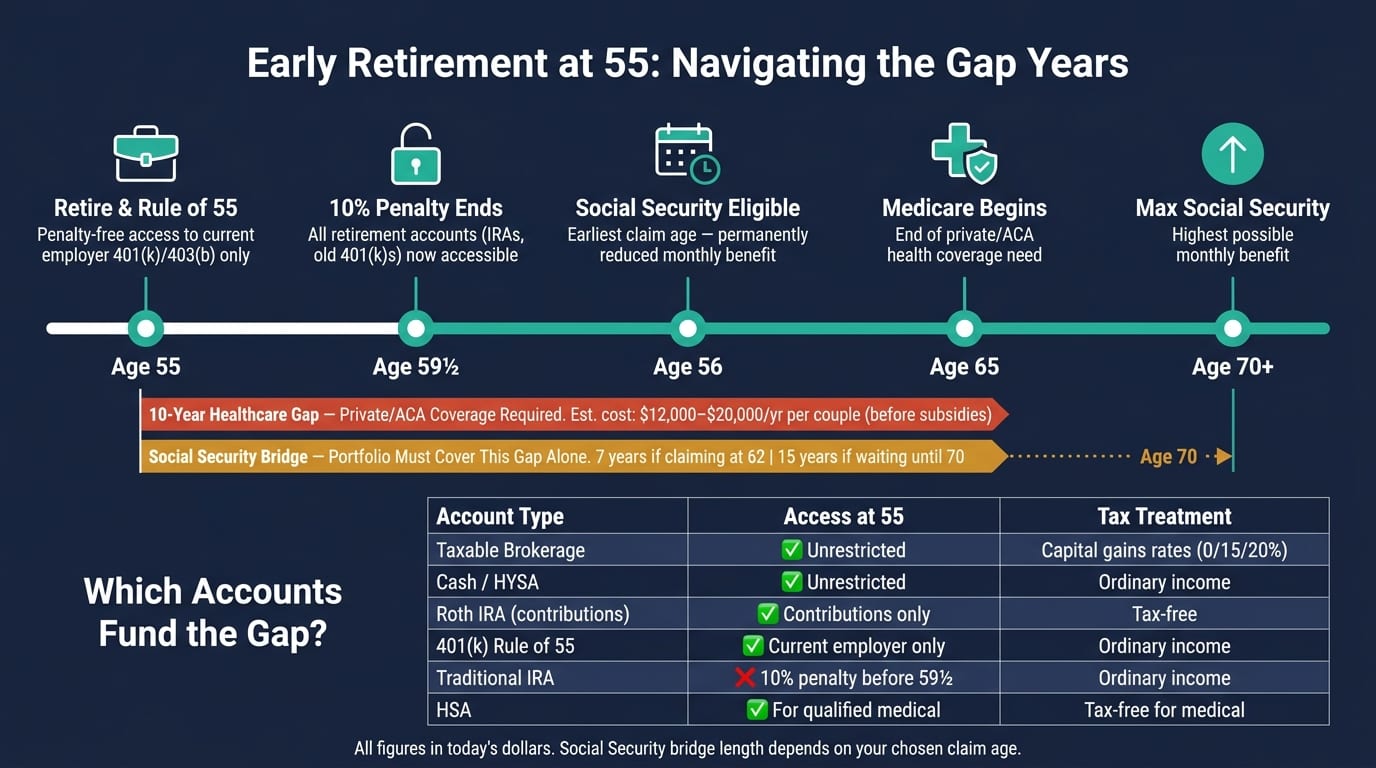
After the withdrawal rate looks workable, the next step is to map the years before any guaranteed income begins. At 55, that usually means covering two separate gaps: ages 55 to 62 before Social Security, and 55 to 65 before Medicare. The big idea is simple: match each account to the years it may cover. That's why account order and timing may matter so much.
Key ages to know: 55, 59½, 62, and 65
In the U.S., four ages tend to shape the early-retirement timeline. Each one opens a different door.
| Age | What Changes |
|---|---|
| 55 | Penalty-free access may be available to a current employer's 401(k) or 403(b) under the Rule of 55, if you separate from that employer in or after the calendar year you turn 55. |
| 59½ | The 10% early withdrawal penalty ends for most retirement accounts, including IRAs and old 401(k)s. |
| 62 | Earliest age to claim Social Security retirement benefits, though claiming then permanently reduces the monthly amount versus waiting. |
| 65 | Medicare begins. Before this, you need separate health coverage. |
That may make the 55-to-65 stretch the hardest period to fund.
Which accounts to draw from in the early years
A common approach starts with taxable accounts and cash, then moves to employer-plan funds, then Roth basis. Traditional IRAs often stay untouched until after 59½, since withdrawals before then may trigger the 10% penalty.
| Source | Access at 55 | Tax Impact | Common Use |
|---|---|---|---|
| Taxable Brokerage | Unrestricted | Capital gains rates (0%, 15%, 20%) | Primary gap-year funding |
| Cash / HYSA | Unrestricted | Interest taxed as ordinary income | Near-term spending buffer |
| Roth IRA (contributions only) | Contributions only, anytime | Tax-free | Flexible reserve; doesn't raise taxable income |
| 401(k) / 403(b) - Rule of 55 | Current employer plan only | Ordinary income tax | Bridge funding between 55 and 59½ |
| Traditional IRA | 10% penalty before 59½ | Ordinary income tax | Hold for later |
| HSA | Anytime for qualified medical expenses | Tax-free for medical expenses | Pre-Medicare healthcare costs |
The Rule of 55 applies only to the plan from the employer you leave. It does not apply to IRAs or old workplace plans. So if your accessible accounts may not cover the 55-to-59½ gap, retiring at 55 may not be workable yet. This order tends to matter most before Social Security starts to reduce the amount you may need from the portfolio.
How Social Security timing changes your required portfolio size
When you claim Social Security has a direct link to how much your portfolio may need to cover, and for how long. Claim earlier, and the income offset starts sooner, but the monthly benefit is smaller. Wait longer, and the benefit goes up, but your savings may need to do all the work for more years.
Take a retiree at 55 with $70,000 in annual spending. If that person claims Social Security at 62, the bridge lasts 7 years. If that person waits until 70, the bridge lasts 15 years. That's a big difference. In the second case, the portfolio may need to support withdrawals for much longer before any guaranteed income begins.
Looking at age 62 versus 70 makes the tradeoff easier to see. Delaying benefits may reduce how much you need to pull from savings later, but it also extends the early bridge.
Step 4: Adjust for taxes, healthcare, and inflation - then decide if 55 is realistic
Once you've mapped the bridge years, there's one more pass to make. Taxes, healthcare, and inflation may change the math in a big way. In practice, three things tend to shift the final number: account type, pre-Medicare healthcare, and inflation.
Account type changes how far your money goes
A $3,000,000 portfolio doesn't always mean $3,000,000 of spending power.
Money in a traditional 401(k) or IRA may be taxed as ordinary income when withdrawn. At a 20% effective tax rate, $3,000,000 in pre-tax accounts may function more like $2,400,000 in spendable dollars. Roth accounts work differently. Qualified withdrawals are tax-free, so $1,000,000 in a Roth IRA may be closer to $1,000,000 of spending power. Taxable brokerage accounts usually fall somewhere in the middle, since long-term capital gains rates are often lower than ordinary income rates.
That means two households may each have a $2 million portfolio and still end up with very different spending power, based on how much sits in traditional, Roth, and taxable accounts.
A simple way to look at it: convert each balance into after-tax dollars before testing any withdrawal rate.
Discount traditional accounts by your estimated effective tax rate
Count Roth balances at full value
Discount taxable balances for expected capital gains
That adjusted total may be the more useful starting point.
After taxes, one of the biggest early-retirement costs may be health coverage before Medicare.
Budget for pre-Medicare healthcare and inflation separately
Healthcare before age 65 may be one of the largest costs in early retirement. That's the price of retiring before Medicare begins. It may make sense to budget pre-Medicare healthcare separately for the full 55-to-65 gap, since for many households, this expense takes up a large share of the plan.
Inflation needs its own lane too. For this framework, use 3% for general inflation and a higher rate for healthcare costs, which have historically risen faster. And here's the part that trips people up: all earlier dollar figures in this framework are in today's dollars. Don't mix today's dollars with future dollars in the same plan.
Conclusion: Calculate your number, find the weak spots, and close the gap
If the plan still holds after those adjustments, retiring at 55 may be realistic.
Start with your annual spending in today's dollars. Divide that by a withdrawal rate that may fit your timeline - for example, 3.0%–3.5% for a 35- to 40-year retirement. Convert portfolio balances into after-tax dollars based on account type. Add a separate healthcare budget for ages 55–65. Map the Social Security bridge. Then apply a 3% general inflation assumption and a higher rate for medical costs.
That process may leave you in one of three buckets: Ready, Close, or Short.
Ready means your after-tax, inflation-adjusted plan may support your spending at a conservative withdrawal rate, including pre-Medicare healthcare.
Close means you're within 10%–20% of the target. In that range, small changes like delaying retirement by a year or two, changing withdrawal sequencing, or trimming discretionary spending may close the gap.
Short means you're more than 20% below target. In that case, a later retirement date, a higher savings rate, or a lower spending target may be needed.
If you'd like to test this framework against your own numbers, Mezzi may run the analysis using your actual accounts.
FAQs
What if my spending changes in retirement?
If your spending shifts in retirement, it may make sense to recalculate your target portfolio and revisit how you draw from it.
Start by updating your annual after-tax spending assumptions. That may include day-to-day expenses, inflation, and healthcare costs, which may change over time.
Then pressure-test the plan with a couple of withdrawal methods:
Fixed-dollar withdrawals
Percentage-based withdrawals
It may also help to refresh your tax-aware withdrawal order and related scenarios. Taxes may vary based on the type of account you pull from and when those withdrawals happen.
How do I know which withdrawal rate fits me?
Don’t start with one rule. Start with your spending.
A withdrawal rate may make more sense when it matches your after-tax spending target, your tax picture, and the mix of accounts you plan to draw from. In plain English: figure out what you may want to spend after taxes, then translate that into gross withdrawals based on whether the money may come from taxable, tax-deferred, or Roth accounts.
From there, some people use a fixed-dollar method. Others use a percentage approach. And some prefer guardrails, such as 3.5%–4.5%, where withdrawals may move up or down within a set range.
Inflation matters too. So does sequence risk - the chance that early market losses may put extra strain on a portfolio when withdrawals have already started. That’s why it may make sense to pressure-test your plan rather than assume one rate will fit every year.
A lot of retirees revisit their withdrawal rate annually and adjust as needed. In many cases, a more conservative starting range - often 3.5%–4% - may be safer.
Can I retire at 55 if most of my money is in a 401(k)?
Yes, it may be possible, but it depends on your after-tax withdrawal needs and any penalties. Withdrawals from a Traditional 401(k) are generally taxed as ordinary income, so you may need to take out more in gross dollars to support the same level of spending.
Pulling money out before age 59½ usually comes with a 10% penalty unless an exception applies. That may make a 401(k)-heavy plan harder to manage without bridge funds or a tax-aware approach.
Some people test a 4% starting rule and then adjust for taxes and inflation.
Disclosures:
This content is for informational purposes only and does not constitute investment advice or a recommendation to buy or sell any security.
Past performance is not indicative of future results. No guarantee of future performance or outcomes is implied.
Savings and performance examples are hypothetical and for illustrative purposes only. Actual results will vary based on individual circumstances, portfolio composition, market conditions, and fees.