
I’d sum the article up this way: taxes may change, income may shrink, and spending may stay closer to the same than many people expect. That may leave a gap unless I recheck all three at once.
Here’s the short version:
Taxes may shift fast. In the year of death, a joint return may still apply. After that, filing status may change, and the same IRA withdrawal may create more tax.
Income may change more than expected. One Social Security check stops. A survivor benefit may be lower. Pension or annuity payments may continue, change, or end.
Spending may not fall much. Housing, insurance, utilities, and healthcare may stay high. Some costs, like paid help at home, may even go up.
Account decisions may matter. IRA beneficiary choices, final-year RMDs, withholding, and Roth conversion timing may affect cash flow and taxes.
The key math is simple: compare after-tax monthly income with actual monthly bills, then test what may happen if taxes, healthcare, or markets change.
A few numbers stand out:
The 2026 standard deduction may be $32,200 for joint filers and $16,100 for single filers.
Social Security taxation for a single filer may start once provisional income goes above $25,000.
The standard Medicare Part B premium for 2026 may be $202.90 per month for people at lower income tiers.
A missed RMD may trigger an excise tax of up to 25%, with a lower rate that may apply if fixed in time.
If I were reading this after a loss, I’d take away one main point: don’t reuse the old withdrawal plan without checking the new tax status, the new income total, and the new budget first.
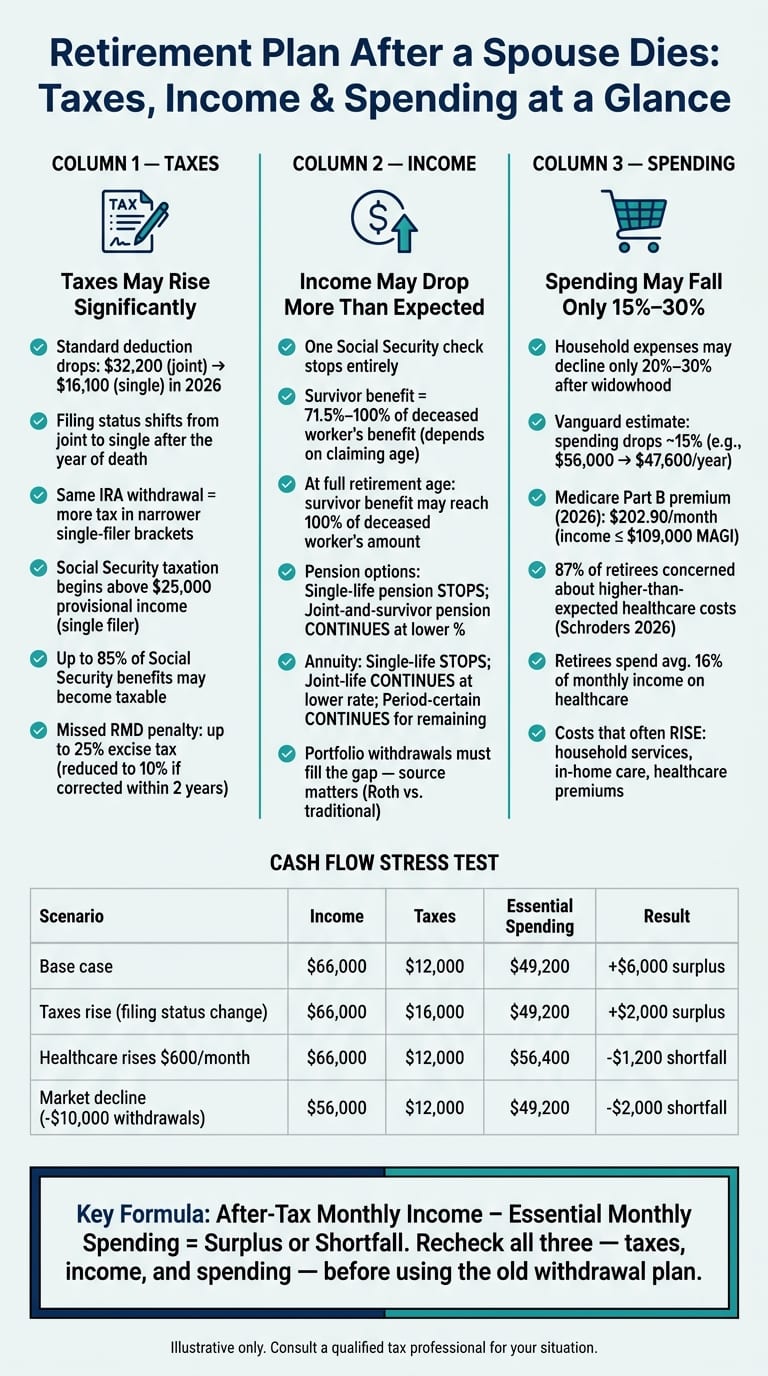
Retirement Planning After Losing a Spouse
Recheck taxes before using the old withdrawal strategy
Taxes may change a lot from the year of death to the years that follow. A withdrawal plan that fit a joint return may become much more costly once you file as single. That shift may change how much cash is left for day-to-day spending, so taxes need a new review before anything else.
Compare tax rules in the year of death versus later years
In the year of death, you may still be able to file a joint return with your spouse if you were married at the time of death and meet the eligibility rules.[6][8][11] That may keep the wider tax brackets and the higher standard deduction for one last year. After that, you may qualify for qualifying surviving spouse status for up to two more tax years if you have a dependent child and meet other IRS conditions.[6][11][12] That status usually keeps joint brackets and the larger standard deduction in place. After that, the same withdrawal may create more tax.
| Planning item | Year of death | Later tax years |
|---|---|---|
| Filing status | Can you still file jointly for the year of death? | Often single, unless qualifying surviving spouse or head of household applies [6][11][12] |
| Taxable income sources | Survivor's income plus any reportable income belonging to the deceased spouse through the date of death | Survivor's ongoing Social Security, pension, investment income, and retirement-account withdrawals |
| Standard deduction | Joint-return amount may apply ($32,200 for 2026) [9] | Single-filer amount may apply ($16,100 for 2026); qualifying surviving spouse generally keeps the higher amount [9] |
| Tax brackets | Joint-return brackets may accommodate more income before higher rates apply | Single-filer brackets are generally narrower, so the same withdrawal may create more tax |
| Withholding and estimated taxes | Existing withholding may have been based on joint income | Recalculate withholding or quarterly estimated payments using the survivor's projected income |
Confirm your filing status with a tax preparer. Eligibility depends on the facts of your case - your dependents, whether you've remarried, and the date of death.
With filing status reset, the next step is rebuilding taxable income from the survivor's actual sources.
Recalculate taxable income and withdrawal timing
Start by rebuilding your income picture from scratch using only what you'll actually receive: your Social Security survivor benefit, any pension or annuity, investment income, and planned retirement-account withdrawals. Don't carry over the old household numbers. The aim is a withdrawal pattern that may still cover monthly expenses after one spouse is gone.
One detail may catch many survivors off guard: Social Security taxation. The IRS uses a provisional-income formula to determine how much of your benefit is taxable:
Provisional income = adjusted gross income (excluding Social Security) + tax-exempt interest + ½ of Social Security benefits [10][13][14]
For a single filer or qualifying surviving spouse, benefits start entering the taxable calculation above $25,000 of provisional income, and up to 85% of benefits may be taxable at higher income levels.[7][10][13] A traditional IRA withdrawal may raise AGI and may make more of your Social Security taxable.
Here's what that may look like in plain English. If you receive $24,000 in Social Security and have $20,000 of other income, your provisional income is roughly $32,000 ($20,000 + half of $24,000). A $10,000 IRA withdrawal may push that figure into a different Social Security taxation range - while the withdrawal itself may also count as taxable income.[10]
Some people compare Roth conversions, multi-year withdrawals, and taxable-account spending against their bracket, RMDs, and Medicare thresholds. The best fit may depend on your current bracket, future RMDs, Medicare income thresholds, and whether you have cash available to pay conversion taxes without taking more from pretax accounts.
Review inherited IRA and RMD decisions carefully
Moving a deceased spouse's retirement account before confirming beneficiary status, account type, and IRS rules may cause problems. If you were the sole beneficiary of your spouse's IRA, you may generally elect to treat it as your own IRA rather than remain as a beneficiary.[2] That choice changes when required minimum distributions (RMDs) must begin and how they're calculated - and the wrong call may distort both taxes and spendable income. Depending on your age relative to your spouse's, staying as a beneficiary may give you more flexibility - or less.
Before signing any transfer paperwork, get clear answers to these questions from your IRA custodian, plan administrator, and tax preparer working together:
| Item to review | Question to answer | Who to contact |
|---|---|---|
| Filing status | Can you still file jointly for the year of death? Does qualifying surviving spouse status apply later? | Tax preparer |
| Final-year income | What income belongs on the joint return versus the estate or survivor's return? | Tax preparer and estate attorney |
| Withholding | Are pension, annuity, and retirement-account withholding elections still appropriate? | Employer, pension provider, and tax preparer |
| Social Security | What survivor benefit will be paid, and how much may be federally taxable? | Social Security Administration and tax preparer |
| Pension or annuity | Does the payment continue, change, or stop after death? What withholding applies? | Pension provider or insurance carrier |
| Retirement-account type | Is the account a traditional IRA, Roth IRA, 401(k), 403(b), SEP IRA, or another plan? | IRA custodian or employer-plan administrator |
| Beneficiary designation | Were you the sole beneficiary? Are there other beneficiaries? | IRA custodian or employer-plan administrator |
| Spousal rollover or owner election | Should you remain a beneficiary or treat the account as your own? | Tax preparer and IRA custodian |
| RMD status | Was your spouse required to take an RMD? Is a final-year distribution still due? | IRA custodian, plan administrator, and tax preparer |
| Roth conversion | Would a conversion fit your projected tax bracket and available cash flow? | Tax preparer and fiduciary financial adviser |
| State taxes | Does your state treat Social Security, pensions, or inherited accounts differently? | State tax professional |
If your spouse had already reached their RMD starting age, a distribution for the year of death may still be required - even if they passed away before taking it. Your custodian can confirm whether a final-year RMD is still outstanding and calculate the amount.
Once taxes are reset, rebuild income from what remains.
Rebuild retirement income from what actually remains
Once taxes are reset, the next step is to rebuild income based on what may still be there. Some income streams may continue. Some may drop. Some may stop altogether.
Take stock of Social Security, pensions, and annuity payments
Social Security may be the biggest income shift after a spouse dies. In many cases, Social Security pays only one benefit: either the survivor benefit or the survivor's own retirement benefit, whichever is higher. The amount may depend on claiming age. Claiming before full retirement age generally leads to a lower amount, and the SSA says survivor benefits may range from 71.5% to 100% of the deceased worker's benefit depending on when the claim begins.[1][4] At full retirement age, the benefit may generally reach 100% of the deceased worker's basic benefit amount.[16][3]
Some survivors start with one benefit and switch later if the timing and rules line up in a better way.[17][5] But this is one area where guessing may create problems. To get the actual numbers, contact the Social Security Administration directly at 1-800-772-1213 rather than relying on older benefit statements.[1]
Pension income may change based on the option chosen when the pension started. That election usually controls whether payments continue after death.
A single-life pension stops when the participant dies.
A joint-and-survivor pension may continue to the surviving spouse, often at a lower percentage.
The exact amount may depend on the original election.
It may help to contact the pension administrator and ask for written confirmation of the survivor payment amount, the start date, whether any cost-of-living adjustment applies, and any terms that may reduce or end the payment.
For annuities, the contract matters more than assumptions. A joint-life annuity may continue at a lower rate. A single-life annuity stops. A period-certain annuity may continue for whatever term remains. Any amount should be treated as available only after the payer confirms it in writing.
Recalculate portfolio withdrawals on an after-tax basis
Confirmed income sources such as Social Security, a continuing pension, or a qualifying annuity may form the first layer of monthly cash flow. After that, the rest may need to come from portfolio withdrawals: traditional IRAs, Roth IRAs, 401(k)s, taxable brokerage accounts, or cash reserves.
That leaves one practical question: how much of the spending gap may need to come from investments?
A simple way to look at it:
Monthly surplus or shortfall = Reliable monthly income after deductions − Essential monthly spending
Gross income may make the picture look better than it is. What matters is what may remain after withholding and other deductions. Traditional IRA and 401(k) withdrawals may add to taxable income, and they may affect Medicare IRMAA in a later year. Qualified Roth IRA withdrawals are generally tax-free. So the source of the withdrawal may matter just as much as the amount.
Here’s a simple example. If confirmed after-tax Social Security and pension income total $3,900 per month and essential spending is $5,200 per month, the shortfall may be $1,300 per month, or $15,600 per year, before any nonessential spending.[15][3]
At that point, the withdrawal plan may need to answer two things:
Which account may supply that amount
What the after-tax cost of that withdrawal may be
Build a remaining income worksheet
Before settling on any withdrawal plan, write down each income source and place it in one of three buckets: continues unchanged, continues at a different amount, or stops.
| Income source | Continues unchanged | Continues at a different amount | Stops |
|---|---|---|---|
| Survivor's own Social Security | If already in payment and unaffected | If survivor switches to survivor benefit | - |
| Deceased spouse's Social Security payment | - | Survivor benefit replaces it; amount depends on claiming age | Stops entirely |
| Pension | - | Joint-and-survivor percentage applies | Single-life pension |
| Annuity | - | Survivor percentage or period-certain amount applies | Single-life annuity |
| Traditional IRA / 401(k) withdrawals | - | New withdrawal amount must be calculated | - |
| Roth IRA withdrawals | - | New withdrawal amount must be calculated | - |
For each row, record the gross monthly amount, the expected net amount after withholding and deductions, the first payment date, any inflation adjustment, the tax treatment, the continuation category, and the name of the contact who confirmed the number.
Use this worksheet for confirmed amounts only.
Then use the confirmed monthly total to test spending in the next step.
Recalculate spending because expenses rarely fall as much as income
Use the confirmed monthly income from the prior worksheet to test whether spending still works. Once you have that income number, line it up against what the household may actually spend.
A common mistake after a spouse dies may be assuming spending will drop a lot. In many cases, it may fall only a little, while income may drop by much more. One planning estimate suggests household expenses may decline only 20%–30% after widowhood, while income may fall by a much larger amount.[19] Vanguard’s retirement planning illustration uses a 15% drop in spending when one spouse dies, taking a couple’s $56,000 annual goal down to $47,600.[20]
Build a 12-month budget and a long-term retirement budget
Build two budgets: one for the first 12 months and one for spending later in retirement.
The 12-month transition budget should start with current survivor income and after-tax cash flow. It should also include one-time costs such as funeral, legal, tax, transfer, moving, and temporary-help expenses. Those costs may need funding now, but they don’t belong as permanent line items.
The long-term retirement budget may shape withdrawal decisions later on. It should reflect recurring annual spending after the transition period ends, including housing, property taxes, Medicare premiums, supplemental coverage, prescription drugs, transportation, home maintenance, family travel, and possible in-home or residential care. Some people review the short-term budget monthly during the first year, then revisit the long-term budget at least once a year or after a major health, housing, or income change.
Mark each expense as continuing, falling, rising, or ending
Classify each expense as continuing, falling, rising, or ending.
| Expense type | Likely direction | Planning treatment |
|---|---|---|
| Mortgage or rent | Continues | Fixed; reassess only if a housing move is planned |
| Property taxes, homeowners insurance, HOA dues | Continues | Recheck annually; include reassessment risk |
| Utilities | Falls modestly | Use actual bills; distinguish fixed charges from usage |
| Food and restaurants | Falls | Estimate a realistic reduction; don't eliminate the category |
| Transportation | Mixed | Model the vehicle decision and replacement transportation separately |
| Healthcare | Rises for the survivor | Review premiums, prescriptions, and care needs separately |
| Household services | Often rises | Add lawn care, cleaning, repairs, and delivery help |
| Taxes on withdrawals | May rise | Use after-tax cash flow, not gross income |
| Funeral, legal, transition costs | One-time | Fund separately; remove from the long-term budget after year one |
Watch for costs that often rise after a spouse dies
Healthcare deserves its own line. The survivor may lose employer coverage, move to Medicare, or need more paid help at home.[19][21] For 2026, the standard Medicare Part B premium is $202.90 per month for individuals with modified adjusted gross income of $109,000 or less; higher income triggers surcharges.[18] Higher withdrawals may increase modified adjusted gross income and may push Medicare costs higher later.
Household services also may rise after a spouse dies. If the deceased spouse handled cooking, yard work, snow removal, home repairs, or bill paying, those tasks may now need to be outsourced or paid for. These costs may replace work that still needs to get done. Add realistic amounts for cleaners, handypersons, lawn care, meal delivery, and transportation assistance before finalizing the long-term budget.
Locking in permanent cuts based on the first few months may be premature, since grief and one-time tasks may distort early spending. Use these updated numbers in the cash-flow stress test next.
Stress-test the new plan and finish with a taxes-income-spending checklist
Run a revised cash-flow stress test
Now put the updated plan under pressure.
The main question: may after-tax income cover core bills, leave some room for optional spending, and still hold up if something changes? A basic stress test may include your expected filing status in future years, a market drop, higher inflation, higher healthcare costs, and any required minimum distributions (RMDs) that may force taxable withdrawals.
Start with this formula:
Estimated surplus or shortfall = gross recurring income − taxes − essential spending − discretionary spending
If the numbers look tight, run a few pressure scenarios before settling on a new withdrawal plan.
The table below shows how that math may look in four realistic scenarios for a survivor receiving $5,500 per month in gross recurring income from Social Security, a pension, and portfolio withdrawals, with $1,000 per month set aside for federal and state taxes.
| Scenario | Income | Taxes | Essential spending | Discretionary spending | Estimated surplus or shortfall |
|---|---|---|---|---|---|
| Base case | $66,000 | $12,000 | $49,200 | $10,800 | $6,000 shortfall |
| Taxes rise after filing-status change | $66,000 | $16,000 | $49,200 | $10,800 | $10,000 shortfall |
| Healthcare rises by $600/month | $66,000 | $12,000 | $56,400 | $10,800 | $13,200 shortfall |
| Market decline; portfolio withdrawals reduced by $10,000 | $56,000 | $12,000 | $49,200 | $10,800 | $16,000 shortfall |
This example is illustrative, not a tax projection. Individual results will vary based on account type, state tax rules, and benefit elections.
Even the base case in this example runs a $500 monthly shortfall - $6,000 a year. A $400 monthly jump in Medicare, insurance, or prescription costs may widen it to about $900 a month. Schroders' 2026 U.S. retirement survey found that 87% of retirees were concerned about higher-than-expected healthcare costs, and retirees already allocate an average of 16% of total monthly income to healthcare, including premiums, prescriptions, and out-of-pocket spending.[23][24]
The final version of the plan may spell out:
which expenses may be reduced
which accounts may cover a shortfall
how much cash may be held before selling investments during a market decline
If any scenario shows a shortfall, that usually points to the first item to revisit in the checklist below.
Final recheck checklist for taxes, income, and spending
Use this checklist to review the same three moving parts: taxes, income, and spending.
Taxes
Confirm the correct filing status for the year of death and each year after; update Form W-4P, W-4R, IRA withholding, pension withholding, and estimated-tax payments as needed
Confirm beneficiary status, ownership election, and RMD obligations before moving the account
Identify any unpaid RMD from the deceased spouse's account; a missed RMD may trigger an excise tax of up to 25%, potentially reduced to 10% if corrected within the two-year window[22]
Review Roth conversion timing in years when taxable income may be lower, while accounting for Medicare premium thresholds and state rules
Consider qualified charitable distributions when eligible and appropriate; verify IRS requirements and annual limits for the relevant tax year
Record the order for tapping cash, taxable, pretax, and Roth accounts
Ask a qualified tax professional to verify rules that depend on death date, age, beneficiary status, filing status, or state law
Income
Confirm the survivor benefit amount and which benefit is higher
Confirm whether the deceased spouse's benefit stops and when survivor payments begin
Confirm which pension, annuity, or joint-and-survivor payments continue, decrease, or stop
Identify income sources that continue, decrease, or end, including employment income, rental income, royalties, and account distributions
Recalculate portfolio withdrawals using after-tax dollars, not gross account balances
Document the withdrawal order for normal years, market declines, and unexpected expenses
Compare recurring income with essential spending and record the annual surplus or shortfall
Spending
Build a new 12-month budget from actual post-death bills, not assumptions
Classify each expense as continuing, falling, rising, or ending
Reprice healthcare premiums, prescriptions, deductibles, dental and vision care, and any long-term-care coverage
Reassess housing, utilities, insurance, and maintenance costs in one pass; update property taxes, homeowners insurance, HOA dues, and any relocation expenses
Add one-time costs - legal, funeral, estate-settlement, tax-preparation, and home-maintenance - as a separate line; remove them from the long-term budget after year one
Separate essential from discretionary spending and identify which discretionary categories may be reduced if a shortfall occurs
Record the account that would fund any projected shortfall
How Mezzi can help without making decisions for you
Mezzi is an SEC-registered fiduciary that gives you read-only access to linked accounts, so your assets stay where they are and no account transfers are required. It may help surface items to review, such as Roth conversion timing, tax-efficient withdrawal sequencing, tax-loss-harvesting candidates, wash-sale risk, and account-location gaps.
Mezzi does not move money or execute trades, and it does not replace a tax professional or benefits administrator. Anything it flags - especially inherited IRA treatment, RMD obligations, or filing status - should be verified before you act.
FAQs
What should I update first after my spouse dies?
First, revisit your retirement plan and update your assumptions around income, taxes, and spending. It may help to list every account and income source so you have a clearer view of what your tax picture may look like now.
If your spouse’s death lowers your Modified Adjusted Gross Income, you may be able to file Form SSA-44 with the Social Security Administration to request a Medicare IRMAA reassessment. It also may make sense to update titles on inherited accounts so they line up with the required distribution rules.
How can filing single change my retirement taxes?
Filing as single after a spouse dies may raise taxes in retirement.
Here’s the basic issue: single filers usually face narrower tax brackets and a lower standard deduction than married couples filing jointly. That shift may increase taxable income and may move more income into a higher tax bracket.
It may also lower the income thresholds tied to Social Security taxation and Medicare IRMAA surcharges. Because of that, withdrawals from tax-deferred accounts may deserve a closer look.
How much might my spending really change?
Spending often may not drop as much as people expect after a spouse dies. A few costs, like groceries or personal entertainment, may go down. But many of the big bills may stay close to the same.
Housing costs may continue. The same may be true for property taxes, insurance, utilities, and home maintenance. Health care costs may also stay high or may rise, and inflation may still matter, especially for health care.
Disclosures:
This content is for informational purposes only and does not constitute investment advice or a recommendation to buy or sell any security.
Past performance is not indicative of future results. No guarantee of future performance or outcomes is implied.
Registration does not imply a certain level of skill or that the SEC has approved the company or its services.
Savings and performance examples are hypothetical and for illustrative purposes only. Actual results will vary based on individual circumstances, portfolio composition, market conditions, and fees.